
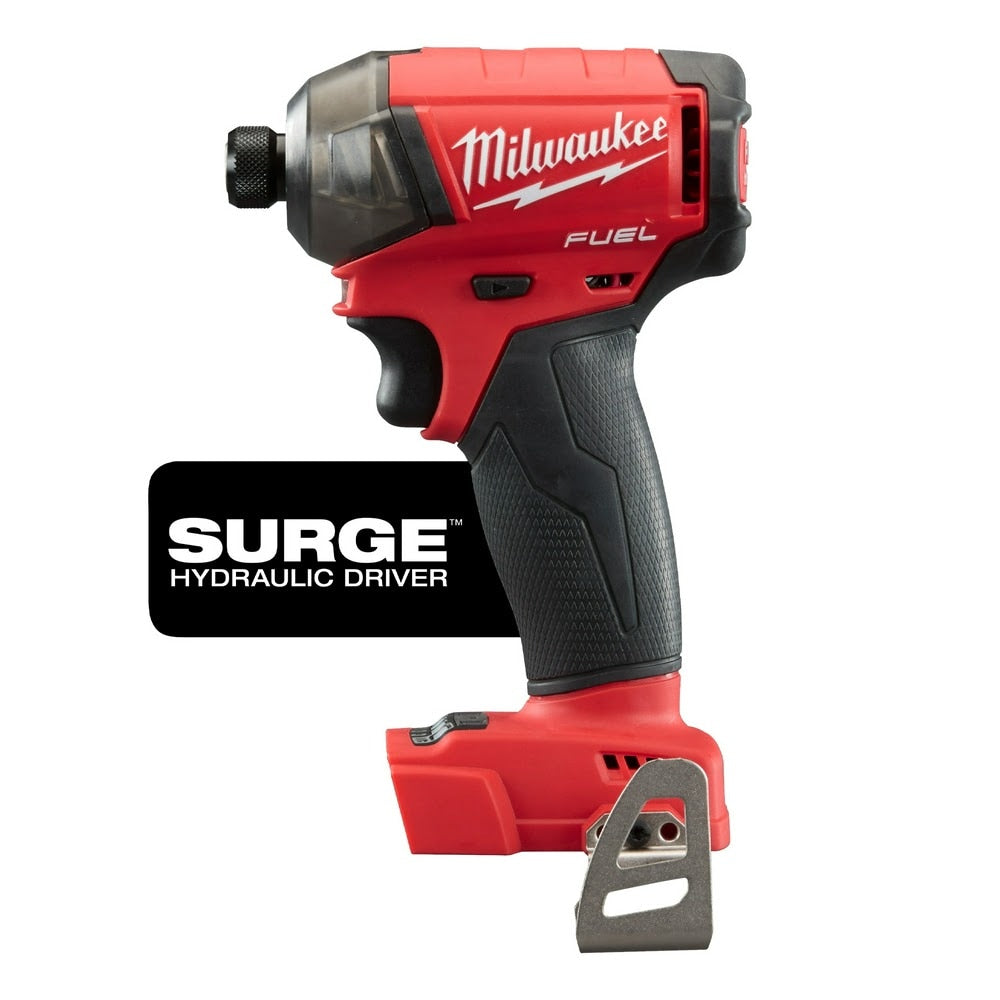
Milwaukee M18 FUEL SURGE vs a Standard Impact Driver: Is Hydraulic Worth It?
The Milwaukee M18 FUEL SURGE (model 2760-20) uses a hydraulic (FLUID-DRIVE) powertrain instead of the steel hammer-and-anvil inside a normal impact driver. That makes it dramatically quieter, smoother, and far less prone to cam-out — but a standard M18 FUEL impact still hits harder on big fasteners and costs less. Short version: get the SURGE for noise-sensitive, repetitive, or finish work where control matters. Get a standard impact driver if you mostly drive long lags and heavy structural fasteners and want maximum brute torque per dollar.
Both run on the same M18 batteries, so whichever you pick drops onto the packs and chargers you already own.
What is the SURGE hydraulic driver, and how is it different?
The SURGE is a member of Milwaukee's M18 FUEL line — same brushless POWERSTATE motor and REDLINK PLUS electronics as the rest of the FUEL family. What sets it apart is *how* it delivers its hits.
Hydraulic FLUID-DRIVE vs hammer-and-anvil — what actually happens inside
A normal impact driver builds torque by spinning a steel hammer that physically slams into an anvil, thousands of times a minute. That metal-on-metal hammering is what gives impacts their grunt — and their harsh rattle, vibration, and noise.
The SURGE swaps that mechanism for a sealed hydraulic unit. Instead of steel striking steel, it sends rotational impulses through a cushion of oil. Same basic job — delivering bursts of rotational force so the tool doesn't kick back in your wrist — but the oil softens every blow.
What that buys you: quieter, less vibration, less cam-out, more control
Three real things come out of that design:
- Noise drops a lot. The metallic clatter is mostly gone. On long days, or indoors, your ears notice.
- Vibration drops too. Less buzz in your hand means less fatigue over a few hundred screws.
- More control and less cam-out. The smoother power delivery makes it easier to start fasteners straight and stop clean, so the bit is less likely to jump out of the screw head and chew it up.
The trade is that all that cushioning costs a little top-end torque. You give up some peak grunt to gain control and quiet.
SURGE vs a standard M18 FUEL impact driver — head to head

Noise and vibration
This is the SURGE's whole reason to exist. Milwaukee rates it as significantly quieter than its standard impact, and the difference is obvious the first time you run one indoors. If you do trim, cabinets, or any work where you're talking to a client or wearing the tool for hours, this matters more than a spec sheet suggests.
Raw torque and speed (where the standard impact still wins)
A standard M18 FUEL impact like the 2953-20 produces higher peak torque than the SURGE. When you're sinking long structural screws or breaking loose stubborn bolts, that extra hammering grunt is what you want. The SURGE can do this work — it's just not where it shines.
Price and kit options
The SURGE typically costs more than the standard FUEL impact for the same job, because the hydraulic mechanism is more complex. Both come as bare tools or in battery kits, so you can buy in at whatever level fits the packs you already own.
| M18 FUEL SURGE (hydraulic) | Standard M18 FUEL impact | |
|---|---|---|
| Powertrain | Oil-cushioned hydraulic | Steel hammer-and-anvil |
| Noise | Much quieter | Loud, metallic |
| Vibration | Low | Higher |
| Cam-out / control | Very controlled | More aggressive |
| Peak torque | Strong, but lower | Highest |
| Best for | Finish, interior, repetitive | Heavy structural fastening |
| Battery | Any M18 pack | Any M18 pack |
The numbers and caveats live in the prose above; the table is just the shape of the decision.
How does it compare to DeWalt and Makita?
Makita oil-impulse (the closest rival) — same idea, different execution

Makita got to the quiet-driver idea first with its oil-impulse line (the Makita XST01Z on the 18V LXT platform). The concept is the same as the SURGE: cushion the impacts with oil to cut noise and vibration. If you're already on Makita's 18V platform, that's your in-house equivalent — there's no reason to jump brands just for this feature.
DeWalt — no true hydraulic equivalent
DeWalt doesn't make a hydraulic or oil-impulse driver. On the 20V MAX platform, your choice is a standard brushless impact — the XR DCF887 or the more compact ATOMIC DCF845. They're excellent impacts, but they're mechanical: you get the grunt and the noise that comes with it. If quiet, low-cam-out driving is your priority and you're on DeWalt, there's no native answer.
All three platforms are 18V-class (DeWalt's "20V MAX" is 18V nominal, same as Milwaukee M18 and Makita 18V), so this is a feature decision, not a voltage one.
Which one should you buy?
Buy the SURGE if…
- You do interior, trim, cabinet, or finish work where noise and control matter.
- You drive a *lot* of fasteners and want less vibration fatigue.
- You work indoors, overhead, or anywhere the racket of a standard impact is a problem.
Buy a standard impact if…
- Your work is mostly heavy structural fastening — long lags, big bolts.
- You want the most peak torque for the money.
- You only reach for an impact occasionally and don't need the quiet.
Neither is "better." They're tuned for different jobs.
Don't forget the bits (the part that actually breaks)
Whichever driver you pick, it's still an impact-class tool — and that means impact-rated bits only. Standard bits aren't built for the sudden torque spikes and can snap or shatter. (We dig into why impact bits fail, and which bits are worth buying.)
A magnetic bit holder is the cheap upgrade that punches above its price: it seats bits firmly, cuts wobble that leads to cam-out, and lets you swap bits one-handed up a ladder. It fits Milwaukee, DeWalt, and most other brands.
And since you'll be running a battery hard all day, a USB-C fast charger for M18 batteries keeps your phone and devices topped off straight from the M18 packs you already carry.
FAQ
Is the M18 FUEL SURGE better than a regular impact driver? For noise, vibration, and control, yes. For raw top-end torque on big fasteners, a standard M18 FUEL impact still hits harder.
What does "hydraulic driver" mean? It delivers rotational impacts through an oil-cushioned (hydraulic) mechanism instead of a steel hammer striking an anvil, so it runs much quieter and smoother.
Is the SURGE quieter than a standard impact? Yes. The oil powertrain removes most of the metallic hammering noise, and Milwaukee rates it as significantly quieter than its standard impact.
Does DeWalt make a hydraulic impact driver? No true hydraulic equivalent. DeWalt's answer is a standard brushless impact like the XR DCF887 or the ATOMIC DCF845.
Does Makita make one? Yes — Makita's oil-impulse brushless driver uses the same hydraulic idea to cut noise and vibration.
Can I use my regular bits in the SURGE? Use impact-rated bits in any impact-class tool; standard bits can shatter under the torque spikes. A magnetic bit holder helps seat and retain them.
Whichever driver fits your work, the accessories make it better — impact-rated bits, a solid bit holder, and a way to keep your batteries earning their keep all day. Browse the full Milwaukee accessories collection for the gear that fits your M18 tools, and if you're still sorting out what "FUEL" even buys you, start with what M18 FUEL actually means. Newer to the platform? Our M12 vs M18 breakdown lays out which lineup to commit to.