
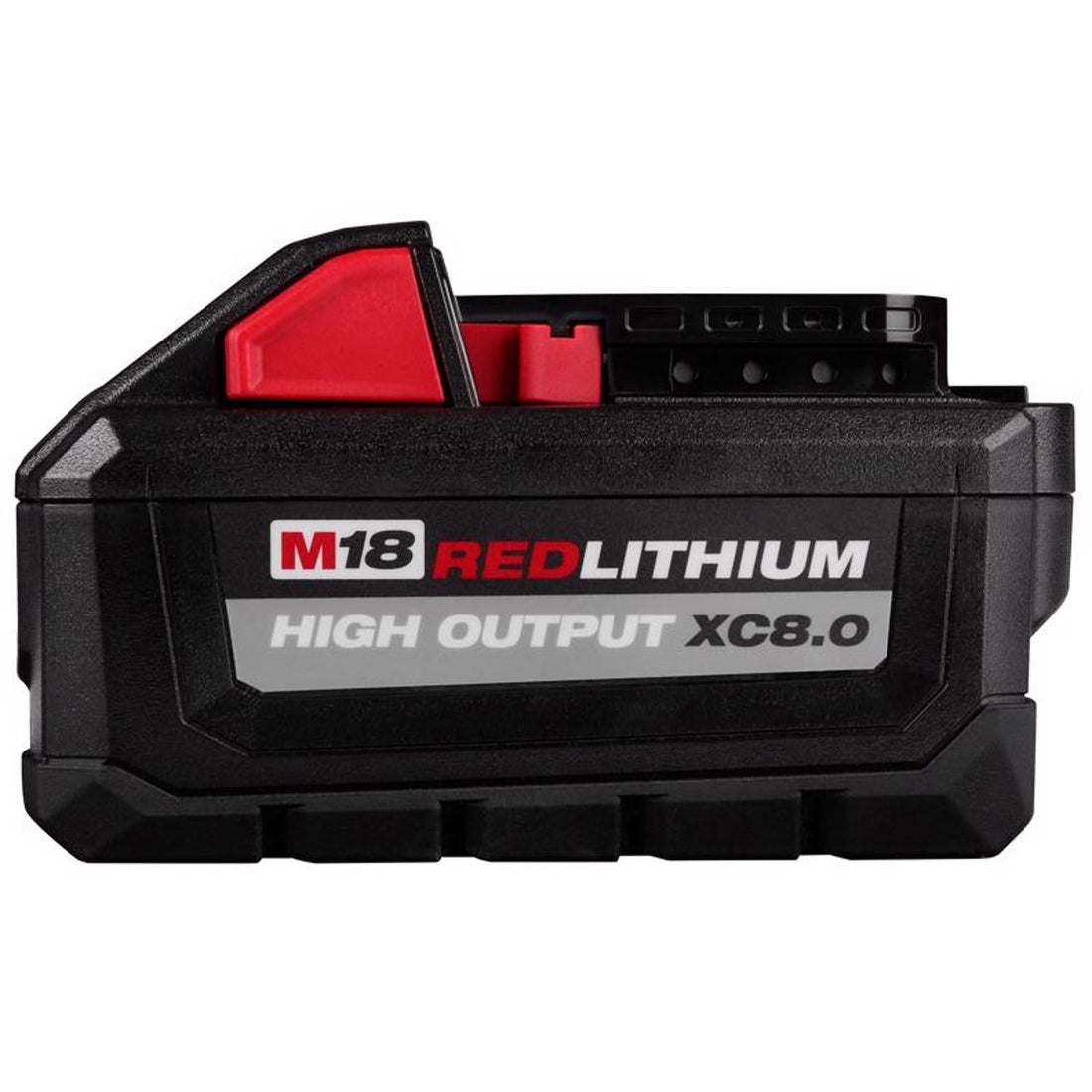
How to Store Power Tool Batteries the Right Way (M18 & 20V MAX)
Four things determine whether your battery survives a long break: charge level, temperature, charger connection, and physical protection. Store at 40–60% charge — not full, not empty. Keep it between 50–77°F (10–25°C). Disconnect from the charger — leaving it plugged in for months damages cells. Store in a dry, non-conductive case with terminals protected from metal contact. That's the short version. Here's why each rule matters — and how Milwaukee M18 and DeWalt 20V MAX batteries handle it.
Why Storage Kills More Batteries Than Heavy Use
You might expect a battery to wear out from hard use. In practice, bad storage is what finishes most of them.
What's Happening Inside the Cell
Lithium-ion batteries self-discharge whether you use them or not. Leave one sitting for months and it slowly drains. That's manageable — unless it drains all the way to zero. Below a certain voltage, the cell's protection circuit trips and won't let the battery accept a charge. That's a dead battery, full stop.
The other side of the problem: storing at 100% charge keeps cells under continuous electrochemical stress. The electrolyte inside degrades faster when cells sit fully saturated for extended periods.
The Two Mistakes That Kill Batteries
Stored fully charged — accelerates electrolyte degradation and capacity fade. You get a battery that holds maybe 80% of its original charge after a winter, then drops further.
Stored fully discharged — risks tripping the over-discharge protection. The charger may not recognize it at all when you come back to it. Milwaukee and DeWalt both design protection into their packs, but "protection" means "shutdown" — not "automatic recovery."
The Right Charge Level for Storage (and How to Hit It)
The 40–60% Rule
Both Milwaukee and DeWalt recommend storing batteries at a partial charge — not full, not empty. Milwaukee's care guidance points to a partial state of charge rather than a full pack, and DeWalt's FAQ similarly steers users toward a mid-range charge level for any battery being put away for an extended period.
The working target: get the battery to roughly half charge, then put it away. Use the battery normally until the indicator shows the middle of the range, or run a tool lightly until it steps down a level.
Reading the Milwaukee M18 Charge Indicator
Press the charge indicator button on the battery. The LEDs represent charge tiers. Aim for the indicator reading that falls in the middle of the scale — roughly half the LEDs lit — before you store it.
Reading the DeWalt 20V MAX Fuel Gauge

DeWalt 20V MAX batteries include a push-button fuel gauge. Aim for a reading in the middle of the indicator range before storing — that middle zone is the right ballpark for long-term storage.
Same principle as the Milwaukee: middle of the indicator range = right ballpark for storage.
Short-Term vs. Long-Term Storage
Two to six weeks — the 40–60% rule still applies, but it's not as critical. If you use your tools every few weeks, you don't need to adjust the charge before putting them down. Just don't leave them on the charger.
Two or more months — follow the rule precisely. For storage beyond three months, check the charge level every 90 days and top up to ~50% if it's dropped significantly. Lithium-ion self-discharge is slow but real. Milwaukee recommends a top-up charge after approximately 1 year of storage; DeWalt recommends a top-up charge after 6 months of storage.
Temperature: The Range That Actually Matters
The Storage Window
Both platforms target the same window: 50–77°F (10–25°C) for storage. Milwaukee's and DeWalt's care guidance both point to a cool, climate-controlled environment as the ideal storage condition — a range that a temperature-controlled interior space hits year-round in most climates.
A climate-controlled interior space — workshop, basement, utility closet — fits this range year-round in most climates.
Garage Storage in Winter
A garage that stays above 50°F works fine. A garage that drops below freezing in January does not.
The batteries won't explode in the cold, but capacity takes a hit, and if the temperature swings repeatedly through freezing, the internal structure of the cells degrades over time. Bring batteries inside when winter sets in. A shelf in the mudroom beats the tool chest in a cold garage.
The floor is also not ideal in cold conditions — the slab runs colder than the ambient air. Put the case on a shelf.
Hot Storage — The Real Damage Threshold
Heat does more damage than cold. Sustained high temperatures accelerate electrolyte breakdown fast.
Milwaukee specifies an upper storage limit of 120°F / 50°C for M18 batteries, while DeWalt sets their 20V MAX upper limit at 105°F / 40°C — meaningfully lower, and a useful reminder that the two platforms don't share identical tolerances.
Manufacturer guidance generally lands in the 77–85°F (25–30°C) range as the upper limit for storage. The practical takeaway: don't leave batteries in a car, an unventilated shed, or anywhere that gets genuinely hot in summer. A vehicle in direct sun on a warm day can hit well above 100°F inside.
The "Freezing Extends Life" Myth
This circulates because freezing *does* slow self-discharge in some chemistries. For lithium-ion, it doesn't apply. Freezing causes electrolyte crystallization, internal stress, and capacity loss. Below 32°F / 0°C, you're doing damage, not preserving the pack.
Cold storage is a different problem from cold charging — but both are bad. For details on why you shouldn't charge a cold battery (lithium plating, permanent capacity loss), see why you shouldn't charge a cold battery.
The Charger Problem — Disconnect Before You Store
This is the step most guides skip, and it's where the actual accessory angle matters.
Standard Milwaukee and DeWalt chargers use a charge-maintain cycle. When a battery is fully charged, the charger applies a small maintenance current to keep it topped up. That's fine for a day or two. Over weeks and months, that continuous trickle-charge applies sustained stress to the cells at high state of charge — exactly the condition we're trying to avoid.
USB chargers and power inverters are a related issue. A power inverter built for active jobsite use — running a phone, a fan, or a light off your M18 battery while you're working — is fine on the job. Left connected to a stored battery with no load, it draws a small parasitic current. Over months, that drains the pack toward zero. That's not what it's designed for, and the battery pays for it.
The rule is simple: when you put the battery away, take it off everything. No charger, no inverter, no adapter sitting connected.
If you're wondering how long an M18 battery actually runs the inverter when you *are* using it on the job, that's a different calculation — see the guide on power inverter runtime.
When the battery comes back out after storage, the right charger matters. A quality USB-C fast charger brings it back to working charge quickly without the guesswork. The Milwaukee M18 USB-C power supply is what you want ready for that first charge after a long break — same for the DeWalt side with the USB-C Fast Charger with LED Screen Compatible with Dewalt Max XR Battery.
Where to Physically Store the Battery
Case Options
Original OEM case — the best option if you have it. It fits the battery, protects the terminals, and was designed for exactly this. Check the Milwaukee or DeWalt collection for compatible accessories: Milwaukee tools / DeWalt tools.
Tool bag — fine for short-term, not ideal long-term. The terminals are exposed and can contact metal zippers, other tools, or hardware.
Dedicated plastic battery box or bin — any non-conductive plastic container works. Keep batteries separated from each other and from any metal objects.
Protect the Terminals
Bare terminals touching metal is a short-circuit risk. It won't usually cause a fire if the battery is at 50% charge, but it will drain the pack and can damage the terminal contacts. If your case doesn't cover the terminals, use a terminal cap (available for most M18 and 20V MAX packs) or wrap the terminal end with electrical tape.
Humidity
"Dry" means no condensation, no moisture exposure. A basement with controlled humidity is fine. A damp garage or outdoor shed is not. Moisture corrodes terminals and can work into the cell housing.
The Concrete Floor Myth
You'll hear that batteries should never sit on a concrete floor. The "concrete drains electricity" version of this is folklore — concrete isn't conductive in any meaningful sense.
The real issue: a concrete slab in a cold garage runs several degrees cooler than the ambient air. That puts the battery lower in the temperature range, which combined with freezing temps, can push it below the safe storage floor. Concrete also holds moisture.
Keep batteries on a shelf or in a case off the floor. That's good practice, but "electricity draining into concrete" isn't why.
Step-by-Step Storage Checklist
Short-Term Storage (Up to 6 Weeks)
1. Check charge level. If the battery is at 40–60%, store it as-is. If it's fully charged, run a brief tool task to drain it slightly before storing. 2. Disconnect from all chargers and adapters. Nothing connected. 3. Place in original case or a non-conductive container with terminals covered. 4. Set on a shelf in a space that stays between 50–77°F. Out of direct sun, away from heat sources.
Long-Term / Seasonal Storage (2+ Months)
1. Discharge or charge to 40–60%. Use the battery's indicator to confirm. Don't skip this — it's the most important step. 2. Disconnect from all chargers and devices. Inverters, USB adapters, everything. 3. Protect the terminals. Terminal cap, original case, or electrical tape over the terminal end. 4. Store in a dry, non-conductive container on a shelf in a climate-controlled space. Not in a hot vehicle, not in a freezing garage. 5. Check charge level every 90 days. If it's dropped below 30–40%, connect the charger briefly to bring it back to ~50%, then disconnect and return to storage.
Testing the Battery After Storage — and Knowing When to Replace
Signs Storage Went Wrong
- Charger flashes an error code and won't charge — the pack may have over-discharged past the protection threshold.
- Battery charges but drains in half the usual time — capacity loss from degradation during storage.
- Charger cycles on and off repeatedly without reaching full charge — cell imbalance or partial cell failure.
- Physical swelling — a puffed-up battery pack is damaged and should not be used. Dispose of it at a lithium-ion battery recycling point.
Recovery Mode — Does It Exist?
Some Milwaukee chargers include battery maintenance or conditioning functions, but whether a dedicated recovery or maintenance mode is available — and which charger models support it — is not uniformly documented across the M18 lineup. Check the documentation for your specific charger model to confirm what features it offers.
DeWalt 20V MAX chargers do not have a recondition mode for lithium-ion packs. A maintenance charge mode is referenced in DeWalt's battery documentation for select models like the DCB118, but this is not a marketed feature across the 20V MAX charger lineup.
If the charger doesn't recognize the battery at all, a conditioning cycle won't help. At that point, the pack is at end of life.
For context on how Milwaukee's FORGE battery chemistry differs from standard RedLithium — which affects self-discharge rate and long-term storage behavior — see the comparison of Milwaukee M18 battery types.
Frequently Asked Questions
Is it OK to store power tool batteries in the garage?
Depends on the temperature. A garage that stays between 50–77°F year-round is fine. A garage that drops below freezing in winter is not — bring the batteries inside. The issue is temperature, not the garage itself.
Should I store batteries fully charged or empty?
Neither. Store at 40–60% charge. Full charge accelerates electrolyte degradation; zero charge risks over-discharge that the battery's protection circuit can't recover from.
How long can you store a power tool battery without using it?
At 40–60% charge and 50–77°F, most lithium-ion tool batteries hold usable capacity for several months. DeWalt recommends fully charging batteries before storage longer than 6 months; Milwaukee recommends charging after about 1 year of storage. For storage beyond three months, check and top up to ~50% charge every 90 days.
Can you store lithium batteries in a cold garage in winter?
Storage in a cold-but-above-freezing garage is tolerable if the battery is at 40–60% charge. Do not charge a cold battery — bring it to room temperature first. Below 32°F / 0°C is not recommended for storage. For the full explanation of why cold charging causes permanent damage, see the guide on charging lithium-ion batteries in cold weather.
Should I leave my Milwaukee or DeWalt battery on the charger when not in use?
No. Milwaukee and DeWalt chargers are designed for charging cycles, not indefinite storage maintenance. Weeks or months on a charger applies continuous stress to cells at high charge. Charge to ~50%, remove, store.
Do power tool batteries go bad if not used?
Yes, but the rate depends entirely on storage conditions. A battery stored correctly at ~50% charge in moderate temps will hold capacity for years. Stored at 0% or 100% in heat, you'll see measurable capacity loss within months.
Can you store batteries in a plastic container?
Yes — non-conductive plastic is ideal. The original tool case works great. Avoid metal containers: if a terminal contacts metal, you get a short-circuit path that drains the battery and can damage the contacts.
What temperature is too hot to store a power tool battery?
Sustained temperatures above 77–85°F (25–30°C) start to accelerate degradation. Don't store in a hot vehicle or an unventilated shed in summer. Milwaukee M18 batteries are rated to a maximum storage temperature of 120°F (50°C), while DeWalt 20V MAX batteries are rated to 105°F (40°C) — but staying well below those limits is the goal, not treating them as targets.
Battery storage is one half of the equation. The other half is how you charge it when it comes back out — and the right charger makes that fast and safe. When your M18 or 20V MAX pack comes out of storage, a USB-C fast charger gets it back to working charge without the wait. Check Milwaukee tools for Milwaukee gear and DeWalt tools for DeWalt accessories.