
Milwaukee vs DeWalt Reciprocating Saw Blades: Which Actually Cuts Better?
Here's the thing most comparisons miss: the logo on your saw doesn't matter. Milwaukee and DeWalt reciprocating saw blades both use a universal 1/2-inch tang — they fit any major-brand recip saw, including Milwaukee Sawzalls, DeWalt, Ridgid, Makita, and Bosch. The real question is which blade *line* wins for your material. Short answer: for demolition and nail-embedded wood, Milwaukee's AX and carbide lineup generally leads. For general bi-metal metal and wood cutting, the two brands are close enough that price-per-blade decides. Buy by material and TPI. Not brand.
Are Milwaukee and DeWalt Reciprocating Blades Interchangeable?
Yes, fully. Recip blades across all major brands share a universal standard shank — the same design fits Milwaukee Sawzalls, DeWalt, Ridgid, Makita, Bosch, and every other major recip saw on the market. That shank seats into any recip saw's blade clamp, regardless of brand.
What actually has to match the job:
- Blade length — longer for deep cuts, shorter for tight quarters
- TPI (teeth per inch) — the single biggest factor in blade performance for a given material
- Tooth material — carbon steel, bi-metal, or carbide-tipped
> The logo on your saw ≠ the logo you need on your blade. A Milwaukee AX blade runs on a DeWalt saw. A DeWalt bi-metal blade runs on a Milwaukee Sawzall. Buy by material and TPI, then grab whichever brand has the right blade for the job.
For a deeper look at what's universal-fit and what isn't across all recip blade brands, see blade compatibility guide.
Milwaukee vs DeWalt at a Glance
Milwaukee's SAWZALL lineup is organized into three main product lines — The AX, Torch, and Wrecker — with Nitrus Carbide as a hardened variant technology featured within the Torch and Wrecker families. On the DeWalt side, the core lines are the 2X Long Life bi-metal series and the ELITE SERIES™ carbide-tipped blades; Flexvolt® serves double duty as both DeWalt's battery platform and a distinct blade product line in its own right.
| Line | Brand | Best Use | Material | Our Take |
|---|---|---|---|---|
| The AX | Milwaukee | Demo / nail-embedded wood | Wood + nails | Purpose-built for demo; best in class at this price |
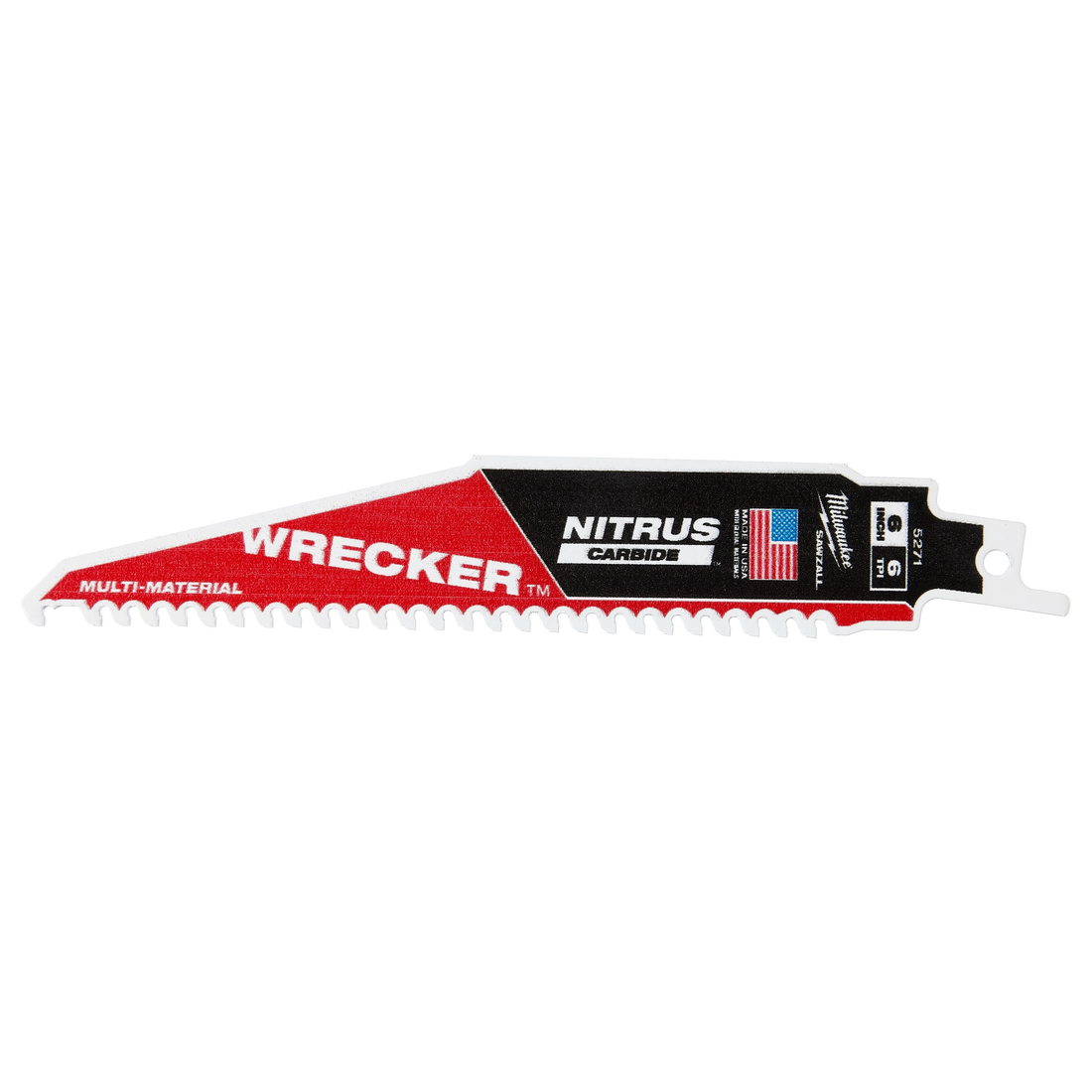
| Wrecker | Milwaukee | Heavy multi-material demo | Nails, pipe, embedded debris | Goes where bi-metal gives up |
| Torch | Milwaukee | Metal cutting | Steel, pipe, bolts | Carbide variant outlasts bi-metal on hard metal |
| Nitrus Carbide | Milwaukee | Hard/abrasive material | Cast iron, nail-embedded, demo | Longest-lasting option on the toughest applications |
| 2X Long Life bi-metal | DeWalt | General purpose | Wood, metal, mixed | Solid all-rounder; competes on kit pricing |
| ELITE SERIES™ carbide-tipped | DeWalt | Metal / abrasive | Metal, heavy demo | Strong performer; verify life-multiplier claim vs Milwaukee carbide |
Demolition & Nail-Embedded Wood — Milwaukee Wins
For the nastiest demo work — pulling nails, cutting nail-embedded framing, going through a wall with no idea what's behind it — Milwaukee's lineup is deeper and more specialized than DeWalt's.
Milwaukee's edge:
- The AX is built specifically for nail-embedded wood. The tooth geometry is designed to survive nails repeatedly without folding over. It's Milwaukee's most-used demo blade for good reason.
- The Wrecker goes further — engineered for multi-material demo where the blade might catch nails, embedded pipe, or metal debris without warning. When you need a blade that won't quit mid-wall, this is it.
- Nitrus Carbide (carbide-tipped) is the step up when bi-metal teeth are getting chewed through too fast. On abrasive material, carbide teeth last up to 50X longer than standard bi-metal.
DeWalt's answer: DeWalt's carbide-tipped blades handle nail-embedded and demo work well, but the lineup doesn't have purpose-built demo differentiation like Milwaukee's AX/Wrecker split. Their demo options lean toward general carbide rather than a specialty nail-embedded design.
Verdict: Milwaukee. The AX/Wrecker/carbide range is simply more dialed in for demo-specific work. If you're doing volume demolition, the Milwaukee demolition blade set — 12 pieces covering the core demo blade options — is the efficient buy, and it runs on your DeWalt saw.
For more on Milwaukee's full SAWZALL line, see complete SAWZALL buying guide.
Metal Cutting — Close, Milwaukee Edges on Carbide

For cutting steel pipe, conduit, rebar, bolts, and sheet metal, both brands make capable bi-metal blades. The gap shows up in carbide.
Milwaukee Torch: The Torch family is Milwaukee's metal-focused line. The bi-metal version handles general steel and structural cutting. The carbide-tooth Torch is the upgrade for harder metals, cast iron, and situations where you're burning through bi-metal faster than makes economic sense.
DeWalt bi-metal and carbide: DeWalt's metal blades are solid competitors — their bi-metal holds up well on light-to-medium steel, and the carbide-tipped option matches Milwaukee's carbide in longevity range. Verify the life claim directly; don't take the marketing number at face value.
On tooth alloy: Premium bi-metal blades use a high-cobalt M42 tool-steel alloy in the teeth. That's the difference between a budget bi-metal blade and one that actually stays sharp through a day of cutting.
TPI for metal cuts:
- Thick metal (pipe, structural, bolts): 10–14 TPI
- Thin/sheet metal: a higher TPI for maximum tooth contact and reduced chatter
Verdict: Effectively tied on bi-metal. Milwaukee takes a slight edge with the Torch carbide variant for hard/abrasive metal. For general steel and pipe on a budget, the tiebreaker is price-per-blade in kit form.
Wood & General-Purpose Cutting — Buy on Price
For dimensional lumber, branches, or general demo where you're not repeatedly hitting embedded metal, bi-metal is all you need. Carbide is overkill here — it costs more and cuts no faster in soft material.
Both Milwaukee and DeWalt bi-metal wood blades perform at the same level. Neither has a meaningful edge for clean-ish wood cutting. Buy whichever kit gives you the blades you need at the best per-blade cost.
TPI for wood cuts:
- General wood / framing: 3–6 TPI
- Nail-embedded / demo: a mid-range TPI suited for mixed wood and embedded hardware
Also worth a look if you're comparing blades across brands: Milwaukee blade recommendations.
Bi-Metal vs Carbide — Which to Buy, and When It's Worth It
Carbon steel (HCS): Cheap. Cuts fast in wood and soft material. Dulls quickly and snaps under flex. Right for very light, occasional cutting — not metal, not demo.
Bi-metal: HCS body for flex-resistance + hardened HSS or M42 cobalt teeth for edge retention. The right blade for most situations. Handles mixed material, resists snapping, and costs enough that you care about getting TPI right but not so much that one nail hit is a write-off.
Carbide-tipped: Much harder teeth, much longer service life on hard/abrasive material — nail-embedded wood, cast iron, stainless, concrete-embedded rebar. Higher cost per blade. If you're burning through bi-metal blades in a day of heavy demo, carbide pays for itself.
Simple rule: If you're hitting nails, cast iron, or abrasive material regularly, go carbide. General mixed cutting? Bi-metal is the right call.
TPI + Length by Material — Quick Reference
| Material | TPI | Blade Length | Notes |
|---|---|---|---|
| General wood / framing | 3–6 TPI | 6–9" | Fewer teeth = faster cut in soft material |
| Nail-embedded / demo | mid-range TPI | 6–12" | Carbide preferred; bi-metal OK for occasional nails |
| Thick metal (pipe, bolts) | 10–14 TPI | 6" | Let the blade do the work — don't force feed rate |
| Thin / sheet metal | 18–24 TPI | 6" | More teeth in contact = less chatter, cleaner edge |
| Mixed demo (unknown material) | 6–10 TPI | 9–12" | AX or Wrecker; carbide if heavy abrasives expected |
Price Per Blade — The Real Tiebreaker
When blade specs are this close — and in the mid-tier bi-metal range, they are — cost per blade decides the buy. Multi-blade sets always beat buying singles.
The Milwaukee demolition blade set (12-piece demo) and Milwaukee metal-cutting blade set (16-piece metal-cutting bi-metal) both get per-blade pricing that individual blade purchases can't touch. If you're running these regularly, the sets make sense even if you only use two-thirds of the assortment.
We don't stock DeWalt reciprocating blade sets — so if you're on the DeWalt platform and shopping for blades: the Milwaukee sets above are universal-fit and will run on your DeWalt saw without modification. That's the honest recommendation.
Frequently Asked Questions
Are Milwaukee and DeWalt reciprocating saw blades interchangeable?
Yes. Both brands use a universal 1/2-inch tang shank, so Milwaukee blades fit DeWalt saws, and DeWalt blades fit Milwaukee Sawzalls. Same goes for Ridgid, Bosch, Makita, and every other major recip saw brand.
Do DeWalt blades fit a Milwaukee Sawzall?
Yes. "Sawzall" is Milwaukee's brand name for their reciprocating saw — it's not a proprietary blade format. Any recip blade with a universal shank fits it, regardless of brand.
Which reciprocating saw blade lasts the longest?
Carbide-tipped blades last longest on hard or abrasive material — nail-embedded wood, cast iron, stainless steel. For general mixed cutting, a premium bi-metal blade with M42 cobalt teeth is the best value-to-life balance.
What's the difference between bi-metal and carbide reciprocating blades?
Bi-metal: flexible carbon-steel body with hardened high-speed steel teeth. Durable, versatile, affordable. Carbide-tipped: harder carbide teeth that stay sharp far longer on abrasive material, at higher cost per blade. Both are universal-fit.
Is Milwaukee or DeWalt better for demolition?
Milwaukee, in our assessment. The AX and Wrecker lines are purpose-built for nail-embedded and heavy demo work in a way DeWalt's lineup doesn't match blade-for-blade. Milwaukee's carbide demo blades push the advantage further.
What TPI do I need for metal vs wood?
General wood: 3–6 TPI. Demo/nail-embedded: a mid-range TPI suited for mixed demo and nail-embedded cuts. Thick metal: 10–14 TPI. Thin/sheet metal: 18–24 TPI.
Are Diablo blades better than Milwaukee or DeWalt?
Diablo makes competitive recip blades and they're also universal-fit — they run on your saw regardless of brand. For a full three-way breakdown, see three-way blade comparison.
Shop Milwaukee SAWZALL Sets — Universal-Fit for Any Saw
Both Milwaukee and DeWalt make blades worth owning, and since they're universal-fit, you can run the best blade for the job no matter which saw is in your hand. We carry two Milwaukee SAWZALL sets that cover the situations where blade quality pays off most — demo work and metal cutting. Both run on DeWalt saws.
- SAWZALL demolition kit — 12-piece SAWZALL demolition set. The demo kit that covers nail-embedded framing, teardown work, and everything in between.
- SAWZALL metal-cutting kit — 16-piece bi-metal metal-cutting set. TPI range from pipe to sheet metal.
Milwaukee platform or DeWalt platform, the rest of your accessories are here: Milwaukee · DeWalt