
Milwaukee Sawzall Blade Guide: TPI, Type & Which Blade Fits Your Saw
Every Milwaukee SAWZALL blade uses a universal T-shank — so the same blade fits your M12 FUEL Hackzall, M18 SAWZALL, and M18 FUEL SAWZALL interchangeably. No separate Hackzall blades. No platform sorting. The choice comes down to two things: TPI (teeth per inch — lower for wood, higher for metal) and the right blade family for your material. The AX for wood with nails, The TORCH for metal, Carbide TORCH for cast iron and stainless, Demo Demon for mixed demolition. Here's the full breakdown.
Do Milwaukee Sawzall Blades Fit All Milwaukee Saws? (Start Here)
What Is the Universal T-Shank — and Why It Matters
The T-shank refers to the shape of the blade tang — a square-notched profile built to a 1/2-inch universal tang standard, designed to snap into the spring-loaded blade clamps found on virtually every reciprocating saw built in the last two decades. The industry landed on this as a standard, and Milwaukee uses it across every blade in the SAWZALL lineup.
The practical payoff: you buy one set of blades. You don't sort them by saw.
M12 FUEL Hackzall vs. M18 SAWZALL vs. M18 FUEL SAWZALL — Same Blade, All Three

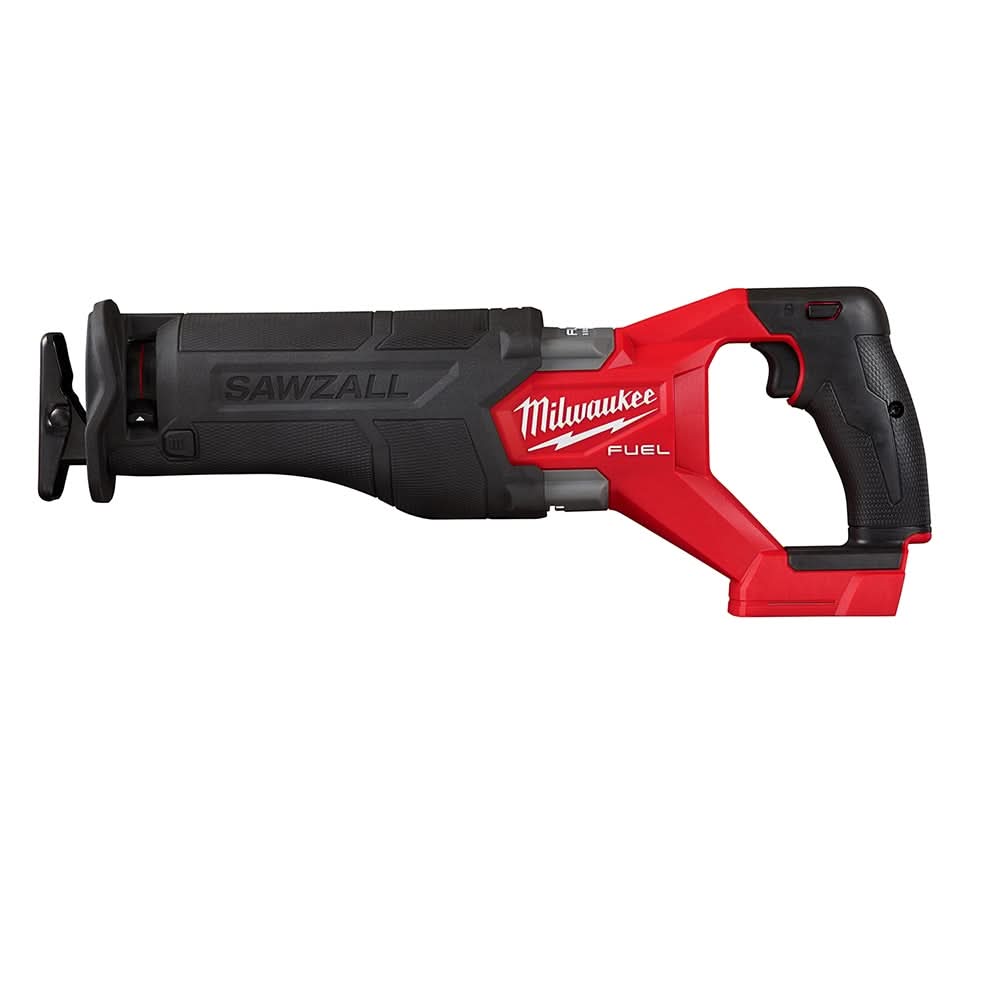
Milwaukee's reciprocating saw lineup runs from the compact, one-handed M12 FUEL Hackzall up through the full-size M18 SAWZALL (models 2621, 2821, 2721, and 2722) and the top-tier M18 FUEL SAWZALL. All three accept the same T-shank blade. If you own more than one, you're running a single blade inventory across all of them.
Not sure how the FUEL designation fits into the Milwaukee platform? Our guide to M18 FUEL covers what FUEL means for motor class and when it matters.
Do Milwaukee Sawzall Blades Fit DeWalt, Bosch & Other Saws?
Milwaukee T-shank blades also fit DeWalt, Bosch, Ridgid, Makita, and any other saw built to the standard. If you run mixed platforms on a crew, Milwaukee blades travel freely between them. Diablo or Lenox blades drop into a Milwaukee saw just as easily.
The T-shank is also the attachment standard for jigsaw blades — same interface, different tool. More on that crossover in our jigsaw blade compatibility guide.
Milwaukee Sawzall Blade Families: Which Line Is Which?
Milwaukee makes five distinct blade families. Same T-shank across all of them — everything else is purpose-built for a specific job.
The AX™ — Wood and Nail-Embedded Lumber

Built for demolition wood cuts. Wide, aggressive teeth at low TPI rip through framing lumber and chew through nails without snapping teeth on hidden fasteners.
- TPI: 3–5 TPI
- Available lengths: 6", 9", and 12"
- Buy it when: You're pulling walls, cutting rough framing, or anywhere nails are a given. This is the blade electricians and plumbers grab when tearing into structure.
The TORCH™ — Mild Steel, Pipe, and Conduit
Milwaukee's standard metal blade. Finer teeth, harder tip alloy, optimized for EMT conduit, mild steel tube, and pipe. It's not a good wood blade — fine teeth pack up with sawdust fast, and it cuts slower in wood regardless.
- TPI: 8–24 TPI
- Buy it when: You're running conduit daily, cutting pipe, or making regular steel cuts. The keep-two-packs-on-the-truck blade for electricians and plumbers.
The Carbide TORCH™ — Cast Iron, Stainless Steel, and Hardened Bolts
Standard bi-metal teeth fail fast on cast iron, stainless, and hardened fasteners — the material is just too hard. The Carbide TORCH uses carbide teeth, which is a different material category, not just a tougher version of The TORCH.
- Tooth type and TPI: Carbide-tipped teeth; available in 8 TPI for thick metals and 10 TPI for medium metals.
- Buy it when: Cast iron drain pipe, stainless fittings, hardened bolts that have been torqued in for decades. Overkill for mild steel; the only real option for the hard stuff.
Demo Demon™ — All-Material Demolition
The Demo Demon is the mixed-bag blade for situations where the material changes every cut — wood, nails, light metal, conduit, whatever demolition throws at you. Not the fastest blade in any single category, but the one you reach for when sorting by material isn't practical.
- Material rating: Engineered for mixed demolition — wood, nails, light-gauge metal, and conduit — with a tooth geometry designed to handle whatever teardown throws at it rather than optimizing for any single material type.
- Buy it when: You're doing teardown and will hit wood, pipe, conduit, and fasteners in the same hour. Remodelers and demo crews run these.
Standard SAWZALL® Blades — General Purpose
Milwaukee's base-tier lineup — no specialty name, no specialty tooth geometry. These handle basic wood and metal cuts at a lower price point and are fine for occasional use.
- Buy it when: You cut a few times a month and don't need a specialty blade. Light home projects, occasional DIY, situations where you just need *a* blade in a pinch.
TPI & Blade Length: Quick-Reference Chart by Material
| Material | Recommended TPI | Blade Length | Milwaukee Series |
|---|---|---|---|
| Framing lumber (no nails) | 3 TPI | 9" | The AX or Standard |
| Nail-embedded lumber | 5 TPI | 6"–9" | The AX |
| Drywall / plaster | 8 TPI | 6" | Standard or Demo Demon |
| PVC / plastic pipe | 14 TPI | 6"–9" | Standard or The AX |
| Thin-wall conduit / EMT | 24 TPI | 6"–9" | The TORCH |
| Mild steel tube / pipe | 8–10 TPI | 6"–9" | The TORCH |
| Sheet metal (<18 ga) | 24 TPI | 6" | The TORCH |
| Cast iron drain pipe | Carbide-tipped | 6"–9" | Carbide TORCH |
| Stainless steel / hardened rod | Carbide-tipped | 6" | Carbide TORCH |
| Demo / mixed unknowns | 3–10 TPI | 9" | Demo Demon |
Choosing blade length:
- 6" — tight access, plunge cuts into walls, flush cuts in confined spaces
- 9" — the standard length for most general cutting
- 12" — thick structural stock or cuts where the shoe can't register flat against the material
Rule of thumb: the blade tip should clear at least 1" past the far side of whatever you're cutting. If it doesn't reach, you're fighting the saw the whole cut.
For context on how blade sizing works across other Milwaukee-compatible tools, see our circular saw blade sizing and multi-tool blade compatibility guides.
Are Milwaukee Branded Blades Worth It vs. Aftermarket?
Most blade guides won't take a side here. This one will.
Milwaukee (or Diablo / Lenox quality tier) is worth it when:
- You're cutting metal every day. At volume, bi-metal geometry holds an edge longer and the blade steel flexes without snapping under sustained load. Cheap blades burn out fast on daily conduit and pipe runs.
- You're hitting cast iron, stainless, or hardened hardware. This isn't preference — carbide teeth are the only tool for the job. Bi-metal fails fast on these materials regardless of brand.
- Blade failure is a safety risk. In overhead or awkward cuts, a snapping blade isn't just an inconvenience.
Aftermarket is fine when:
- You're cutting wood a few times a month. The first several cuts on a premium blade and a cheap blade feel essentially the same in lumber.
- You're in drywall or fiberglass. These materials eat blades regardless of quality — buy in bulk and cheap.
- You're a DIYer who buys one pack a year. Premium geometry pays off over hundreds of cuts. If you're making twelve, you won't notice the difference.
The threshold: if you're cutting metal pipe or conduit daily — Milwaukee, Diablo, or Lenox bi-metal. If you're cutting one shelf bracket a month — buy the $9 pack and spend the difference on something else.
One thing to flag: Tool Army's Milwaukee lineup covers chargers, power inverters, and platform accessories — we don't currently stock saw blades. Browse what we carry for the M12 and M18 platform at our Milwaukee collection.
Frequently Asked Questions
Do Milwaukee Sawzall blades fit other brands of reciprocating saw? Yes. The T-shank is an industry-wide standard. Milwaukee blades fit DeWalt, Bosch, Ridgid, Makita, and any other saw with a standard blade clamp. It goes both ways — other brands' T-shank blades fit your Milwaukee saw too.
Do the same blades fit the Milwaukee M12 Hackzall and M18 SAWZALL? Yes. Both use the same T-shank. There is no separate Hackzall blade — any Milwaukee SAWZALL blade that fits one fits the other.
What TPI sawzall blade for cutting metal? 10, 14, and 18 TPI for mild steel and conduit; 24 TPI for thin-wall sheet metal under 18 gauge. For cast iron or stainless, move to the Carbide TORCH — TPI becomes less relevant when you're cutting with carbide teeth.
What Milwaukee Sawzall blade cuts through nails? The AX™ is Milwaukee's nail-embedded-wood blade — wide, aggressive teeth designed to handle hidden fasteners without snapping. The Demo Demon also handles nails alongside mixed metal and demo materials. Standard blades can cut nails but wear faster.
What's the difference between Milwaukee AX and TORCH blades? The AX is a wood blade — wide, aggressive teeth that clear sawdust and punch through nail-embedded lumber. The TORCH is a metal blade — finer teeth, harder tip alloy for pipe and conduit. Using the TORCH in wood is slow. Using the AX on metal dulls it fast. They're purpose-built for different materials and aren't interchangeable for their intended jobs.
What length sawzall blade do I need? 6" for plunge cuts and tight access. 9" for most general work. 12" when you need reach or the shoe can't register flush. The blade should clear at least 1" past the far side of your material.
Are Milwaukee Sawzall blades worth the price? For pros running heavy metal-cutting or demo daily — yes, the blade steel and tooth geometry hold up better at volume. For DIYers making occasional cuts in wood or drywall — quality aftermarket from Diablo or Lenox is a reasonable call at lower cost.
How many TPI for cutting PVC pipe? Milwaukee's blade selector calls for 14 TPI for PVC pipe — finer than general demolition blades, giving you a clean cut that clears chips without grabbing or stalling on plastic.
The compatibility question has a simple answer: all of it, any of your Milwaukee saws. The blade selection takes about 30 seconds once you know your material and the series that matches it. Browse the full Milwaukee platform accessory lineup — chargers, power inverters, and more for your M12 and M18 tools — at our complete M12 and M18 lineup.