
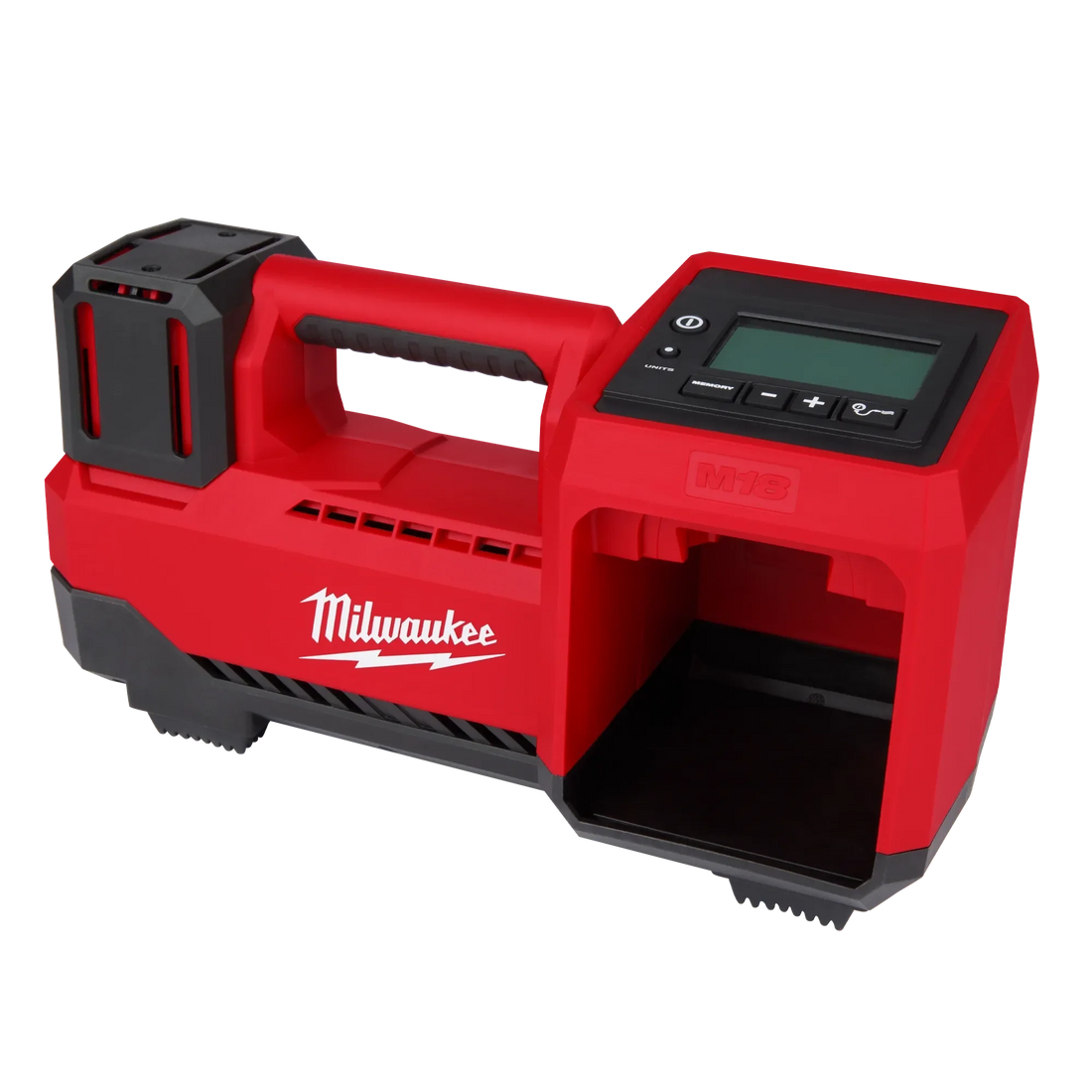
Milwaukee M12 vs M18 Tire Inflator: Which One Should You Buy in 2026?
Short answer: Buy the Milwaukee tire inflator that matches the batteries you already own. The M12 (2475-20) hits 120 PSI and weighs about 2.5 lb — right pick if you're already on M12 or mostly inflate bike tires, mower tires, and sports balls. The M18 (2848-20) hits 150 PSI and weighs about 4.7 lb — faster on car and light-truck tires, and the pick if you already run M18. Don't buy into a second battery platform for 30 extra PSI. It's rarely worth it.
Both are bare-tool SKUs — no battery, no charger included. Budget accordingly.
M12 vs M18 Tire Inflator: Specs at a Glance
| M12 — 2475-20 | M18 — 2848-20 | |
|---|---|---|
| Max PSI | 120 PSI | 150 PSI |
| Battery platform | M12 (12V) | M18 (18V) |
| Weight (bare tool) | ~2.5 lb | ~4.7 lb |
| Hose length | 26 inches | 36 inches |
| Digital gauge | Yes | Yes |
| Preset auto-shutoff | Yes | Yes |
| LED work light | Check milwaukeetool.com | Yes (confirmed Cordless Tire Inflator) |
| Sold with battery? | No (bare tool) | No (bare tool) |
| Street price (bare tool) | $139.00 | Check current retailer pricing |
| Minimum battery pairing | CP3.0 recommended | CP3.0 minimum; XC5.0+ preferred |
Which One Is Faster?
Speed is the M18's main selling point. Here's where that actually shows up — and where it doesn't.
Car Tire (P225/65R17, ~20 → 35 PSI)
The M18 fills a standard car tire faster than the M12. The gap is real, but for a slightly low tire, you're measuring in seconds, not minutes. Both get the job done before you've finished your coffee.
One thing neither inflator does: replace a shop compressor for rapid inflation from flat. They're top-off tools. Set that expectation before you buy.
Bike Tire (700c Road, ~0 → 80 PSI)
The M12 has a quiet edge here. Road bike valves and thin Presta fittings reward a lighter touch — the M12 is easier to hold steady without bending a valve stem at high pressure. The M18 can do it, but you're holding a heavier tool in an awkward crouch. The M12's 120 PSI ceiling covers everything except extreme high-pressure road setups.
Mountain bike tires at 30–40 PSI? Either tool works fine.
Mower Tire / Sports Ball
Low volume, low pressure — both inflators handle this easily. The M12 makes more sense here. Lighter, easier to carry to the back yard, less overkill. Set the preset and walk away; the auto-shutoff keeps you from overinflating a soccer ball.
Max PSI — When It Actually Matters
Most people focus on PSI first. Here's when it genuinely changes the decision:
- Car tires (30–44 PSI): Both inflators handle this with substantial headroom. Not a differentiator.
- Light-truck tires (50–80 PSI): Still fine on both tools. Even a half-ton truck running 65 PSI in the rear sits comfortably below either ceiling.
- Road bike tires (90–120 PSI): The M12 gets you there, but you're at the limit. No margin. The M18's 150 PSI ceiling gives you room.
- Trailer / RV tires above 100 PSI: This is where the M18 wins cleanly. The M12 can't reach some specialty trailer tire specs.
For the majority of homeowners and contractors doing car and truck tires, 120 PSI is plenty. The extra 30 PSI matters for cyclists running high-pressure road tires or anyone dealing with trailer setups that spec above 100 PSI.
Battery Runtime — How Many Tires Per Charge?
Milwaukee doesn't publish a precise tires-per-charge spec, and it wouldn't mean much anyway — runtime depends on starting pressure, tire volume, and ambient temperature. Here's the honest picture:
M12 (2475-20):
- CP3.0: Handles 3–5 car tires from 25 → 35 PSI before needing a recharge. Fine for a family driveway.
- XC5.0 / XC6.0: Noticeably more runway. A full five-car household plus a couple of bikes without stress.
M18 (2848-20):
- CP3.0: Works, but the M18's higher-output pump draws more current per fill. Similar real-world result to M12 + CP3.0 on car tires.
- XC5.0 / HO8.0: The practical combination for most M18 users — check tires on a trailer and a work truck before a job with room to spare.
- Forge HD12 / HO10.0: Overkill for inflation specifically, but if you're already running these packs on your other tools, you won't run dry.
If you're buying a battery specifically for the inflator: CP3.0 is the minimum that makes sense on either platform. XC5.0 is the practical pick for most people.
Ergonomics, Hose, and Gauge
This part gets skipped in most reviews. It shouldn't.
Weight: 2.5 lb vs 4.7 lb bare is a meaningful difference when you're crouching behind a trailer wheel or reaching around a front tire in a tight bay. Add a CP3.0 to each and the M12 stays under 3.5 lb total; the M18 climbs past 6 lb. For a quick garage top-off, who cares. For daily contractor use, you'll feel it.
Hose length: The M18's longer hose gives better reach on bigger vehicles — truck beds, trailers, RVs — without repositioning. The M12's shorter hose is fine for bikes and cars, but can feel tight under a high-clearance truck. The M18 hose measures 36 inches; the M12 comes in at 26 inches — a 10-inch difference that adds up when working around larger vehicles.
Digital gauge and auto-shutoff: Both tools have a backlit digital gauge and preset shutoff — set your target PSI, inflate, done. Readable in sunlight, readable at night. No babysitting required.
One-hand use: The M12 handles easily one-handed. The M18 is manageable but benefits from a second hand steadying the hose on bigger tires.
The Platform Question — Buy the One That Matches Your Batteries
This is the argument most reviews miss entirely.
The M18 inflator costs more than the M12, but the inflator price isn't the real expense. The real cost is the battery platform you're committing to. If you don't already own M18 batteries and a charger, you're adding both to the inflator cost — and those batteries can't power any of your M12 tools.
Here's what the *same* battery does outside of inflating tires:
If you already own M18:
- The portable USB-C charger for M18 batteries turns that M18 battery into a USB-C fast charger for phones and tablets on the job
- The M18 power inverter gives you a 150W outlet in the truck — power a tire-plug kit, a small work light, or a laptop
- One platform, one charger, three tools living in the truck bed
If you already own M12:
- The M12 USB power adapter turns that same M12 battery into a USB charger for heated jackets and USB devices
- Lighter kit overall — the M12 platform runs compact and the inflator fits that profile
- Still handles every car, mower, and bike tire you'll encounter
The case for crossing platforms: only if you're planning to build out the other system anyway. Going M18 just for the inflator when all your other tools are M12 is an expensive 30 PSI upgrade.
For more on why these systems don't mix, see our M12-to-M18 compatibility guide and the complete M12 vs M18 platform breakdown.
Who Should Buy the Milwaukee M12 2475-20?

- You already own M12 batteries and a charger
- Your main use is bike tires, mower tires, sports balls, or topping off car tires
- You want the lightest possible inflator — fits a backpack, smaller tool bag, or bike kit
- You don't regularly inflate trailer tires above 100 PSI
- You're not planning to add M18 tools anytime soon
Who Should Buy the Milwaukee M18 2848-20?
- You already own M18 batteries and a charger
- You fill car tires regularly and want the fastest fill time available
- You deal with light-truck, trailer, or RV tires at higher PSI
- You want the 150 PSI headroom for high-pressure road bike tires
- You're building out M18 tools and the inflator is one piece of that system
If you're shopping M18 and run across "FUEL" branding on other tools in the lineup, that refers to Milwaukee's brushless motor designation — see what FUEL means for what it means and whether it matters for your situation.
The 2475-20 carries a 3-year limited warranty on the tool itself, while the 2848-20 carries a 5-year limited warranty.
What to Grab Alongside Your Inflator
The inflator is a bare tool. Here's what completes the kit.
Battery (required): CP3.0 is the minimum for real-world use on either platform. XC5.0 or XC6.0 if you're doing more than a few tires or want the same pack to pull double duty in other tools.
Charger (required if you don't already own one): Milwaukee chargers are platform-specific. M12 chargers don't charge M18 batteries — and the reverse is also true. If you're curious why, see battery charging compatibility across platforms.
Platform accessories that use the same battery:
- M18 users: The M18 USB-C charger and M18 power inverter turn your M18 battery into a full jobsite power station. The inflator stays in the truck; the inverter handles gear during the workday. For a detailed look at how those two accessories stack up for different use cases, see the accessory comparison guide.
- M12 users: The M12 USB power adapter is a simple grab — same M12 battery, USB devices charged, heated jacket powered. One less thing to plug into the wall.
Frequently Asked Questions
Which Milwaukee tire inflator is better, M12 or M18?
Whichever platform you already own batteries for. Starting fresh and mostly doing car and light-truck tires? Get the M18 2848-20 (150 PSI, faster fill). Mostly bikes, mower tires, and sports balls — or you're already on M12? The 2475-20 is the better fit and a lighter tool.
What is the max PSI of the Milwaukee M12 tire inflator?
120 PSI (model 2475-20).
What is the max PSI of the Milwaukee M18 tire inflator?
150 PSI (model 2848-20).
Can the M12 tire inflator fill a car tire?
Yes. 120 PSI is well above the 30–44 PSI most passenger car tires need. It fills a car tire slower than the M18, but it gets there.
How many tires can I inflate on one battery charge?
Roughly, a CP3.0 on either inflator handles 3–5 car tires from 25 → 35 PSI. An XC5.0 or HO8.0 M18 pack does significantly more. Cold weather and starting from a low baseline both reduce runtime.
Does the Milwaukee tire inflator shut off automatically?
Yes. Both the 2475-20 and 2848-20 have a digital gauge with preset auto-shutoff. Set your target PSI, connect, inflate — the tool stops when it hits the number.
Can I use an M18 battery on the M12 tire inflator, or vice versa?
No. M12 and M18 batteries are physically and electrically incompatible — they won't fit each other's tools. More on this: M12-to-M18 battery compatibility.
Is the Milwaukee tire inflator sold with a battery and charger?
No. The 2475-20 (M12) and 2848-20 (M18) are bare-tool SKUs. Battery and charger are sold separately. Kit versions with a battery included carry different model numbers — confirm before purchasing.
Which inflator is quieter?
The M12 runs noticeably quieter. The M18 is louder at higher output. Neither is silent — both are inflation tools in a closed garage — but the M12 is easier on the ears for extended use.
Whichever inflator you pick, that same battery can do a lot more than air up tires. Browse our Milwaukee tool collection for the platform-matched USB-C charger, 150W inverter, and heated-jacket adapter — one battery, a truck full of capability.