
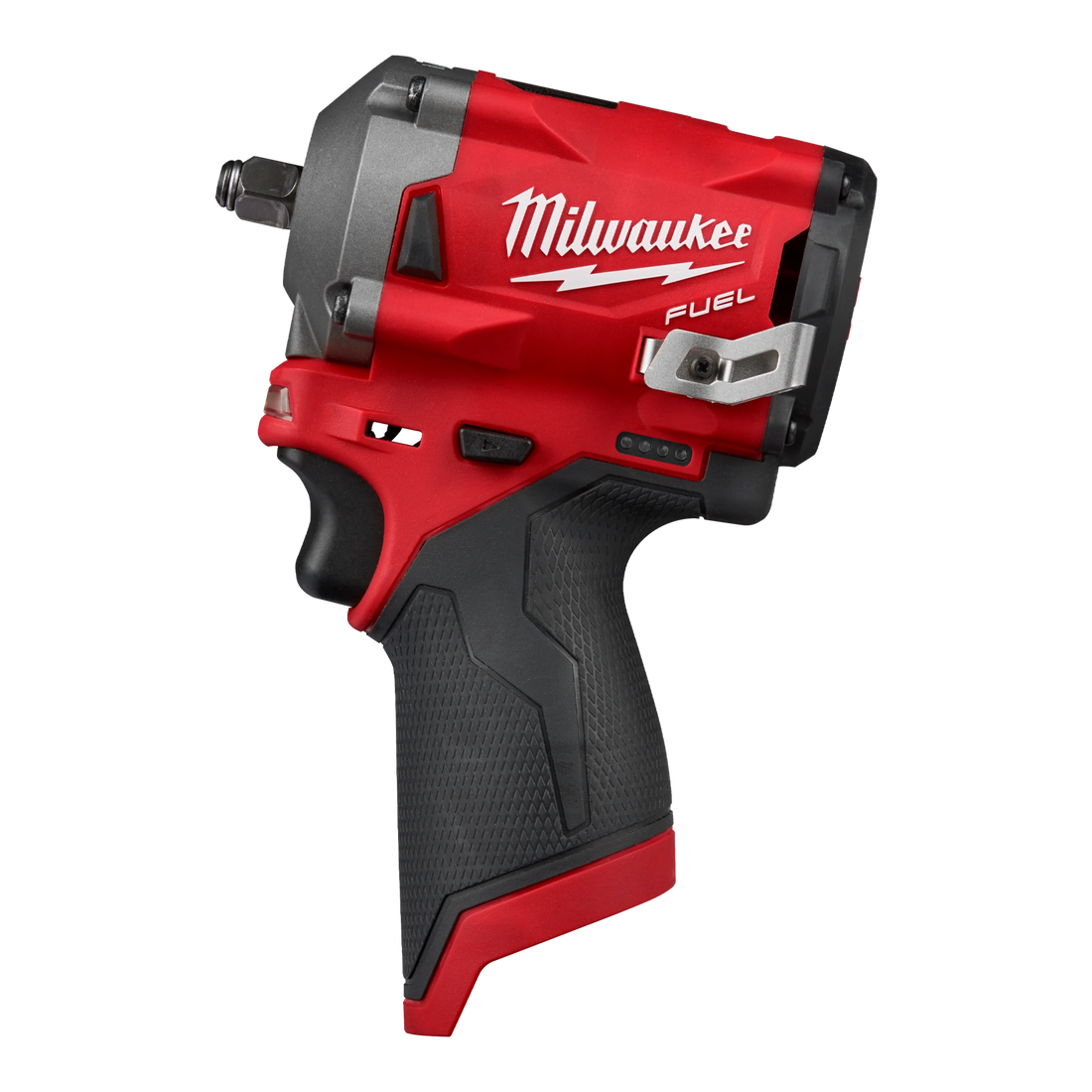
Milwaukee M12 Stubby 3/8" vs 1/2": Which Drive Size Should You Buy?
Short answer on the Milwaukee M12 Stubby 3/8" vs 1/2": Get the 3/8" (2554) if most of your work is under the hood, inside a dash, on HVAC equipment, or on appliances — you'll actually use the smaller head and lighter body. Get the 1/2" (2555) if you're breaking lug nuts, working on suspension, or turning anything that already came off a 1/2" ratchet. Both run on the same M12 battery platform, so whichever you pick, the M12 batteries you already own fit it.
That's the whole decision. Everything below helps you confirm it.
M12 Stubby 3/8 vs 1/2: Specs at a Glance
Both tools are M12 FUEL — brushless motor, REDLINK PLUS electronics, Milwaukee's power management. For what "FUEL" actually means on the label, our guide to what FUEL means breaks it down. What matters here is how the two drive sizes compare on paper.
| Spec | 3/8" Stubby (2554-20) | 1/2" Stubby (2555-20) |
|---|---|---|
| Drive size | 3/8" | 1/2" |
| Max fastening torque | See Milwaukee spec page | See Milwaukee spec page |
| Nut-busting torque | 250 ft-lbs | 250 ft-lbs |
| Overall length | 4.8 inches | 4.9 inches |
| Bare-tool weight | 2 lbs | 2.00 lbs |
| RPM / IPM | 2,700 RPM / 3,200 IPM | 0–2,700 RPM / 0–3,200 IPM |
| Drive modes | 4 | 4 |
| Anvil options | Friction ring (2554-20) | Friction ring (2555-20) · Pin detent (2555P-20) |
| Battery platform | M12 REDLITHIUM | M12 REDLITHIUM |
Kit SKUs: Both are available as bare tools or kits — the 2554-22 and 2555-22 include batteries and a charger. If you're starting fresh on M12, the kit is the better value. If you're already running M12, the bare tool is usually the smarter buy.
Pin-detent note: Milwaukee currently offers a pin-detent variant on the 1/2" (2555P-20) but not on the 3/8" — pin-detent Stubbies are 1/2" drive only. More on what that means below.
What Each Stubby Actually Does Well
When the 3/8" Stubby Is the Right Call
The 3/8" Stubby is built for situations where clearance matters more than raw torque.
Under a hood, behind an appliance panel, or inside an HVAC unit, you're fighting for angle and reach more than you're fighting stuck fasteners. The 3/8" head is shorter and lighter than the 1/2" — enough that you feel it during an hour of overhead work or a day of automotive interior disassembly.
Jobs where the 3/8" is the obvious pick:
- Automotive interior — seat bolts, dash panels, door panels, interior trim fasteners
- HVAC service — condensate connections, coil mounting bolts, tight equipment access
- Appliance repair and installation — everything is in a tight cabinet or behind a panel
- Motorcycle and small-engine work — small fasteners, tight clearances throughout
- Cabinet hardware, furniture assembly, light deck work
- Any job where your existing socket set is already 3/8" drive
That last point is underrated. If your sockets are 3/8" drive — and most mechanics start there — the 3/8" Stubby is the obvious buy. No adapter, no torque lost at a joint, nothing to break.
When the 1/2" Stubby Earns Its Extra Size

When the fastener is large, corroded, or load-bearing, the 1/2" is the right wrench.
Lug nuts are the clearest case. A stuck OEM truck lug nut — cross-torqued at a tire shop or seized from road salt — is past what the 3/8" model handles reliably. The 1/2" has more nut-busting torque and a 1/2" anvil rated to take that stress. Impact sockets in common automotive sizes are also far more widely available in 1/2" drive.
Other jobs where the 1/2" makes sense:
- Wheel and brake work on passenger cars and light trucks
- Suspension components — ball joints, control arms, strut bolts
- Structural fasteners — deck lag bolts, heavy hardware in dense material
- Industrial fasteners, flange bolts, anything corroded or overtorqued
- Any job where your socket set is already 1/2" drive
The 1/2" Stubby is still compact by impact wrench standards — that's the whole Stubby concept. But it is doing heavier work, and the added weight shows up in your wrist after a long day of repetitive fastening. If you're on heavy-truck suspension or lifting a rig's front end, the M12 1/2" Stubby is still a stretch — that's where you step up to M18. The M12 vs M18 comparison lays out the full platform trade-off.
The Trade-Offs the Spec Sheet Won't Tell You
Does the Size Difference Actually Matter in the Hand?
The table has the numbers, but it can't show you how these tools feel when you're torqued into a tight corner. The 3/8" is meaningfully shorter and lighter than the 1/2", and the gap is noticeable in cramped engine bays or overhead HVAC installation.
If most of your work is in open, accessible spaces, the difference is minor. If a quarter of your work is in tight quarters, the 3/8" saves real frustration over a full day.
Battery Pack Is the Hidden Variable
Most comparisons stop at the spec-sheet torque number. What they skip: the battery pack you run determines whether you actually hit that number.
The M12 CP2.0 (compact 2.0Ah) keeps the tool light — great for overhead work and automotive interior where weight matters. But under sustained heavy load — repetitive lug nuts, stuck bolts, production fastening — the CP2.0's smaller cell capacity triggers the tool's overload protection before you reach rated torque. It will slow down or cut out.
The XC5.0 (5.0Ah extended capacity) and M12 High Output packs hold sustained torque under load and recover faster between impacts. For any heavy sustained work, run the bigger pack.
Pair either Stubby with a CP2.0 and expect full rated torque under load — that's a mismatch. Match the pack to the job.
Don't Run 1/2" Sockets on the 3/8" Anvil via Adapter
This comes up constantly: *"Can I just use a 3/8"-to-1/2" adapter on the smaller Stubby and run my bigger sockets?"*
No — not for actual impact work. Adapters under repeated impact load snap. The 3/8" anvil isn't rated for the torque that makes the 1/2" Stubby worthwhile, and the adapter joint is a stress point. You'll break adapters, risk damage to the anvil, and lose most of your torque to flex and slop at the connection.
Buy the drive size that matches the sockets you already own. Adapters are fine for occasional mismatches. They are not a primary setup under repeated impact loads.
Friction Ring vs Pin Detent — Pick the Right SKU Before You Buy
Milwaukee sells the 1/2" Stubby in two anvil styles, and it matters depending on where you work:
- Friction ring (2555-20): Socket held by tension. Fast one-handed swaps. Easy on, easy off. Right for ground-level work where a dropped socket is just a nuisance.
- Pin detent (2555P-20): A pin locks the socket physically. It is not coming off unless you release it. Right for overhead work, confined access panels, or under-vehicle work where a dropped socket means crawling around to find it.
For the 3/8" drive, Milwaukee currently ships friction ring only — pin-detent Stubbies are 1/2" drive only. If pin-detent retention is a priority for your work, the 1/2" side is your only option in the Stubby lineup.
Most buyers doing ground-level work will be fine with friction ring. If you spend real time above your head, consider the 2555P-20 on the 1/2" side.
Which M12 Battery and Charger to Pair With It
Any M12 REDLITHIUM battery fits both Stubbys — see our battery compatibility guide for more M12 battery crossover details. The question is which pack to pair with your actual work.
Short bursts, light fasteners, overhead or interior work: The CP2.0 keeps the tool light and is the right call. You're not asking for sustained output; the compact pack keeps reach weight down where it matters.
Wheel work, stuck bolts, sustained production fastening: Run an XC5.0 or High Output pack. The extra capacity holds sustained torque and gives more runtime between charges. Don't shortchange the tool on battery and then blame the spec sheet.
On the charger side — if you want to charge M12 batteries and keep a phone or tablet running from the same pack on a jobsite or in the truck, the M12 USB-C power adapter plugs into any M12 battery and handles it. Same platform, no separate power source needed. Practical for a mobile shop or service van setup.
For the full rundown on M12 charging options that pair with these tools, check out our M12 charger guide to see the full lineup.
Frequently Asked Questions
What's the difference between the M12 FUEL Stubby 3/8" and 1/2"?
The 1/2" delivers higher fastening and nut-busting torque and takes 1/2"-drive sockets. The 3/8" is shorter, lighter, and takes 3/8"-drive sockets. Both run on the same M12 REDLITHIUM battery platform — any M12 battery you own fits either tool.
Can the M12 Stubby 3/8" remove lug nuts?
On a passenger car with well-maintained fasteners, often yes. On stuck OEM truck lug nuts, corroded fasteners, or anything overtorqued at the tire shop — no. For that work, get the 1/2" version. Don't stand there spinning on a lug that won't break; get the right tool.
How much torque does the M12 FUEL Stubby 1/2" have?
It delivers 250 ft-lbs of nut-busting torque; for current fastening torque figures, check Milwaukee's spec page for the 2555-20 directly — these numbers have shifted across model refreshes.
Is the M12 Stubby 1/2" enough for automotive work?
For most passenger-car and light-truck work, yes — wheel work, brake jobs, general under-hood fasteners. For heavy-truck lug nuts, suspension on a lifted rig, or seriously corroded industrial fasteners, step up to the M18 FUEL 1/2" impact. The M12 is a capable compact tool, not a shop floor production wrench.
What batteries fit the M12 Stubby?
Any M12 REDLITHIUM battery fits both Stubbys. For sustained heavy work — stuck bolts, wheel sets, repetitive fastening — run an XC5.0 or High Output pack. The CP2.0 will trigger overload protection before you reach rated torque under sustained load.
What's the difference between friction ring and pin detent on the Stubby?
Friction ring holds the socket by tension — fast one-handed changes, easy swaps. Pin detent locks the socket with a physical pin — right for overhead work or anywhere a dropped socket is a real problem. Milwaukee offers both on the 1/2" (2555-20 friction ring, 2555P-20 pin detent). The 3/8" currently ships friction ring only — no pin-detent variant is available for the 3/8" drive.
Should I buy the M12 Stubby or the older standard M12 impact wrench?
The Stubby is Milwaukee's current platform — shorter head, refined drive control, and better all-around. Go Stubby unless you find the older model at a steep discount that actually makes sense for your budget. At normal pricing, the Stubby is the better buy.
Both Stubbys run on the same M12 batteries — so if you're adding one to an existing M12 setup, you're already most of the way there. A spare pack in the right size for your work makes either tool a lot more useful on a long job. Browse Tool Army's Milwaukee tools and accessories, or grab the M12 USB-C power adapter if you want your M12 batteries pulling double duty as a USB charger on the jobsite.