
Milwaukee M12 vs M18: The Real Difference (and Do the Batteries Cross Over?)
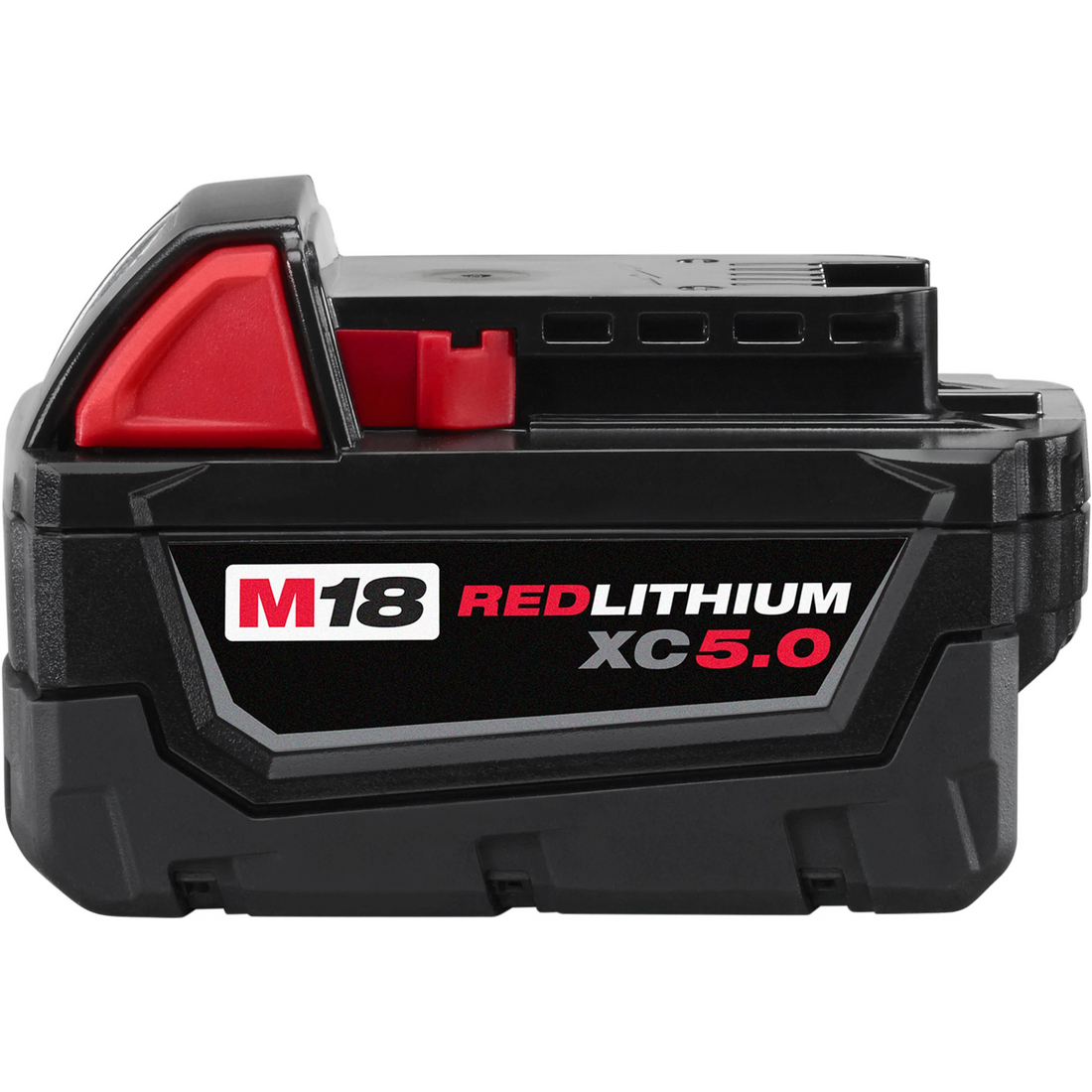
M12 is Milwaukee's 12V compact platform. M18 is the 18V full-power platform. The batteries are not interchangeable — different voltage, different physical stem, different tool electronics. Full stop.
Pick M12 if most of your work is light-duty, overhead, or in tight quarters: trim carpentry, electrical, HVAC service, plumbing, cabinetry. Pick M18 if you need real power and runtime: framing, demo, drilling big holes, outdoor power equipment. A lot of pros own both. Here's how to decide — and what it means for the accessories you'll buy.
M12 vs M18 at a Glance

Quick Comparison
| M12 | M18 | |
|---|---|---|
| Voltage | 12V max / 10.8V nominal | 18V max / 18V nominal |
| Battery Ah range | ~1.5–6.0 Ah | ~2.0–12.0 Ah (including HD/Forge) |
| Tool count | A broad lineup of compact tools across dozens of categories | An extensive catalog spanning a wide range of tool categories |
| Weight class | Lighter, more compact | Heavier, full-size |
| Best for | Tight spaces, overhead, service work | Power, runtime, heavy-duty tasks |
| Battery cross-compatibility | ❌ Does not fit M18 tools | ❌ Does not fit M12 tools |
The voltage gap is real — 12V vs 18V is roughly a 50% increase in battery output. That translates to noticeably more torque and faster RPM on the M18 side. But M12 tools are smaller and lighter by design. That's not a weakness. That's the point.
Do M12 Batteries Fit M18 Tools (or Vice Versa)?
No. Not in either direction. Here's why.
Why M12 and M18 Batteries Don't Interchange
1. Voltage mismatch. M12 batteries run at 12V max (10.8V nominal). M18 batteries run at 18V. An M12 pack can't power an M18 tool — the motor is engineered around 18V. The electronics won't allow it.
2. Physical stem geometry. The battery slide stem on an M12 pack is physically smaller than an M18 stem. They don't seat in each other's receivers. You can't force one in — they're shaped differently.
3. Tool electronics. Both platforms use REDLINK intelligence — a communication layer between battery and tool. M12 electronics expect M12 voltage and signal behavior. M18 tools expect M18. Swapping platforms confuses the protection circuitry even before the voltage issue.
These aren't software limitations or arbitrary restrictions. The incompatibility is baked into the hardware.
Can One Charger Charge Both M12 and M18?
This is where things get more flexible. Milwaukee makes multi-voltage chargers that accept both M12 and M18 packs in separate bays. You don't need two separate chargers if you own both platforms.
Milwaukee's current dual-platform lineup includes the M18™ & M12™ Super Charger (48-59-1811), M18™ & M12™ Rapid Charger (48-59-1808), M18™ & M12™ Multi-Voltage Charger (48-59-1812), M18™ & M12™ Rapid Charge Station (48-59-1807), M18™ and M12™ Gangbox Rapid Charger (48-59-1804), and the M18™ and M12™ Four Bay Simultaneous Super Charger with PACKOUT™ Compatibility (48-59-1818).
Single-platform chargers — M12-only or M18-only — also exist and cost less. If you're on one platform and staying there, those work fine. If you're building out both, a multi-voltage charger saves counter space and money.
Are There Adapters to Use M18 Batteries on M12 Tools?
They exist. Don't use them.
Third-party adapters that claim to let you run M18 batteries on M12 tools (or vice versa) void your tool warranty immediately. More importantly, you're feeding a 12V tool from an 18V pack — the tool's overcurrent protection wasn't designed for the wrong voltage. You risk damaging the electronics and, in worst cases, creating a real safety hazard. Not worth it.
When M12 Is the Right Pick
Trades and Tasks That Lean M12
M12 is the pro platform for work that happens in confined spaces or above your head all day:
- Trim carpentry — nailers, oscillating tools, jigsaws where you need precision and low weight
- Electrical — wire pulling, box work, drilling through studs in tight panels
- Plumbing — press tools, pipe cutters, close-quarters drilling
- HVAC service — M12 is practically the official platform of mechanical service techs
- Cabinet install — drilling and driving in boxes, overhead in upper cabinets
- Automotive work — ratchets, right-angle drills, inspection lights
The reason M12 dominates service trades isn't just weight. The tools themselves are engineered to fit where M18 tools can't. An M12 right-angle drill fits in a wall cavity an M18 won't touch.
What You Give Up Compared to M18
- Runtime. M12 batteries top out around 6.0 Ah. M18 runs up to 12.0 Ah on High Demand packs. If you're running a tool hard all day, M12 packs run out faster.
- Raw torque. M12 drills and impacts hit lower torque ceilings. For most trim and service work that's irrelevant. For driving large fasteners or drilling big holes, you'll feel it.
- Tool selection. M18 has a deeper catalog. A few specialty tools — larger saws, outdoor equipment, certain demo tools — simply don't exist on M12.
When M18 Is the Right Pick
Trades and Tasks That Lean M18
M18 is the platform when the work demands real power and runtime:
- Framing — high-torque drills, circular saws, pneumatic-replacement nailers
- Remodel and demo — Sawzalls, rotary hammers, demo hammers
- Deck building — big drills, impact wrenches, circular saws running all day
- Outdoor power equipment — mowers, string trimmers, leaf blowers (M18 is Milwaukee's OPE platform; M12 has no meaningful OPE lineup)
- Large-diameter drilling — hole saws, self-feed bits, and core bits eat battery fast; M18 runtime matters here
If your work involves cutting a lot of material or driving a lot of large fasteners, M18 is the right call. The power floor is simply higher.
What You Give Up Compared to M12
- Size and weight. M18 tools are noticeably bigger and heavier. Overhead work for hours makes that matter more than the spec sheet suggests.
- In tight spots. An M18 drill won't fit everywhere an M12 will. Some framing and plumbing scenarios require a compact tool.
- Entry price. M18 starter kits, battery packs, and chargers cost more. It's a bigger investment up front.
What About M18 FUEL — Does That Change the Comparison?
M18 FUEL is a tier within the M18 platform, not a separate platform. FUEL tools use a brushless motor, REDLINK PLUS electronics, and REDLITHIUM battery technology — they run on standard M18 batteries. The upgrade is more power, longer runtime, and longer tool life compared to standard (brushed) M18 tools.
If you're deciding M12 vs M18, M18 FUEL doesn't change the battery compatibility answer. It's still M18 voltage, still M18 stems. Whether to go FUEL vs standard M18 is a separate conversation worth its own breakdown.
Owning Both: When It Actually Makes Sense
Most career tradespeople end up here. The split that works looks like this:
M12 for service, M18 for build.
You use M12 when you're in someone's finished house — service calls, trim work, electrical rough-in in tight panels, HVAC maintenance. Small tools, no damage to existing work, less fatigue on an overhead day.
You reach for M18 when you're framing, demoing, or on a slab. Power matters, weight doesn't, and you're not worried about dinging a finished wall.
The multi-voltage charger makes owning both cleaner — one charger, both platforms, no confusion on the shelf.
The financial case gets stronger the more specialized your work. If you're a trim carpenter who occasionally helps a buddy frame, M12 is your primary. If you're a framer who does occasional finish work, start with M18, then add M12 later for the compact tools you actually need.
What This Means for Accessories
Here's where most comparisons drop the ball. Battery-side accessories and tool-side accessories follow completely different rules.
Chargers and USB Accessories
Chargers are platform-specific. An M12-only charger won't accept M18 packs. An M18-only charger won't accept M12 packs. If you run both platforms, get a multi-voltage charger and skip the clutter.
USB and USB-C charging accessories — the kind that let you charge your phone from a battery pack — exist on both platforms but are sold separately per platform. An M12 USB adapter works on M12 packs only.
Check out the full Milwaukee lineup for chargers and charging accessories across both platforms.
Inverters and Power Sources
Power inverters — the kind that run AC devices from a battery pack — are M18 only. M12 at 12V doesn't have enough headroom to run a useful inverter. If you want to run a corded tool or charge a laptop from a Milwaukee battery on the jobsite, you need M18.
Bits, Blades, and Driver Sets
This is what most buyers get wrong: drill bits, driver bits, saw blades, and hole saws are not platform-specific. They're tool-side accessories. A 1/2" drill bit fits any drill with a 1/2" chuck — M12 or M18. A 7-1/4" circular saw blade fits any saw with a 7-1/4" arbor, regardless of battery platform.
When you're shopping bits and blades, you're matching the tool's chuck size or blade arbor — not the battery platform. A quality driver bit set works in your M12 screwdriver and your M18 impact driver equally well.
That's a useful thing to know. It means you don't have to rebuy consumables when you add the other platform.
Browse the full Milwaukee accessory lineup — chargers, inverters, bits, blades, and driver sets — at the Milwaukee collection.
Frequently Asked Questions
Can I use M12 batteries in M18 tools? No. M12 is 12V and M18 is 18V. The battery stems are physically different shapes, and the tool electronics are built for a specific platform voltage. They don't interchange in either direction.
Is M18 more powerful than M12? Yes. M18 runs at 18V and delivers significantly more torque, RPM, and runtime than M12 tools. M12 trades raw power for smaller size and lighter weight — that's intentional, not a deficiency.
Can one charger charge both M12 and M18 batteries? Yes. Milwaukee makes multi-voltage chargers with separate bays for M12 and M18 packs. Current options include the M18™ & M12™ Rapid Charger (48-59-1808), M18™ & M12™ Super Charger (48-59-1811), and M18™ & M12™ Multi-Voltage Charger (48-59-1812), among others. Single-platform chargers also exist and cost less.
Is M12 strong enough for real work? For trim carpentry, electrical, plumbing, HVAC service, cabinet installation, and most automotive work — yes, easily. For framing, demo, or driving large lags and bolts — no. That's what M18 is for.
Should I buy M12 or M18 first? Buy the platform that matches the work you do most. If you do both heavy and light tasks and aren't sure, start with M18 — it covers more ground. Add M12 later when you specifically need a compact tool for tight-quarters work.
Do M12 and M18 use the same accessories? Battery-side accessories (chargers, inverters, USB adapters) are platform-specific. Tool-side accessories (drill bits, driver bits, saw blades) are universal — they fit based on the tool's chuck size or arbor, not the battery platform.
Are there adapters to use M18 batteries on M12 tools? Third-party adapters exist. Don't use them. They void your tool warranty, can damage the electronics (a 12V tool wasn't designed to handle 18V supply), and create real safety risks. The money you save isn't worth it.
The decision comes down to one line: pick M12 for compact, overhead, and service work — pick M18 for power and runtime on heavy tasks — and know that your bits, blades, and driver sets will follow you to either platform.
When you're ready to outfit whichever platform you pick, start with the Milwaukee collection at Tool Army.