
Milwaukee HOLE DOZER vs BIG HAWG: Which Hole Saw Should You Buy?
Here's the short version: Milwaukee's HOLE DOZER is bi-metal, cuts wood, metal, plastic, and drywall, and comes in more sizes than most trades will ever need. BIG HAWG with Carbide Teeth is built for speed — boring large holes fast through wood studs, plates, and nail-embedded lumber. If you cut metal, or need a wide range of hole sizes, buy the HOLE DOZER. If you're a plumber or electrician drilling big holes through framing all day, the BIG HAWG pays for itself in time saved.
HOLE DOZER vs BIG HAWG at a Glance
| Milwaukee HOLE DOZER | Milwaukee BIG HAWG (Carbide) | |
|---|---|---|
| Tooth type | Bi-metal cobalt | Carbide teeth |
| Material sweet spot | Wood, metal, plastic, drywall | Wood, plastic, nail-embedded lumber |
| Cuts metal? | Yes | Not the right tool — see note below |
| Speed in wood | Standard | Noticeably faster |
| Size selection | Wide range, small to large | Fewer sizes, skews toward larger |
| Cost per cutter | Lower | Higher |
| Best fit | All-material versatility, any trade | High-volume rough-in in wood/plastic |
| Kits we stock | 28PC; 10PC + PACKOUT | 9PC + PACKOUT |
Diameter ranges and cut depths vary within each line — those numbers are in the sections below.
What Is the Milwaukee HOLE DOZER?
Bi-metal construction means two metals bonded together: a flexible body that absorbs shock without cracking, and hardened cobalt-steel teeth that cut through wood, metal, and plastic. That flexibility is the whole point — when you hit a hidden fastener in framing lumber, a bi-metal saw flexes and dulls where a brittle carbide tooth can chip or snap.
The 28PC general-purpose kit (49-22-4185) covers sizes from ¾" to 4¾" and cuts 1-5/8" in a single pass. That range handles EMT and conduit knock-outs, lock-set bores, cable grommets, and most plumbing rough-in.
Two features worth knowing: RIP GUARD recesses the rim teeth so they're protected if you clip a buried nail or screw. There's also a clean-out slot that lets you pop the slug without prying it out with a screwdriver. Both come standard on the bi-metal design.
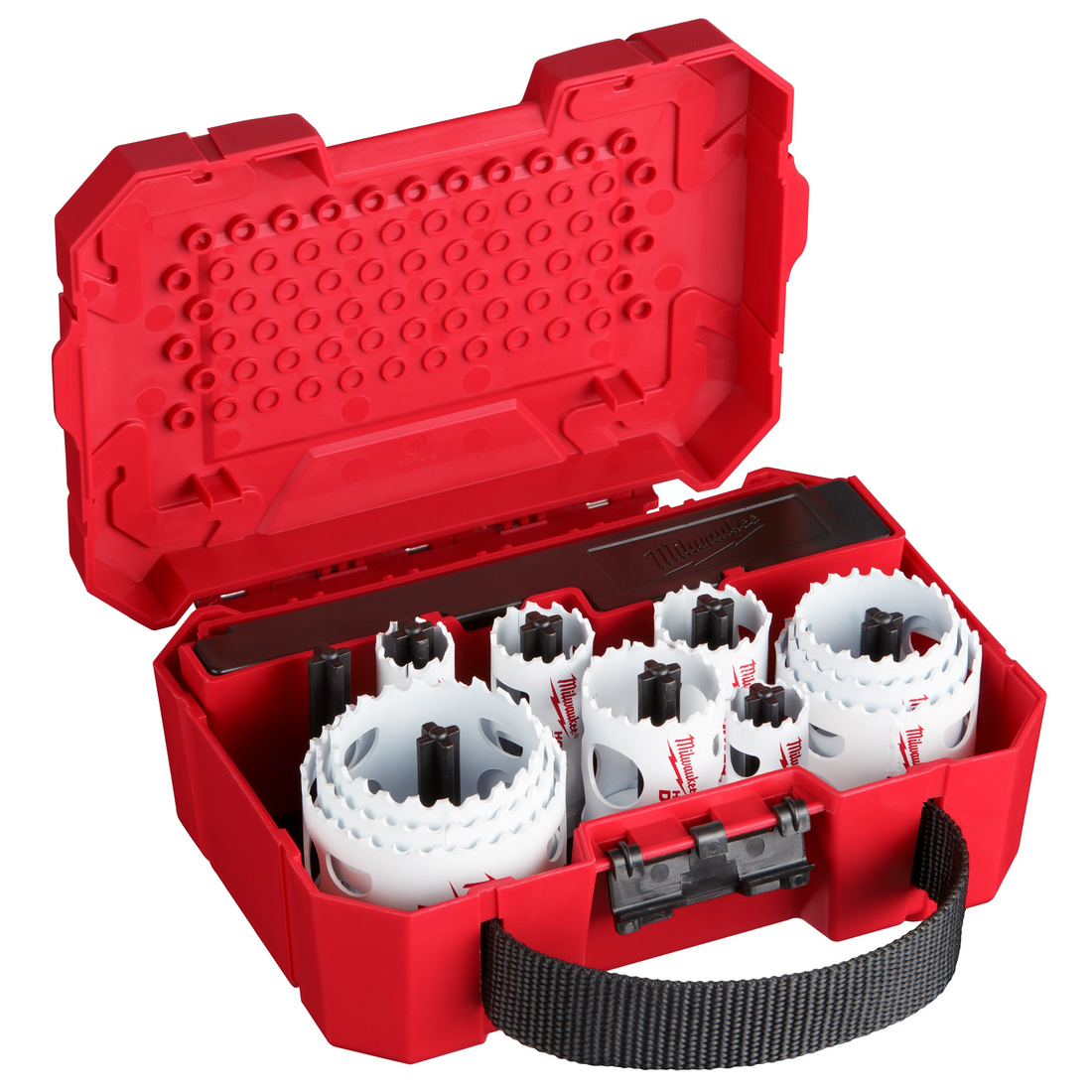
The 10PC PACKOUT kit (49-22-5606) pairs the most-called-for sizes with a PACKOUT Compact Organizer. Sizes included: 1-1/2", 2", 2-1/2", 3", 3-5/8", and 4-1/4". It drops straight into any PACKOUT stack without an adapter.
What Is the Milwaukee BIG HAWG (with Carbide Teeth)?

Carbide is harder than the cobalt steel in a bi-metal saw. That hardness means the BIG HAWG's teeth hold their edge longer in abrasive materials — plywood, OSB, Douglas fir framing, engineered lumber, and nail-embedded wood where a standard bi-metal saw grinds down fast. Milwaukee claims the BIG HAWG cuts significantly faster in wood than a standard bi-metal hole saw.
The trade-off matters: carbide is more brittle. Hit steel plate or a buried bolt with the wrong tooth angle and you're looking at a chipped cutter. The BIG HAWG is rated for wood and plastic, including nail-embedded framing — ferrous metal cutting is not in its spec. If in doubt, use the HOLE DOZER for anything metal.
The 9PC carbide kit (49-56-9295) covers 2-1/2" to 4-3/8" and cuts to 2.34 inches deep. Fewer sizes than the HOLE DOZER lineup, weighted toward the larger diameters that plumbers and electricians need most — pipe and conduit rough-in through studs and joists.
Like the HOLE DOZER 10PC, this kit ships with a PACKOUT Compact Organizer ready to stack.
HOLE DOZER vs BIG HAWG: The Differences That Matter
Material range
The biggest fork in the road. HOLE DOZER handles the whole mix: wood, metal, plastic, drywall. That makes it the right default for trades that switch materials often and for any DIYer who can't predict what the next job brings. EMT, sheet metal, stainless back-boxes? HOLE DOZER.
The BIG HAWG stays in its lane: wood, plastic, and nail-embedded lumber. It excels there. It doesn't belong in steel.
Cutting speed
In wood, the BIG HAWG is faster — Milwaukee says so directly. Carbide teeth stay sharper longer in abrasive wood grain, each cut requires less feed pressure, and the saw runs cooler. Milwaukee documents that speed advantage directly on their product page. A plumber running hundreds of holes a week notices that gap. A weekend DIYer probably won't.
Cut depth
Both lines publish cut-depth specs. HOLE DOZER: 1-5/8". BIG HAWG: 2.34 inches. If you're boring through engineered I-joists, stacked plates, or anything thicker than standard dimensional lumber, check the spec for your size before ordering.
Diameter range
HOLE DOZER wins on breadth, and it's not close. The 28PC kit spans a wide range covering nearly every hole an electrician, HVAC tech, or remodeler encounters. The BIG HAWG carbide kit offers fewer sizes, concentrated in the larger diameters that rough-in plumbers and electricians drill most. If you need a 7/8" hole for Romex and a 4-1/8" hole for a toilet flange, HOLE DOZER. If you mostly need 2-1/2" and 3" holes for pipe stacks through stud plates, BIG HAWG works.
Durability and cost per cut
Carbide outlasts bi-metal in wood — full stop. But the BIG HAWG costs more per cutter. If you're doing light or mixed use, bi-metal is the smarter buy; you won't wear it out fast enough to justify the carbide premium. Running high-volume rough-in and replacing bi-metal saws every season? The BIG HAWG's longer edge life can make the math work in its favor over time.
Do HOLE DOZER and BIG HAWG Share an Arbor?
This is the question most comparison posts skip. Before mixing kits, you need to know whether your existing HOLE DOZER arbors will mount BIG HAWG saws — and vice versa.
Both lines share the 5/8"-18 thread standard on saws 1-1/4" and larger, and traditional arbors interchange between HOLE DOZER and BIG HAWG. The one exception: QUIK-LOK standard adapters are not compatible with the BIG HAWG — those require Milwaukee's Pin Adapters (49-56-7575) instead.
Both Milwaukee hole-saw lines use a pilot bit and arbor system: the arbor threads into the center of the cup saw, the pilot bit runs through it to start the hole, and the whole assembly chucks into your drill. Whether the lines share an arbor matters a lot if you already own one system and want to add the other without buying duplicate hardware.
Full details on what arbors fit what, and which pilot bits carry over, are covered in our arbor compatibility breakdown. Read that before pulling the trigger if you're mixing lines.
Which Milwaukee Hole Saw Should You Buy? (By Trade)
Electrician — You cut EMT knock-outs, back-box holes, conduit bores, and the occasional lock-set. Metal and wood, constantly mixing. HOLE DOZER is your all-day tool. The 28PC kit covers virtually every size in an electrical rough-in. Add the BIG HAWG later if you're doing heavy framing penetrations.
Plumber — Large holes through wood framing, over and over, with buried nails hiding in half the studs. This is what the BIG HAWG was designed for. It'll cut faster and stay sharp longer in those conditions. Keep a few HOLE DOZER sizes around for any metal work (copper stub-outs, steel floor pans).
HVAC — Sheet metal duct penetrations and refrigerant line sets belong to the HOLE DOZER. The BIG HAWG has no place in sheet metal. If your rough-in also involves large wood bores, carry a couple of BIG HAWG sizes for those, and use the HOLE DOZER for everything else.
Remodeler / GC — Mixed materials, mixed hole sizes, every day. HOLE DOZER 28PC is the right default kit. You'll use almost every size across a year of work. Add BIG HAWG if you're phasing through heavy wood rough-in.
DIY / occasional use — HOLE DOZER, no question. Lower cost per cutter, handles every material you'll hit in a house, and the 10PC PACKOUT kit gives you the common sizes in a compact organizer that won't get lost in a drawer.
High-volume rough-in pros — Most serious tradespeople carry both. HOLE DOZER for metal and versatility. BIG HAWG for speed on large-diameter wood work. Both kits fit in PACKOUT Compact Organizers and stack neatly.
The Kits We Stock
HOLE DOZER 28-piece kit The widest coverage in one box. Covers the full HOLE DOZER size range across every material. The right first kit for electricians, remodelers, and anyone who wants one set that handles whatever comes up.
HOLE DOZER 10-piece kit with PACKOUT organizer The most common sizes in a PACKOUT-ready organizer. Good for the tradesperson who has their go-to sizes dialed in and wants organized storage that stacks with the rest of their PACKOUT gear — or the DIYer who doesn't need all 28 cups but wants the kit to stay put.
BIG HAWG 9-piece carbide kit with PACKOUT organizer Nine carbide-tooth saws in the sizes rough-in trades use most, in a PACKOUT Compact Organizer. Built for the plumber or electrician running hundreds of holes through framing. The premium you pay per cutter comes back in time saved over a season.
All three kits are in the Milwaukee tool collection.
FAQ
Is the Big Hawg better than the Hole Dozer? Neither is better — they're built for different jobs. HOLE DOZER (bi-metal) cuts more materials across more sizes and costs less per cutter. BIG HAWG (carbide) is faster in wood and holds its edge longer in nail-embedded framing. Which one is "better" depends entirely on what you're cutting and how often.
Can a Big Hawg cut metal? The BIG HAWG with Carbide Teeth is designed for wood, plastic, and nail-embedded lumber — ferrous metal cutting is not in Milwaukee's spec for this saw. For metal — sheet metal, EMT, stainless — use the HOLE DOZER. Carbide teeth and steel don't mix well; you risk chipping the tooth.
Is the Big Hawg faster than the Hole Dozer? In wood, yes. Milwaukee rates the BIG HAWG up to 5x faster than a standard bi-metal hole saw in wood and plastic. In metal, there's no comparison — HOLE DOZER is the only rated option.
Do the HOLE DOZER and BIG HAWG use the same arbor? Both lines use the same thread standards — ½–20 for small saws and ⅝–18 for large — and large-thread arbors interchange between both lines. See hole saw arbor compatibility details for the full arbor and pilot-bit compatibility breakdown before mixing kits.
What is a Big Hawg used for? Fast, large-diameter holes for pipe rough-in, conduit runs, and cable penetrations through wood studs, plates, and joists. Any high-volume framing-penetration work where the material is wood or plastic and you need speed and edge life.
What's the difference between bi-metal and carbide hole saws? Bi-metal bonds a flexible steel body to a hardened cobalt-steel tooth edge. It absorbs shock, handles a wide material range, and won't snap if you clip a fastener — though it'll dull. Carbide teeth are harder, stay sharper longer in abrasive wood, and cut faster — but they're brittle and don't belong in metal. Carbide costs more per saw. Bi-metal is the safer all-purpose choice; carbide earns its premium in high-volume wood rough-in.
The choice is straightforward once you know your job: all-material versatility goes to the HOLE DOZER, fast large-bore wood work goes to the BIG HAWG. Most pros end up with both.
Browse the full Milwaukee accessory lineup — both hole-saw kits ship in PACKOUT Compact Organizers that drop into any existing stack.
Also worth reading before you order: Milwaukee saw blade selection for circular and recip blade guidance, and SAWZALL blade recommendations if SAWZALL blades are on your list too.