
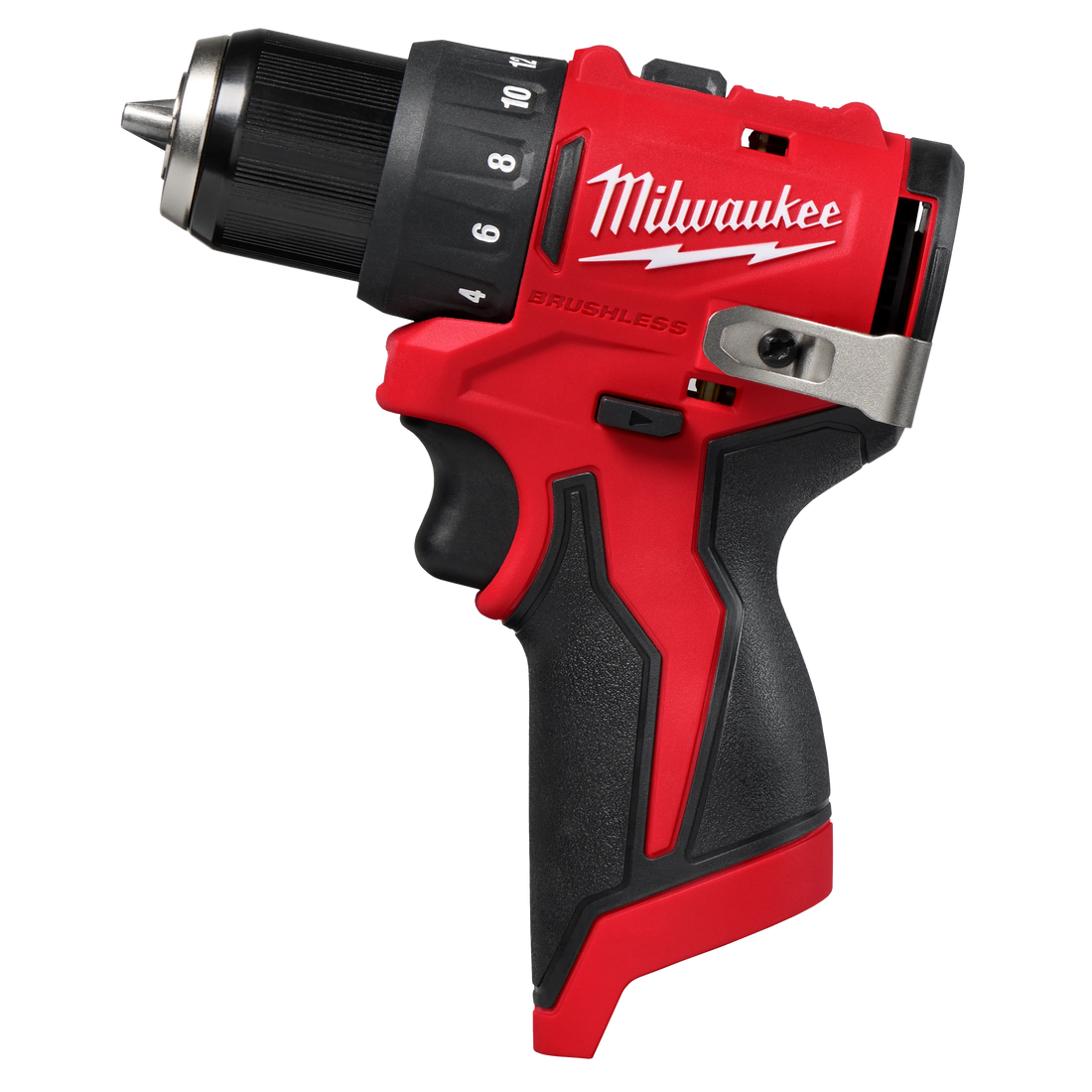
Milwaukee M12 FUEL vs Non-FUEL: What's the Difference (and When to Pay for FUEL)
Choosing between Milwaukee M12 FUEL vs non-FUEL tools comes down to one motor decision. M12 FUEL packs three things into a tool: a POWERSTATE brushless motor, REDLINK PLUS electronics, and the full REDLITHIUM battery system. That combination gives a FUEL tool more power, more runtime per charge, and a longer working life than a standard non-FUEL M12 tool, which runs a brushed motor and costs less. The fact most comparison guides skip: both lines run on the exact same M12 REDLITHIUM batteries and chargers. No FUEL-only packs exist. You can own both and swap batteries freely.
Short answer — pay for FUEL on tools you push hard. Save with non-FUEL on anything you pick up occasionally.
Do M12 FUEL and Non-FUEL Use the Same Battery and Charger?
Yes. Every M12 REDLITHIUM pack — CP2.0, XC4.0, XC6.0 — fits any M12 tool regardless of whether it says FUEL on the body. Same story for chargers: any M12 charger works on any M12 tool.
Milwaukee has never made a FUEL-specific battery. The brand just names the battery in the FUEL definition because REDLITHIUM tech is baked into the three-part FUEL system — but the pack itself is shared across every M12 tool ever made.
That matters for your wallet. You're not buying into a separate battery ecosystem when you go FUEL. You're buying a better motor in one specific tool while every other M12 pack and charger you already own still works with it.
→ More on picking the right M12 pack: our battery selection guide
What Does "M12 FUEL" Actually Mean?
Milwaukee is specific about it. FUEL isn't just "brushless" — it's a three-part designation.
POWERSTATE Brushless Motor
This is the core upgrade. A brushless motor has no physical brushes to wear, runs cooler, and converts more battery energy into output instead of losing it as heat. On the same battery, a POWERSTATE motor pulls meaningfully more torque and keeps that torque consistent as the battery drains.
REDLINK PLUS Intelligence
REDLINK PLUS is the onboard electronics that protect the tool and the battery. It monitors temperature, load, and cell state in real time. Under hard use it can adjust draw to prevent damage — something a basic brushed tool can't do.
REDLITHIUM Battery

Milwaukee lists this in the FUEL definition to signal that FUEL tools are built to take full advantage of the REDLITHIUM cell chemistry. But again — those packs work on every M12 tool. REDLITHIUM is the platform, not a FUEL-only gate.
M12 FUEL vs Non-FUEL: Side-by-Side Comparison
| M12 FUEL | Standard M12 (non-FUEL) | |
|---|---|---|
| Motor type | Brushless (POWERSTATE) | Brushed |
| Power output | Higher | Lower |
| Runtime per charge | More | Less |
| Motor lifespan | Longer | Shorter |
| Weight/size | Often slightly heavier | Often slightly lighter |
| Price tier | Higher | Lower |
| Battery compatibility | Any M12 REDLITHIUM | Any M12 REDLITHIUM |
| Charger compatibility | Any M12 charger | Any M12 charger |
The battery row is the same in both columns — that's intentional.
On price: the FUEL premium varies by tool category. For an impact driver it's significant; for a light or a small utility tool it can be minimal. Pull live pricing on the tools you're comparing — don't let a sticker shock on the flagship impact make you assume every FUEL tool is out of reach.
Brushless vs Brushed — What the Motor Change Actually Buys You
A brushed motor works by dragging physical carbon brushes across a spinning commutator. That creates friction, heat, and wear. Eventually the brushes wear down and the tool loses performance or dies. A brushless motor uses magnets and electronics to do the same job — no contact, no wear, less heat.
Practical differences you'll feel on the job:
More runtime. Less energy goes to heat, more goes to output. On a long day of driving fasteners or running a ratchet under a car, that runtime gap is real.
Consistent power. A brushless motor holds torque closer to full output as the battery discharges. A brushed motor drops off noticeably as the pack depletes.
Smaller head on some tools. Without a commutator assembly, FUEL tools can sometimes package a shorter front end — useful in tight spots.
Where it doesn't matter. A work light doesn't care whether its motor is brushless. A soldering iron, an inflator on light duty, a diagnostic device — tools where the motor isn't the limiting factor. Brushed is fine there.
Which M12 Tools Are Worth the FUEL Upgrade — and Which Aren't
Worth Paying for FUEL
Impact driver. This is the clearest call. The M12 FUEL impact driver (3453-20) puts out 1,500 in-lbs of peak torque. If you're driving long fasteners, working in hardwoods, or using the impact all day, the brushless motor earns its keep.
Drill/driver. If you're drilling regularly — into concrete block, hardwood, stacked framing — the POWERSTATE motor handles sustained load without cooking itself. Light drilling on drywall or pilot holes in softwood? A non-FUEL M12 drill is fine.
Ratchet under load. Running stubborn fasteners, working in an engine bay all day — that's where brushless matters. A standard M12 cordless ratchet (2457-20) handles lighter or occasional ratcheting work well, but if you're snapping fasteners loose or working high-volume fastener cycles, the FUEL version delivers more consistent torque.
Hammer drill. Sustained drilling in masonry generates serious heat. Brushless handles it better.
Skip FUEL or Let Price Decide
Work lights. The motor type doesn't affect lumen output. Save your money.
Soldering iron. Heat comes from a heating element, not the motor. Non-FUEL here is sensible.
Inflator for occasional use. Running a tire to pressure once a week doesn't justify the FUEL premium.
Any M12 tool you use a few times a year. If it's living in the truck and only comes out occasionally, the brushed motor will outlast your patience for the job.
How to Tell If an M12 Tool Is FUEL
Three quick checks:
1. The "FUEL" badge. It's printed on the tool body — usually on the side or near the motor housing. No badge, not FUEL. 2. Red-and-black styling. Milwaukee uses a darker red/black scheme on many FUEL tools, though color alone isn't a guarantee — always confirm the badge. 3. Model number on the listing. Milwaukee's product pages and retail listings call out FUEL explicitly in the title. If you're buying used or repackaged, search the model number directly on Milwaukee's site. The spec sheet will confirm motor type.
When in doubt, look up the model number. The spec page will list "POWERSTATE brushless motor" if it's FUEL.
Which M12 Battery and Charger Should You Get?
Once you decide on a FUEL or non-FUEL tool, the real long-term choice is which battery pack you're pairing with it.
CP2.0 (2.0 Ah): Compact and light. Good for occasional use, lighter-duty tasks, or when weight matters (think working overhead all day). Less runtime.
XC4.0 (4.0 Ah): The sweet spot for most users. The M12 XC4.0 battery gives you solid runtime without the bulk of the 6.0.
XC6.0 (6.0 Ah): Maximum M12 runtime. The M12 XC6.0 pack is the pack to grab if you're running a FUEL impact driver or drill all day. It's bigger, but you'll feel the difference mid-shift.
For charging, the M12 TOP-OFF charger keeps any M12 pack topped off — FUEL or not — and doubles as a USB power supply when you're away from an outlet.
And if you run M12 drills or impact drivers, a set of magnetic bit holders keeps your most-used bits within reach without digging through a pouch.
Related: comparing M12 and M18 if you're weighing whether M12 is even the right platform for you.
Frequently Asked Questions: M12 FUEL vs Non-FUEL
Is M12 FUEL worth it?
For tools you use hard or run most of the day — yes. The brushless motor gives you more torque, longer runtime, and a motor that holds up longer under sustained load. For occasional-use tools, the non-FUEL option gets the job done and saves real money. Match the tool to how hard you actually use it.
What's the difference between M12 and M12 FUEL?
M12 FUEL adds a brushless POWERSTATE motor and REDLINK PLUS electronics to the standard M12 platform. That translates to more power, more consistent output as the battery drains, and a motor that doesn't wear brushes. Standard M12 tools use a brushed motor, cost less, and are often a bit lighter.
Does M12 FUEL use a different battery?
No. Every M12 REDLITHIUM battery — CP2.0, XC4.0, XC6.0 — fits both FUEL and non-FUEL tools. There is no FUEL-specific pack. Same goes for chargers.
Is M12 FUEL brushless?
Yes. Every M12 FUEL tool uses a brushless motor. If it doesn't say FUEL, it's brushed.
Are M12 FUEL tools more powerful than non-FUEL?
Yes. FUEL tools are rated for higher torque output and more runtime per charge. The exact gap varies by tool category — it's most noticeable in impact drivers, drills, and ratchets under sustained load. Milwaukee rates the M12 FUEL line at up to 2X more power and 4X more runtime vs. leading competitors.
Can I use a non-FUEL M12 battery on a FUEL tool?
Yes — all M12 batteries are interchangeable. That said, a higher-capacity XC pack gets the most out of a FUEL tool. Pairing a CP2.0 with a FUEL impact driver works, but you're leaving runtime on the table.
If you're on the M12 platform, the battery and charger are the foundation — not the badge on the tool. Pick up the right capacity pack, keep it charged, and add FUEL tools where the extra output genuinely pays off on your jobs.
Browse the full M12 collection lineup, or check the broader Milwaukee tools collection for chargers, adapters, and accessories that run across the whole platform.
*Also worth reading:*
- M18 FUEL vs non-FUEL — same decision on the bigger platform
- what M18 FUEL means — how FUEL carries across to M18
- M12 FUEL vs Makita and Bosch — how M12 FUEL stacks up against other 12V platforms