
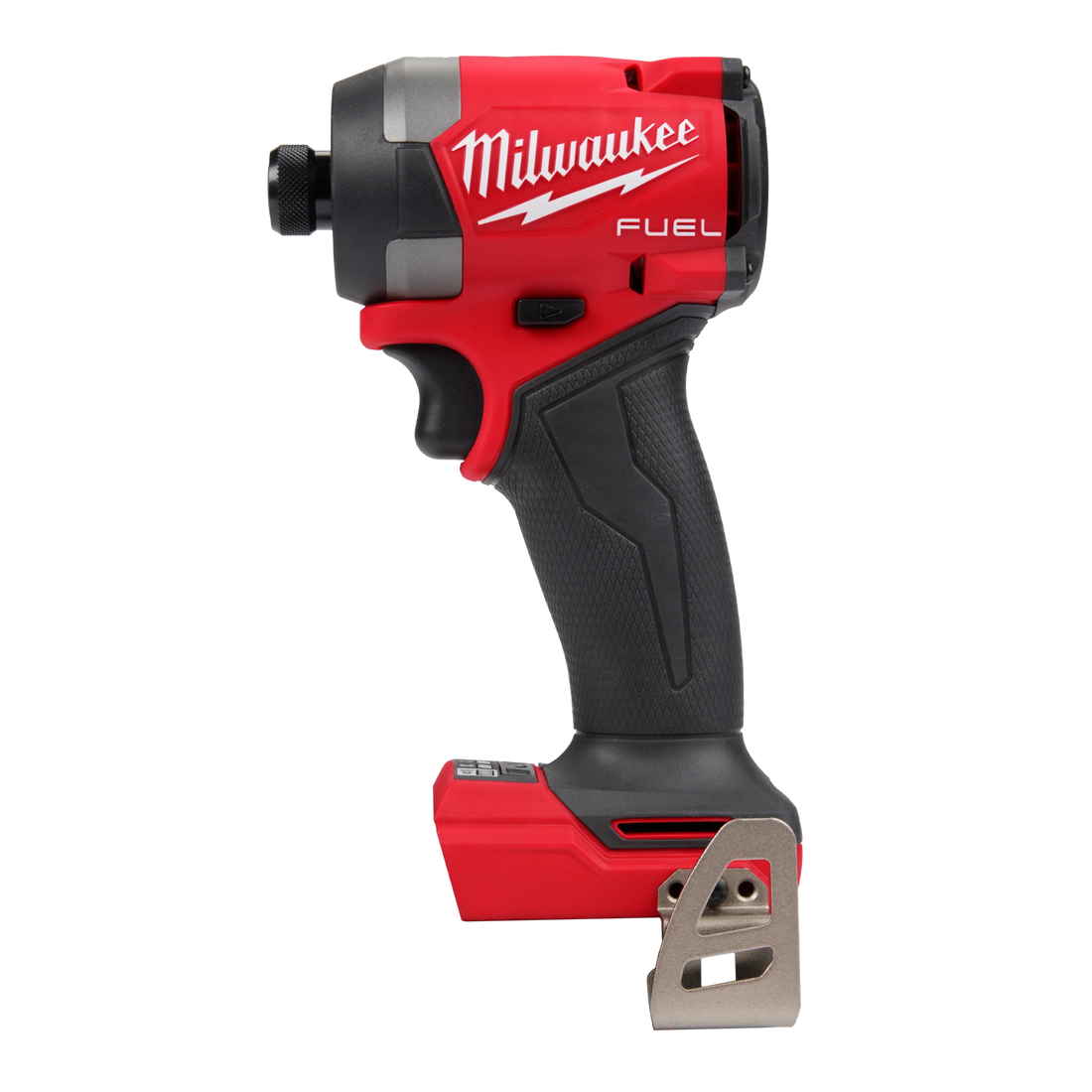
Milwaukee M18 vs M18 FUEL: Is the FUEL Premium Actually Worth It?
FUEL is worth the premium on the tools that see real work — 1/2" impact wrench, hammer drill, circular saw, recip saw. For occasional-use tools (basic drill/driver, work light, inflator, caulk gun), standard M18 is the smarter buy. Either way, your M18 batteries, chargers, USB adapters, and inverters work identically on FUEL and non-FUEL tools. You're not choosing between platforms. You're choosing between motors — and only on the tools where that motor choice actually shows up in your work.
The battery deck you've already built stays exactly where it is.
What's the Actual Difference Between M18 and M18 FUEL?
The Three Things FUEL Adds
Milwaukee built FUEL around three proprietary components, always packaged together:
POWERSTATE brushless motor. More efficient than a brushed motor — less friction, less heat, more of the battery's energy going into actual work. No brushes means less wear over time, which matters if a tool lives on your truck for years.
REDLINK PLUS electronic intelligence. Overload protection, temperature monitoring, and active communication between the tool, battery, and charger. When the motor gets pushed too hard or the battery heats up, REDLINK PLUS backs off before damage happens rather than just tripping a shutoff. That's the part that extends tool and battery life under sustained heavy use.
REDLITHIUM battery integration. The battery talks to the tool through REDLINK PLUS. The system manages current draw dynamically when temps spike, giving you better runtime per charge and longer battery lifespan over hundreds of charge cycles.
All three have to be present before Milwaukee puts the FUEL badge on a tool.
What FUEL Is NOT: Same Battery, Same Accessories
FUEL is not a different battery platform. This trips people up more than anything else.
Every M18 battery — the Compact 2.0Ah, XC 5.0Ah, High Output 6.0Ah, Forge HD12 — fits every M18 tool, FUEL or not. Same chargers. Same accessories. The pack slides in identically and powers the same lights, radios, USB chargers, and inverters either way. If you want the full rundown on which pack to buy for your M18 kit, our M18 battery comparison guide covers that decision tool-by-tool.
If you already own M18 gear, you are not starting over when you add FUEL tools.
How Much More Does M18 FUEL Cost?
At the bare-tool level, FUEL runs roughly 40–80% more than the non-FUEL equivalent. That gap is wider on heavy-duty, high-torque categories and narrower on lighter tools.
Here are the most popular pairs:
| Tool | Non-FUEL Model | FUEL Model | Typical Premium |
|---|---|---|---|
| 1/2" High-Torque Impact Wrench | 2663-20 | 2767-20 | ~60–75% |
| Hammer Drill/Driver | 2606-20 | 2904-20 | ~40–60% |
| 7-1/4" Circular Saw | 2630-20 | 2732-20 | ~50–70% |
| SAWZALL Recip Saw | 2621-20 | 2720-20 | ~50–65% |
| 1/2" Drill/Driver | 2801-20 | 2803-20 | ~30–50% |
Check current bare-tool pricing before buying — it moves. Kit pricing closes the gap because battery and charger costs dominate the kit total regardless of which tool is in the box.
One thing worth knowing: Milwaukee has quietly discontinued non-FUEL versions of several tools. In some categories you no longer have a choice — if you want the best impact wrench or top-tier hammer drill, FUEL is the only option. That's not necessarily a bad thing; it just means the "non-FUEL vs FUEL" comparison isn't always on the table.
When Is M18 FUEL Worth the Premium?
Pay the premium when the tool is going to work hard, work daily, and work in demanding conditions.
FUEL earns its keep when:
- You're drilling into hardwood, steel, or masonry on a regular basis
- The tool runs most of the day — not a project here and there on weekends
- Torque headroom matters — driving long lags, tightening large fasteners, drilling big holes
- Runtime per charge is critical and you can't afford to stop and swap batteries constantly
- The tool lives on the truck and gets genuine daily abuse
The specific tools where the FUEL gap is largest:
1/2" High-Torque Impact Wrench. This is the clearest case in the lineup. The FUEL 2767-20 delivers 1,400 ft-lbs of nut-busting torque versus 450 ft-lbs on the standard 2663-20. That gap matters when you're breaking loose rusted lug nuts, torquing lug nuts to spec, or doing any sustained automotive work.
Hammer Drill. Drilling through concrete, block, or masonry taxes motors hard over the course of a shift. FUEL's REDLINK PLUS manages heat better and backs off intelligently before you fry the motor. The standard M18 will get the job done; it just works harder to do it.
7-1/4" Circular Saw. Full sheets of OSB, framing lumber, all day long. The FUEL saw handles sustained load better and runs cooler under continuous cutting.
SAWZALL Recip Saw. Demolition work puts motors through the wringer — cutting through nail-embedded framing, pipe, and demo debris. FUEL handles more load before electronics start managing back current. Check our saw blade guide for blade recommendations that keep up with either saw.
Band Saw. Same logic as the recip saw — sustained cutting load is where FUEL's motor efficiency shows up.
When Should You Skip M18 FUEL?
Skip the premium when the tool is light-duty, occasional-use, or rate-limited by something other than motor output.
Standard M18 makes sense when:
- You're a DIYer reaching for the tool a few times a month
- The work is light — hanging stuff, assembling furniture, running a few screws
- The job rate-limits on something else — you can only caulk so fast; you can only inflate a tire so fast
- You'd rather spend the savings on an extra battery, which benefits the whole kit
Specific tools where FUEL's advantage nearly disappears:
Drill/Driver (light use). A standard M18 drill/driver is more than enough for most home use. Screw driving and light drilling don't stress motors to the point where POWERSTATE and REDLINK PLUS make a noticeable difference.
Work Light. No motor efficiency story here. Light output is light output.
Inflator. Rate-limited by the pump, not the motor. You won't inflate a tire faster with FUEL.
Caulk Gun. Dispensing speed is mechanical, not motor-driven.
Jobsite Radio. Same deal — no performance difference.
One callout worth making: some newer non-FUEL M18 tools are brushless, just without the full FUEL stack. The current brushless non-FUEL drill/driver lineup includes the 2801-20, 3601-20, and 3602-20. Milwaukee's naming has gotten less consistent over the years. A "non-FUEL" tool today might have a brushless motor without POWERSTATE or REDLINK PLUS. Read the spec sheet rather than assuming non-FUEL means brushed. For a deeper dive into what the FUEL badge actually means on each tool, our in-depth FUEL motor guide is the companion post.
Tool-by-Tool: FUEL or Non-FUEL? The Honest Table
| Tool Category | Verdict | Why |
|---|---|---|
| 1/2" High-Torque Impact Wrench | FUEL | Biggest torque gap in the lineup; daily use more than justifies the price |
| Hammer Drill | FUEL for pro/daily; non-FUEL OK for light DIY | Heat management in concrete is real; less critical for drywall anchors |
| 7-1/4" Circular Saw | FUEL for daily framing/sheet goods | Non-FUEL fine for occasional cuts |
| SAWZALL Recip Saw | FUEL for demo work; non-FUEL for occasional use | Sustained motor load on demolition is where FUEL earns it |
| 1/4" Hex Impact Driver | FUEL if driving fasteners all day; borderline for DIY | Daily fastening — yes. Weekend projects — non-FUEL holds up fine |
| 1/2" Drill/Driver | Non-FUEL for most DIY | Standard M18 more than enough for drilling and driving at normal pace |
| Band Saw | FUEL | Sustained cutting load benefits from POWERSTATE motor |
| Work Light | Non-FUEL | No motor efficiency advantage applies here |
| Inflator | Non-FUEL | Not motor-limited |
| Caulk Gun | Non-FUEL | Dispensing is mechanical; FUEL adds nothing |
| Jobsite Radio | Non-FUEL | No performance difference |
Do M18 FUEL and Standard M18 Share the Same Batteries and Accessories?
Yes — completely. FUEL and non-FUEL M18 share everything downstream of the tool.
Same M18 battery. Same charger. Same USB-C charger. Same 150W power inverter. Same magnetic bit holders. All of it works across the entire M18 lineup without exceptions or adapters.
That means:
- Buy FUEL for your impact wrench and hammer drill today, standard M18 for the inflator and radio.
- The batteries you own right now power every tool in that mix.
- Accessories you add to the kit now stay useful for as long as you stay on M18.
Your M18 USB-C charger doesn't care whether the tool you just put down was FUEL or not. Plug in any M18 pack and charge your device. The M18 power inverter runs off any M18 battery in the kit — FUEL or non-FUEL, 2.0Ah or 12.0Ah. The magnetic bit holder in your pocket goes straight from the FUEL impact driver to the standard drill/driver without a second thought.
This is the real argument for committing to M18 as a platform: the accessory compatibility doesn't split along FUEL/non-FUEL lines. Everything talks to everything.
How to Build a Mixed M18 + FUEL Kit Without Wasting Money
You don't need an all-FUEL kit. You also don't need to decide everything upfront.
Start with FUEL on the tool you lean on hardest. For most tradespeople, that's the impact wrench or hammer drill. That's where motor quality shows up in real work, and where the premium pays back over time.
Use non-FUEL for supporting tools. Work light, inflator, caulk gun, radio — these are support players. Standard M18 is the right call. Redirect the savings to an extra battery, which benefits every tool in the kit.
Share batteries across all of it. Buy good packs — an XC 5.0Ah or High Output 6.0Ah — and run them through both lines. They don't care which tools they're powering.
Replace with FUEL when tools actually wear out. If your standard M18 drill/driver is working, don't replace it. When it finally gives up, that's the right time to weigh whether the FUEL upgrade makes sense for how you use it.
If you're still sorting out the broader platform question, our M12 vs M18 guide covers whether M12 or M18 makes sense for your use case before you commit to FUEL pricing on any of it.
Both FUEL and non-FUEL M18 tools carry a 5-year limited warranty — though select M18 FUEL models carry 2–3 years — so warranty differences rarely drive the decision either way.
Frequently Asked Questions About M18 FUEL
Is M18 FUEL worth the extra money? Yes — on the tools that work hard daily. Impact wrench, hammer drill, circular saw, recip saw: pay for FUEL. Light-duty or occasional-use tools like a basic drill/driver, work light, or inflator: save your money. The premium is real (40–80% at the bare-tool level), so spend it where it makes a difference.
What's the difference between M18 and M18 FUEL? FUEL adds three specific things: a POWERSTATE brushless motor, REDLINK PLUS electronic intelligence (overload and temperature protection), and REDLITHIUM battery integration. Standard M18 tools use simpler motors and controls. Both run the same M18 battery platform.
Do M18 FUEL tools use the same batteries as regular M18? Yes, completely. Every M18 battery — Compact, XC, High Output, Forge — fits every M18 tool whether it's FUEL or not. Same chargers. Same accessories. No exceptions.
Are M18 FUEL tools more powerful? Yes, meaningfully — more torque, higher no-load speed, and better runtime management on the same pack compared to the non-FUEL equivalent. The gap is most pronounced on high-torque applications like impact wrenches and hammer drills.
Is M18 FUEL always brushless? FUEL always means a POWERSTATE brushless motor. That said, some newer non-FUEL M18 tools also use brushless motors — just without the full FUEL stack. Check the spec sheet; don't assume non-FUEL automatically means brushed.
How much more expensive is M18 FUEL? Roughly 40–80% more at the bare-tool level. Kit pricing narrows the gap considerably because battery and charger costs dilute the tool-price premium either way.
Can I mix M18 and M18 FUEL tools in the same kit? Absolutely. They share batteries, chargers, and all accessories. Buy FUEL where the motor matters, standard M18 where it doesn't, and run the same battery packs through all of it.
Which M18 FUEL tool should I buy first? The one you push hardest every day. For most trades that's the 1/2" high-torque impact wrench, hammer drill, or circular saw. For light DIY, the standard M18 versions of all three are perfectly capable.
Is FUEL heavier than regular M18? Usually, yes. The bigger motor and gearbox add weight — enough to notice on tools you hold overhead for long stretches. It's a real trade-off. Worth it for the tools where you need the extra capability; less so for occasional-use tools.
Whatever mix of M18 and M18 FUEL tools you end up with, the accessories carry over to all of it. Browse the full Milwaukee tool collection — chargers, inverters, bit holders, and more — and none of it cares whether the tool is FUEL or not.