
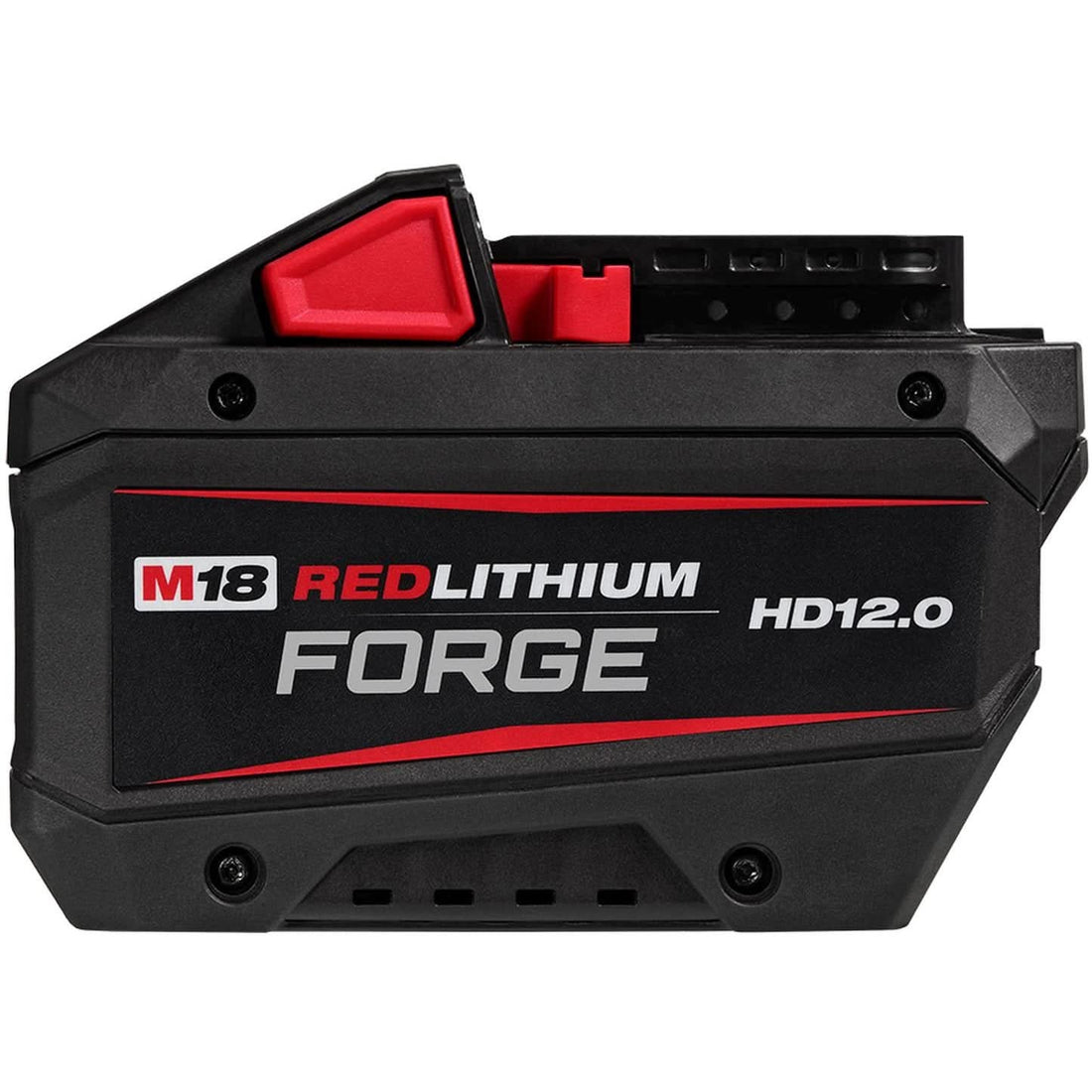
Milwaukee M18 Forge vs High Output vs RedLithium: Which Battery Do You Actually Need?
Here's the short version: Forge is Milwaukee's newest M18 battery — next-gen tabless 21700 cells, highest power output, fastest charging (on a Forge Super Charger). High Output sits in the middle, using tabless 21700 cells on the 8.0/12.0 Ah packs for serious power at a saner price. Standard RedLithium (the CP and XC packs) uses 18650 cells and is exactly right for drills, impacts, lights, and everyday work. All three fit every M18 tool and every M18 charger.
Quick call: Running drills and impacts? RedLithium XC 5.0 or HO 5.0. Heavy FUEL tools? HO 8.0 or 12.0. High-draw tools daily, or you own the Forge Super Charger? That's when Forge earns its price.
M18 Battery Tiers at a Glance
| Standard RedLithium (CP/XC) | High Output (HO) | Forge | |
|---|---|---|---|
| Cell type | 18650 lithium-ion | Tabless 21700 (8.0/12.0) | Next-gen tabless 21700 |
| Capacity range | 1.5–6.0 Ah | 5.0–12.0 Ah | 6.0–12.0 Ah |
| Peak power vs standard XC | Baseline | 50% more power | 50% more power (Forge HD12.0 vs. HO HD12.0) |
| Charge time (rapid charger) | 60 minutes (XC 5.0) | 60 minutes (Super Charger) or 130 minutes (Rapid Charger) for original HO HD12.0; 45 minutes for newer Forge HD12.0 | Forge Super Charger charges to 80% in 15 minutes and 100% in approximately 25 minutes; standard rapid charger charge time not officially published by Milwaukee |
| Weight | 1.60 lbs (XC 5.0) | 3.42 lbs (HO 12.0) | 3.3 lbs (Forge 12.0) |
| Fastest-charge charger | Any M18 charger | Any M18 charger | Forge Super Charger (required for max speed) |
| Cost per Ah | Lowest | Middle | Highest |
| Best for | Compact tools, everyday work | M18 FUEL tools, heavy use | High-draw tools, constant charging |
All three run at 18V nominal and are fully cross-compatible across the M18 platform.
What "RedLithium" Actually Means
This trips up a lot of buyers. RedLithium is Milwaukee's battery chemistry and electronics platform — not a product tier. Every M18 battery ever made — standard CP packs, High Output, and Forge — is a RedLithium battery. The name refers to the cell chemistry, the onboard electronics, and the protection circuitry Milwaukee builds into all of them.
So when you see "M18 RedLithium XC 5.0," the RedLithium part just means it's a Milwaukee M18 battery. The XC 5.0 part tells you the tier and the Ah rating.
The tier names that actually matter for comparing battery performance:
- CP — Compact Pack. Smaller 18650 cells, shorter packs, fits tight tools.
- XC — Extended Capacity. Bigger 18650 cells, more Ah, same cell technology as CP.
- HO — High Output. Tabless 21700 cells on the 8.0 and 12.0 Ah versions for more power and less heat.
- Forge — Milwaukee's current top tier. Next-generation tabless 21700 cells.
Once you know that, the whole line makes sense.
High Output: What Changed and Who It's For
The jump from standard XC to High Output isn't just more Ah. The HO 8.0 and 12.0 packs use tabless 21700 cells — a different cell form factor that reduces internal resistance, which means more power delivery and less heat under sustained load.
Milwaukee claims 50% more power from HO vs standard XC packs. In practical terms, that matters most on M18 FUEL tools — things like the FUEL circular saw, FUEL rotary hammer, and FUEL Super Sawzall — tools that pull high current and stress standard cells. Running those on an HO pack gives you better sustained performance and longer cell life because the pack runs cooler.
For drills, impacts, and lights? You'll notice longer runtime with more Ah, but you won't feel a dramatic power difference. A standard XC 5.0 handles those tools fine.
The HO line is also where Milwaukee's value story is strongest. You get tabless 21700 cell technology at a better cost per Ah than Forge. If you're building out an M18 FUEL kit and want high-capacity packs without overpaying, HO 8.0 and 12.0 are the smart picks.
Forge: What's New and When It's Worth It

Forge takes the next step from HO. Milwaukee's next-generation tabless 21700 cells deliver the highest power output of any M18 battery, plus faster charging — but that last part has a catch.
Fastest charging requires the Forge Super Charger. Slot a Forge pack into a standard M18 rapid charger and it charges at normal M18 rates. The speed advantage only fully activates on a Forge-compatible Super Charger. If you're evaluating Forge and don't already own or plan to own one of those chargers, factor that cost into your budget.
On power output, Forge delivers measurably more than HO — the Forge HD12.0 puts out 50% more power than the HO HD12.0 — and that matters for specific tools: large-capacity table saws, heavy rotary hammers, the FUEL Super Sawzall, and other sustained-draw applications where you're pushing the battery hard.
The honest trade-off: Forge 6.0 and 12.0 cost more per Ah than HO packs. If you're not running high-draw tools daily, you're paying for headroom you won't use. The charging speed benefit also doesn't matter much if your workflow has you swapping batteries throughout the day rather than rapid-charging mid-job.
When Forge makes sense:
- You run a table saw, large rotary hammer, or Super Sawzall as your main tools
- You own or will buy the Forge Super Charger
- Charge wait time costs you billable time
- You want Milwaukee's current best, full stop
Compatibility: What Fits What
This is the part most comparisons skip.
All three battery lines — standard RedLithium, High Output, and Forge — fit every M18 tool and work in every M18 charger. All M18 batteries are compatible with all M18 tools and chargers; the system currently supports 275+ M18 solutions with full backward and forward compatibility maintained across all new products. There are no compatibility restrictions within the M18 platform. A Forge 12.0 will run your seven-year-old M18 drill. An XC 5.0 will run a brand-new FUEL circular saw.
A few practical notes:
- Forge's fastest-charge spec is charger-dependent. Standard M18 rapid chargers will charge any Forge pack, just not at Forge's maximum rate. You need the Forge Super Charger for that.
- Tall packs in tight spaces. The HO 12.0 and Forge 12.0 are both tall, heavy packs. Some tools with close clearances at the battery foot — certain trim nailers, compact tools — don't leave much room. Check your tool before assuming a 12.0 Ah pack always fits the way you need it to.
- Weight matters on all-day work. A 12.0 Ah pack on a drill you're holding overhead for hours gets old fast. Match Ah to the tool and the task.
What This Means for Our M18 Accessories
Our USB-C fast charger with LED screen and 150W power inverter accept any M18 battery — standard RedLithium, High Output, or Forge. Voltage is identical across all three tiers (18V nominal), so compatibility is never a question. Runtime scales with Ah.
Rough math on the 150W inverter:
- 5.0 Ah pack (XC or HO 5.0): 18V × 5.0 Ah = 90 Wh. At 150W draw, roughly 30–36 minutes at near-full load. These figures are estimates based on watt-hour capacity and are not Milwaukee-tested runtime values.
- 12.0 Ah pack (HO or Forge): 18V × 12.0 Ah = 216 Wh. Same calculation: roughly 75–90 minutes at near-full draw. As with the 5.0 Ah estimate, this is a calculated approximation from watt-hour capacity, not a tested or published figure.
For the M18 USB-C fast charger: up to 65W output regardless of which M18 pack you slot in. A higher-Ah battery just means you can charge more devices before swapping packs.
Which One Should You Buy?
Buy standard RedLithium (CP 3.0 / XC 5.0) if:
- Your main tools are a drill, impact driver, work light, or other low-to-mid draw tools
- You want the lowest cost per pack
- You're just getting into M18 or adding spare packs on a budget
- You use accessories like a USB-C charger or 150W inverter — those don't need HO or Forge to work great
Buy High Output (HO 5.0 / 8.0 / 12.0) if:
- You own M18 FUEL tools — circular saw, rotary hammer, reciprocating saw, angle grinder
- You do sustained, heavy work and want packs that run cooler under load
- You want the best value per Ah at high capacity
- You're building a serious M18 kit and want packs that match the platform's top tools
Buy Forge (6.0 / 12.0) if:
- You run high-draw tools — table saw, heavy rotary hammer, FUEL Super Sawzall — as your daily drivers
- You own or plan to buy the Forge Super Charger
- Charge time costs you real money
- You want Milwaukee's current best and price isn't a deciding factor
For most M18 owners running a drill, impact, and a few accessories: HO 5.0 is the sweet spot. More power than XC if you ever step up to FUEL tools, better price than Forge, not overbuilt for everyday work.
What This Means for Accessories
No matter which battery tier you land on, the accessories work the same.
The M18 power inverter — 150W, 120V outlet, two USB ports — accepts any M18 pack. Forge gives you more runtime per charge, but the inverter doesn't care which pack you use. Same goes for the Milwaukee M18 USB-C power supply, which puts out up to 65W USB-C to charge your phone, tablet, or job-site device off whatever M18 battery you've got in hand.
If you're using heated gear on M12, the M12 USB charger for heated jackets is the M12-specific adapter — that's a separate platform and battery size, so it doesn't interact with M18 packs.
Pick your battery tier based on your tools and workload, not on the accessories. The accessories are platform-agnostic within M18.
See the full Milwaukee collection for M18-compatible chargers, inverters, and accessories — whatever battery tier you're running.
FAQ
Is Milwaukee Forge better than High Output?
For peak power and charge speed, yes. Forge uses next-generation tabless 21700 cells and charges fastest on a Forge Super Charger. But for most M18 FUEL work, High Output 8.0/12.0 delivers more than enough power at a lower cost per Ah. Forge is worth the premium if you run high-draw tools daily or charge time is a real cost for you.
Can I use a Forge battery on any M18 tool?
Yes. Forge batteries fit and run every M18 tool and charge on every M18 charger. The faster-charging benefit only fully activates on a Forge-compatible Super Charger — on a standard M18 charger, a Forge pack charges at normal speed.
What does RedLithium mean on a Milwaukee battery?
RedLithium is Milwaukee's battery chemistry and electronics platform — not a tier. Every M18 battery (standard CP/XC, High Output, and Forge) is a RedLithium battery. The tier names (CP, XC, HO, Forge) tell you the cell technology and capacity range.
Are M18 High Output and Forge batteries interchangeable with standard M18 chargers?
Yes — all M18 batteries charge on any M18 charger. The Forge Super Charger is the only charger that delivers Forge's maximum charge speed.
Will a Forge battery work on the M18 power inverter and USB chargers?
Yes. The M18 USB-C fast charger and 150W M18 inverter accept any M18 battery — standard, HO, or Forge. Higher-Ah packs give you more runtime per charge. Voltage (18V nominal) is the same across all three tiers.
Which M18 battery is best for a drill and impact driver?
A standard RedLithium XC 5.0 or a High Output 5.0 is plenty. Drills and impacts don't pull enough current to use what Forge offers — you'd be paying for power headroom that never gets touched. Save the Forge budget for high-draw FUEL tools.
Whichever tier you land on, the accessories are the same — see our M18-compatible chargers, inverters, and accessories in the Milwaukee collection.