
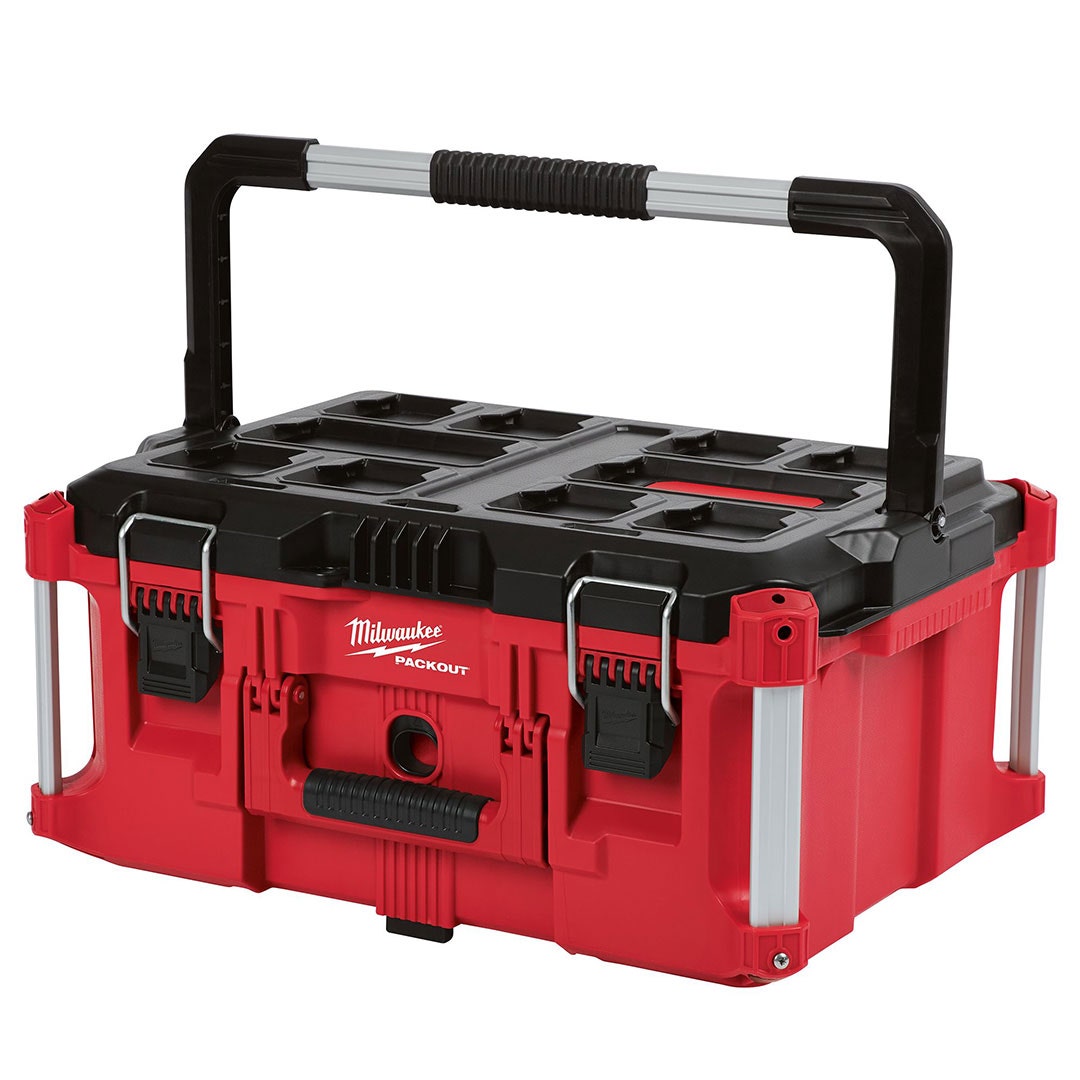
Milwaukee PACKOUT vs ToughBuilt StackTech: Which Modular Tool Box System Wins?
Comparing Milwaukee PACKOUT vs ToughBuilt StackTech? Start here: these systems do not connect to each other. Different mounting standards, zero cross-compatibility. Pick one — you're committing to a platform.
Get StackTech if you want the fastest one-handed stacking mechanism, a lower entry price, and you're fine with a mostly first-party accessory catalog. Get PACKOUT if you want the deepest, cheapest-to-expand storage ecosystem available — a large first-party lineup plus a cottage industry of aftermarket accessories that's been building for years.
The box is the down payment. The accessories are the mortgage.
Quick Verdict — Who Each One Is For
Buy ToughBuilt StackTech if:
- You want the slickest one-handed connect/disconnect on the market (StackTech genuinely wins this)
- You're building a stationary shop setup and won't need much bolted to the outside
- Entry price is the priority over long-term expansion cost
- You're not already deep in the Milwaukee ecosystem
Buy Milwaukee PACKOUT if:
- You want the widest accessory catalog available — mounting plates, side tables, foam inserts, cup holders, cord organizers, cleats, van/truck racking
- You're already on M18 or plan to grow a Milwaukee tool setup
- You need wide retail availability and easy warranty support
- You might sell used gear — PACKOUT holds value; StackTech hasn't established a resale market yet
Do StackTech and PACKOUT Work Together?
No. Full stop.
PACKOUT uses Milwaukee's cleat-and-side-latch system. StackTech uses ToughBuilt's top-mounted latch. The two mounting geometries are incompatible — you can't stack a StackTech box on a PACKOUT base, and no adapter bridges them.
Accessories don't cross over either. A PACKOUT mounting plate won't grab a StackTech surface. A StackTech organizer won't lock into a PACKOUT stack.
If you already own one of these: stay in that lane. Trying to run both systems is just two separate stacks taking up floor space with no benefit between them.
How Do They Stack? The Latch Mechanism Compared
StackTech: top-mounted one-handed latch
StackTech's standout feature is real. The one-handed center latch sits on top of each box and flips with one hand — no side clips to work, no need to re-seat a heavy unit. Drop the box on top, flip the latch, done.
This is a genuine win. If you're stacking and breaking down your setup multiple times a day across different jobs, that single-motion release adds up.
PACKOUT: cleat-seat plus side latches
PACKOUT stacks by dropping the box's integrated feet onto the cleat-shaped surface of the unit below, then snapping two side latches. It locks down solid — the side latches pull the boxes together tightly and keep that connection firm under load and over rough ground.
The trade-off: it's a two-step process that typically takes two hands. There's nothing wrong with the system — it's proven over years of field use — but it's slower to break down than StackTech's single-motion release.
Stack stability when rolling
Both systems stay locked under normal jobsite rolling. PACKOUT's side-latch design is particularly tight on uneven surfaces — gravel, concrete cracks, van floors. StackTech's top-latch approach is newer, and owner feedback has been positive, but the field track record is shorter. PACKOUT launched in 2017; StackTech launched in October 2023. That's a meaningful gap in real-world stress data.
PACKOUT vs StackTech: Side-by-Side Spec Comparison
| Milwaukee PACKOUT | ToughBuilt StackTech | |
|---|---|---|
| Mounting mechanism | Cleat-seat + side latches | Top-mounted latch |
| One-handed connect/disconnect | No — two steps | Yes — single motion |
| Rolling base load capacity | Heavy-duty rated | Heavy-duty rated |
| Weather sealing | Gasketed; weather-resistant | Weather-resistant |
| Box/organizer lineup | Large, long-established | Smaller, still growing |
| First-party accessories | Extensive | Limited but growing |
| Third-party/aftermarket | Large cottage industry | Early-stage |
| Warranty | Limited warranty | Limited warranty |
| Retail availability | Wide — Home Depot, Amazon, Acme | More limited — Lowe's, direct |
| Resale market | Active secondary market | Too new for comparison |
*Exact load ratings, IP/weather specs, and warranty terms for both systems need verification against manufacturer spec pages — don't rely on marketing language alone. Check the spec tab for the specific model you're buying. Verified values will replace the qualitative rows above once Stage 5 runs WebFetch.*
The Accessory Ecosystem — The Real Long-Term Decider
This is where the two systems separate for most buyers, and where the cost comparison gets more honest.
PACKOUT's ecosystem
PACKOUT has been on the market for years and Milwaukee has built a first-party accessory line that covers nearly every trade need: vacuum attachments, radio mounts, inflator integration, individual cleats, half-size organizers, modular tray inserts, and tools that integrate directly into the stack.
Then there's the aftermarket. Because PACKOUT's cleat geometry is widely documented, a sizable third-party ecosystem has grown around it. Aluminum rail systems, folding side tables, precision foam inserts, cup holders, level mounts, truck-bed racking kits — most of it available for well under what Milwaukee charges for equivalent first-party pieces.
We carry several of these at Tool Army:
- Manta Mount Cleats — 6-Pack: six individual cleats that let you mount a single PACKOUT accessory anywhere — van wall, a shelf, a workbench — without needing a full mounting plate. Flexible and cheap.
- Front & Side Mounting Plate: attaches to the front or either side of your stack and turns that surface into expansion real estate. More attachment points, more ways to grow the setup.
- Foldable Magnetic Work Table: folds flat when not in use, mounts to the PACKOUT stack magnetically — no drilling. Pop it open and you've got a work surface wherever your stack is sitting.
That's what ecosystem depth means in practice: useful gear that makes the stack more functional, at aftermarket prices, without waiting on Milwaukee to release it.
StackTech's ecosystem
ToughBuilt's accessory lineup for StackTech is newer and primarily first-party. The boxes are well-built, and ToughBuilt has been adding to the system. But the third-party aftermarket isn't there yet — the cleat geometry isn't broadly documented among accessory makers, and no significant cottage industry has formed around it the way one has for PACKOUT.
If you go StackTech, you'll mostly buy from ToughBuilt directly. That's not inherently a problem — first-party accessories fit precisely. But it means fewer options, less price competition, and slower ecosystem growth until the platform matures.
Is StackTech Cheaper Than PACKOUT? Start Cost vs. Expansion Cost
StackTech's entry boxes generally run a bit less than comparable PACKOUT units, though prices fluctuate by retailer and season — check toughbuilt.com or Lowe's for current StackTech pricing, and milwaukeetool.com or Home Depot for PACKOUT.
But starter-stack price isn't the full picture. Once you're past the initial purchase, PACKOUT's expansion cost can run lower — because the aftermarket keeps accessory prices competitive. A third-party PACKOUT side table or cleat set typically costs less than a comparable first-party ToughBuilt piece.
The resale angle matters too. Used PACKOUT gear moves on eBay and Facebook Marketplace; the installed base is large enough to sustain a real secondary market. StackTech is too new for that market to exist yet. If you're the kind of buyer who rotates gear, PACKOUT recovers more on exit.
Are PACKOUT and StackTech Weatherproof?
Both systems are marketed as jobsite-rated and weather-resistant.
Milwaukee's PACKOUT line uses gasketed lids and the side-latch design contributes to a tighter overall seal, with key models carrying an IP65 rating.
ToughBuilt markets StackTech as weather-resistant as well, with key models also rated IP65.
One thing worth saying clearly: IP ratings vary by model within the same system. The rolling toolbox and the small organizer in the same lineup may carry different ratings. If weather resistance is a real requirement for your work, check the spec tab on the specific SKU — not just the system-level marketing.
Cold-weather note: both systems use polypropylene-type materials that can become brittle in extreme cold. Neither is exempt from what happens when you drop a plastic box onto frozen concrete.
So Which Should You Buy?
Weekend DIYer or garage hobbyist: Either works for a stationary shop setup. If entry price is the priority and you mostly keep the stack in one place, StackTech's latch is genuinely slicker for quick access. If you're already on Milwaukee tools or plan to customize the setup over time, PACKOUT's ecosystem is worth the extra entry cost.
Mobile tradesperson (plumber, electrician, HVAC, carpenter): PACKOUT. Wide retail availability means replacement parts and accessories when you actually need them. The van and truck mounting ecosystem is far more developed. Milwaukee's warranty infrastructure is established.
Van or truck build: PACKOUT — more third-party rack and tie-down mounting options by a wide margin. Our setup guide has a full breakdown of common configurations.
Buyer focused on long-term expandability: PACKOUT is the clear call. If you're going to add mounting plates, side tables, foam inserts, and cord storage over the next few years, you want the system with the large aftermarket behind it.
If StackTech's one-handed latch is the non-negotiable: Buy it. The latch is genuinely better for high-frequency breakdown and rebuild. We're not going to tell you that doesn't matter.
FAQ
Is ToughBuilt StackTech compatible with Milwaukee PACKOUT? No. They use different mounting systems and do not lock together. Accessories are not cross-compatible. Pick one platform and stay in it.
Which is easier to stack and unstack? StackTech. The top-mounted latch connects and releases one-handed in a single motion, no lifting required. PACKOUT requires seating the box on the cleat and snapping two side latches — two steps, usually two hands.
Is StackTech cheaper than PACKOUT? StackTech's entry boxes generally run a bit less up front, though prices vary by retailer and change frequently. That said, PACKOUT can cost less to expand long-term because the aftermarket is large and price-competitive.
Does StackTech have as many accessories as PACKOUT? No. PACKOUT has a substantially larger first-party lineup and a well-developed third-party ecosystem. StackTech's is newer and mostly first-party. For most buyers building out a setup over several years, this is the deciding factor.
Are these tool boxes waterproof? Both are weather-resistant, not waterproof — the rolling toolboxes in each lineup carry an IP65 rating. Check the spec for the specific model you're buying, as ratings vary across each lineup.
Can I mount either system in a van or truck bed? Yes to both. PACKOUT has considerably more third-party van and truck mounting options available. StackTech mounting solutions exist through ToughBuilt directly, but the third-party market isn't developed yet.
Which holds up better long-term? Both are built for jobsite use. PACKOUT has a longer field track record, having launched in 2017, and established warranty support through Milwaukee. Both systems carry limited warranties; check milwaukeetool.com and toughbuilt.com respectively for current terms before purchasing.
If you've landed on PACKOUT — or you're already in the ecosystem and looking to get more out of it — the expansion accessories that actually make a stack useful are available at our PACKOUT accessories collection. Start with a cleat kit or a folding work table and build from there. For setup ideas and configuration options, our setup guide is worth a look.
Comparing across more brands? See also: PACKOUT vs ToughSystem · PACKOUT vs Klein ModBox · PACKOUT vs Ridgid Pro Gear · best PACKOUT accessories