
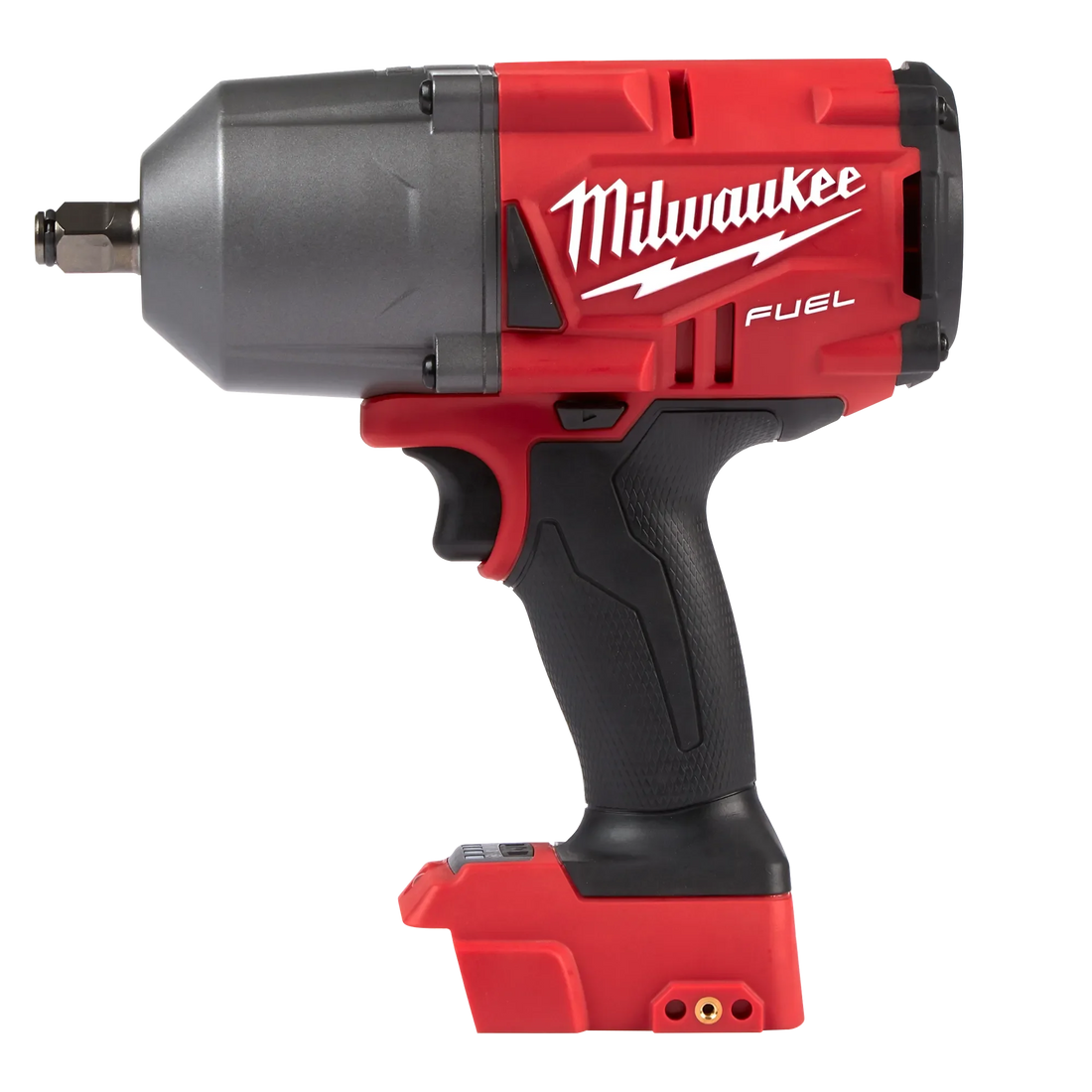
Milwaukee M18 Impact Wrench Won't Remove Lug Nuts? Work Through These 7 Fixes
The Milwaukee M18 can remove lug nuts — but there are exactly seven things that stop it, and most of them take 30 seconds to fix. Start at step 1 and work down. The most common culprits in order: wrong torque mode, a battery that sags under load, and a non-impact socket spinning instead of gripping. If you've got the non-FUEL M18 (models like the 2663-20), there's also a hard ceiling on what it can break loose — and knowing whether you've hit it saves a lot of frustration.
First: Which M18 Impact Wrench Do You Have?
This matters more than anything else on this list. Milwaukee makes two very different 1/2" M18 impact wrenches, and they're not in the same league for lug nuts.
| Model | Line | Mode Dial | Max Loosening Torque |
|---|---|---|---|
| 2663-20, 2664-20 | M18 (non-FUEL) | No | Sufficient for OEM-torqued hardware |
| 2767-20, 2863-20 | M18 FUEL | Yes (4 modes) | 1,400 ft-lbs |
M18 (Non-FUEL): 2663-20, 2664-20
These are solid tools — reliable and more than enough for most fastening work. For lug nuts, they handle standard OEM-torqued hardware without complaint. The problem shows up with overtightened fasteners from a tire shop.
Max loosening torque: sufficient for OEM-torqued fasteners, but limited against heavily overtightened hardware.
No mode dial. One output level. What you see on the spec sheet is what you get.
M18 FUEL: 2767-20, 2863-20
The FUEL line runs brushless motors and delivers substantially more loosening torque. These are purpose-built for automotive use.
Max loosening torque: 1,400 ft-lbs.
The 2767-20 also has a four-mode torque dial — more on that in Fix 1.
Why Lug Nut Torque Is Actually a Problem
OEM lug nut specs for passenger cars typically run 80–100 ft-lbs. Trucks run higher. Those are the correct numbers.
Tire shops routinely hit lug nuts with air guns set well above OEM specs — significantly more than what the spec sheet calls for, as professional mechanics who deal with this regularly can attest. If your lug nuts were last touched at a quick-lube, that's what you're fighting. A non-FUEL M18 loosening spec that falls short of heavily overtightened hardware isn't a bad tool. It's just math.
Fix 1 — Direction Switch and Torque Mode (30 Seconds)
Before anything else: check the direction switch. It has three positions — forward, reverse, and a center detent. That center detent is neutral. If the switch slid even slightly off full reverse, the wrench puts out nothing useful.
M18 FUEL models: The mode dial is where most people leave torque on the table. Mode 1 and 2 are for controlled fastening — deliberately limited output. For removal you need Bolt Removal Mode. That's max loosening mode. If you're not on it, you're not getting everything the tool has.
Non-FUEL M18: No mode dial. Skip to Fix 2.
Fix 2 — Your Battery Is the Weakest Link
This is the most overlooked variable in every forum thread about this problem.
When an impact wrench hits a stubborn fastener, the motor demands a surge of current. A small or worn battery can't deliver that current without the voltage dropping — and when voltage sags, the tool's electronics back off torque output to protect the pack. The wrench bogs, the lug nut doesn't move, and you assume the tool can't do it.
The CP2.0 compact pack isn't built for sustained high-current automotive pulls. A High Output XC6.0 or FORGE XC6.0 delivers more capacity and better cell chemistry under load. The FORGE cells are particularly good at holding voltage when current demand spikes. Swapping from a small or tired pack to a High Output or FORGE pack has broken loose lug nuts the same wrench couldn't move on a compact battery. That's how voltage sag works.
Fix 3 — Use an Impact-Rated, 6-Point Socket
Standard chrome sockets aren't designed for impact use. Under repeated hammer blows they flex, and they're more likely to crack than grip. More practically: a 12-point socket contacts a hex fastener on its corners. Under load, it rounds those corners off before the wrench gives up.
A 6-point impact socket set contacts the flats — six points, full engagement, no rounding. That's the geometry that works on a lug nut.
Most passenger cars use 17mm, 19mm, or 21mm lug sockets, but check your owner's manual or the driver-door jamb sticker for your specific vehicle. Don't guess. For the full breakdown on why socket type matters: impact vs. standard sockets and socket point geometry.
Fix 4 — The Socket Is Falling Off the Anvil Mid-Spin
Symptoms: the wrench runs, the socket wobbles, nothing moves.
Both the 2763-20 and 2767-20 use a friction ring — not a detent pin — to hold 1/2" sockets on the anvil. A worn friction ring loses grip under the snap-reversal load of a high-torque removal pull. The socket holds fine during fastening, where force keeps it seated — then kicks loose when the direction reverses and the impact fires.
If the socket is moving at all when the tool fires, that's your diagnosis. Full breakdown on fix options: how to fix a loose impact socket.
Fix 5 — Extensions and Adapters Kill Effective Torque
Every adapter in the chain — 1/2"-to-3/8", any extension, a universal joint — introduces flex that absorbs energy before it reaches the lug nut. The spec sheet shows torque at the anvil, not at the end of a three-piece stack.
For lug nuts: shortest possible socket, straight drive, no wobble joints. If wheel well clearance forces an extension, use a rigid, impact-rated extension only. Flexible wobble bars and standard extensions not rated for impact use don't belong here.
Fix 6 — Lug Nut Condition: Rust, Damage, or Cross-Thread
Impact wrenches overcome friction. Corrosion adds a chemical bond on top of the mechanical clamp load — and that bond doesn't care how many ft-lbs you throw at it.
If the lug nut is visibly rusted or seized, penetrating oil before the wrench is the right call. Apply it, let it penetrate fully before trying the wrench again. Blasting through corrosion with pure torque usually damages the fastener before it moves it.
A cross-threaded lug nut is a different problem entirely. Torque won't fix it.
Fix 7 — When It's the Tool (Non-FUEL Has a Torque Ceiling)
This is an honest diagnosis, not a fix.
If you have a non-FUEL M18 impact wrench, you're working with a more modest loosening torque ceiling. Against a shop-overtightened lug nut in the 150–300+ ft-lb range, that's a real limitation. The wrench isn't broken — it's just not rated for that job.
The M18 FUEL at 1,400 ft-lbs handles the vast majority of passenger vehicle lug nuts, including most overtightened shop work. If the non-FUEL ceiling is the issue, the M18 impact wrench lineup is where to look for the upgrade.
The other option: a breaker bar with a 24"+ pipe extension breaks the initial lug loose on the first pull, then the impact wrench handles the rest. That's how a lot of professionals approach badly seized hardware anyway. For more on the M18 platform's automotive range: impact wrenches for automotive work.
Frequently Asked Questions
Can the Milwaukee M18 remove lug nuts?
Yes, with the right setup. The M18 FUEL (2767-20 and similar) at 1,400 ft-lbs handles all standard passenger vehicle lug nuts, including most overtightened shop work. The non-FUEL M18 handles OEM torque specs but can lose to heavily overtightened fasteners.
How many ft-lbs do I need to remove lug nuts?
OEM specs run 80–100 ft-lbs for most passenger cars, higher for trucks — confirm yours in the owner's manual. Tire shops commonly apply far more than that with air guns, so your loosening torque needs to exceed whatever was put on. The M18 FUEL's spec clears standard OEM figures with room to spare.
Does battery size affect how much torque my impact wrench makes?
Yes. Small or worn batteries voltage-sag under the high current draw of a stubborn fastener, and the tool's electronics pull back torque output to protect the pack. A High Output or FORGE pack sustains voltage better — sometimes enough to break loose a fastener the same wrench couldn't move on a compact battery.
What size socket do I need for lug nuts with an M18 impact wrench?
Most passenger cars use 17mm, 19mm, or 21mm — confirm your exact size in the owner's manual or on the door jamb sticker. Always use a 1/2"-drive, 6-point, impact-rated socket. Never use a standard chrome socket on an impact wrench.
Why does my impact wrench spin but not loosen the lug nut?
Three most likely causes: (1) the direction switch is in the center neutral detent instead of full reverse, (2) the socket is slipping off the anvil mid-spin due to a worn friction ring, or (3) the lug nut is corroded and needs penetrating oil before the wrench can move it.
My M18 FUEL still won't remove the lug nut — what now?
If you're on max torque mode with a fresh High Output or FORGE battery, a 6-point impact socket, no extensions, and it still won't budge — the lug nut is either corroded or cross-threaded. Soak with penetrating oil and retry. If that fails, a breaker bar with a pipe extension is the next step. The wrench has done what it can.
What's the difference between the M18 and M18 FUEL for lug nuts?
The torque gap. The non-FUEL M18 delivers sufficient torque for OEM-torqued hardware but has limited reserve against heavily overtightened fasteners. The M18 FUEL delivers 1,400 ft-lbs. On OEM-torqued hardware, either works. On shop-overtightened fasteners, that gap is the difference between "might not break it" and "almost always does."
The right socket fixes most of these problems — a 6-point impact socket set covers every common passenger car lug nut size. If the battery is the bottleneck, a High Output XC6.0 or FORGE XC6.0 changes what the same wrench can do. And if the tool itself is the ceiling, head to the M18 impact wrench lineup.