
6-Point vs 12-Point Sockets: Which to Use and When
Choosing between 6-point vs 12-point sockets comes down to two variables: how much grip you need and how much swing arc you have.
A 6-point socket grips on the six flat faces of a bolt — maximum contact, minimum chance of rounding a stuck or high-torque fastener. That's why impact sockets are 6-point. A 12-point socket drops onto a fastener every 30° instead of every 60°, making it faster in tight-swing situations, and it's the *only* socket that fits a 12-point (double-hex) fastener. Compatibility in plain terms: a 12-point socket works on standard hex bolts AND on 12-point fasteners; a 6-point fits hex only. Default to 6-point, add 12-point where access or fastener type demands it.
6-Point vs 12-Point at a Glance
| 6-Point | 12-Point | |
|---|---|---|
| Contact surface | 6 flat faces | Near the corners (standard broach) |
| Repositioning angle | Every 60° | Every 30° |
| Rounding resistance | High — grips the flats | Lower on standard broach; narrows with flank-drive designs |
| Fits standard hex bolt? | Yes | Yes |
| Fits 12-point (double-hex) fastener? | No | Yes |
| Fits square fasteners? | Yes (with correct size) | No |
| Standard for impact use? | Yes | Rarely — specialty only |
| Best for | Stuck bolts, impact work, high torque | Tight swing arcs, 12-point fasteners |
Will It Even Fit? Compatibility First
Before you worry about which socket is "stronger," check whether the socket will seat on the fastener. This is the question most guides bury three sections in.
A 12-Point Socket on a Standard Hex Bolt
Works fine. A 12-point socket seats on any standard hex head — the 12 internal teeth engage both the flats and corners of a hex fastener and it'll turn the bolt. You lose a little grip efficiency at maximum torque compared to a 6-point, but for most everyday turning tasks it's a non-issue. This is why plenty of mechanics run 12-point sets daily without incident.
A 6-Point Socket on a 12-Point (Double-Hex) Fastener
Won't work. A double-hex head has 12 points — picture two overlapping hex patterns offset by 30°. A 6-point socket won't seat correctly on that shape. If you've ever had a socket spin freely on a bolt head without grabbing, you may have been attempting this exact mismatch. You need a 12-point socket or 12-point wrench.
What Are 12-Point Fasteners, and Where Do You Meet Them?
Double-hex heads are less common than standard hex but they're real — and only a 12-point tool will crack them loose. One well-known example is the OEM 12-point driveshaft flange bolt (QU20103) used on Ford F-Series and Super Duty trucks from 1980 through 2018, covering flange-to-axle and flange-to-transfer-case connections on everything from the F-150 through the F-550. They appear on other engine and driveline hardware as well, and are standard in aerospace applications where the extra engagement positions aid assembly in confined spaces. If you're doing European import work with any frequency, a 12-point set earns its place in the tray.
How the Geometry Actually Works
6-Point: Drive on the Flats
A 6-point socket has six sides, each contacting one flat face of the hex fastener. When torque loads up, it spreads across those six flat surfaces — and critically, the force is positioned *away* from the corners. Corners are the weakest part of a fastener head, especially on a bolt that's rusted, over-torqued, or already chewed from a previous fight. Driving on the flats sidesteps the vulnerable edges.
Standard socket geometry and dimensions are governed by ASME B107.110-2019 (Socket Wrenches, Handles, and Attachments), the ASME hand-socket standard.
12-Point: Twice the Positions, Contact Near the Corners
A 12-point socket has 12 internal teeth, so you can drop it onto a fastener at any 30° increment — versus every 60° for a 6-point. That's the real access advantage. In a tight engine bay where the ratchet can only arc a few degrees before hitting something, 12-point means you can always find a seating angle and keep ratcheting without pulling the socket off and repositioning it.
The trade-off is geometry: those 12 teeth contact the fastener nearer the corners than a 6-point does. On a healthy fastener with clean edges, the contact is fine. On a corroded or already-chewed bolt head, corner contact concentrates stress in exactly the wrong place.
The Part Most Guides Miss: Flank Drive vs Corner Drive
Here's what separates a good answer from the right one. The point count tells you *how many* positions you get — it doesn't tell you *where* the socket contacts the fastener. That's the broach geometry, and it matters at least as much as 6 vs 12.
Standard 12-point sockets use a corner-contact broach: under torque, the load goes into the corners of the fastener. That's the design that gives 12-point its reputation for rounding bolts.
Starting in the 1960s, manufacturers began engineering off-corner broaching — sockets designed to shift contact from the corners to the flat faces, regardless of point count. Three names you'll see on quality sockets:
- Snap-on Flank Drive® — the original proprietary design. The socket wall is undercut to grip the fastener on its flats (flanks) rather than its corners, directing force away from weaker corners to stronger flat faces even under high torque.
- GearWrench Surface Drive® — same principle: a 6-point box end with off-corner loading design and a 15° offset moves the load onto the flat surfaces, reducing rounding risk on worn fasteners and delivering up to 25% more torque.
- Wright WrightDrive® — Wright Tool's version, designed to relocate fastener contact load to flat faces instead of corners. The contact length measures 0.057" versus 0.005" for conventional 12-point sockets, a measurable geometry advantage on worn fasteners.
The practical upshot: the difference between a cheap 12-point with standard corner-contact broaching and a quality 12-point with flank/surface-drive broaching is bigger than the difference between 6-point and 12-point point count on quality tools. A good flank-drive 12-point closes most of the gap with a basic 6-point.
That said, a well-made 6-point still has the edge for all-out high-torque and impact work. Six full flat contacts beat twelve partial ones. But the old blanket rule — "6-point is always stronger" — glosses over the fact that broach design is doing most of the heavy lifting.
Why Impact Sockets Are (Almost) Always 6-Point
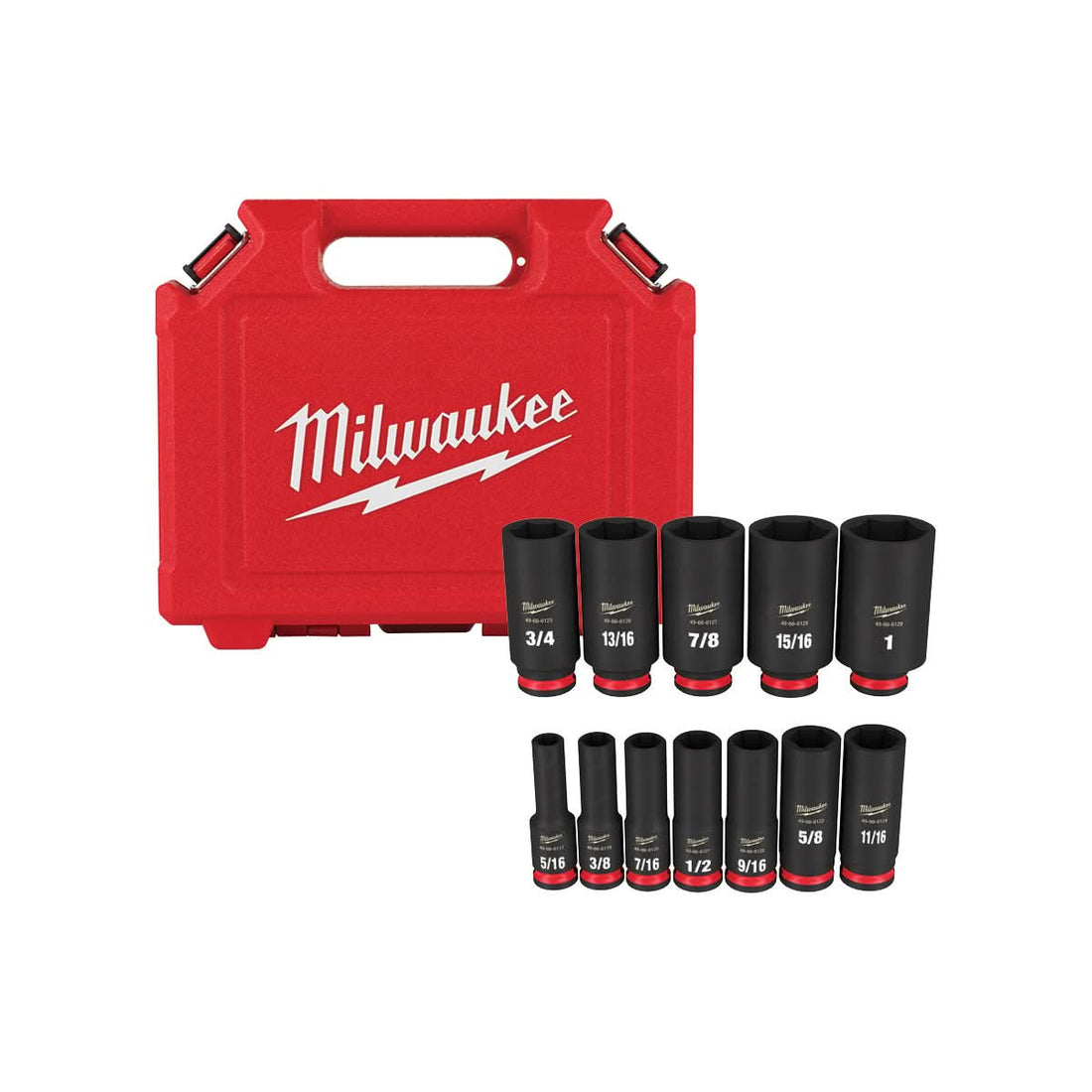
Pull any impact socket from a reputable line — Sunex, Grey Pneumatic, Tekton, or Milwaukee SHOCKWAVE — and it'll be 6-point. Two reasons.
Contact geometry. An impact gun delivers sharp rotational pulses, not a smooth torque arc. Those pulses concentrate force at the contact points. Six flat contacts distribute that shock load without hammering the fastener's corners into soft metal.
Wall thickness. Impact sockets are made from chrome-moly (Cr-Mo) steel — stronger and more shock-resistant than the chrome-vanadium (Cr-V) used in most hand sockets — and they have thicker walls. The 6-point broach works cleanly at those heavier dimensions and tolerances.
12-point impact sockets do exist in specialty sets, but they come with caveats about clean, undamaged fasteners. If you're running an impact gun in general shop use, the rule is 6-point.
One related note: if you're driving impact sockets off a standard impact driver with a hex-shank adapter, check our breakdown of socket adapter failures before putting serious load on that setup.
Which Should You Buy?
The working-pro decision rule is simple.
Start with a 6-point set. For general automotive, mechanical, and construction work — stuck bolts, impact guns, high-torque fasteners — 6-point is the all-rounder. Most mechanics reach for 6-point the majority of the time.
Add 12-point when you need it. Two situations call for it:
1. Tight access where the ratchet can only swing a few degrees and you need to reposition more often. 2. You actually have 12-point (double-hex) fasteners to deal with.
Drive size and depth are separate decisions. Whether you need 1/4", 3/8", or 1/2" drive — and whether you need shallow or deep sockets — has nothing to do with the 6-vs-12 question. Don't let those variables muddy this one. Pick drive size based on torque requirements and clearance. Pick point count based on the fastener type and your swing arc.
For the ratchet that drives these sockets, the drive mechanism and tooth count are what matter next — see our detailed ratchet comparison for the specifics.
When you're fighting a bolt that won't move, the choice between a breaker bar and a torque wrench comes up fast. Our breaker bar vs torque wrench guide covers that decision, and this automotive torque wrench reference shows how to match the right tool to the job once the fastener starts moving.
FAQ
Are 6-point or 12-point sockets better? Neither is universally better. 6-point grips harder for stuck, high-torque, and impact work. 12-point repositions faster in tight spaces and is required for 12-point (double-hex) fasteners. Match the socket to the job.
Can you use a 12-point socket on a 6-point (standard hex) bolt? Yes. A 12-point socket seats fine on any standard hex head and turns the bolt normally. It just gives you twice as many positions to drop onto — handy in tight spots.
Can a 6-point socket turn a 12-point fastener? No. A 6-point socket won't seat correctly on a double-hex head — it'll skip or spin without engaging. You need a 12-point socket or 12-point wrench for those fasteners.
Why are impact sockets always 6-point? Impact guns deliver sharp torque pulses rather than a smooth arc. Six flat-face contacts handle that shock load without hammering the fastener's corners. Impact sockets also have thicker, tougher walls than hand sockets, and the 6-point broach works best at those dimensions.
Do 12-point sockets strip bolts? Standard 12-point sockets are more prone to rounding on soft, corroded, or already-worn fastener heads — because contact points are closer to the corners. A quality flank-drive or surface-drive 12-point largely closes that gap. For any fastener that's visibly chewed, reach for 6-point first regardless.
What are 12-point bolts used for? Double-hex fasteners appear on engine and driveline hardware and are standard in aerospace applications — ARP 12-point head bolts for Cummins B-Series diesel connecting rods, for instance, deliver 23% greater clamping force than factory rods (16,430 ft-lb vs. 13,407 ft-lb at 80% yield). Some European vehicles also use them. If a bolt head looks like two overlapping hex patterns, you need a 12-point tool.
Which sockets do mechanics use most? 6-point for general shop work and anything going on an impact gun — that's the workhorse. Most keep a 12-point set alongside for tight-access jobs and for the double-hex fasteners they encounter. The split is roughly "6-point for force, 12-point for access."
If you're sourcing a ratchet to pair with a new socket set, our ratchet mechanics guide is worth reviewing — the drive mechanism differences matter more than most people expect once you're working in a tight bay.