
Wera Zyklop vs GearWrench 120XP: Which Ratchet Is Actually Worth It?
Short version: GearWrench 120XP is the right buy for most DIYers and occasional wrenchers — 3° arc swing via a dual-pawl 60-tooth design, lifetime warranty, made in Taiwan, street price roughly half of Wera's. Wera Zyklop Speed 8000 earns the premium if you work tight engine bays or close-clearance fasteners, or if tool-time is billable. Both carry lifetime warranties. The critical difference isn't tooth count — it's head profile and pass-through capability. Don't buy on spec-sheet bragging rights; read the model-by-model breakdown and the flat call per job type below.
At a Glance: Wera Zyklop vs GearWrench 120XP
| Spec | Wera Zyklop Speed 8000 A | GearWrench 120XP 81230F |
|---|---|---|
| Drive size | 3/8″ | 3/8″ |
| Tooth count | 72 | 60 (dual-pawl — see below) |
| Effective arc swing | 5° | 3° |
| Mechanism | Single-pawl 72-tooth | Dual-pawl 60-tooth ring |
| Head style | Pivoting/lockable multi-angle | Flex-head |
| Pass-through / hollow drive | Yes (select models) | No |
| Country of origin | Czech Republic | Taiwan |
| Warranty | Lifetime | Lifetime |
*The Zyklop Metal 8100 SB (3/8″) runs 80 teeth at a 4.5° arc swing — tighter swing, higher torque spec, all-metal body. More on that below.*
Prices are not in the table — street prices shift week to week. The Zyklop Speed 8000 A currently runs $87.99; check current retailer listings (Amazon, Home Depot, Acme Tools) for the GearWrench 120XP 81230F, as its price fluctuates with promotions and sales.
What "120XP" Actually Means (It's Not Really 120 Teeth)
How the Dual-Pawl Design Actually Works
GearWrench's branding is legitimate — but the mechanism is not a 120-tooth gear. Here's what it actually is: a 60-tooth ring gear with two pawls sitting offset by exactly half a tooth pitch. Each individual pawl engages every 6°. Because they're staggered by half a step, one catches while the other is in the gap, alternating on each micro-click. Net result: 3° effective arc swing. Solid engineering, used across several professional ratchet lines. Just not the same as a single-pawl 120-tooth mechanism, which would require a much finer — and more fragile — gear ring.
That distinction matters for one practical reason: the dual-pawl design has a documented failure mode under sustained heavy torque. Loosening seized bolts, stuck lug nuts without an impact gun, heavily corroded fasteners — these conditions have produced reports of the second pawl failing to catch cleanly after the first slips, creating a brief free-spin under load. GearWrench's lifetime warranty covers it, and the failure is uncommon in normal use. But working techs who hammer on stuck fasteners regularly should know the design's limits.
What 3° Feels Like on a Real Fastener
Three degrees is tight — and in the right spot, that's actually an advantage. If you have only 4° of handle arc (half a fingertip against a firewall), you get one click with the GearWrench. The Zyklop Speed's 5° might give you nothing. In shallow, flat-access spaces — fuel rail fasteners, a panel tight against a frame rail — the tighter arc wins. The longer-run story on arc swing is in its own section below.
What Wera Zyklop Actually Is (The Model Tree Matters)
Most reviews compare "the GearWrench 120XP" to "the Wera Zyklop" as though each is a single tool. The 120XP line is consistent in mechanism — what changes is head style and drive size. Wera Zyklop splits into three functionally distinct sub-lines.
Zyklop Speed 8000 — The Pivoting-Head Flagship
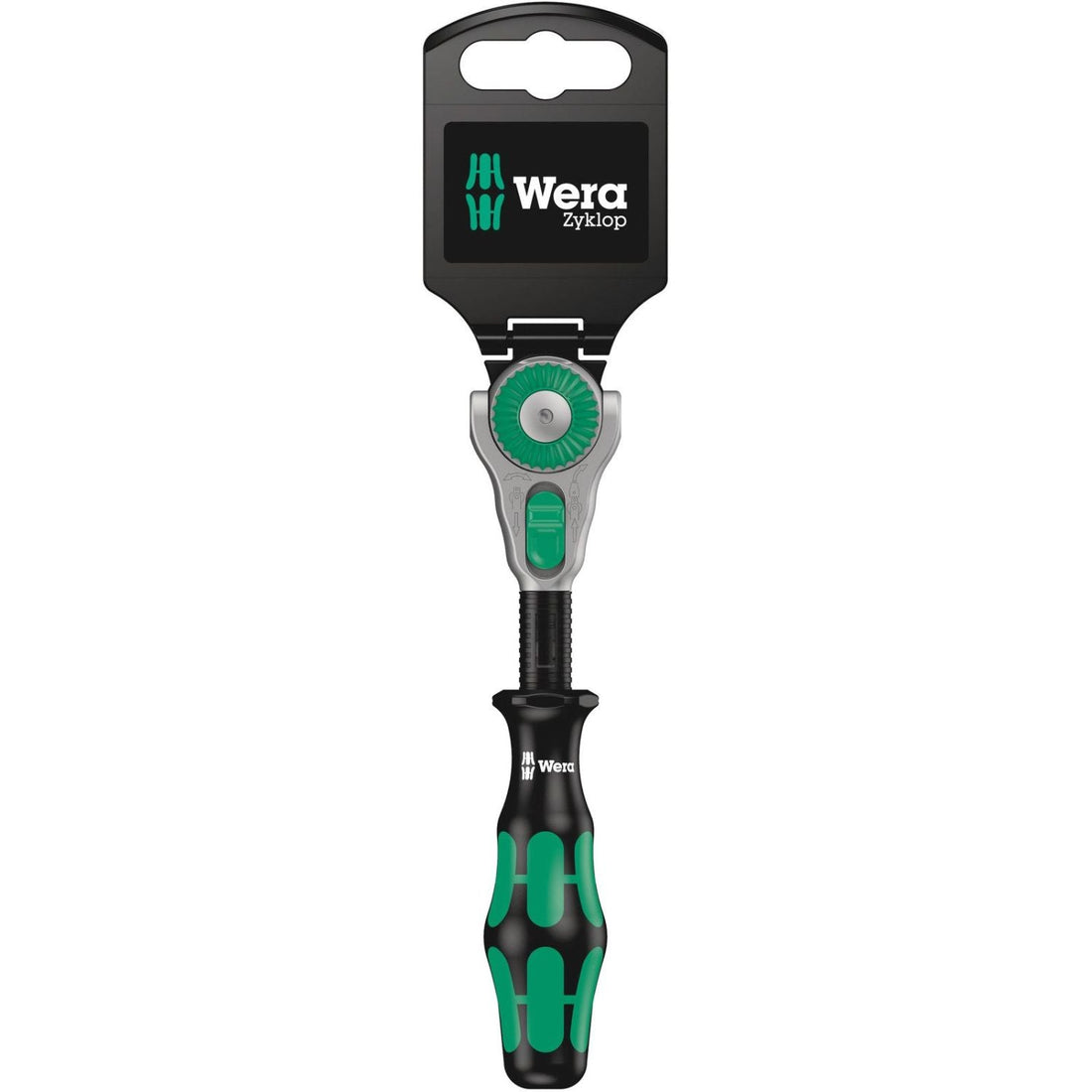
This is the ratchet most reviewers mean. The Speed 8000 A is the 3/8″ model (Wera part 05004016001): 72-tooth, 5° arc swing, pivoting head that locks at multiple angles. That pivot isn't a gimmick — it lets you start a fastener with the head at 90° to the workpiece, then swing to inline for ratcheting. The hollow drive on select Speed 8000 models lets a bolt shank pass through the ratchet body entirely, reaching bolt-plus-stud combinations that no fixed-head ratchet can touch.
Also in the Speed 8000 family: the 8000 B (3/8″ longer handle) and 8000 C (1/2″ drive).
Zyklop Metal 8100 — High-Torque Variant

All-metal construction, no polymer body panels. 80-tooth, 4.5° arc swing. Narrower arc than the Speed 8000 but rated for more torque — designed for situations where you're genuinely pulling hard, not just positioning. The 8100 SA is 1/4″ drive, 8100 SB is 3/8″, 8100 SC is 1/2″. Heavier in the hand, less comfortable for repetitive light work, the better choice when something needs to actually come off.
Zyklop Mini 8009 + Hybrid — Where They Fit
The Zyklop Mini 8009 is the tight-space specialist: shorter body, same pivoting-head concept. Useful for appliance repair or anywhere a standard-length ratchet body won't fit laterally. The Zyklop Hybrid adds a bit-holder to the back — useful in one specific niche (switching between ratchet and screwdriving without setting the tool down), awkward in most others.
*Quick note: Wera also makes Kraftform Kompakt kits — ratchets bundled with bits in a roll or tray. Not in this comparison; that's a different buying decision. GearWrench also makes a 90-tooth line that's mechanically distinct from the 120XP. Not in this comparison either.*
Head Profile & Pass-Through — The Difference No One Talks About
Wera Zyklop Speed's Pivoting Head
This is the single biggest reason a working pro pays the Zyklop premium. When a fastener is buried behind a bracket at 45°, you set the Zyklop head to that angle and ratchet without fighting geometry. The head profile is also noticeably low — less bulk above the socket, which matters when overhead clearance is measured in millimeters. The hollow drive (available on certain Speed 8000 models) adds another dimension: pass a long bolt through the ratchet body and you can torque fasteners in configurations a conventional ratchet physically can't access.
GearWrench 120XP's Flush/Teardrop Head
The 120XP's flush head is a genuine advantage in a specific scenario: tight vertical wells. A nut at the bottom of a deep socket tube, a valve cover bolt recessed into a cavity — situations where the ratchet head protrudes past the socket OD and contacts the surrounding structure. The GearWrench teardrop (81230P pear-head) handles these better than the Zyklop pivot in that exact configuration. No pivot mechanism to catch on anything, no moving parts at the head.
The 120XP flex-head (81230F) adds an articulating joint, but its angle range is more limited than the Zyklop's full lockable pivot. For most DIYers, the GearWrench flex is more than enough.
Does Arc Swing Actually Matter? (3° vs 5°, In Practice)
Numbers: GearWrench 120XP = 3°. Wera Zyklop Speed 8000 A = 5°. Wera Zyklop Metal 8100 SB = 4.5°.
The GearWrench wins in extreme-cramped spots precisely because 3° is tighter — if you have almost no handle arc at all, a 3° ratchet gets you a click where a 5° one doesn't. That situation is real, but it's not the common case.
Where the 5° arc swing on the Zyklop Speed starts to matter is repetitive long-ratcheting work and fatigue. Tighter arc = more individual clicks to rotate a fastener through 360°. A full-time tech running 50 fasteners on an intake manifold in an afternoon notices this. A DIYer doing an annual brake job doesn't. If you're in the first group, the Zyklop's wider swing reduces hand fatigue over a full day.
Which Is Better Built — and Does Country of Origin Matter?
Steel and Finish
Both ratchets use chrome-vanadium steel. GearWrench specs the 120XP line as heat-treated CR-V — standard for quality hand tools at this price point. Wera doesn't publish alloy grade in accessible spec sheets, but their machining tolerances on the Zyklop line are tighter than most CR-V production tools. The polish and the smoothness of the ratchet head motion are the tell: the Zyklop feels more precisely machined, less stamped.
The Zyklop Speed bi-material handle absorbs vibration and the grip geometry rotates the ratchet to center your hand on each stroke. That's a real ergonomic feature for sustained use, not marketing copy. The GearWrench handle is comfortable and well-shaped — just conventional.
Country of Origin
Wera Zyklop ratchets are made in the Czech Republic, at Wera's facility in Bystřice nad Pernštejnem. Some other Wera hand tools are made in Germany.
GearWrench 120XP ratchets are made in Taiwan. GearWrench is a brand under Apex Tool Group.
Taiwan manufacturing is not a quality signal by itself. Some of the most precise professional hand tools sold in North America — portions of the Snap-on accessory line, much of Proto's catalog — come from Taiwanese factories. Country of origin tells you less than who's designing and spec'ing the tool. Don't let it decide the purchase.
Warranty, Service, and Real-World Failure Modes
Both Are Lifetime — What That Actually Covers
Both Wera and GearWrench offer lifetime warranties on their ratchets. Wera's Limited Lifetime Warranty covers defects in materials and workmanship, excluding abuse, misuse, negligence, improper storage, and consumable items. GearWrench's lifetime warranty covers manufacturing defects, excluding normal wear, abuse, and unauthorized repairs.
"Lifetime" on a hand tool typically means defects in materials and workmanship, covered for the product's service life. It generally does not cover abuse damage: over-torquing, impact use, dropped-and-bent. GearWrench warranty claims run through Apex Tool Group; replacement availability through major retailers (Home Depot, Acme Tools) is broad. Wera North American warranty claims go through their US distribution channels — slower process, but they honor them.
Known Failure Modes
The 120XP's dual-pawl mechanism can skip under heavy sustained torque. This shows up repeatedly in trades forums — r/MechanicAdvice, r/Tools — in accounts of loosening seized fasteners. The second pawl fails to catch after the first slips, producing a brief free-spin under load. Not universal, not common in normal use, covered under warranty. But if your work involves routinely breaking loose stuck fasteners without an impact gun, you should know this.
The Zyklop Speed's pivot lockout loosens on some units after extended high-use at non-90° head angles — not a structural failure, a slop issue that develops gradually. The Metal 8100 doesn't have this problem (fixed head). If you buy a Speed 8000 for primarily fixed-head ratcheting, you may never notice it.
Price — Is Wera ~2× Worth It?
Street-Price Snapshot
At the time of writing, the Zyklop Speed 8000 A (3/8″) runs roughly 1.8–2.2× the price of the GearWrench 120XP 81230F, depending on retailer and current promotions. The Zyklop Speed 8000 A currently streets for $87.99; the GearWrench 120XP 81230F is priced considerably lower — check current retailer listings (Amazon, Home Depot, Acme Tools) for the latest figure, as promotions move it regularly.
Both go on sale. If you're patient, the gap narrows somewhat.
Cost-Per-Year Math
A full-time automotive tech doing 40+ billable hours a week: if the Zyklop's pivoting head saves 5 minutes per day on repositioning fasteners, that's roughly 20 hours a year recovered. At even a modest shop rate, the ratchet pays for itself inside the first month. The math is clear.
A DIYer doing two brake jobs and an oil change per year: the pivoting-head advantage is basically never triggered in those jobs. The 120XP does everything you'll ask it to do. Spend the price difference on a good socket set.
Which One Should You Buy?
DIYer / Weekend Wrencher
GearWrench 120XP 81230F. It does 95% of what the Zyklop does. The 3° arc swing is legitimately excellent for tight work. Spend the price difference on sockets. If you want one flex-head 3/8″ ratchet and you're not on a paycheck, this is the call.
Automotive Tech / Full-Time Mechanic
Wera Zyklop Speed 8000 A. The pivoting head and slim profile pay for themselves on jobs where head clearance is the binding constraint — and if you work in modern engine bays, that's not an edge case. If you also do high-torque work regularly (pulling seized components, serious final-torque on structural fasteners), consider adding a Zyklop Metal 8100 SB alongside it. The fixed all-metal head holds under load better than the Speed 8000's pivot-body design.
HVAC / Plumbing / Appliance Repair (Tight-Space Work)
Split call, depends on the specific access problem. Deep vertical wells with minimal radial clearance: the GearWrench 120XP teardrop (81230P) head actually clears better than the Zyklop Speed pivot head in that exact geometry. Diagonal or obstructed-angle access: the Zyklop Speed wins. If both come up regularly in your work, you eventually own both — which is a real answer, not a dodge.
Already Own Good Ratchets, Looking for a Second Set
Don't buy a second 3/8″ drive ratchet of the same head style. If you want the Zyklop for tight-space access specifically: buy the Zyklop Mini 8009 rather than a duplicate Speed 8000 A. If you're adding small-fastener capability: GearWrench 120XP 81210P (1/4″ drive) is the add.
FAQ
Is Wera Zyklop worth the money?
For a working tech, yes — the pivoting head and pass-through drive save real time in tight engine bays. Those are job-type features, not brand-loyalty features. For a DIYer doing occasional maintenance, a 120XP handles the same jobs for roughly half the price. The premium is real and earned; it just only pays off if your work triggers it.
How many teeth does the Wera Zyklop have?
Depends on the model. The Zyklop Speed 8000 A (3/8″) is 72-tooth, 5° arc swing. The Zyklop Metal 8100 SB (3/8″) is 80-tooth, 4.5° arc swing. Tooth count is not the reason to buy a Zyklop — the pivoting head and hollow drive pass-through are.
Is the GearWrench 120XP really 120 teeth?
Effectively yes, mechanically no. It's a 60-tooth ring gear with two pawls staggered by half a tooth. Each pawl engages every 6°, alternating, for a 3° effective arc. That's the same practical result as a true 120-tooth ratchet — just a different mechanism to get there.
Where are Wera Zyklop ratchets made?
Czech Republic — specifically at Wera's factory in Bystřice nad Pernštejnem, where manufacturing was relocated in 1995. Some other Wera hand tools are made in Germany.
Where are GearWrench 120XP ratchets made?
Taiwan. GearWrench is part of Apex Tool Group.
Do GearWrench 120XP ratchets have a lifetime warranty?
Yes. GearWrench offers a lifetime warranty on 120XP hand tools through Apex Tool Group — the warranty is non-transferable and applies to the original end-user purchaser.
Wera Zyklop vs Snap-on — is Wera as good?
Different tools, not really comparable on the same axis. Snap-on's flagship ratchets (Dual 80 Technology line) compete on tooth count and swing arc from a fixed head. Zyklop competes on head versatility — the pivoting head and hollow drive are features Snap-on's standard line doesn't offer. Both are pro-tier. Buy by feature, not brand: if the pivot matters, Snap-on doesn't have it. If you want a precise fixed-head ratchet with an exceptional swing arc, Snap-on Dual 80 is a real option.
Which Wera Zyklop should I buy first?
Zyklop Speed 8000 A — the 3/8″ model. It covers the most use cases and the pivoting head is the feature that makes the line worth buying. That's the one to get.
Both of these are genuinely good ratchets. The 120XP punches well above its price. The Zyklop Speed earns its premium if you actually need what it does.
If you're building out a premium hand-tool kit, these comparisons are in the same vein: Klein vs. Wera insulated screwdrivers covers the Wera vs. value-brand question for screwdrivers; adjustable wrench comparison does the same for adjustable wrenches; and professional pliers for electricians for pliers. If you're using any ratchet under impact-style torque loads, why socket adapters break under impact explains why socket adapters fail under that kind of stress.
*Tool Army does not sell Wera or GearWrench products. This is an editorial comparison — no affiliate pressure, no money page.*