
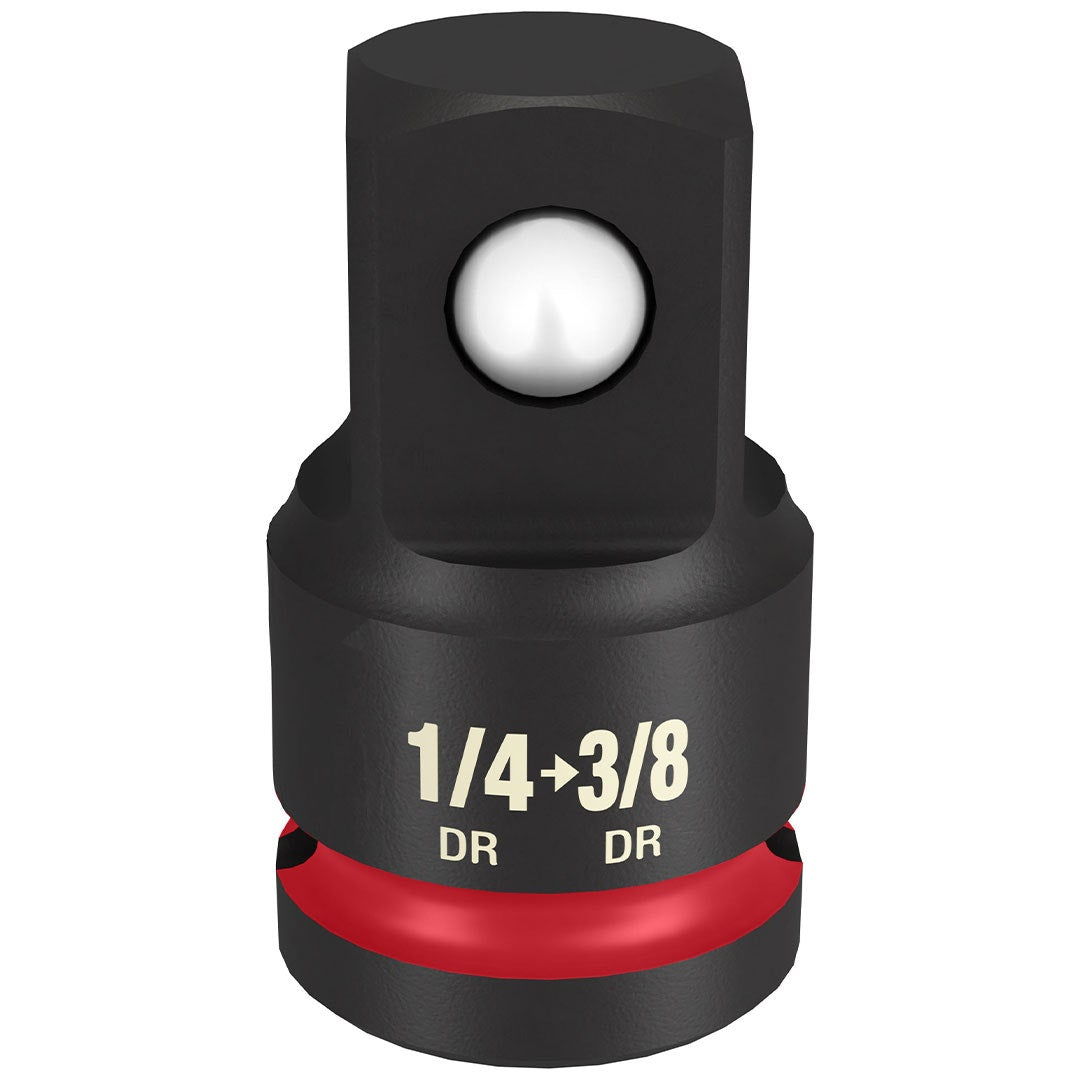
Why Impact Driver Socket Adapters Break — and What to Use Instead
Impact driver socket adapters snap because the hammer-and-anvil mechanism doesn't deliver smooth, continuous torque — it fires rapid torsional *shock* pulses. Standard Chrome Vanadium (Cr-V) steel handles steady rotational load fine, but under that kind of impact it doesn't flex — it cracks.
The break almost always happens at the hex-to-square junction: the point where the 1/4" hex shank steps up to the larger square drive post is the narrowest cross-section under the most stress.
The fix is an impact-rated (Cr-Mo) adapter — but if you're driving lug nuts or large structural bolts with a 1/2" drive adapter in an impact *driver*, the adapter isn't the real problem. The tool is.
The real reason it snapped (it's not a defective adapter)
Impact drivers hit with shock, not just torque
A standard drill/driver spins. An impact driver stacks an internal hammer-and-anvil mechanism on top of that rotation — firing discrete torque pulses measured in IPM (impacts per minute). The Milwaukee M18 FUEL 2853-20 reaches up to 4,300 IPM with a peak torque of 2,000 in-lbs. The DeWalt DCF887B runs comparably, delivering up to 1,825 in-lbs of peak torque.
Each of those pulses is an abrupt torsional shock — not a smooth push. That's the load a standard Cr-V adapter was never designed to absorb.
Where it always snaps — the hex-to-square stress riser
The 1/4" hex shank is the universal entry point for every impact driver chuck. The square drive post — 3/8" or 1/2" — is rigidly attached to it. At the junction between them you've got the smallest cross-section of material under the highest torsional load: a textbook stress riser.
The worst setup is a 1/4"→1/2" adapter. The square drive is twice the diameter of the hex shank, making the geometry change abrupt and severe. Under impact shock, that junction is where the break happens — every time, not occasionally.
Cr-V vs. Cr-Mo — what the steel actually does
Chrome Vanadium (Cr-V): Hard and strong under steady torque. Brittle under shock — it doesn't flex, it fractures. Most non-rated adapters use it — Chrome Vanadium Steel turns up on non-impact adapter listings (no impact rating claimed), and many others won't list the material at all. In either case, absence of an "impact-rated" label is the real tell.
Chrome Molybdenum (Cr-Mo): Slightly softer, far more ductile — it flexes under an impact pulse and recovers rather than cracking. Every legitimate impact-rated adapter uses it; look for Cr-Mo or impact-grade steel called out explicitly in the product specs before buying.
The same failure mode that snaps adapters breaks impact bits too — our impact driver bit failure guide walks through how Cr-V shanks fail under the same torsional shock.
The drive-size problem — when the adapter isn't the real issue
Impact drivers are built for hex-head fasteners: structural screws, lag bolts, smaller machine bolts. They weren't designed for lug nut removal, large structural connections, or rusted fasteners that need real socket torque.
The size ladder tells the story:
| Adapter size | Stress level | Appropriate use |
|---|---|---|
| 1/4" hex → 1/4" square | Lowest | Light socket work, impact-rated adapter fine |
| 1/4" hex → 3/8" square | Moderate | Medium fasteners, impact-rated adapter handles it |
| 1/4" hex → 1/2" square | Highest | Light socket work only — heavy torque needs a dedicated impact wrench |
If you're chasing lug nuts or large structural bolts through a 1/2" adapter in an impact driver, you haven't bought a bad adapter — you're using the wrong tool. The fix there isn't a better adapter; it's a 3/8" or 1/2" impact wrench built for socket work on your platform.
What to use instead — three tiers
Impact-rated socket adapters (what to look for on the label)
When an adapter is the right format for the job, buy the right one. Before you click anything:
- Must say "impact-rated" or "for use with impact tools" — not just "for drills and drivers"
- Cr-Mo construction called out in the specs — if the material isn't listed, assume it isn't impact-rated
- Torsion zone or flex zone in the shank — some impact-rated adapters include a dedicated flex section that absorbs torsional shock before it reaches the hex-to-square junction; look for this called out in the product description
- Spring-loaded ball-detent retention on the square drive — stops sockets from flying off under impact
- Smallest drive size that covers your sockets — don't default to 1/2" if 3/8" handles your whole set
Hex-shank socket bits — no adapter, no failure point

For smaller fasteners — nuts and bolts up to roughly 3/4" hex — skip the adapter entirely. 1/4" hex shank socket bits go straight into the impact driver chuck: no adapter, no hex-to-square junction, no stress riser to crack.
A magnetic bit holder keeps them seated and stops them from dropping mid-job — it fits Milwaukee and DeWalt impact drivers and works with any 1/4" hex shank bit. Worth adding to your kit if you're doing light socket work on a regular basis.
Honest limitation: hex-shank socket bits don't cover every socket size, and they're a lighter-duty format. For serious socket work, the impact wrench is still the right answer. If you're sorting out which shank format is right for your whole bit setup, our shank compatibility guide covers the full compatibility breakdown.
Are your sockets impact-rated? (Most people miss this)
Here's a failure mode that bites people even after they buy a proper impact-rated adapter: regular chrome sockets are also Cr-V steel. Same brittleness, same cracking risk under impact shock.
Impact-rated sockets use a black oxide finish — that's the standard visual tell across the industry. Standard chrome sockets are silver.
Upgrade the adapter but leave the chrome sockets in, and you've fixed half the problem.
Quick checklist before you buy a replacement adapter
- [ ] Does it explicitly say "impact-rated" — not just "for drills and drivers"?
- [ ] Does it list Cr-Mo construction in the specs?
- [ ] Does it have a torsion zone or flex zone in the shank?
- [ ] Is the drive size the smallest one that covers your socket set?
- [ ] Are your sockets also impact-rated (black oxide finish, not silver)?
- [ ] Breaking lug nuts or large structural bolts? → You need an impact wrench, not an adapter.
For the broader picture on what bits and accessories actually hold up in an impact driver, our impact driver bit guide is the right hub — and if you're running hole saws, our hole saw arbor compatibility guide covers the same compatibility logic applied to arbors.
FAQ
Can you use a regular socket adapter with an impact driver?
Technically yes, but standard Cr-V adapters aren't rated for impact shock and will eventually snap — almost always at the hex-to-square junction. Use an adapter explicitly labeled "impact-rated."
What is an impact-rated socket adapter?
One made from Chrome Molybdenum (Cr-Mo) steel, which is ductile enough to flex under torsional shock and recover rather than crack. Look for "impact-rated" on the label — not just "for drills and drivers."
Why does my socket adapter keep slipping or popping off?
The ball-detent — the spring-loaded ball that locks the socket onto the square drive — wears faster under impact shock than under steady rotation. Impact-rated adapters use a more robust detent. Also check that the socket's drive size matches the adapter's square drive precisely; a loose fit accelerates wear.
What's the difference between an impact driver and an impact wrench?
An impact driver has a 1/4" hex chuck and is built for driving fasteners with hex-shank bits. An impact wrench has a square drive (3/8" or 1/2") and is built for socket work on larger fasteners like lug nuts. Using a driver with a socket adapter for wrench-level torque is the most common cause of adapter failure.
Do I need impact-rated sockets too, or just an impact-rated adapter?
Both. Regular chrome (Cr-V) sockets can crack under impact shock even with a proper impact-rated adapter. Impact sockets have a black oxide finish; standard chrome sockets are silver. Always pair them.
What size socket adapter fits an impact driver?
All impact drivers use a 1/4" hex chuck. Adapters step that up to 1/4", 3/8", or 1/2" square drive. Use the smallest drive size that covers your socket set — the 1/4"→1/2" adapter puts the most stress on the 1/4" shank and is the most failure-prone setup.
For Milwaukee M18 and DeWalt 20V users building out a bit and socket kit, our accessories pages are sorted by platform so you're only looking at gear that fits your tools: Milwaukee collection or DeWalt collection. And if hex-shank socket bits are part of that kit, a magnetic bit holder is worth keeping on the belt — no dropped bits, no fumbling at height.