
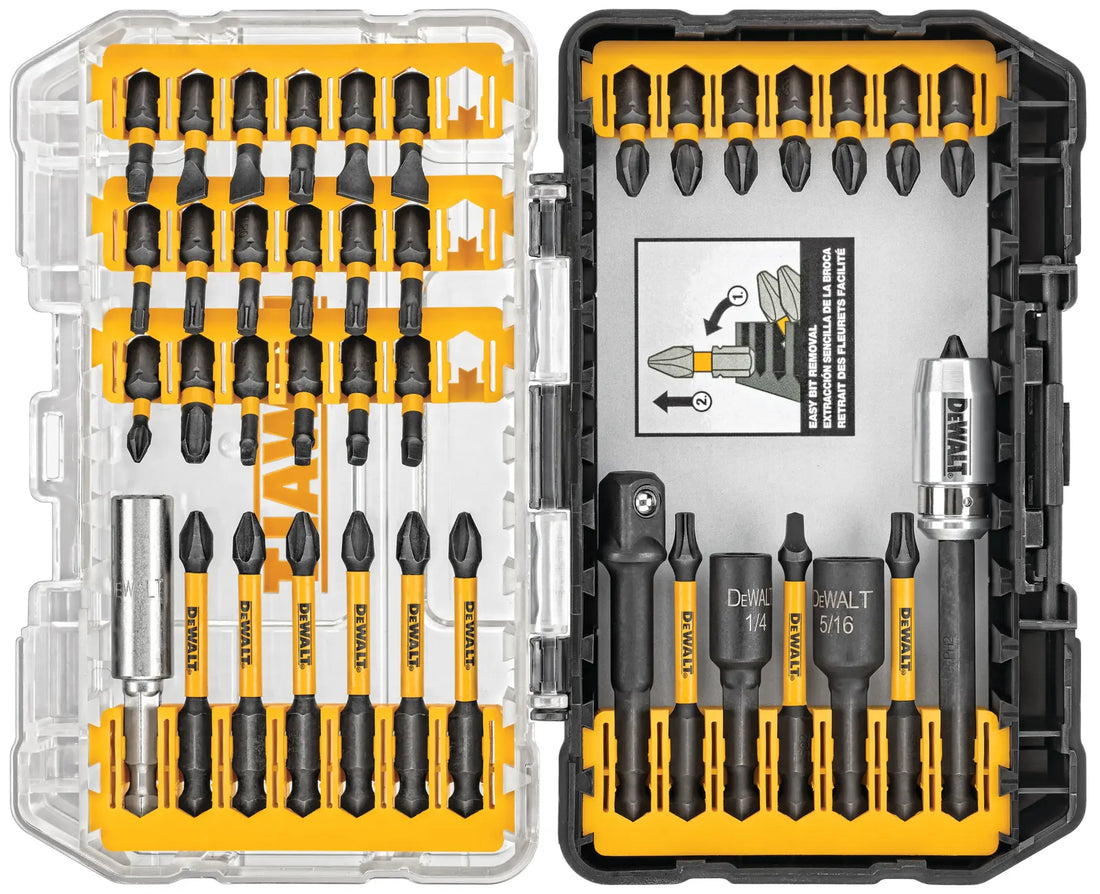
Why Impact Driver Bits Break (and the $12 Fix Most People Skip)
Impact driver bits break for two reasons: they're not rated for impact driving, or the connection between the driver and the bit is rigid — so every concussive burst transfers full torsional shock directly into the bit with nowhere to go. A drill bit in an impact driver will snap fast. Even a quality impact-rated bit will fail early when locked into a solid metal holder. Before you buy a new bit set, check whether your bits have a torsion zone and whether you're running a magnetic flex holder. One of those two things is almost always the problem.
How an Impact Driver Is Actually Hard on Bits
An impact driver doesn't apply continuous torque the way a drill does. It fires rapid concussive rotational bursts — the mechanism hammers the anvil in pulses, which is how it drives long screws into hardwood without stripping them. That hammering action is also why it's brutal on bits.
Why That Mechanism Destroys Non-Impact Bits
Standard drill/driver bits are made to handle bending stress — the kind you get pushing a bit straight into wood or metal with steady rotation. Concussive torsional loads are different. Each pulse sends a shockwave through the bit shank. Bits that aren't engineered for this cycle fail at the point of highest stress concentration: the hex shank, right where it seats in the holder.
The Two Failure Modes
There are two ways a bit fails, and they have different causes:
| Failure | Where It Breaks | Root Cause |
|---|---|---|
| Snap at the shank | Hex shank or just above it | Wrong bit spec — steel too brittle for torsional shock |
| Strip at the tip | Drive tip rounds out | Bit tip too soft, or bit not fully seated (cam-out) |
Snapping is a bit-spec problem. Stripping is usually a tip-hardness or seating problem. Don't confuse them — the fixes are different.
What "Impact-Rated" Actually Means on the Spec Sheet
"Impact-rated" is not a regulated term. Any manufacturer can print it on a package. So what actually separates a real impact bit from a drill bit with marketing copy?
The torsion zone. A genuine impact-rated bit has a machined section on the shank — slightly narrowed or shaped — designed to flex under load before stress reaches the tip. Think of it as a built-in shock absorber. When the impact mechanism fires, the torsion zone deflects slightly, dissipating energy instead of concentrating it at the tip or shank.
Milwaukee calls theirs "Shockwave" geometry. DeWalt calls it "FlexTorq." Different names, same principle. If a bit doesn't have a visible torsion zone or the packaging doesn't describe flex geometry, it's not a real impact bit — regardless of what the label says.
The steel alloy and heat treatment also differ. Impact bits are engineered to flex before fracturing — not hardened-brittle like masonry bits. The goal is controlled flex, not maximum rigidity.
The Six Reasons Your Bits Keep Breaking
1. Using drill/driver bits in an impact. The most common reason. Drill bits use a steel spec too brittle for concussive torsional loads. They'll snap, often on the first heavy drive. Only use bits labeled "impact-rated" or "impact-ready" in an impact driver.
2. Running a rigid metal holder with no flex. Even a quality impact bit can fail early when locked solid with no compliant connection. A rigid holder passes every hammer pulse directly into the bit. A magnetic flex bit holder adds a small amount of give that absorbs shock before it concentrates at the shank.
3. Too much torque for the fastener size. High-torque impacts on small fasteners overtorque immediately. Use clutch modes or electronic torque control for smaller screws. Not every fastener needs full hammer-on.
4. Bit not fully seated. Partial seating multiplies the shear force at the hex shank. The bit should click fully into the holder before you drive. If it's rattling loose, reseat it.
5. Side-loading the driver. Driving at an angle puts bending stress on top of torsional stress — the worst combination. Keep the driver straight to the fastener axis.
6. Cheap bits marketed as impact-rated without a real torsion zone. The tip looks the same. The packaging says "impact ready." But without the flex geometry, it's a standard bit in different packaging. Check for the visible narrowed section on the shank before you buy.
Fix the Holder Before You Buy New Bits

Most people go straight to buying a premium bit set. That's often the wrong order of operations.
If you're running a rigid hex chuck or a basic metal bit holder, try a magnetic flex bit holder first. It adds a compliant connection between the driver output and the bit. The holder's flex zone absorbs a portion of the concussive shock before it reaches the bit — which extends bit life and makes it easier to stay on axis with the fastener.
The Magnetic Silicon Bit Holder fits both Milwaukee M18 and DeWalt 20V MAX impact drivers — any 1/4" hex drive. It's cross-platform. If you're running either system, you don't need two holders.
If bits are still breaking after switching to a flex holder *and* confirming you're using properly impact-rated bits — then it's a bit-spec or technique issue. For specific bit picks, see the impact driver bit guide.
Milwaukee M18 and DeWalt 20V MAX — Platform Notes
Both platforms use the standard 1/4" hex shank. Any impact-rated 1/4" hex bit works in both. That's the easy part.
The harder part: higher-torque drivers are more demanding on bits, not less. The Milwaukee M18 FUEL 1/4" Hex Impact Driver (2853-20) delivers up to 2,000 in-lbs of torque, while the DeWalt 20V MAX XR Impact Driver (DCF887) puts out up to 1,825 in-lbs — significantly more concussive force than compact or mid-range models produce. If you've upgraded to a FUEL or XR driver, the bit-holder flex matters *more*, not less.
If you're running a mid-range M18 or DeWalt 20V MAX compact and noticed bit life drop after upgrading to a FUEL or XR model — this is why. The tool got meaner. The bits and holder need to match.
For more on the torque difference between M18 compact and FUEL tools, see the M18 FUEL guide. For platform selection, learn how M12 and M18 systems differ beyond just bit compatibility.
Frequently Asked Questions About Impact Driver Bits
Can you use regular drill bits in an impact driver? Technically yes — most impact drivers accept any 1/4" hex shank — but you shouldn't for anything beyond the lightest tasks. Drill bits use a different steel spec that's brittle under concussive torsional loads. They'll snap, often quickly. Use only bits labeled "impact-rated" or "impact-ready."
How do I stop my impact driver bits from cam-out (stripping the screw head)? Cam-out happens when the bit tip is too soft or the bit isn't fully seated. Make sure the bit clicks fully into the holder before driving. For hardwood or high-torque applications, use a tip optimized for the drive type — ACR Phillips holds better than standard Phillips under high torque, and Torx eliminates cam-out entirely where the fastener allows.
What is a torsion zone on an impact bit? A torsion zone is a machined section on the bit shank — slightly narrowed — designed to flex under load before stress reaches the tip. It acts like a built-in shock absorber. Without one, the full concussive force goes straight to the tip or shank, which is why the bit snaps or strips.
Does a magnetic bit holder help prevent breakage? Yes, meaningfully. A flex-style magnetic bit holder adds a compliant connection between the driver and the bit, absorbing some of the concussive shock. It won't save a non-impact-rated bit in heavy-duty work, but it extends bit life on impact-rated bits and is usually the first fix worth trying before buying a premium bit set.
What's the best bit length for impact driving? Shorter 1-inch insert bits are stiffer and better for high-torque applications where precision matters. Longer 2-inch bits flex more, which can help in moderate-torque work but can wobble and cause cam-out under high torque. Match length to the application and torque class of your driver.
Why do my impact bits break at the shank? Shank breakage is almost always a spec problem — the bit isn't rated for impact use and the steel is too brittle for torsional shock cycles. Switch to impact-rated bits with a real torsion zone. Also confirm the bit is fully seated; partial seating multiplies shear force right at the hex shank.
Do Milwaukee M18 and DeWalt 20V MAX impact drivers use the same bits? Yes. Both use the standard 1/4" hex shank. Impact-rated bits and bit holders designed for 1/4" hex are fully cross-platform compatible. The magnetic bit holder stocked at Tool Army fits both systems.
Most bit failures come down to one of two things: wrong bit spec or a rigid connection that has no way to absorb shock. That's a $12 fix or a technique fix — not a $50 bit set upgrade. If you're running a Milwaukee M18 or DeWalt 20V MAX, start with the Magnetic Silicon Bit Holder. If you still need bit picks after that, the impact driver bit guide has you covered.
Browse accessories for your platform: Milwaukee | DeWalt
Image credits
- "every picture tells a story" by ndrwfgg — licensed under CC BY 2.0 · via Flickr
- "Wall Mount Hex (Allen) Impact Bits" by Matthew Young — licensed under CC0 · via Thingiverse