
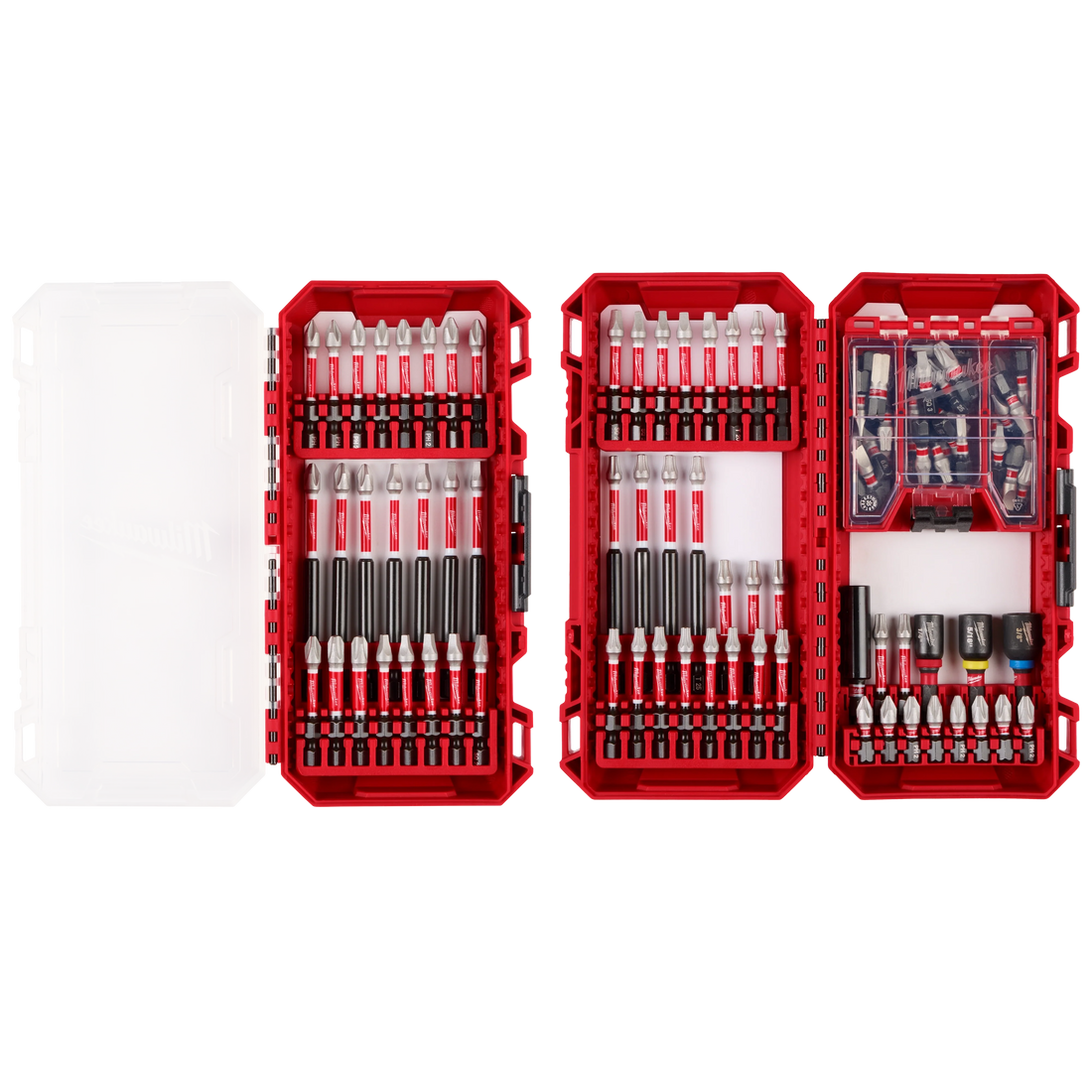
Best Impact Driver Bits for Milwaukee M18 and DeWalt 20V Drivers
The best impact driver bits have a torsion zone — a flex point along the shank that absorbs the rotational hammering pulse of an impact driver. Standard screwdriver bits are rigid steel all the way through; they concentrate stress at the tip and snap or strip fastener heads fast. For most Milwaukee M18 and DeWalt 20V MAX users, a 1/4-inch hex set covering #2 Phillips, #2 Square/Robertson, and T25 Torx in both 1-inch insert and 2-inch power-bit lengths handles 90% of fastening work. What separates a good set from a waste of money is steel grade, tip geometry, and an impact rating that actually means something.
What Makes a Bit "Impact-Rated" — and Why It Matters for Your Driver
Torsion Zone vs. Standard Bit: The Failure Mode
A standard screwdriver bit is hardened all the way through. Put that in an impact driver and the hammering pulse has nowhere to go except the tip, which either snaps off or tears up the fastener head. An impact-rated bit has a torsion zone — a section of the shank machined to be slightly softer and narrower than the rest. Think of it like a crumple zone in a car: it flexes to absorb the hit so the tip stays intact and seated.
That's the whole game. A bit without a torsion zone will fail faster in an impact driver regardless of how expensive the set is.
Steel Grades You'll See on Packaging
Three materials show up most often:
- S2 tool steel — hard and tough; Milwaukee's Shockwave line uses Custom Alloy76™. The tip hardness grips the fastener, and the shank is processed to allow flex without brittleness.
- S45C carbon steel — a mid-grade carbon steel used in many budget and mid-tier bits. Less wear-resistant than S2 under sustained impact torque.
- Chrome-vanadium (CrV) — common in screwdriver sets not designed for impact use. Fine for hand tools, not the right choice in an impact driver.
DeWalt's FlexTorq line is made from Alloy Steel. Whatever the exact grade, the design goal is the same — controlled flex in the shank, hard tip.
If a set's packaging doesn't list steel grade or mention impact rating, treat it as S45C at best.
Tip Geometry — Why a Machined Tip Matters
A cheap Phillips tip is stamped, not machined. Tolerances are loose. The first time you drive a hundred screws, the flanges round off and you're camming out constantly. Look for tight, sharp geometry on #2 Phillips especially — it's the fastest-wearing profile and the one where tip quality shows up immediately.
Which Shank and Length for Your Driver
1/4-Inch Hex Is Universal — But Check Your Chuck's Magnet
Every Milwaukee M18 and DeWalt 20V MAX impact driver uses a 1/4-inch hex chuck — confirmed across the Milwaukee 2853-20, the DeWalt DCF887, and the DeWalt DCF850. There is no compatibility problem between a Milwaukee bit and a DeWalt driver, or vice versa. The shank standard is universal.
What does vary is chuck magnet strength. Higher-torque drivers — the M18 FUEL 2853-20 at 2,000 in-lbs and the DeWalt XR DCF887 at 1,825 in-lbs — generate enough rotational force that a weak chuck magnet lets the bit shift under load. The DeWalt ATOMIC DCF850 at 1,825 in-lbs runs at comparable torque, and the principle holds across the board.
Insert Bits (1 Inch) vs. Power Bits (2 Inch) vs. Extended
- Insert bits (1 in / 25 mm): Designed for quick-change bit holders. Short and fast to swap. Not ideal seated directly in the chuck — the short shank limits torsion flex.
- Power bits (2 in / 50 mm): The better default for impact driver use. More shank length means more torsion zone to work with. Better retention in the chuck. This is what you want for most driving tasks.
- Extended (3–6 in): For driving into tight or deep spaces — countersinking lag bolts through deep framing, decking in hard-to-reach spots, or overhead work where you need clearance. Buy these individually for specific jobs, not as part of a general set.
If you're doing general work, load up on 2-inch power bits and use a bit holder for your insert bits.
What a Magnetic Bit Holder Adds
A magnetic bit holder solves two real problems: bit retention when your chuck magnet isn't strong enough to hold at full torque, and the ability to pre-load a screw on the bit for one-handed work overhead. For anyone running 1-inch insert bits directly in the chuck, it's not optional — the bit will walk.
The Magnetic Silicon Bit Holder we stock fits both Milwaukee M18 and DeWalt 20V chucks (1/4-inch hex, universal). Per the product listing: "fits most drill and impact brands including latest generations of Milwaukee and DeWalt." It's one of the cheaper upgrades in your kit and it makes any bit set work better.
Bit Types by Fastening Job
Match the bit to the task. This is where most DIYers leave performance on the table.
| Job | Bit type | Why |
|---|---|---|
| Framing / structural screws | #2 Phillips or #2 Square, 2-inch power bit | High torque demands torsion flex; redundancy in your set matters here |
| Decking / exterior | T25 Torx | Centered engagement — no cam-out at high torque; driver tip lasts significantly longer |
| Cabinet / furniture assembly | #2 Square/Robertson | More cam-out resistant than Phillips for controlled, lower-torque work |
| Self-tapping metal screws | #2 Phillips or T20/T25 | Match the screw head exactly; wrong size destroys the head fast |
| Lag bolts / hex-head | 1/4-inch hex-to-socket adapter | Bits aren't the right tool here; use an adapter with the correct socket |
On Torx/Star: Decking pros switched to T25 Torx for a reason. The star profile engages on six surfaces simultaneously. Under the torque of an M18 FUEL or DeWalt XR driver, that centered engagement means the driver tip stays in the fastener head instead of skipping out. Your bits last longer. Your screws seat flush. If you do any exterior work, Torx is worth learning.
Sets vs. Individual Bits — When Each Makes Sense
When a Set Makes Sense
Variety tasks, a new shop setup, or you don't know yet what you'll be driving most. A good 40-piece impact-rated set has redundancy in #2 Phillips — which is the right call, since that's the bit you'll wear out first and the one you'll reach for most. Redundancy isn't padding in this case.
When to Skip the Set and Buy in Bulk
If your work is specialized — all T25 Torx for a decking season, or all #2 Square for cabinet installs — a single 25-pack of that one bit type will serve you better and cost less than a set where 30 of 40 bits never leave the case.
Red Flags on Cheap Sets
- No mention of "impact-rated," "torsion zone," or a brand-specific name (Shockwave, FlexTorq, SHOCKZONE)
- No steel grade listed anywhere on the packaging
- Tip wobble when you hold the bit up and spin it — visible right out of the box
- No country of manufacture or QC information — quality claims are unverifiable
Does the Brand of Bit Matter for M18 or DeWalt?

No. The 1/4-inch hex shank is an industry standard. A Milwaukee Shockwave bit fits a DeWalt chuck perfectly. A DeWalt FlexTorq bit fits an M18 driver perfectly. Brand loyalty on bits is about quality tiers and steel specs, not fit.
Milwaukee Shockwave and DeWalt FlexTorq are the "safe" brand-matched choices because their torsion zones are presumably calibrated to their own drivers' torque output — but a quality third-party impact-rated bit from Bosch or Makita in a 1/4-inch hex shank fits identically and will perform similarly if the steel grade is comparable.
FAQ: Impact Driver Bit Questions — Answered
What type of bit is best for an impact driver? Impact-rated bits with a torsion zone — look for "SHOCKWAVE," "FlexTorq," or "SHOCKZONE" labeling. These flex slightly along the shank to absorb the driver's hammering pulse instead of snapping or stripping fastener heads.
Can you use regular drill bits in an impact driver? For screwdriving, no — standard screwdriver bits aren't designed for the hammering pulse and will fail fast. Standard twist drill bits in 1/4-inch hex shank versions can handle light drilling in a pinch, but impact drivers aren't optimized for drilling. Use a drill for drill work.
What is the most common impact driver bit size? \#2 Phillips is the most-used size in general construction. T25 Torx is the most-used in decking and structural work. Most setups need both.
How long do impact driver bits last? It depends on material and torque. A quality impact-rated #2 Phillips driving wood screws can last through hundreds of fasteners; driving self-tapping screws into steel will wear the same bit in dozens. Buy multiples of your highest-use size — #2 Phillips especially.
Are Milwaukee and DeWalt bits interchangeable? Yes. Both use a standard 1/4-inch hex shank. A Milwaukee Shockwave bit seats in a DeWalt chuck and vice versa — no adapter needed.
What's the difference between insert bits and power bits? Insert bits are 1 inch long — designed for quick-change bit holders. Power bits are 2 inches — longer torsion zone, stay seated better in the chuck. Power bits are the better default for impact drivers.
Do I need a magnetic bit holder with an impact driver? Not always, but it helps. If your driver's chuck magnet is weak or you're running 1-inch insert bits, a magnetic holder keeps the bit from falling out between drives and lets you pre-load a screw for one-handed overhead work.
One thing that makes any bit set perform better: a magnetic bit holder keeps the bit seated at full torque and gives you that pre-loaded screw capability. The Magnetic Silicon Bit Holder we carry fits both Milwaukee M18 and DeWalt 20V chucks — straightforward upgrade for either platform.
For the rest of your M18 accessory kit, see Milwaukee tools and accessories. For DeWalt 20V MAX accessories, check out DeWalt products.