
Torque Wrench vs Breaker Bar: What Each One Is Actually For
A torque wrench tightens a fastener to an exact, measured spec. A breaker bar uses raw leverage to loosen a stuck one. Those are opposite jobs — and the tools aren't interchangeable. Here's the good news: they both take the same square-drive sockets, so owning both doesn't mean buying two sets of hardware. One rule before anything else: never use a torque wrench to break a bolt loose. That single move knocks the calibration out of a precision instrument that costs real money to fix.
The Short Answer
| Torque Wrench | Breaker Bar | |
|---|---|---|
| Purpose | Tighten to a precise, specified torque | Break loose seized or over-torqued fasteners |
| Measures torque? | Yes — that's the whole point | No — leverage only |
| Loosen or tighten? | Tighten (final step) | Loosen (first step) |
| Typical drive sizes | 1/4", 3/8", 1/2" | 3/8", 1/2", 3/4" |
| When you reach for it | Setting lug nuts, head bolts, suspension hardware to spec | Cracking a rusted or over-torqued bolt before you switch tools |
What a Torque Wrench Does — and What It Doesn't

A torque wrench is a measuring instrument first, a wrench second. The mechanism — a click, a beam deflection, or a digital readout — tells you when you've reached a specified torque value so you can stop tightening. That's the entire job.
You use it for final tightening to spec: lug nuts, cylinder head bolts, suspension components, axle nuts — anything where the manufacturer publishes a torque figure in ft-lb or N·m and you need to hit it reliably. Under-torque a lug nut and the wheel can work loose. Over-torque a head bolt and you've cracked something expensive.
The three main types are click (the most common), beam (simple, no moving parts, consistently reliable), and digital/electronic (precise but battery-dependent). For most shop and garage use, a quality 1/2" click wrench covers the bulk of automotive work; a 3/8" handles lighter fasteners. For buying guidance on specific models and ranges, see our torque wrench guide.
What a torque wrench doesn't do: help you move a bolt that's frozen solid. That's the breaker bar's job — and trying to use a torque wrench for it is exactly where calibration goes to die.
What a Breaker Bar Does — and What It Doesn't
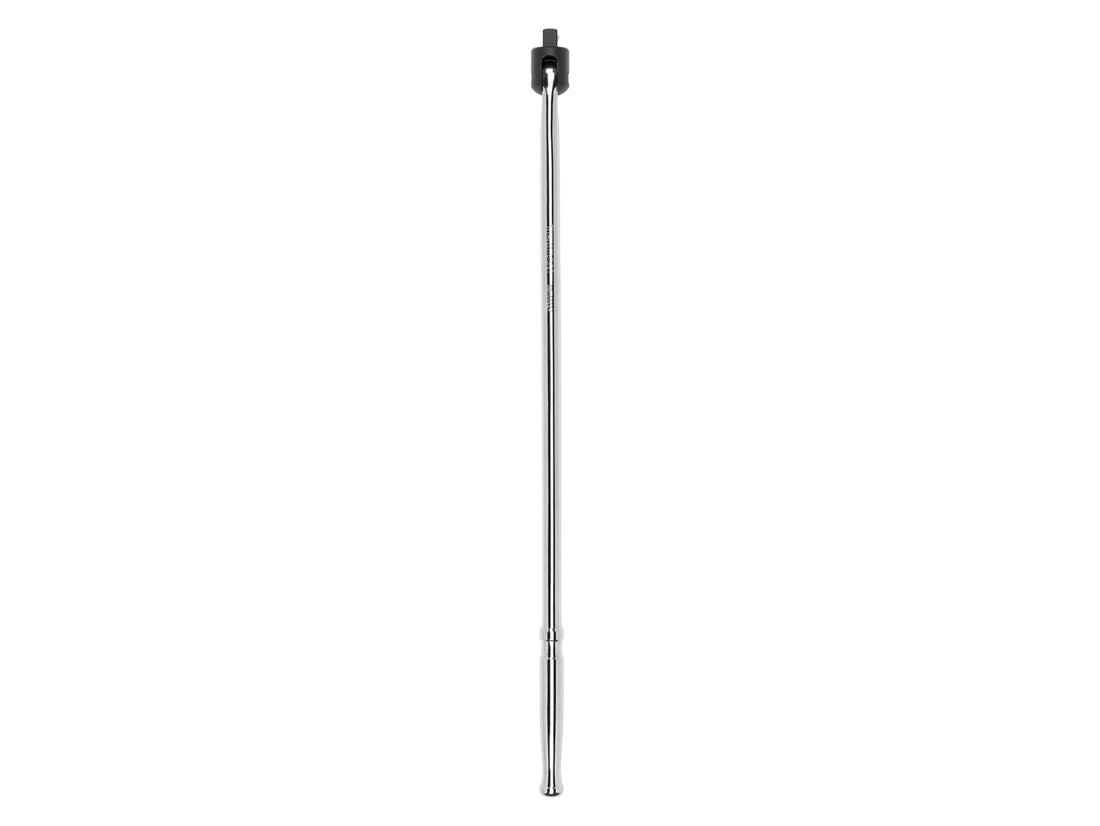
A breaker bar is a long, fixed handle with a square-drive head and zero ratcheting mechanism. That's not a limitation — it's the design. No moving parts means no parts to strip under load. The long handle gives you the leverage to crack loose fasteners that a ratchet or torque wrench can't budge without damage.
You reach for it when a fastener is over-torqued from a previous air-gun job, rusted or seized from sitting, or just very tight from years of heat cycling. You lean on it. The bolt moves. Then you set it aside.
Length matters here. A longer handle multiplies your input force at the socket through basic lever mechanics — more handle means more torque on the fastener without more effort from you. A 24-inch 1/2" breaker bar puts significantly more torque on the fastener at the same body weight as a short ratchet.
What a breaker bar doesn't do: tighten to any measurable spec, ratchet (every swing requires a full pull-and-reposition), or have any place in the "torquing to spec" half of the job.
Do a Torque Wrench and Breaker Bar Use the Same Sockets?
Yes — and this is worth understanding before you buy. Both tools use standard square-drive sockets, and the drive sizes are shared across the industry: 1/4", 3/8", 1/2", 3/4", and 1".
For most automotive work — wheels, suspension, engine components — 1/2" drive is the standard. Your 1/2" sockets work on the breaker bar when you're cracking things loose, then slide right onto the torque wrench for setting final torque. One socket set. Both tools. No duplication.
One caveat worth knowing: when you're hammering a breaker bar against a badly seized fastener, reach for impact-rated (black oxide) sockets rather than polished chrome ones. Chrome sockets are designed for hand-tool loads; under hard breakover force they can crack. Impact sockets are thicker-walled and built for exactly that stress. For more on socket failures under unexpected load.
Why You Should Never Use a Torque Wrench as a Breaker Bar
This is the expensive lesson a lot of people learn once.
A click-type torque wrench works by deflecting an internal spring mechanism to a calibrated point. When you use it to break a bolt loose — especially a seized one — you're applying force in the reverse direction, past the designed range, and often with a sharp jerk. That stresses or shifts the spring in ways the manufacturer didn't engineer for.
The result: the wrench still clicks. But it now clicks at the wrong value. If it was calibrated to click at 100 ft-lb and it's now off by 10%, it's clicking at 90 or 110 ft-lb — and you have no idea. You torque your lug nuts thinking you hit spec, and you didn't.
A properly calibrated click-type torque wrench should hit within ±4% of indicated value (across 20% to 100% of full scale) of the set value in the clockwise direction. Damage the calibration and you're either under-torquing (a safety problem on wheel fasteners) or over-torquing (a fastener or gasket problem). Professional recalibration costs real money. A 1/2" breaker bar costs less than a dinner out.
Storage note: when you're done using a click-type torque wrench, dial it back to the lowest setting on its scale before putting it away — this relaxes the adjustment spring. Leaving it set at a high value keeps the spring loaded and shortens its calibrated service life.
Which One Do You Need First?
This depends on what you're actually doing.
DIYer doing occasional maintenance — oil changes, brake jobs, tire rotations — the breaker bar often comes first. Loosening stuck fasteners is the part that stops a job cold, and a good 1/2" breaker bar with impact-rated sockets handles the frustrating half of that work immediately.
Anyone torquing to spec — lug nuts, wheel bearings, head bolts, spark plugs, or any fastener with a value in the service manual — the torque wrench is non-negotiable. There's no workaround.
Passenger-car lug nuts are a practical example: a Toyota Camry specifies 76 ft-lbs, but your vehicle's spec will differ — always look it up in the owner's manual or service data before tightening. "Pretty tight" is not a torque spec. A torque wrench is.
A 1/2" click wrench in the 30–250 ft-lb range — the CDI 2503MFRPH, for example — covers most passenger-car and light-truck automotive work.
For mechanics doing real shop work, the answer is both — immediately. Every disassembly/reassembly cycle uses both tools, and they cover opposite halves of the same fastener.
What About a Ratchet, Impact Wrench, or "Cheater Bar"?
Ratchet: A ratchet is not a substitute for a breaker bar. The gear mechanism inside a ratchet is designed for normal fastening and loosening under reasonable load — not for the shock of cracking a seized fastener. Under breakover force, you can strip the pawl teeth. That's a frustrating repair on a good ratchet and a trash-bin trip for a cheap one. For light-torque fastener work a ratchet is the right call; for frozen bolts, put the breaker bar in your hand. Milwaukee vs. Gearwrench ratchet comparison
For normal drive work and ratchet comparisons, premium ratchet options is worth a look.
Impact wrench: The powered alternative to the breaker bar for loosening. An impact wrench delivers rotational blows rather than steady torque, which is often more effective on severely seized fasteners. It doesn't replace the torque wrench — final tightening to spec still requires a measured step.
Pipe "cheater" on a ratchet: Don't. Sliding a pipe over a ratchet handle to extend it multiplies the load on the gear mechanism well past its rated capacity. The ratchet fails — sometimes suddenly, mid-pull. If you need more leverage, that's exactly what the breaker bar's long handle is engineered for.
FAQ
Can you use a breaker bar as a torque wrench?
No. A breaker bar applies leverage, but there's no indicator, click, or scale to tell you when you've hit a target value. You can't tighten to a specified torque with it.
Can you use a torque wrench to loosen bolts?
Technically it will turn the bolt — but it risks knocking the spring mechanism out of calibration, especially on a stuck fastener. Use a breaker bar or impact wrench for loosening. The torque wrench is for final tightening only.
Do a torque wrench and breaker bar use the same sockets?
Yes. Both take standard square-drive sockets — 1/4", 3/8", 1/2", or 3/4". Match the drive size and your socket set works on both tools. For breakover work on the breaker bar, favor impact-rated (black oxide) sockets over chrome.
Do I need both a torque wrench and a breaker bar?
For most automotive work, yes — they cover opposite halves of the same job. The breaker bar cracks fasteners loose; the torque wrench sets them to spec. Using the torque wrench for both tasks costs you its calibration.
What size breaker bar and torque wrench do I need?
1/2" drive is the automotive standard — correct for lug nuts, suspension, and most engine work. A 3/8" setup covers lighter work like intake bolts and smaller fasteners. Most people buy 1/2" first and pick up 3/8" if the work calls for it.
Is a breaker bar stronger than a ratchet for loosening?
For breaking fasteners loose, yes. A ratchet's gear mechanism can fail under the shock load of a stuck fastener. A breaker bar's solid, fixed handle is built specifically for that force. Use the right tool for the task.
When you're ready to pick a specific torque wrench — ranges, types, and what to look for by job — our complete torque wrench guide has the full breakdown.