
Do Torque Sticks Work with a Cordless Impact Wrench? (Yes — With Two Conditions)
Torque sticks work with cordless impact wrenches — if your wrench has a 1/2" square drive (not a 1/4" hex impact driver) and you use full-trigger technique. On a pneumatic tool, a torque stick limits torque to within roughly ±5–10%. On a cordless impact, the hammer-blow mechanism is less consistent: expect ±10–15% on a full battery charge, wider as it drains. That's close enough for passenger-car lug nuts. It is not a substitute for a calibrated torque wrench on anything with a torque-to-yield spec or a safety-critical margin.
What a Torque Stick Actually Does — and Why Speed Matters
The Torsion Bar Mechanism
A torque stick is a steel bar with a precision torsion zone machined into it. Below the stick's rated torque, it transfers hammer energy straight through to the fastener. When resistance hits the rated value, the bar flexes — absorbing the impact rather than passing it along. The fastener stops tightening.
Simple in concept. The catch is it only works correctly when the hammer blows arrive fast enough and consistently enough for the bar to flex at its rated threshold on each strike.
Color Codes and Torque Values
Most torque stick sets follow a common color convention. Exact values vary by brand — confirm against the specific product you buy.
| Color | Typical Rating | Common Use |
|---|---|---|
| Yellow | ~65 ft-lbs | Compact cars, lighter lug nuts |
| Red | ~80 ft-lbs | Most passenger cars |
| Blue | ~100 ft-lbs | Mid-size cars and SUVs |
| Silver/Grey | ~140 ft-lbs | Trucks and heavier vehicles |
Color coding is not standardized across the industry — a yellow stick from one brand may carry a different rating than yellow from another, and some manufacturers use different color systems entirely. Treat the table above as a general reference and verify the actual rating printed on the stick before use.
Always check your vehicle's owner manual or a torque-spec database before picking a stick. Most passenger cars fall in the 80–120 ft-lb range; trucks often exceed 150 ft-lbs.
Why IPM Drives the Mechanism
IPM — impacts per minute — is what makes the torsion bar engage. The bar needs rapid, repeating hammer strikes to flex at its rated torque. When IPM drops, the bar doesn't reach its flex threshold on each strike. Instead of absorbing the impact, it transmits it. The fastener gets driven past the rated torque, and you've over-tightened.
A pneumatic tool holds steady IPM as long as the compressor keeps pressure. A cordless impact's IPM fluctuates with battery state of charge and trigger position. That's the root of the accuracy gap between the two.
Cordless vs. Pneumatic — Why Accuracy Is Different
With a pneumatic tool, regulated airflow keeps IPM consistent from the first lug nut to the last. The torsion bar sees a predictable load on every strike. That's how ±5–10% accuracy is achievable.
A cordless impact wrench uses a brushless motor driving a rotary hammer. The motor holds IPM better than a brushed tool, but two variables still bite you:
Battery charge. A pack at 30% delivers measurably lower peak IPM than a fresh one. If IPM drops below the engagement threshold, the stick under-delivers and the fastener over-tightens. Most people don't expect this.
Trigger technique. Feathering the trigger — rolling it on slowly — cuts IPM the same way. The stick may never fully engage.
Brushless tools like the Milwaukee M18 FUEL and DeWalt XR series maintain IPM better than older brushed wrenches. Still, ±10–15% — estimated from mechanism behavior, not a manufacturer-certified figure — is the honest working accuracy on a cordless, not the ±5% a regulated air line achieves.
For daily-driver lug nuts, that range is fine. For torque-to-yield fasteners, it's not tight enough.
The Drive Size Problem — Where Most Cordless Users Get Stopped
This is what trips people up before they even get to the accuracy question.
Standard torque sticks are 1/2" square drive. They mount on a 1/2" impact wrench — the tool with the square anvil. The 1/4" hex impact driver that most M18 and DeWalt 20V MAX platform users carry for screws and deck fasteners? Wrong drive geometry entirely. A torque stick will not attach to it.
If your cordless "impact" takes hex shank bits, you have an impact driver, not an impact wrench. Different tool, different job.
1/2" drive impact wrenches that work with torque sticks:
- Milwaukee M18 FUEL 1/2" High Torque Impact Wrench (2767-20) — 1,000 ft-lbs max fastening torque, 1,400 ft-lbs nut-busting torque
- Milwaukee M18 FUEL 1/2" Mid Torque Impact Wrench (2863-20) — a mid-torque option well-suited to most passenger-car lug nut work
- DeWalt 20V MAX 1/2" High Torque Impact Wrench (DCF899) — 700 ft-lbs max fastening torque (Speed 3)
3/8" drive torque sticks exist for lighter applications in the 50–80 ft-lb range — useful if that's what your kit has, but most wheel work needs the 1/2" setup.
We don't stock torque sticks at Tool Army — Neiko, Sunex, and ACDelco all make solid sets — but we do carry the 1/2" impact sockets you need alongside them.
If your wrench is already sorted and you're chasing a different problem, when your M18 impact wrench won't break lug nuts loose covers the common failure modes. And if you're still deciding between M18 impact platforms, start with choosing between M18 impact wrench models.
How to Get Reliable Results on a Cordless Impact with Torque Sticks
Follow these four rules and the torque stick does what it's supposed to:
1. Start with a full battery. Green indicator or ≥80% charge — not "mostly charged." IPM drops as the pack drains, and accuracy goes with it.
2. Full trigger only. Squeeze and hold. Feathering the trigger cuts IPM below the engagement threshold. The bar may never flex, and the fastener overtightens.
3. One pull per fastener. Run the trigger until you feel the stick take over — the feedback changes noticeably as the bar starts absorbing. Stop there. Don't re-pull.
4. Confirm with a torque wrench on anything that matters. Torque sticks get you close. A calibrated click-type wrench confirms. For suspension components, torque-to-yield bolts, or a truck with a high torque spec, don't skip this step. See when a torque wrench is required for guidance on precision fastening.
Frequently Asked Questions
Are torque sticks as accurate as a torque wrench on a cordless impact?
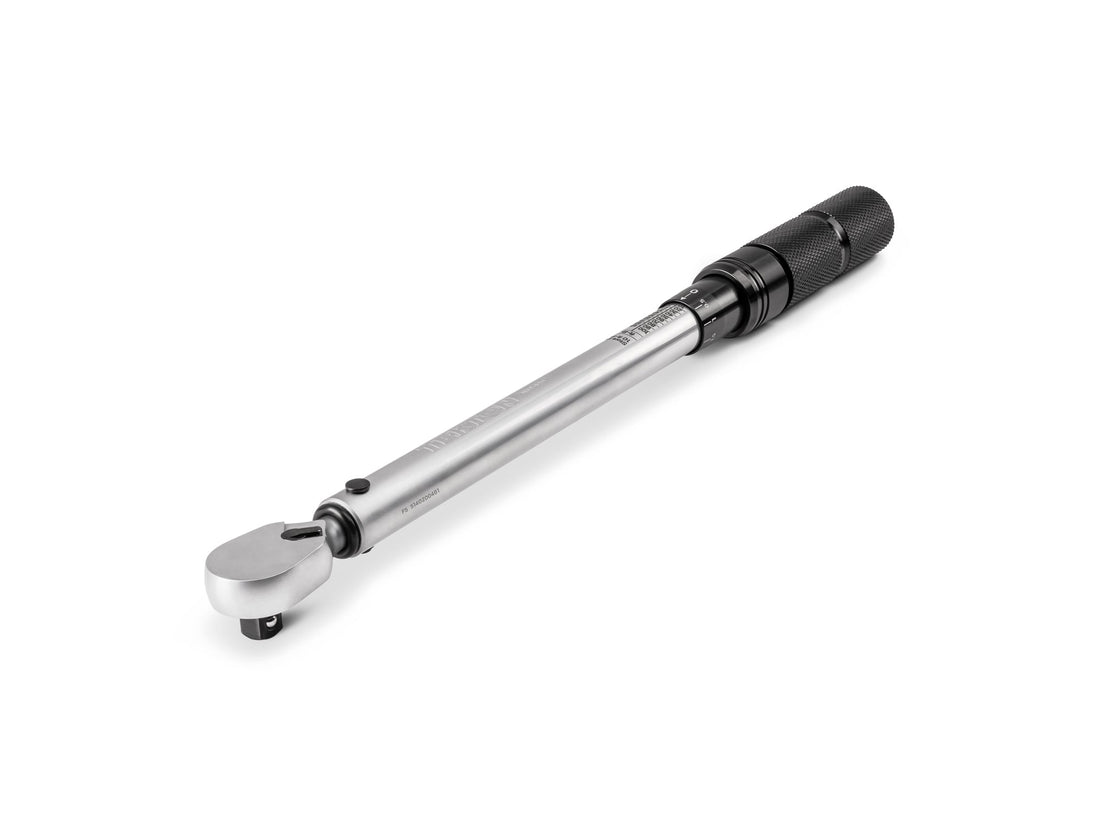
No. A calibrated click-type torque wrench is accurate to ±4%. A torque stick on a cordless impact runs approximately ±10–15% — wider than the ±5–10% on a pneumatic tool. Torque sticks are a speed limiter, not a precision instrument. Use a torque wrench to confirm anything where the spec actually matters.
What size impact wrench do I need to use torque sticks?
A 1/2" square drive impact wrench. The 1/4" hex impact driver — the most common cordless tool most platform users carry — does not accept them. You need a square anvil, not a hex chuck.
What color torque stick should I use for lug nuts?
Most passenger cars spec 80–100 ft-lbs — a red (80 ft-lb) or blue (100 ft-lb) stick covers most of that range. Trucks often need 140 ft-lbs or more (silver stick). Check your vehicle's OEM torque spec before picking one.
Can I use a torque stick instead of a torque wrench?
For routine lug nut work on a daily driver, a torque stick on a cordless impact is a practical, faster approximation. For torque-to-yield fasteners, head bolts, or suspension components with a narrow tolerance spec, use a calibrated torque wrench — often in multiple stages.
Do torque sticks work on Milwaukee M18?
Yes — on Milwaukee M18 FUEL 1/2" impact wrench models (2767-20, 2863-20). Not on the M18 FUEL 1/4" hex impact driver (2953-20), which is an impact driver and physically won't accept a torque stick. The drive type is the deciding factor, not the brand.
Before you run that first lug nut, confirm that the socket between the torque stick and the fastener is impact-rated, not chrome. Chrome sockets can crack under the hammer load of an impact wrench. See the difference between impact-rated and chrome sockets for the full breakdown.
For the socket side of the setup, the Milwaukee SHOCKWAVE 1/2" Drive Metric Deep 6-Point Socket Set covers the common passenger-car lug nut sizes and is impact-rated. It's stocked right here: Milwaukee SHOCKWAVE 1/2" Drive socket set. The full our Milwaukee M18 impact wrench collection is available, and the broader the full Milwaukee collection as well.