
Impact Sockets vs Regular Sockets: What's the Difference (and When It Matters)
Impact sockets vs regular sockets — the one rule that matters: Never put a chrome socket on an impact wrench or any cordless impact tool. Chrome-vanadium sockets are hardened and brittle — the hammer blows from an impact tool can crack them and throw fragments. Impact sockets are made of chrome-molybdenum (Cr-Mo) steel, which is softer and more ductile, so they flex under shock instead of shattering. They also run a black-oxide finish — no chrome plating to flake off. Impact sockets work on both impact tools *and* hand ratchets. Chrome sockets only work safely by hand.
What Actually Makes a Socket "Impact Rated"
Three things separate an impact socket from a regular chrome socket: material, finish, and wall construction.
| Feature | Impact Socket | Regular (Chrome) Socket |
|---|---|---|
| Material | Chrome-molybdenum (Cr-Mo) | Chrome-vanadium (Cr-V) |
| Heat treatment | Softer, more ductile | Hardened, more brittle |
| Finish | Black oxide / phosphate | Polished chrome plating |
| Wall thickness | Thick | Thinner |
| Retention hole | Yes — pin + o-ring through-hole | No |
| Typical point count | 6-point | 6-point or 12-point |
| Safe on impact tools? | ✅ Yes | ❌ No |
| Safe by hand? | ✅ Yes | ✅ Yes |
The retention hole is worth calling out specifically. Impact sockets have a through-hole drilled through the drive end — that's where a retaining pin and o-ring (or hog-ring) snaps in, locking the socket to the tool's anvil. On a powered wrench spinning under load, that hole keeps the socket on the tool. Chrome sockets don't have it because they were never designed to go near a power impact tool.
The black finish is also functional, not cosmetic. Black oxide and phosphate coatings resist corrosion and, critically, don't leave brittle chrome flake in the equation. Impact tools are for the shop floor, not the display cabinet.
Can You Use Regular Sockets on an Impact Wrench?
No. Chrome-vanadium steel is designed for hand torque — steady, controlled pressure applied by a human. Impact tools work fundamentally differently: they deliver rapid, high-energy hammer blows in addition to rotation. Hardened steel doesn't absorb shock well. It cracks, and when it does, fragments travel outward fast.
This isn't theoretical. Chrome sockets breaking on impact tools is a documented shop hazard — and it's why eye protection is mandatory on impact tools regardless of socket type. The risk is real, the fix is simple: impact-rated sockets on any air or cordless impact tool, no exceptions.
Can You Use Impact Sockets by Hand?
Yes, without any issue. Impact sockets use the same square-drive interface as chrome sockets — they fit any hand ratchet, breaker bar, or torque wrench with the matching drive size. No adapter, no workaround needed.
The only actual trade-off: impact sockets have thicker walls. In deep, narrow clearance situations — think tight engine bays or boxed-in fastener locations — a slim chrome socket might fit where an impact socket won't. That's a real consideration in precision mechanical work. For most jobs, it won't matter.
This kills the "need two full sets" argument. If you own a Milwaukee M18 or M12 impact wrench (or plan to add one), just buy impact-rated sockets and use them everywhere. One set does both jobs. The chrome set is a redundancy you don't need.
Impact Wrench vs Impact Driver — The Socket Mistake DIYers Make
This distinction doesn't get explained clearly enough, and it's where DIYers actually get confused.
Impact wrench = square-drive tool. Available in 1/4", 3/8", 1/2", and 3/4" square drive. Standard sockets snap directly onto the anvil. This is the tool where impact sockets slot in directly and the material/retention rules above apply.
Impact driver = 1/4" hex chuck. An impact driver takes hex-shank bits. It does *not* accept square-drive sockets directly — not without an adapter. To run sockets off an impact driver, you need a hex-to-square drive adapter.
That adapter is the weak link. Most "my socket adapter broke" situations trace back to the adapter failing under torque, not the socket itself — especially if someone tries to run a 1/2" socket off an impact driver through a 1/4" hex adapter. See this breakdown on adapter failures for details on why those adapters fail and when they're actually appropriate.
If you're running an M18 FUEL impact driver like the Milwaukee M18 FUEL 1/4" impact driver, that tool was built to drive fasteners with 1/4" hex bits — not to run sockets. It's a bit driver. Keep sockets on the impact wrench where they belong.
Are Impact Sockets 6-Point or 12-Point?
Impact sockets are almost always 6-point — and for good reason. Six-point sockets contact the full flat face of the fastener. Under high torque, that's how you grip without rounding. Twelve-point sockets contact the corners instead, which is perfectly fine for hand ratchet work but becomes a liability when an impact wrench is hammering away at a corroded or over-torqued bolt.
12-point impact sockets do exist. They're less common and usually reserved for applications where access angle matters more than pure grip. For general shop use, 6-point is the correct call.
More on this: see our socket point comparison.
Do You Actually Need Impact Sockets?
Here's the honest call.
Get impact sockets if:
- You own or use any cordless or air impact wrench
- You do automotive, mechanical, or heavy construction work where fasteners see real torque
- You want one socket set that covers every scenario without thinking about it
Chrome sockets are fine if:
- You only work by hand — hand ratchet, breaker bar, torque wrench, nothing powered
- Your tool kit doesn't include and never will include an impact wrench
For most people owning Milwaukee M18 or M12 gear: get impact sockets. If you've got an impact wrench, chrome is redundant. If you're still running drills only but thinking about an impact wrench, impact sockets are the right first purchase — you'll use them the day the wrench arrives.
Still figuring out whether M12 or M18 impact fits your work? Our guide to M12 vs M18 impact wrenches lays out the real-world tradeoffs.
Which Impact Socket Set Should M12 / M18 Owners Buy?
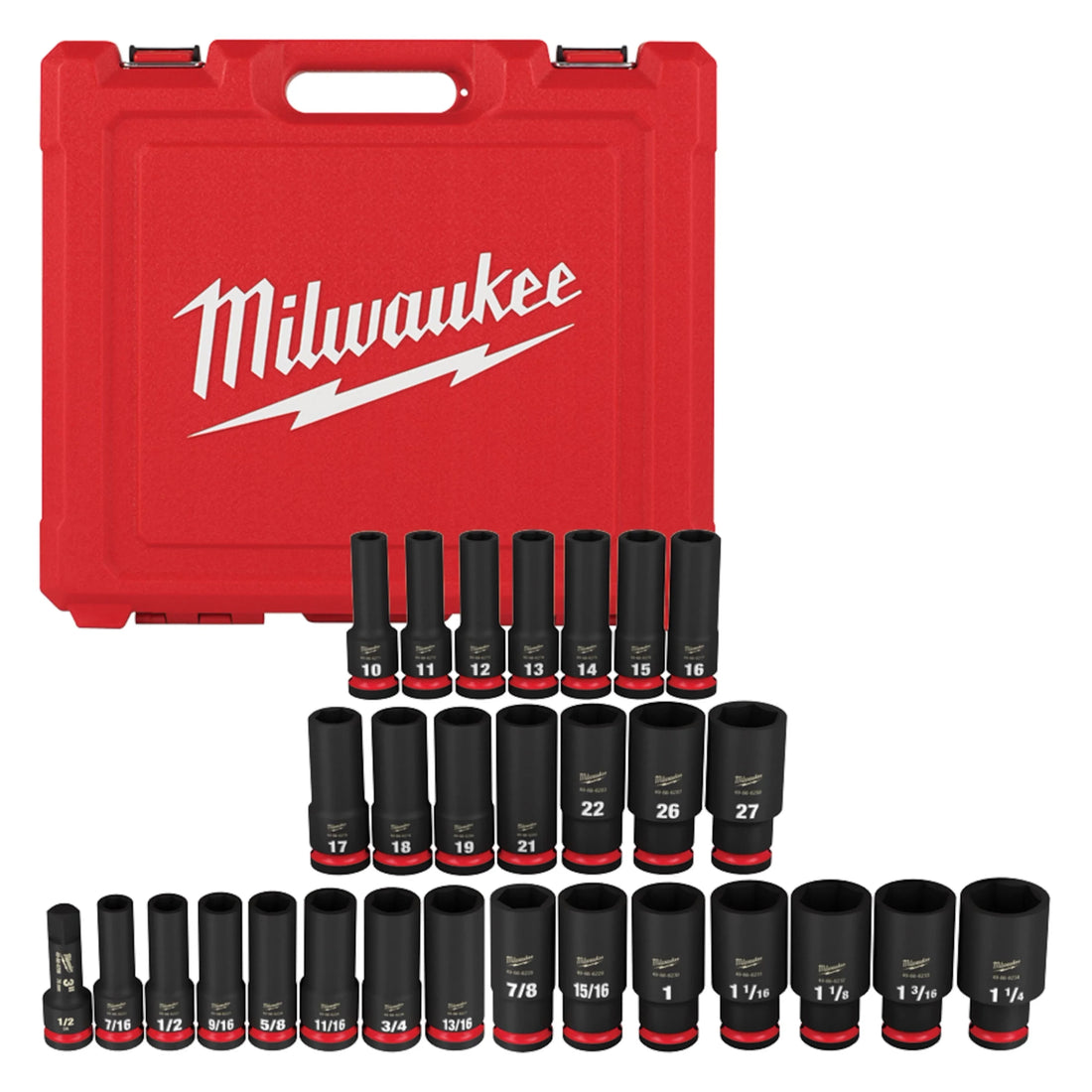
For M18 impact wrench owners, the Milwaukee SHOCKWAVE 14-piece 1/2" drive socket set is the straightforward pick: 14 pieces, 1/2" drive, metric, deep, 6-point, SHOCKWAVE Impact Duty rated. The 1/2" square drive matches the M18 impact wrench's anvil directly. No adapter games.
Milwaukee built the SHOCKWAVE Impact Duty line specifically to handle M18 output levels — Cr-Mo construction, black oxide finish, through-hole for the retaining pin. These aren't generic sockets that got a coat of black paint; they're rated for the tool.
One thing to confirm before buying: match drive size to your impact wrench. M18 impact wrenches run 1/2" drive. M12 impact wrenches typically run 3/8" drive. Check the spec on your tool before picking a set — a 1/2" drive set is useless on a 3/8" anvil without an adapter, and that adapter is just reintroducing the weak link you're trying to avoid.
If you're also sorting out your bit setup for the impact driver side of your kit, our guide on bit failures covers what actually fails and what to buy instead.
Frequently Asked Questions
Can you use a regular socket on an impact wrench?
No. Chrome-vanadium sockets are hardened and brittle. Impact tool hammer blows can crack them and send fragments. Always use impact-rated Cr-Mo sockets on any powered impact tool — cordless or air.
Can you use impact sockets with a normal ratchet or by hand?
Yes. Impact sockets share the same square-drive interface and work fine on hand ratchets, breaker bars, and torque wrenches. They're thicker-walled, which can be tight in deep clearance situations, but there's no functional downside to using them by hand.
Why are impact sockets black?
The black oxide or phosphate finish resists corrosion. More importantly, it isn't chrome plating — no brittle coating that can flake off as shrapnel when the tool is hammering. Functional finish, not a style choice.
Are impact sockets stronger than regular sockets?
Not harder — more ductile. Chrome-molybdenum steel deforms and absorbs shock under impact loading instead of cracking. Chrome-vanadium is harder but brittles out under repeated hammer blows. For hand use, either is plenty strong; for impact tools, ductile wins.
Do I need impact sockets for a cordless impact driver?
An impact driver takes a 1/4" hex chuck — it won't accept standard square-drive sockets without an adapter. For socket work, use an impact wrench. If you're running sockets off a driver through an adapter, read our breakdown on adapter limitations first.
Are impact sockets 6-point or 12-point?
Typically 6-point. Six-point sockets grip the flats of a fastener, not the corners, which holds better under the torque levels an impact wrench delivers. Twelve-point impact sockets exist but are less common and offer less grip when torque gets serious.
If you run an impact wrench, match it with sockets built for it. The Milwaukee SHOCKWAVE socket set covers 1/2" drive M18 work and doubles as your everyday hand-ratchet set. One set, no compromises.
Browse the full Milwaukee collection for the rest of what fits your platform.