
Milwaukee M12 vs M18 Impact Wrench for Mechanics: Which One You Actually Need
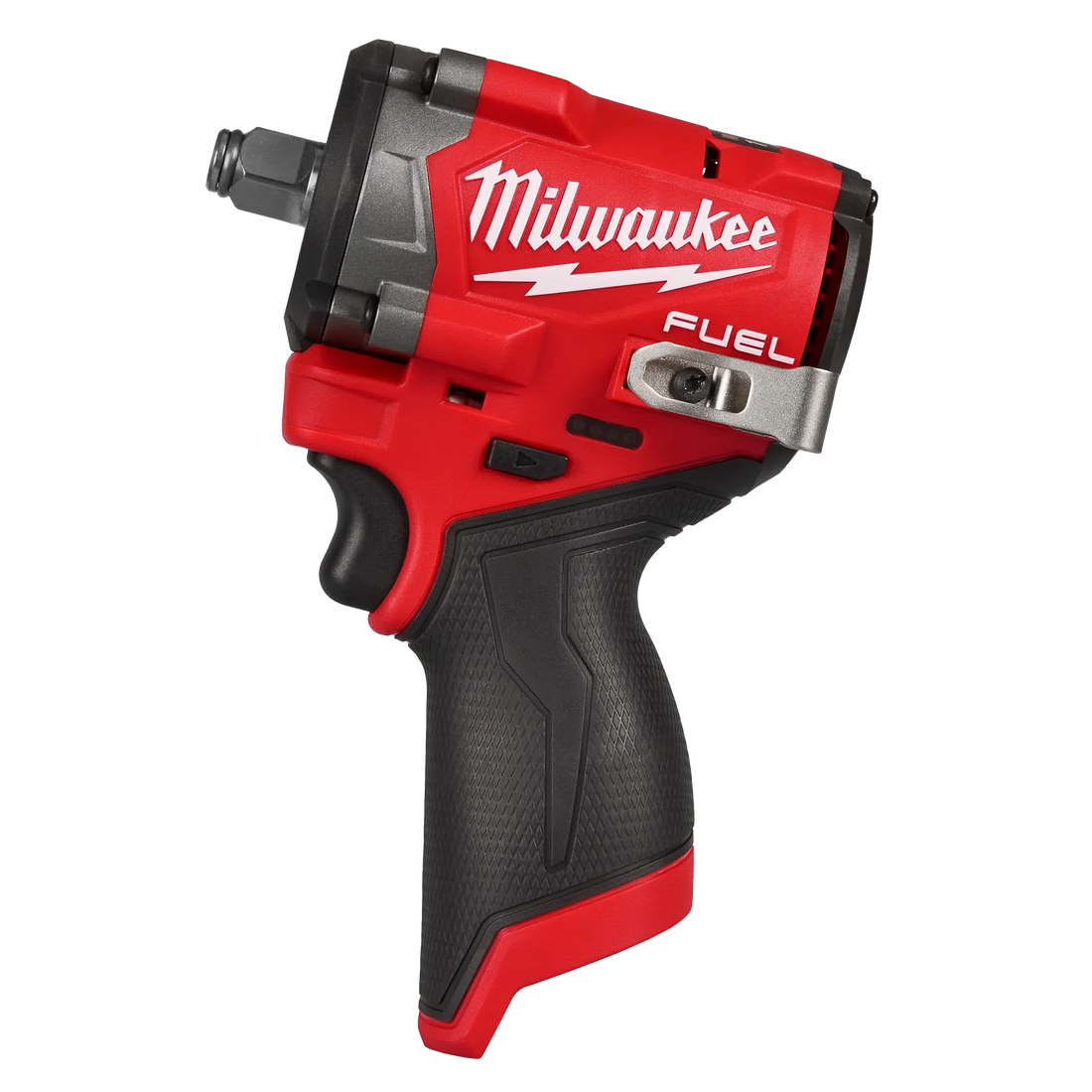
For most mechanics, the Milwaukee M12 FUEL Stubby 1/2" (2555-22) is the right first impact wrench. It delivers 250 ft-lbs of nut-busting torque, fits engine bays at under 5 inches long, and runs all day on a 4.0 Ah battery. Step up to the M18 FUEL mid-torque (2962) when suspension work, brake calipers, and rusted lug nuts are a daily routine. Only reach for the M18 FUEL high-torque (2967, 1,400 ft-lbs nut-busting) if axle nuts, subframe bolts, or Class-8 truck lugs are your regular diet. That choice — M12, mid-torque, or high-torque — determines your battery, your charger, and what else earns its spot on the bench.
Three models, one reference:
| Model | Drive | Nut-busting | Fastening | Best battery | Best for |
|---|---|---|---|---|---|
| M12 FUEL Stubby 1/2" (2555-22) | 1/2" | 250 ft-lbs | 250 ft-lbs | XC 4.0 Ah | Engine bay, daily lugs, caliper bolts |
| M18 FUEL mid-torque (2962-20) | 1/2" | 650 ft-lbs | 600 ft-lbs | HO 6.0 Ah | Suspension, rusted lugs, caliper brackets |
| M18 FUEL high-torque (2967-22) | 1/2" | 1,400 ft-lbs | 1,000 ft-lbs | HO 8.0 Ah or Forge | Axle nuts, Class-8 lugs, heavy equipment |
Which Milwaukee Impact Wrench Is Right for Each Mechanic Job?
| Job | Best pick | Why |
|---|---|---|
| Oil drain plug / caliper slider bolts | M12 Stubby 1/2" (2555-22) | Short head fits tight quarters; more than enough torque |
| Passenger car lug nuts (seated) | M12 Stubby 1/2" (2555-22) | 250 ft-lbs breaks 80–100 ft-lb lugs with room to spare |
| Corroded or overtorqued lugs | M18 mid-torque (2962) | 650 ft-lbs nut-busting for what the M12 can't move |
| Brake caliper brackets / strut bolts | M18 mid-torque (2962) | Right torque band; better runtime on a proper battery |
| Axle nuts / subframe bolts | M18 high-torque (2967) | Built for this job; the other two will tell you so |
| Semi-truck / Class-8 lugs | M18 high-torque (2967) | 1,400 ft-lbs — nothing else in this lineup competes |
Most driveway mechanics and light-shop techs live in the top two or three rows. That means the M12 or the mid-torque, and nothing heavier. The high-torque is a specialty tool.
The M12 Case: Why the Stubby 1/2" Is the Mechanic's Daily Driver
The M12 FUEL Stubby 1/2" (2555-22) is 4.9 inches long and weighs 2.6 lbs bare. Those numbers don't mean anything until you're trying to break a caliper bolt with one hand while keeping the rotor from spinning with the other, or reaching around an intake manifold with a quarter inch of clearance. Then they mean a lot.
250 ft-lbs of nut-busting sounds modest next to the M18 numbers. But passenger-car lug nuts are typically torqued to 80–100 ft-lbs. Even a lightly corroded lug rarely demands more than 150–200 ft-lbs of breakaway torque. The Stubby handles it. Where it honestly runs out of room: badly rusted suspension hardware, half-shaft nuts that haven't moved in 15 years, or anything that got impact-driven past spec by whoever touched it last. That's the M18's territory.
Battery pairing: Run an M12 XC 4.0 Ah for daily work. Upgrade to the 6.0 Ah compact if you're doing a full brake job or a set of four tires without stopping. The 2.0 Ah and slim packs aren't meant for torque-heavy pulls — they'll run the battery hot before the job's done.
What about the M12 3/8" (2554-22)? Great for interior trim, caliper slider pins, and sensor brackets under 100 ft-lbs. But the 3/8" anvil doesn't match standard impact socket sets, and the torque ceiling sits at 250 ft-lbs nut-busting. If you're buying one M12 impact wrench for mechanic work, the 1/2" is the pick. The 3/8" comes later as a second tool. See detailed comparison of the 3/8" vs. 1/2" for the head-to-head.
For how the M12 platform compares to M18 more broadly, M12 vs. M18 platform overview covers the platform-level picture.
The M18 Mid-Torque (2962): The Right Choice for Suspension and Rusted Lugs

The M18 FUEL mid-torque 1/2" (2962-20 bare, 2962-22 kit) is the tool full-time shop mechanics reach for first — not because the M12 can't do lug nuts, but because the mid-torque handles suspension work, rusted fasteners, and everything below it without switching tools.
650 ft-lbs nut-busting. 600 ft-lbs fastening. Four power modes. Overall length is 6.0 inches and bare weight is 3.50 lbs — heavier than the M12, but comfortable for all-day work. Overhead use is less natural; this wrench is most at home under a car or at bench height.
3/8" vs. 1/2" drive for mechanics: Milwaukee makes the mid-torque in 3/8" too (2960 series). Skip it for mechanic work — your impact sockets are 1/2" drive. Get the 2962.
Battery pairing matters here more than anywhere. Feed this wrench a compact or standard M18 battery and it'll protect its cells by pulling back torque before it reaches the rated spec. The High Output 6.0 Ah (48-11-1865) delivers the higher peak current the motor needs to actually reach the 650 ft-lbs you're paying for. Budget for at least one HO 6.0 when you buy this tool. The Forge battery (48-11-1812) is the other option — it runs cooler during sustained high-draw pulls. For the full breakdown on which M18 pack is right for what, see guide to M18 battery packs.
Modes 1–4 are real: Mode 4 breaks rusted subframe bolts. Modes 1–2 handle caliper bracket bolts and sensor bolts where a full-send impact would strip threads. That range is what makes the mid-torque replace two tools in a lot of bays.
When Should You Buy the M18 High-Torque (2967)?

The M18 FUEL high-torque 1/2" (2967-22) exists for a specific situation: the fastener that doesn't move. Axle nuts. Pinch bolts on ball joint and strut assemblies. Subframe mounts that have been fused with corrosion for a decade. Semi-truck wheel studs. That's the list.
1,400 ft-lbs nut-busting. 1,000 ft-lbs fastening. Bare weight is 5.9 lbs, which you feel when you're holding it at an angle under a subframe. This isn't an all-day tool for most mechanics. It lives in the corner of the bay or on the bench, and you grab it specifically when nothing else will move the fastener.
Why it's not the right first impact wrench: it's overkill for 90% of automotive fasteners. Caliper bolts, lug nuts, brake bracket hardware — you'll crack things and strip threads with this tool if you're not careful on Mode selection. And you'll still want the M12 or the mid-torque for everything else, which means you're buying this as a third tool, not a first one.
Battery pairing: The 2967 draws hard. A compact or standard pack will thermal-limit before you finish a stubborn axle nut. Run HO 8.0 Ah (48-11-1880) minimum, Forge (48-11-1812) if you're doing sustained heavy work. On the high-torque, that's not a recommendation — it's a requirement.
Which Battery Do You Need for Each Milwaukee Impact Wrench?
The wrench you choose locks in your battery platform. M12 and M18 batteries are physically incompatible — different footprints, different voltages, no crossover. You pick a platform and stay there. See M12/M18 battery compatibility explained for the full technical explanation.
Within a platform, the battery pack makes a real difference in what the tool actually delivers:
M12 impact wrench (2555-22):
- Sweet spot: XC 4.0 Ah — hits rated torque, good runtime
- Extended jobs: 6.0 Ah compact
- Avoid for torque work: 2.0 Ah and slim packs
M18 mid-torque (2962):
- Minimum for rated torque: HO 6.0 Ah (48-11-1865)
- Best value: HO 6.0 — delivers spec without overpaying
- Best sustained use: Forge (48-11-1812) — thermal stability on long pulls
M18 high-torque (2967):
- Minimum: HO 8.0 Ah (48-11-1880)
- Best: Forge — not optional for heavy repeated use
- Do not run: compact or standard packs — they will throttle the tool
One cold-weather note: Milwaukee lithium-ion packs won't charge below 40°F and charge slower approaching that threshold. If your garage drops below freezing, warm the battery before charging or it won't take a full charge. Cold-weather charging guide covers what that means in practice.
The Accessory Chain: What Belongs on Your Bench
The impact wrench is one piece of the setup. These are the rest.
Impact-rated sockets. Chrome vanadium sockets are not rated for impact loads — they can shatter under the repeated hammer blows an impact mechanism delivers. Use black impact sockets (chrome moly alloy). This is a safety issue, not a preference call. A cracked chrome socket at the wrong angle can take out an eye or a knuckle.
Keeping your phone and scan tool charged. Reading live OBD data or a wiring diagram mid-job? The USB-C charger for M18 batteries runs off any M18 battery and delivers up to 65W — enough for a scan tool, phone, or tablet. No outlet needed. Toss it in the bay or leave it on the bench; it moves wherever you're working.
Running a heat gun or trouble light off the battery. Frozen brake lines, corroded fittings, and dark engine bays all need power. The M18 power inverter clips to an M18 battery and gives you a 120V outlet, two USB ports, and an LED light. 150W handles a heat gun on its lower setting, a work light, or a phone charger — bench utility without running a cord across the floor.
Bit holder for the impact driver. You'll run an impact driver alongside the wrench for guide pins, sensor bolts, and interior fasteners. A magnetic silicon bit holder keeps bits from disappearing into the engine bay. For the broader question of when to reach for an impact driver vs. the wrench, see impact driver vs. impact wrench guide.
What We'd Actually Buy: Three Real Setups
Driveway mechanic — oil changes, brake jobs, tires:
M12 FUEL Stubby 1/2" kit (2555-22 includes two 4.0 Ah batteries and charger). Add one spare 4.0 Ah battery if you do extended jobs. Pair with the M18 USB-C charger on the bench if you have any M18 batteries already; otherwise the M12 USB adapter handles lower-wattage devices.
That setup covers 90% of what a driveway mechanic touches. The M12 will make you wonder why you thought you needed something bigger.
Weekend project mechanic — brakes, suspension, the occasional strut job:
Start with the M12 Stubby 1/2" kit above. Add the M18 FUEL mid-torque (2962-22 kit) with at least one HO 6.0 Ah battery. Add the M18 USB-C charger and the M18 150W inverter for the bench. The mid-torque handles what the M12 can't, the HO 6.0 delivers the rated torque, and the inverter earns its keep the first time you need a heat gun on a frozen brake line.
Full shop / heavy work — suspension, axle nuts, trucks, equipment:
All three impact wrenches. HO 8.0 Ah or Forge for the high-torque, HO 6.0 for the mid-torque, 4.0 XC or 6.0 compact for the M12. A rapid or super charger for the M18 batteries, M18 USB-C on the scan tool bench, and the 150W inverter for bench power. If you're regularly on semi wheels or heavy equipment, the high-torque pays for itself fast.
FAQ
Is the M12 Stubby strong enough for lug nuts?
Yes, for most passenger cars. The M12 FUEL Stubby 1/2" (2555-22) puts out 250 ft-lbs of nut-busting torque — well above the 80–100 ft-lbs most passenger-car lug nuts are spec'd to. Where it struggles: badly corroded lugs or anything that was over-driven with an air gun. Keep a breaker bar handy for those. The M12 wins 90% of the time.
Can I use the M18 high-torque for regular auto work?
You can, but it's the wrong tool most of the time. The 2967 is heavy, long, and calibrated for fasteners that resist everything else. Using it on caliper bolts and trim screws is like using a pipe wrench on a finishing nail — possible, destructive. Buy it as a second or third tool, not a first.
Do M12 batteries fit M18 tools (or vice versa)?
No. The battery footprints are physically different and the voltages don't match. You pick a platform per tool and stay there. Battery compatibility details has the full technical breakdown.
Which battery should I run with an M18 impact wrench?
For the mid-torque (2962): HO 6.0 Ah is the sweet spot — hits rated torque, manageable weight and cost. For the high-torque (2967): HO 8.0 Ah or Forge, no exceptions. Compact and standard packs will thermal-limit both tools under real load before the job is done.
What's the difference between the M12 3/8" and M12 1/2" stubby for mechanics?
Anvil size and torque ceiling. The 3/8" (2554-22) is excellent for caliper slider pins, interior fasteners, and small hex bolts under 100 ft-lbs — but it won't accept your 1/2" drive impact socket set directly. For lug nuts and suspension, the 1/2" (2555-22) is the right tool. See M12 3/8" vs. 1/2" detailed comparison for the detailed comparison.
Do I need impact-rated sockets?
Yes. This is a safety item, not a preference. Chrome vanadium sockets are not designed for impact loads — they can fracture and send shrapnel. Black impact sockets (chrome moly) are the standard for impact wrench use. The price difference is small; the risk of using chrome sockets under a hammer mechanism is not.
What about the M12 3/8" (2554) for lug nuts specifically?
Its nut-busting torque of 250 ft-lbs and the smaller anvil mean you need an adapter for standard 1/2" drive impact sockets. The 1/2" 2555-22 is the direct lug-nut tool — no adapter, better torque, same compact form. The 3/8" is for everything under the steering wheel, not the lugs.
Whichever wrench fits your bay, the accessories that keep it earning — USB charger, bench inverter, bit holders — are all in one place. See the full Milwaukee tool collection, including the USB-C charger for M18 batteries and the M18 power inverter.