
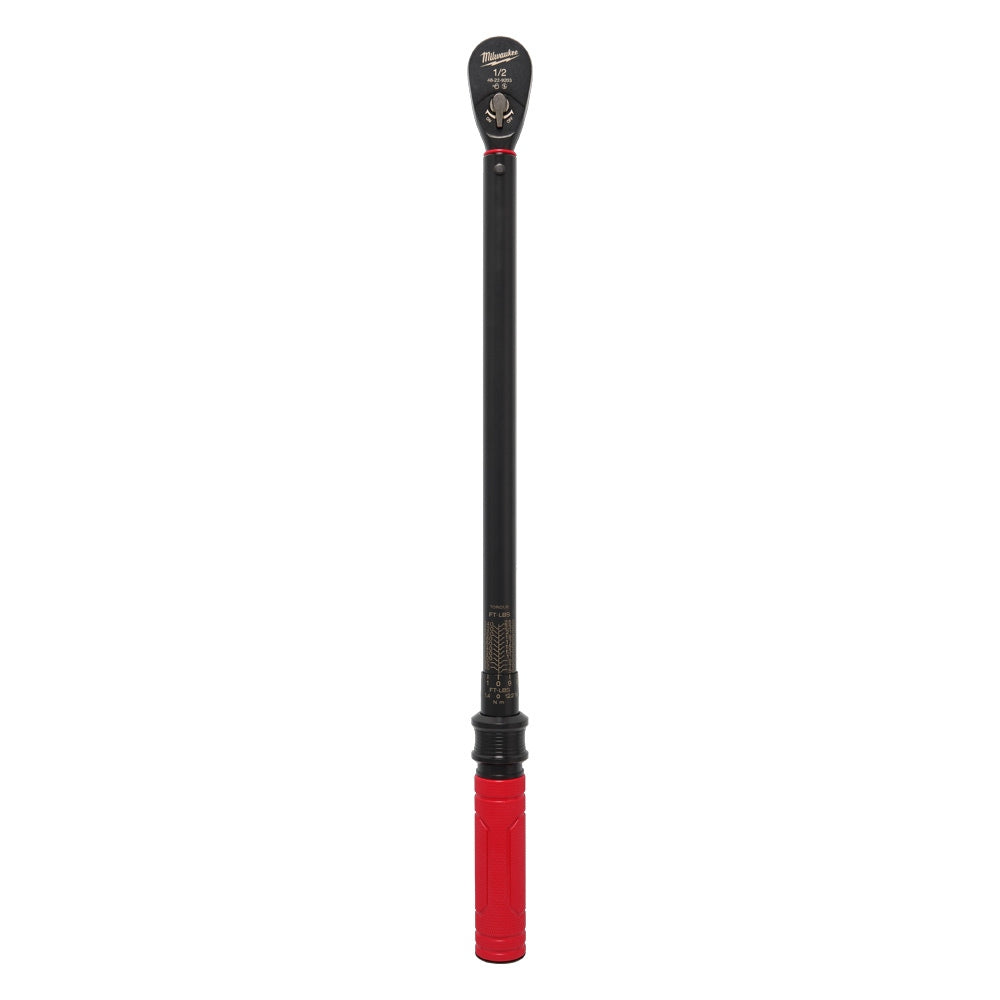
Best Torque Wrench for Automotive Work: Match the Wrench to the Job (Not the Other Way Around)
For most automotive work, one torque wrench isn't enough. You need a 1/2-inch drive wrench rated to at least 150 ft-lb for lug nuts and suspension fasteners, and a 3/8-inch drive wrench in the 10–80 ft-lb range for spark plugs, drain plugs, and engine bolts. A 250 ft-lb wrench torquing an 80 ft-lb lug nut is operating at 32% of its rated range — below the threshold where its ASME accuracy spec actually applies. This guide maps real automotive jobs to the correct wrench range first, then picks the best tools at three price points for each. Buy the range before you buy the brand.
What Torque Does Your Job Actually Need?
Know the spec before you buy the wrench. Most of what goes wrong in torque-wrench buying happens right here — someone grabs a big 1/2-inch model because "cars," then uses it for spark plugs where it's both overkill and inaccurate.
Common Automotive Torque Ranges
| Job | Typical Range (ft-lb) | Drive Size | Notes |
|---|---|---|---|
| Passenger car lug nuts | 80–100 | 1/2" | Check door-jamb sticker; varies by make/model |
| Light truck / SUV lug nuts | 100–165 | 1/2" | Full-size trucks often 140–165 ft-lb |
| Spark plugs — aluminum head | 10–20 | 3/8" | Aluminum threads strip easily; never over-torque |
| Spark plugs — cast-iron head | 20–30 | 3/8" | More forgiving than aluminum, still verify spec |
| Oil drain plug | 15–35 | 3/8" | Most passenger cars 20–30 ft-lb; check your manual |
| Brake caliper bolts | 25–55 | 3/8" | Varies widely by vehicle — look yours up specifically |
| Head bolts | 50–90+ | 3/8" or 1/2" | Many require torque-to-yield multi-stage sequencing |
| Wheel bearing nut | 100–200+ | 1/2" | High variance; always use vehicle-specific spec |
| Intake manifold bolts | 15–25 | 3/8" | Aluminum intakes: stay toward the lower end |
| Valve cover bolts | 5–10 | 3/8" | Often spec'd in in-lb, not ft-lb — confirm before torquing |
*All values are typical ranges across common vehicles. Verify against your vehicle's OEM service manual or torquespecs.com before tightening.*
Three data points from that table explain most of your buying decision: passenger-car lug nuts land at 80–100 ft-lb, truck lug nuts run 120–165 ft-lb, and spark plugs in aluminum heads are 10–20 ft-lb. That nearly 10:1 spread is exactly why two wrenches beat one.
1/2-Inch vs 3/8-Inch vs 1/4-Inch: Which Drive Size Do You Need?
1/2-Inch Drive — The Lug-Nut Wrench
Use 1/2-inch drive for anything above roughly 80 ft-lb: lug nuts, strut tower bolts, axle nuts, and heavy suspension hardware. The larger drive handles the leverage without flexing or wearing the square drive. This is not the wrench for engine work — it's too coarse-grained for the lower torque ranges, and a long 1/2-inch handle creates problems in tight engine bays.
A quality 1/2-inch click wrench rated 25–250 ft-lb covers everything from sedan lug nuts to full-size truck wheel bolts in a single tool.
3/8-Inch Drive — The Engine Workhorse
The 3/8-inch drive is the most useful wrench for automotive work. It covers spark plugs, drain plugs, valve covers, intake manifolds, brake calipers, and most under-hood bolts. A 10–80 ft-lb range hits the sweet spot for this kind of work.
If you only buy one wrench, this is it — as long as you pair it with a breaker bar for lug nuts.
1/4-Inch Drive — Tight Spaces Only
Quarter-inch drive belongs in confined sensor-bolt situations and interior trim fasteners at 30 ft-lb and under. Its physical size helps in cramped quarters. But it's not a structural tool — don't reach for it on brake calipers or anything load-bearing.
A word on drive adapters. A 1/2-inch to 3/8-inch adapter introduces mechanical slop at the joint. That slop absorbs some applied force before it reaches the fastener, which distorts the reading. For the caliper bolt you're trusting with stopping power, buy the right drive. Save the adapters for non-critical fasteners. For a deeper look at why adapters and torque-socket joints fail under load, this detailed breakdown covers the mechanics in detail.
Click vs Digital vs Beam: Which Torque Wrench Type Is Right for Cars?
Click-Type (Micrometer/Cam-Over)
The click-type is the default for automotive work. Set the torque, pull steadily, and the wrench gives you an audible click and a tactile break when you hit the target. No guessing about needle position; no screen to read in poor light.
Calibration drifts over time — that's the main drawback, and it's manageable with a regular calibration schedule. Click-type covers 95% of what most mechanics and DIYers actually do. Start here.
Digital
Digital torque wrenches display live torque as you pull — most beep or vibrate at the target. The value isn't better accuracy (a quality click-type is already accurate enough); it's visibility through a multi-stage torque sequence. Stretch-bolt head bolts, for example, require torquing to a spec then adding a defined rotation angle. Watching live torque climb through that sequence is easier on a digital display than counting clicks.
That said: digital costs more, needs a battery, and adds fragile electronics to a tool that lives in a toolbox and gets dropped. For standard DIY work, it's a want, not a need.
Beam
A beam wrench has two things going for it: no calibration required and no moving parts to wear out. The pointer doesn't drift. Treat it reasonably and it stays accurate for decades.
The problem is practical. You have to watch the needle while pulling. In an engine bay, maintaining smooth, steady pull pressure while staring at a graduated scale is genuinely awkward. There's no click, no signal — just you and the needle. For regular shop work, the beam wrench is a reliable backup, not a daily driver.
Verdict: A quality click-type in the right range is the right answer for the vast majority of automotive work, DIY or shop.
The Accuracy Problem Nobody Explains
Here's what most torque-wrench guides skip entirely. ASME B107.300 guarantees ±4% accuracy only from 20% to 100% of the wrench's rated maximum.
Work through the math. A 250 ft-lb torque wrench used on an 80 ft-lb lug nut is at 32% of range — technically inside the guaranteed zone, but just barely. Use that same 250 ft-lb wrench on a spark plug at 15 ft-lb and you're at 6% of range. The ±4% claim on the box means nothing at that point.
The practical rule: keep your target torque between 30–80% of the wrench's rated max for reliable accuracy. A 1/2-inch 25–250 ft-lb wrench paired with a 3/8-inch 10–80 ft-lb wrench keeps every common automotive job solidly inside that window. The two-wrench system isn't overkill — it's how you stay within the accuracy guarantee on both ends of the spectrum.
Budget wrenches compound this problem. Most don't publish accuracy curves below 20% of rated max. The ±4% figure on the packaging is a mid-range claim. A $40 wrench used in the right range will serve you well; the same wrench pushed to the low end of its scale for precision work is not doing what you think it's doing.
Best Torque Wrenches for Automotive Work, by Use Case
Best 1/2-Inch Drive (Lug Nuts, Suspension)
Budget (~$125): Tekton TRQ52402 1/2-Inch Drive Click Torque Wrench
Tekton publishes their accuracy spec openly (±3%) and backs their tools with a lifetime guarantee. For a DIYer handling oil changes and seasonal tire swaps, the TRQ52402's 40–200 ft-lb range covers every passenger-car and light-truck lug nut spec comfortably mid-range.
Mid-Range (~$165–$215): GearWrench 85180 1/2-Inch Drive Click Torque Wrench
The 85180 spans 20–150 ft-lb and uses GearWrench's 120XP™ micrometer-click mechanism with a 120-tooth ratchet — a meaningful step up in mechanism quality and manufacturing tolerances versus entry-level options. A flex-head model earns its premium when you're working around a wheel well or strut tower.
Pro/Shop (~$200+): CDI Torque or Snap-on 1/2-Inch Drive with Calibration Certificate
The CDI 2503MFRMH (30–250 ft-lb) and Snap-on QD3R250A (50–250 ft-lb) both ship with NIST-traceable calibration certificates and carry ±4% CW/±6% CCW accuracy ratings, with recalibration due at 1 year or 5,000 cycles — tested against a known standard, not just factory-adjusted. For a shop doing brake jobs and suspension work daily, the cert matters for liability as much as accuracy.
Best 3/8-Inch Drive (Engine Work)
Budget (~$40–50): Tekton TRQ51402 3/8-Inch Drive Click Torque Wrench
Same quality story as the 1/2-inch. In a 10–80 ft-lb range, this wrench covers spark plugs, drain plugs, valve covers, and caliper bolts without breaking $50.
Mid-Range (~$140): GearWrench 85062M 3/8-Inch Drive Click Torque Wrench
Better feel and ratchet quality than the entry-level. The 85062M runs 10–100 ft-lb at $139.99 — if you're doing engine work on a regular basis, the investment in quality shows up in every use.
Pro: CDI Torque 2502MRMH 3/8-Inch Drive with Calibration Certificate
CDI is the shop-standard for calibrated torque tools — the 2502MRMH ships with a NIST-traceable calibration certificate on a 1-year or 5,000-cycle recalibration schedule, which is why it's widely specified by dealerships and performance shops.
If You Only Buy One — Which Range?
A 3/8-inch drive in the 10–80 ft-lb range handles the widest variety of automotive jobs: oil changes, spark plugs, brake calipers, valve covers, and most under-hood bolts. Pair it with a breaker bar for lug nuts and you've covered most of what a DIYer needs.
If lug nuts and tires are your primary job — seasonal swaps, wheel changes — buy the 1/2-inch first. Add the 3/8-inch when you start doing engine work.
How to Use a Torque Wrench: Correct Technique and What Destroys Them
1. Start from hand-tight. A torque wrench sets clamping force, not thread engagement. Run the fastener down by hand first, then apply the wrench. Starting from loose means the wrench is doing thread-engagement work, not tension work — and the reading means nothing.
2. Pull smoothly and stop at the click. A steady, even pull gives you the accurate reading. A jerky pull can trip the mechanism before you reach the spec. When the click fires, stop. Don't keep pulling — you've already passed the target.
3. Never use a click-type to break loose fasteners. This is the most common way to ruin a torque wrench. The mechanism releases at a set torque going forward; reverse torque overstresses the cam and spring. Use a breaker bar or impact to loosen. The torque wrench only tightens.
4. Avoid flex or angle extensions on precision fasteners. A rigid extension in line with the drive transmits force cleanly and doesn't meaningfully affect the reading. A flex joint or angle extension absorbs some applied force before it reaches the fastener. On a caliper bolt or head bolt, that error matters.
5. Back the adjuster down after use. On micrometer-style click wrenches, return the setting to the lowest marked value — not fully to zero, which can damage the spring seat on some designs. Never store a click wrench at full tension. Spring fatigue over years is real.
6. Calibrate after a drop. If the wrench hits the floor — from any height — treat it as potentially out of calibration. Don't use it on a safety-critical fastener until it's been checked. Professional shop standard: calibrate annually or every 5,000 cycles, whichever comes first. For DIY use, scheduling periodic recalibration is sound practice — at minimum after any significant drop.
Frequently Asked Questions
What size torque wrench do I need for automotive work? Two sizes cover 95% of jobs: a 1/2-inch drive wrench (25–250 ft-lb) for lug nuts and suspension, and a 3/8-inch drive wrench (10–80 ft-lb) for engine work. If budget allows only one, start with the 3/8-inch — it handles oil changes, spark plugs, and brake calipers.
What ft-lb torque wrench do I need for lug nuts? Most passenger cars spec 80–100 ft-lb; most light trucks and SUVs run 100–165 ft-lb. You need a 1/2-inch drive wrench rated to at least 150 ft-lb. Check your owner's manual or the door-jamb sticker for your vehicle's exact spec — don't rely on a generic number.
Is a 1/2-inch or 3/8-inch torque wrench better for cars? Neither is universally better — they cover different jobs. Use 1/2-inch for lug nuts and suspension fasteners above 80 ft-lb; use 3/8-inch for spark plugs, drain plugs, and most under-hood bolts.
How accurate are cheap torque wrenches? Reputable budget brands — Tekton, GearWrench, ACDelco — typically hit ±4% in the middle of their range. Accuracy degrades below 20% of rated max, and most budget brands don't publish that degradation curve. A $40 wrench in the right range is fine for most DIY work. The same wrench pushed to the low end of its scale is not.
Do I need a digital torque wrench for automotive? Not for most jobs. A quality click-type handles lug nuts, spark plugs, and engine bolts accurately. Digital adds value for precision engine assembly — performance builds, torque-to-yield head bolts — where watching live torque through a multi-stage sequence matters.
How often should I calibrate my torque wrench? Professional shop use: annually or every 5,000 cycles, whichever comes first. DIY use: every 2–3 years. Any wrench that has been dropped should be calibrated before its next safety-critical use, no matter the schedule.
Can I use a torque wrench to loosen bolts? No. Click-type torque wrenches are designed to apply set torque in the tightening direction only. Applying reverse torque overstresses the mechanism and degrades calibration. Use a breaker bar or impact driver to loosen; the torque wrench only tightens.
Two wrenches, right-sized: a 1/2-inch for lug nuts and suspension, a 3/8-inch for everything under the hood. That combination keeps you inside the accuracy window across the full range of common automotive torque specs. If you're also building out a socket set and need to know which ratchet is worth owning at each price point, our ratchet comparison covers exactly that.