
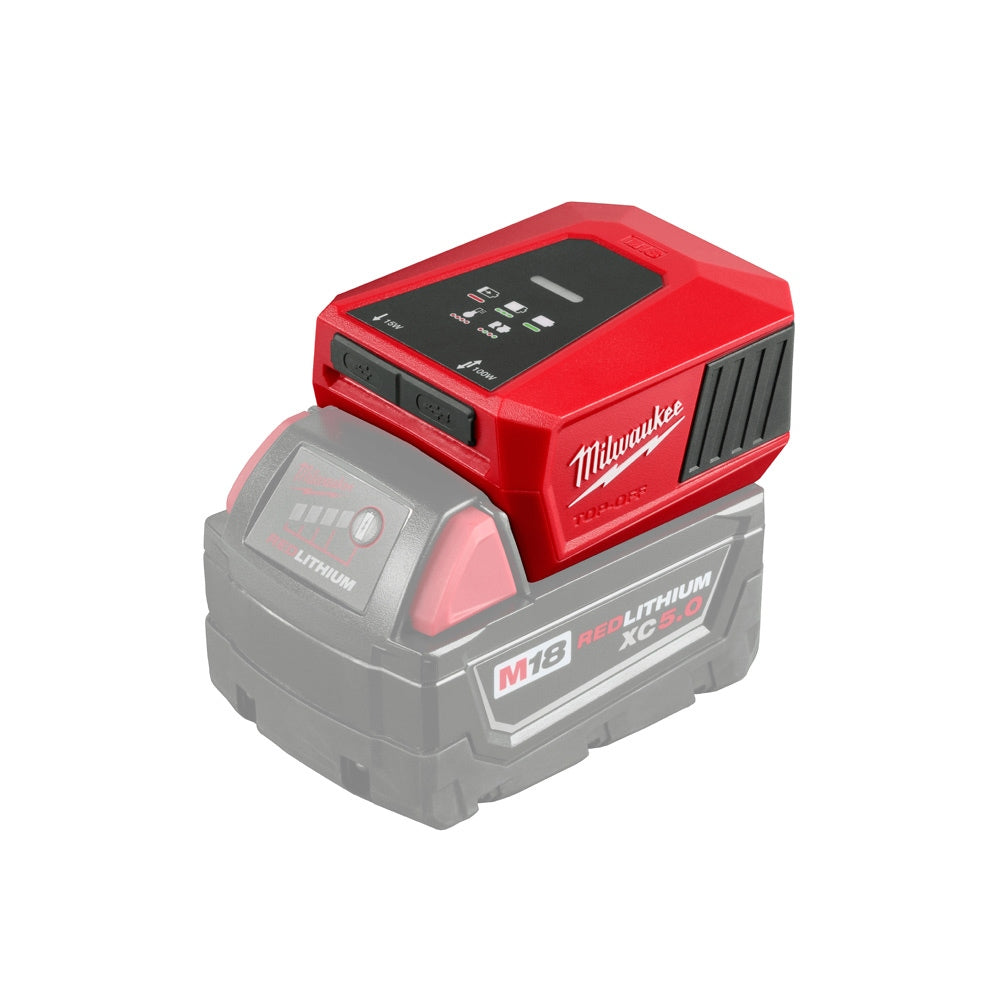
Milwaukee M18 Top-Off Charger vs Power Inverter: Which One You Actually Need
The Milwaukee M18 Top-Off Charger (48-59-2013) is a USB-only device — USB-C PD output, USB-A output, and no wall outlet. The M18 Power Inverter (2846-20) gives you a real 120V AC outlet plus two USB-A ports. If everything you charge takes a USB plug, get the Top-Off (or a cheaper compatible USB-C unit). If you ever need to plug something into a wall — a corded LED work light, a laptop AC brick, a router — you need the Inverter. These two devices solve completely different problems. Here's the breakdown, plus when to skip the OEM price tag entirely.
Milwaukee M18 Top-Off vs Inverter: At a Glance
| M18 Top-Off Charger (48-59-2013) | M18 Power Inverter (2846-20) | |
|---|---|---|
| AC outlet (120V) | No | Yes — 1× NEMA 5-15 |
| Output type | USB-C PD + USB-A | 120V AC + 2× USB-A |
| Charges M18 battery | Yes (USB-C PD in) | No |
| Compatible batteries | All M18 — CP, XC, HD, HO, FORGE | All M18 — CP, XC, HD, HO, FORGE |
| M12 batteries | No | No |
| Best for | Phones, tablets, USB-C laptops | Corded work lights, laptop AC bricks, routers |
| What it won't do | Run anything with a wall plug | Run loads over its continuous watt rating |
Neither unit replaces a generator. Neither runs 240V equipment. Set those expectations now.
What the M18 Top-Off Charger Actually Does (and Doesn't)
It's a 2-Way USB Hub — Battery In, USB Out
The Top-Off Charger does two things:
1. Battery → USB: Clip an M18 pack to it and it powers your USB devices. USB-C PD out for fast-charging devices, USB-A out at 10.5 W (5 V @ 2.1 A). 2. USB → Battery: Plug a USB-C PD source into it — your laptop charger, a car USB-C port, a wall brick — and it trickle-charges the M18 battery clipped on. That's the "Top-Off" feature: recovering some capacity when you're away from a proper Milwaukee charger.
That second feature is legitimately useful if you're already carrying USB-C charging gear. Your 65W laptop brick does double duty.
What It Can Actually Power
At those USB output wattages, you're good for:
- Phones and tablets
- Headlamps, earbuds, Bluetooth speakers
- Any laptop that charges natively via USB-C
- Small USB-powered fans and accessories
What It Cannot Power — At All
Anything with a barrel-plug AC brick, a two-prong NEMA plug, or a three-prong NEMA plug. If your device says "110V" or "120V" anywhere on it, the Top-Off Charger cannot run it. Not a limitation — just not what it is.
A note on naming: the Top-Off Charger is not a charger in the Milwaukee-red-charger sense. It won't fast-charge your M18 packs the way a proper M18 charger does. For a comparison of Milwaukee's actual battery chargers — super charger vs rapid charger, charge times, which one to buy — see super charger vs rapid charger.
What the M18 Power Inverter Actually Does (and Doesn't)

A Real 120V Outlet — One, Plus Two USB-A Ports
The 2846-20 runs 175 watts continuous — with a higher peak rating for brief surge loads — off any M18 battery. One NEMA 5-15 outlet, two USB-A ports, and an LED indicator. That covers:
- LED work lights and corded task lights (most draw 20–100W)
- Laptop AC bricks (check your label — most are 45–90W)
- Job-site routers and Wi-Fi extenders
- Fans, radios, small battery chargers
- Phone and tablet chargers through their wall bricks
One honest caveat on wave type: the 2846-20 outputs a modified sine wave. Most tool chargers and LED lights handle modified sine fine. Sensitive gear — certain audio equipment, older battery chargers, some medical devices — can behave oddly. If you're running a Milwaukee or DeWalt charger off the inverter at a remote site, check your charger's label; modern switch-mode chargers typically tolerate modified sine without issue.
What It Won't Run
Anything pulling more than 175 watts trips the overload. That rules out:
- Microwaves (1,000–1,500W)
- Heat guns (1,200–1,800W)
- Coffee makers (~1,000W)
- Most air compressors (motor surge alone can exceed 500W)
- Any corded saw or large power tool
The M18 inverter is a jobsite convenience tool for low-watt continuous loads, not an off-grid power station. For a clear breakdown of what a 150W inverter can and can't handle across real-world use cases, see our full 150W capacity guide.
The Three Buckets — Which One Fits You
Bucket 1: USB Only — Phones, Tablets, USB-C Laptops
You charge your phone on-site. Maybe top off a headlamp or earbuds. Your work laptop happens to charge over USB-C. That's the full list.
Get the Top-Off — or better: get a compatible M18 USB-C charger at half the OEM price and the same battery interface. It handles Bucket 1 completely. → M18 USB-C fast charger (USB-only)
Bucket 2: You Plug Things Into Walls
Corded LED work light. Laptop with a barrel-plug brick. A Wi-Fi router in a space that isn't wired yet. Any of those = 120V AC needed.
Get the Inverter. The OEM 2846-20 is built to Milwaukee's spec and carries their warranty. If budget is the constraint, a compatible 150W M18 inverter handles the same real-world jobsite load for considerably less. → M18 power inverter (120V AC)
Before you buy, check battery runtime with this inverter — runtime on a 5.0Ah pack at different wattages, so you know how many batteries to bring.
Bucket 3: Both
You need USB charging *and* occasional 120V. These don't overlap — you actually do need both.
Cheapest path: OEM Inverter (for AC reliability) + compatible M18 USB-C charger (saves you the Top-Off premium). Or go compatible on both. Either way, both clip to any M18 pack you own. No adapters, no guessing.
Runtime — How Long Will Your M18 Battery Actually Last?
Top-Off Charger Runtime
A 5.0Ah M18 pack = 5.0Ah × 18V = 90Wh. At ~90% DC-DC efficiency, you have roughly 81Wh usable.
| Pack | Usable Wh | Phone charges (~20W) | Tablet top-ups (~30W) |
|---|---|---|---|
| 2.0Ah CP | ~32 Wh | ~1.5 | ~1 |
| 5.0Ah XC | ~81 Wh | ~3–4 | ~2–3 |
| 12.0Ah HO/FORGE | ~194 Wh | ~8–9 | ~5–6 |
For how FORGE, High Output, and standard packs compare on sustained draw and cold-weather performance — which affects these numbers in the field — see our FORGE vs High Output breakdown.
Inverter Runtime
The math on a 5.0Ah pack at 100W continuous: 5.0Ah × 18V = 90Wh × 0.85 (inverter efficiency) ≈ 76Wh usable ÷ 100W = ~46 minutes
| Load | Runtime on 5.0Ah | What's drawing it |
|---|---|---|
| 30W | ~2.5 hours | Small LED, phone charger brick |
| 60W | ~1 hr 15 min | Laptop (light use), task light |
| 100W | ~46 min | Laptop (heavy), router + light |
| Near continuous max | ~20–25 min | Large work light, multiple devices |
Light loads last longer than most people expect. Heavy loads burn a pack fast — plan to have a second battery on the charger. Bring a 9.0Ah or 12.0Ah pack if you're running anything time-sensitive.
OEM vs Compatible — When to Pay the Milwaukee Premium
Buy OEM When:
- You're on the tools daily and want Milwaukee's warranty standing behind it
- The matched fit and feel matters on client-facing work
- Your company account or tool insurance policy requires OEM gear
Go Compatible When:
- You're a DIYer using it for seasonal or occasional work
- USB charging is all you need and you don't care about the bidirectional battery-top-off feature
- You'd rather put that savings toward another M18 battery or tool
Our compatible M18 USB-C charger M18 USB-C fast charger (USB-only) handles USB delivery with USB-C PD output and fits every M18 pack. Our compatible 150W M18 inverter M18 power inverter (120V AC) runs the same jobsite loads at a fraction of the 2846-20 MSRP. Both use the same battery interface — clip and go.
Straight talk: if this inverter is running 8 hours a day on a job trailer, buy the OEM. If it's powering a corded light on a weekend project a few times a year, the compatible unit does that job without complaint.
M18 Battery Compatibility: Which Packs Fit?
All Current M18 Packs Fit Both Units
Both the Top-Off Charger and the Power Inverter use the standard M18 battery interface. Every current pack in the lineup clicks in:
- Compact (CP) — 2.0, 3.0Ah: fits, but short inverter runtime
- Extended Capacity (XC) — 5.0, 6.0Ah: the everyday sweet spot
- High Demand (HD) — 9.0, 12.0Ah: longest runtime, heavier to carry
- High Output (HO) — 6.0, 9.0, 12.0Ah: same interface, higher discharge capability
- FORGE — 6.0, 8.0Ah: same interface, improved thermal management
Note on small packs with the inverter: a 2.0Ah CP pack at 100W gives you roughly 16 minutes. That's not useless, but plan for it.
M12 Batteries Do Not Fit
M12 packs are physically smaller with a different connector. They will not seat in either device. If you're on M12 and need USB power options, see M12 USB charging options — there are options that actually fit your platform.
FAQ
Can the Milwaukee M18 Top-Off Charger power AC devices?
No. The 48-59-2013 outputs USB-C PD and USB-A only — there is no 120V outlet. For anything with a wall plug, you need the M18 Power Inverter (2846-20) or a compatible M18 inverter.
How many watts is the M18 Power Inverter?
The current model (2846-20) is rated at 175 watts continuous, with a higher peak rating for brief surge loads. The older 2846 had a lower continuous rating — if you're looking at a used unit, check the model number on the label before buying.
How long will a 5.0Ah M18 battery run the inverter?
At 100W continuous: roughly 46 minutes after inverter efficiency losses. At 30W (a phone charger brick or small LED): around 2.5 hours. At or near the inverter's full continuous rating: roughly 20–25 minutes. Pack matters — bigger Ah means longer runtime, same math.
Can you charge an M18 battery with the Top-Off Charger?
Yes — plug a USB-C PD source (65W or higher recommended) into the Top-Off and it charges the M18 battery clipped to it. It's slower than a proper M18 charger, but it works off a car USB-C port or laptop brick. Useful for keeping a pack topped up during a long drive between sites.
Will the Top-Off Charger run a laptop?
Only laptops that charge via USB-C. If your laptop came with a barrel-plug AC brick, that brick needs a wall outlet — which means the Inverter, not the Top-Off.
Do M12 batteries fit either of these?
No. Both units are M18-only. M12 packs have a different, smaller connector and will not fit either device. For M12 USB power options, see M12 USB charging options.
Is there a cheaper alternative to the OEM units?
Yes. Compatible M18 USB-C chargers and 150W inverters use the same battery interface and run around half the OEM price. Trade-off: build feel and warranty length. For occasional or DIY use, compatible is fine. For daily professional use, OEM is the safer bet.
Which One Should You Buy?
USB-only reader: you don't need the Inverter. A compatible M18 USB-C fast charger clips to any M18 pack you already own and costs a fraction of the OEM Top-Off price.
Need a real wall outlet: get the Inverter. OEM if it's daily use, compatible if it's occasional. Our compatible 150W M18 inverter handles the real-world jobsite load without burning you on price.
Both work with every M18 battery in your bag today.
→ M18 USB-C fast charger (USB-only) → M18 power inverter (120V AC) → Full Milwaukee M18 accessory lineup