
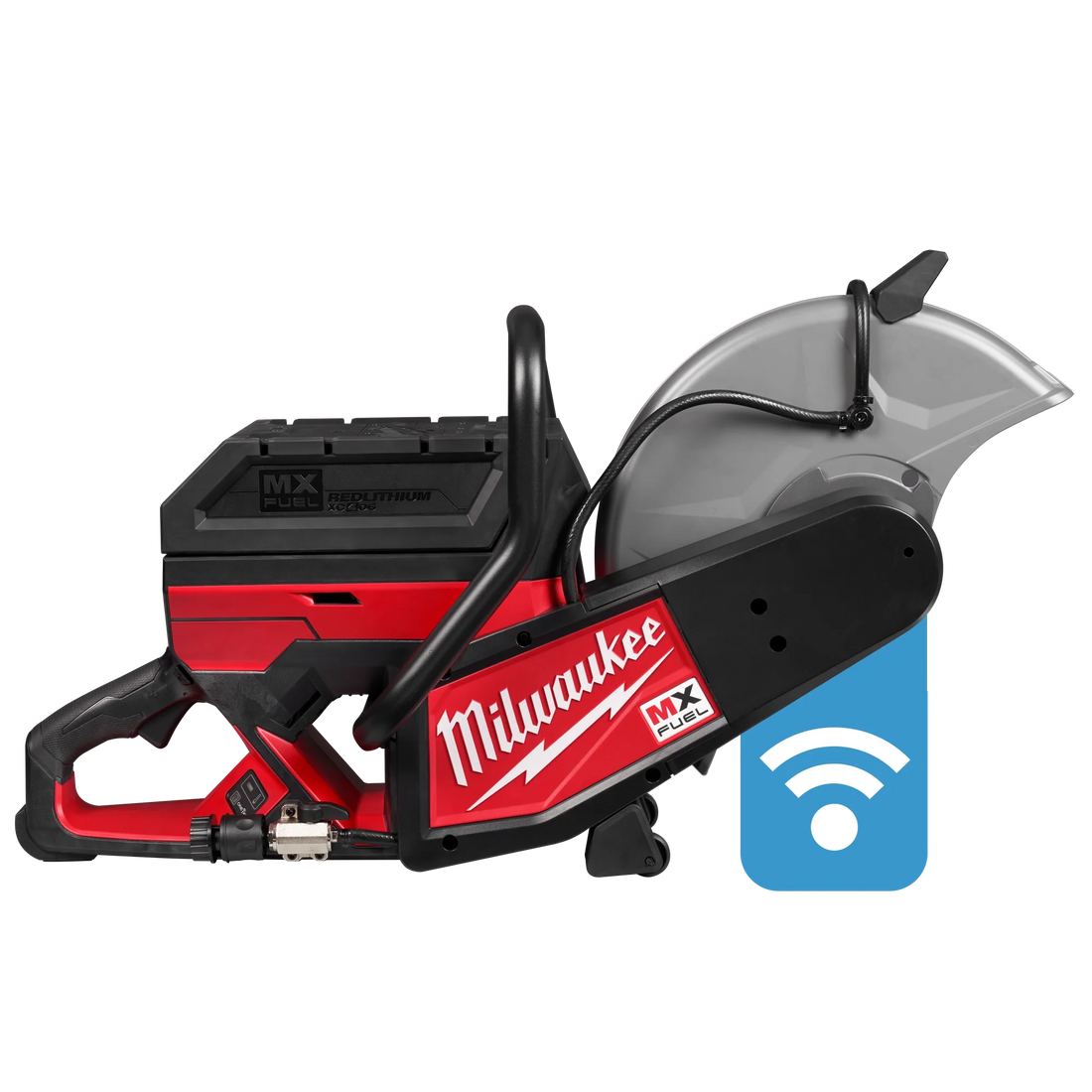
Milwaukee MX FUEL vs Gas Equipment: Is Battery Power Finally Ready to Replace Gas?
For most cut, break, and core work indoors or on a finish-out, MX FUEL already beats gas: no exhaust, no pull-start, way less vibration, and ONE-KEY tracking built in. Gas still wins when you're cutting hard all day without a break, or working somewhere you can't swap and charge packs. One thing to get straight before you spend a dollar: MX FUEL is its own battery platform. Your M18 and M12 packs do not fit it, and its packs do not fit your hand tools. Plan for it as a separate system, not an M18 upgrade.
What is MX FUEL (and how is it different from M18 FUEL)?
This trips up a lot of guys, so let's kill the confusion first.
- M18 FUEL is Milwaukee's brushless *hand-tool* line on the M18 platform — drills, impacts, circular saws, the stuff that runs off your red 18V packs.
- MX FUEL is a completely separate, equipment-class platform. It's built to run gear that used to need a gas engine or a cord: cut-off saws, breakers, core drills, and portable power.
Same "FUEL" word, different worlds. If you walked in thinking MX FUEL was just a bigger M18 battery, that's the trap.
The batteries — and why they don't fit M18
MX FUEL runs on its own 72V REDLITHIUM packs — the XC406 (6.0Ah) and the larger REDLITHIUM FORGE HD12.0 (12.0Ah) — on their own charger. The battery footprint and the tool interface are different from M18 on purpose — this gear pulls far more current than an 18V hand-tool pack is built to deliver. So there's no adapter, no cross-charging, no shortcut: MX FUEL is a separate 72V platform with its own charger, electrically incompatible with the 18V M18 system. If you buy into MX FUEL, you're buying batteries and a charger for it specifically.
MX FUEL vs gas — the honest trade-offs
Here's the straight version, no brochure talk.
| Factor | MX FUEL | Gas equipment |
|---|---|---|
| Fumes / exhaust | None — runs indoors | Exhaust + CO; ventilation needed |
| Noise | Much quieter | Loud |
| Vibration | Lower | High |
| Startup | Trigger pull, instant | Pull-cord, choke, warm-up |
| Maintenance | Charge packs | Fuel, oil, spark plugs, mixing |
| Continuous heavy runtime | Limited by pack; swap spares | Refuel and keep going |
| Best for | Indoor, finish, intermittent | All-day, remote, sustained load |
Where MX FUEL wins
No engine means no exhaust, so you can run a cut-off saw or breaker inside a building without choking the crew or tripping a CO alarm. It's quieter, which matters in occupied buildings and for your hearing over a career. Vibration is lower, which matters if you've ever finished a day on a gas breaker with your hands buzzing — that's the HAVS (hand-arm vibration) exposure OSHA cares about. No fuel to mix, no carb to clean, and it starts on a trigger pull every time, even cold. ONE-KEY tracking and tool management come baked in.
Where gas still wins
If you're cutting concrete or asphalt hard for hours straight, gas refuels in seconds and never slows down — battery gear taps out and you're swapping packs and waiting on charges. On remote sites with no power to recharge, a couple jerry cans beat a dead battery. And at the absolute top end of sustained output, a big gas engine still has headroom that batteries are still chasing.
MX FUEL vs DeWalt POWERSHIFT (the real rival)
Milwaukee isn't the only one chasing the gas engine. DeWalt's answer is POWERSHIFT — a cordless equipment system aimed squarely at concrete and masonry crews, built around a 554Wh battery and a 550W charger that refills it in under 52 minutes.
The short version: both are betting that jobsites go electric, but they aim a little differently. POWERSHIFT is tightly focused on the concrete trade. MX FUEL spreads across a broader range of equipment — including the 14" cut-off saw, breaker, core drill, sewer drum machine, and the CARRY-ON power supply. If you live in one trade, the system built for it may fit better; if you want one battery family across mixed equipment, MX FUEL's spread is the draw.
Which jobs is MX FUEL actually ready for?

- Cut-off saw work — interior cutting, retrofit, anywhere fumes are a problem. Strong yes.
- Demo / breaking — chipping and breaking where noise and vibration matter. Strong yes.
- Core drilling — clean, controlled, no fumes in an occupied space. Yes.
- Drain / sewer machines — running cordless instead of dragging a cord. Yes.
- Portable power — the CARRY-ON power supply, rated at 3600 peak watts and 1800 continuous watts of pure sine power, turns MX FUEL into a quiet, inverter-style power station for tools and small AC loads where a gas generator is overkill or banned.
- All-day high-production cutting on a remote site — this is still gas territory.
Powering the rest of your jobsite
Here's the honest part, because we sell accessories — not MX FUEL equipment. MX FUEL is the answer when you need to *replace a gas machine*. It is absolute overkill if all you want is to keep your phone, lights, and small gear charged on the truck.
For that, the batteries you already own do the job. A USB-C fast charger for M18 batteries turns an M18 pack into a fast USB/USB-C charger for phones and devices. Need a real 120V outlet for a small AC load? A M18 power inverter gives you a 150W socket plus USB ports off the same M18 packs — no second platform, no gas can. Want to know how long a pack will actually run a given load before you rely on it? We broke that math down in how long a power-tool battery runs an inverter.
So: MX FUEL for gas-class equipment, M18 accessories for everyday jobsite power. Two different jobs, two different buys.
FAQ
Do MX FUEL batteries fit M18 tools? No. MX FUEL is a separate, higher-output platform with its own battery interface and charger. M18 and MX FUEL don't interchange in either direction — no adapter makes them work.
Is MX FUEL more powerful than M18? Yes. MX FUEL is built for gas-class equipment — cut-off saws, breakers, core drills — that M18 was never designed to run. M18 covers hand tools.
Is MX FUEL better than gas? For fumes, noise, vibration, instant start, and indoor or OSHA-sensitive work, yes. Gas still wins for continuous all-day high-load cutting and for instant refueling on remote sites with no power.
What's the difference between MX FUEL and DeWalt POWERSHIFT? Both are cordless systems built to replace gas equipment. POWERSHIFT centers on concrete and masonry gear with a large battery and fast charger; MX FUEL spans a broader equipment range. Check each brand's current tool list for the gear you actually run.
How long does an MX FUEL battery last versus a tank of gas? It depends on load. The bigger HD12.0 pack runs longest, but sustained heavy cutting drains any battery fast, so you carry spares and keep one on the charger. Gas refuels in seconds, which is still its edge for nonstop work.
If you're committing to a Milwaukee jobsite, it's worth knowing what runs on which platform before you buy — start with the Milwaukee accessory lineup, and if "FUEL" still has you second-guessing, here's what M18 FUEL actually means in plain English. For how Milwaukee's battery tech actually differs across packs, see FORGE vs HIGH OUTPUT vs REDLITHIUM.