
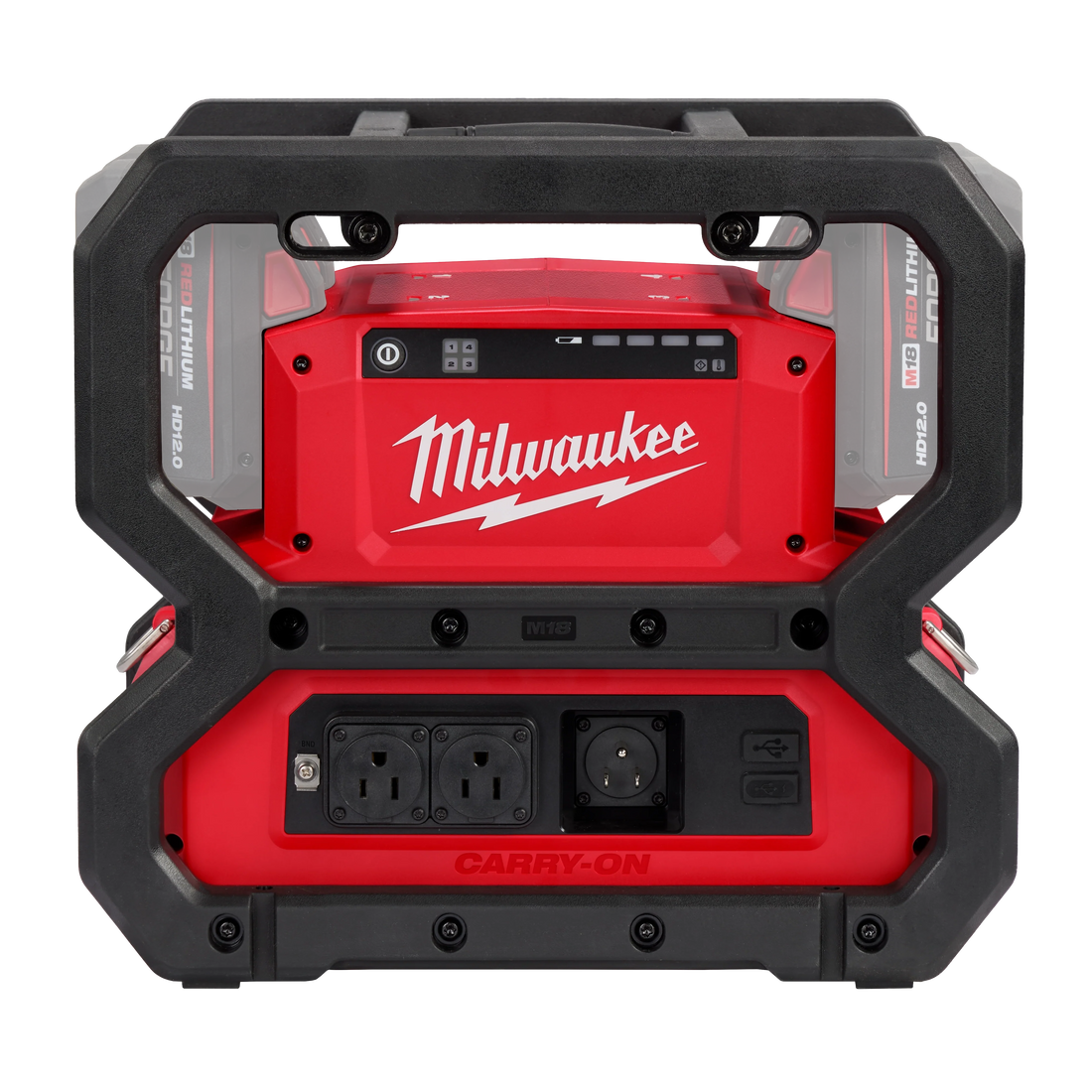
Is 150W Enough for a Power Tool Inverter? (What It Runs, What It Won't)
Short answer: yes, for most things you actually need on a jobsite. A 150W inverter covers phone and tablet charging, laptops drawing up to ~90W, LED work lights, Bluetooth speakers, and small rapid chargers for spare batteries. What it won't touch: coffee makers, heat guns, microwaves, or any AC-powered tool. The real catch most guides skip — 150W is the ceiling, not the clock. A Milwaukee M18 5.0Ah battery holds roughly 90 watt-hours; run it at a full 150W draw and you get about 30 minutes. Match your battery size to the job.
What Can You Run on a 150W Power Inverter?
Devices a 150W Inverter Handles
| Device | Typical Draw | Notes |
|---|---|---|
| Smartphone | 5–20W | Use the built-in USB ports — no reason to touch the 120V outlet |
| Tablet | 15–30W | Same — USB handles it and saves your AC headroom |
| Laptop | 45–90W | Comfortably within the 150W ceiling; see FAQ for runtime |
| LED work light | 20–60W | Standard jobsite use; runs without issue |
| Bluetooth jobsite radio | 10–30W | Common use case, light draw |
| Small portable fan | 30–50W | Fine for compact units |
| Spare battery rapid charger | 60–100W | Keeps a second pack topped up without hitting the ceiling |
Devices That Need More Than 150W
| Device | Typical Draw | Notes |
|---|---|---|
| Coffee maker | 600–1,200W | Even compact drip models pull far beyond 150W — the resistive heating element alone exceeds the inverter's ceiling |
| Microwave | 700–1,200W | Exceeds 150W before it even heats anything |
| Heat gun (corded) | 1,000–1,500W | The DeWalt DWHG1 draws 13 A (1,550 W) — a clear overload at this inverter class |
| AC-powered drill or saw | 1,000–1,800W | Startup surge alone trips the inverter |
| Space heater | 750–1,500W | Resistive loads are immediate overloads at this class |
Both our Milwaukee M18 inverter and DeWalt MAX XR inverter include two USB ports alongside the 120V AC outlet. For phones, tablets, and Bluetooth speakers, you never need the AC side at all — keeping it free extends your battery runtime for anything heavier.
How Long Will a 150W Inverter Run on a Tool Battery?
The watt rating sets your ceiling. Your battery's watt-hours set how long you stay there.
The formula, plain:
- Wh = Voltage × Ah — total energy in the pack
- Runtime (minutes) = (Wh × 0.85) ÷ load watts × 60 — the 0.85 accounts for inverter efficiency losses, standard for modified sine wave units at this class
M18 Runtime Estimates (18V nominal, ~85% efficiency)

| Battery | Wh (calculated) | At 50W | At 100W | At 150W |
|---|---|---|---|---|
| 2.0Ah | 36Wh | ~37 min | ~18 min | ~12 min |
| 3.0Ah | 54Wh | ~55 min | ~28 min | ~18 min |
| 5.0Ah | 90Wh | ~1h 32m | ~46 min | ~31 min |
| 8.0Ah | 144Wh | ~2h 27m | ~1h 13m | ~49 min |
| 12.0Ah | 216Wh | ~3h 40m | ~1h 50m | ~1h 13m |
*Calculated from rated voltage × capacity at estimated 85% inverter efficiency. Real-world varies with battery age, temperature, and load fluctuation.*
For sustained 150W draw, the 5.0Ah is the practical floor — about half an hour at the ceiling, nearly two hours if you drop to a 50W load. A phone or laptop charger pulling 50–65W real-world will nearly double the runtime on the same pack.
For a deeper look at runtime across use cases, our runtime analysis goes further.
DeWalt 20V MAX Runtime Estimates (20V labeled, ~85% efficiency)

| Battery | Wh (calculated) | At 50W | At 100W | At 150W |
|---|---|---|---|---|
| 2.0Ah | 40Wh | ~41 min | ~20 min | ~14 min |
| 3.0Ah | 60Wh | ~1h 1m | ~31 min | ~20 min |
| 5.0Ah | 100Wh | ~1h 42m | ~51 min | ~34 min |
| 6.0Ah | 120Wh | ~2h 2m | ~1h 1m | ~41 min |
| 8.0Ah | 160Wh | ~2h 43m | ~1h 22m | ~54 min |
*DeWalt uses "20V MAX" as the marketing label; Wh figures calculated from that rated voltage × capacity at 85% efficiency.*
The 20V MAX 5.0Ah edges ahead of the M18 5.0Ah on paper (100Wh vs. 90Wh) because of the higher labeled voltage. At real-world loads, the gap is a few minutes — not a reason to switch platforms.
Can You Use a Milwaukee Inverter with a DeWalt Battery (or Vice Versa)?
The connectors are mechanically different. No adapter makes them cross-compatible safely — this isn't a workaround situation.
- Milwaukee M18 inverter fits all Milwaukee M18 batteries. It does not accept DeWalt 20V MAX packs.
- DeWalt MAX XR inverter fits all DeWalt 20V MAX batteries. It does not accept M18 packs.
If you're on Milwaukee, buy the M18 version. On DeWalt, buy the 20V MAX version. That's the whole decision.
When Is 150W Enough — and When Should You Size Up?
Stick with 150W if you're running:
- Phones, tablets, or a laptop — your actual daily jobsite charging load
- LED work lights or a Bluetooth radio
- A rapid charger keeping a spare battery ready
Size up if:
- You need to run multiple high-draw devices at the same time
- You have any resistive heating load — coffee maker, heat gun, hot plate
- You want to power an AC tool, even briefly — 150W won't do it
Here's the honest read: most real jobsite inverter use lands under 100W. You're charging devices, not running appliances. For that, 150W is the right call, and the runtime numbers above back it up. If your situation is genuinely heavier, that's a different product category and you know it.
For broader context on running your battery pack as a portable power source, our full guide covers the full picture.
Frequently Asked Questions
What can you run on a 150W power inverter? Phones, tablets, laptops up to ~90W, LED work lights, Bluetooth speakers, small portable fans, and rapid chargers for spare batteries. Not microwaves, coffee makers, heat guns, or AC-powered tools — those draw far more than 150W and will trip the inverter immediately.
Can a 150W inverter run a laptop? Yes. Most laptops draw 45–90W under load, well inside the 150W ceiling. An M18 5.0Ah pack (~90Wh, ~76Wh usable) will run a 65W laptop for roughly 70 minutes by the math. A DeWalt 20V MAX 5.0Ah (~100Wh, ~85Wh usable) gives a bit more headroom. Real-world varies with battery age and screen brightness.
How long will a 150W inverter run on a tool battery? At the full 150W draw: an M18 5.0Ah lasts about 31 minutes; an M18 12.0Ah pushes past an hour. Drop the load and the math stretches fast — an 18W phone charger on that same M18 5.0Ah runs for roughly 4 hours. The battery's Ah is the real variable here.
Can a 150W inverter run power tools? No. AC-powered tools draw 1,000–1,800W at startup — a 150W inverter trips before the motor finishes spinning up. Keep the inverter for device charging and lighting, not tool operation.
Can I use a Milwaukee M18 inverter with a DeWalt battery? No. The connectors are platform-specific by design. The M18 inverter only accepts M18 packs; the DeWalt 20V MAX inverter only accepts 20V MAX packs. There's no safe cross-platform adapter.
If you're on Milwaukee, the M18 inverter covers everything in the tables above. On DeWalt, the 20V MAX inverter is the right fit. Browse the full Milwaukee collection or DeWalt collection to find the battery Ah that matches your runtime needs.