
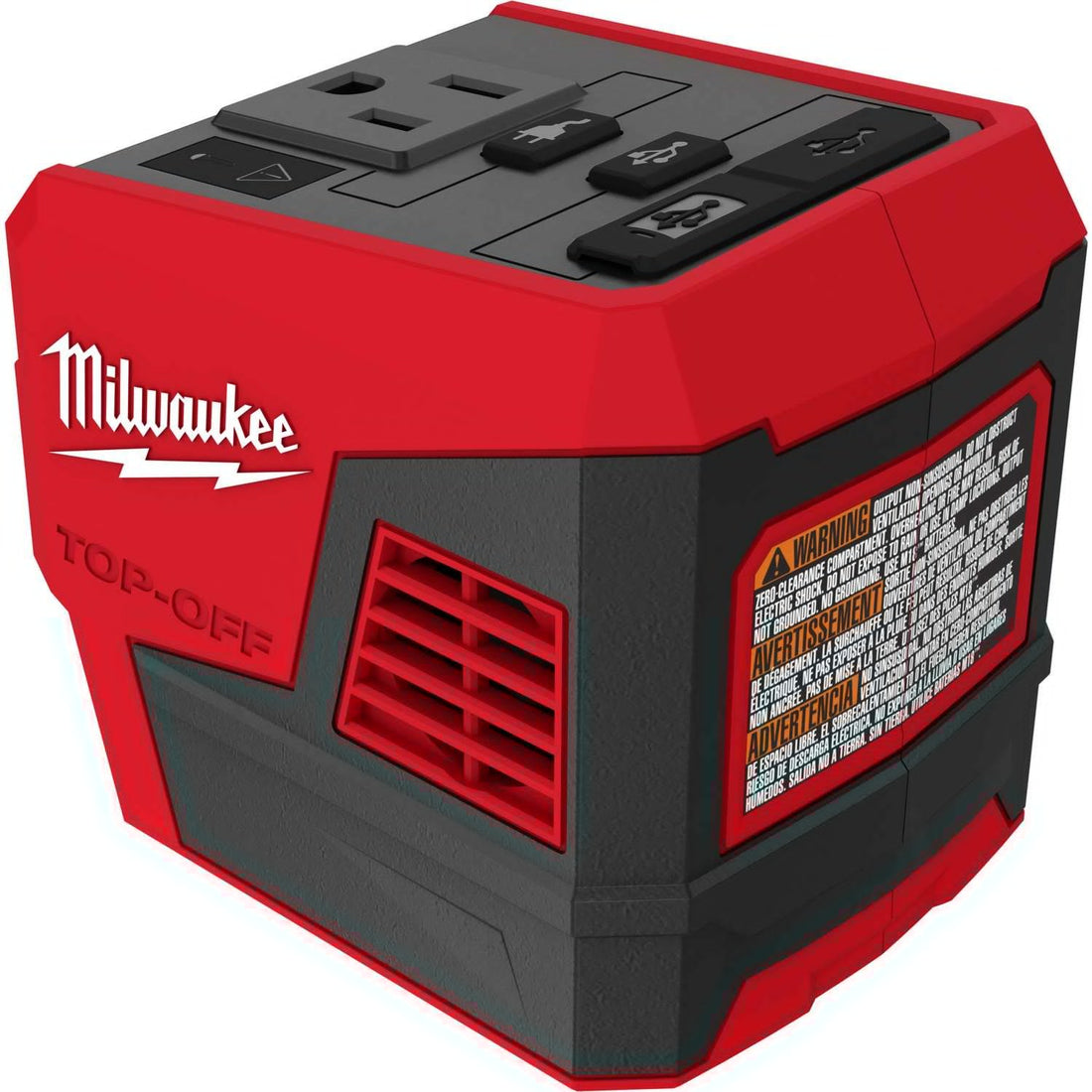
Using a Power Tool Battery as a Portable Power Source
Yes — the Milwaukee M18 or DeWalt 20V battery already in your toolbox can run as a portable power source. You snap on an adapter and the pack becomes a battery bank: a USB adapter charges phones and small gear, while a power inverter gives you a 120V wall outlet for AC devices. No separate power station to buy or keep charged. The right choice comes down to what you need to power. Here's how each option works, what it can run, and which one fits your platform.
Can you really use a power tool battery as a power source?
You can. An adapter mounts on a charged pack the same way a tool does, then gives you USB ports or a wall outlet to run your gear. Think of the battery you already carry as a power bank that happens to also run your drill.
One thing to be clear on: the adapter pulls power *out* of a charged pack. It doesn't recharge the battery — for that you still need your normal charger. So you're spending the charge that's in the pack, not adding to it.
USB adapter vs. power inverter (what each can run)

This is the real decision. Both mount on your battery, but they output different things.
| USB adapter | Power inverter | |
|---|---|---|
| Output | USB ports (5V / USB-C) | 120V AC outlet (plus USB) |
| Best for | Phones, tablets, headlamps, small USB gear | Anything with a wall plug |
| Size | Pocket-size | Larger, heavier |
If everything you need to charge runs off USB, the adapter is smaller, cheaper, and all you need. If you have to plug in something with a standard wall cord — a laptop brick, a small light, a charger for another device — you need an inverter that gives you a real 120V socket. Our 150W inverters include a 120V outlet plus two USB ports and an LED light, so they cover both.
How much can you actually run?
Set expectations here. Runtime depends on two things: how many amp-hours your pack holds, and how much the device draws. A big 8.0Ah or 12.0Ah pack running a phone charger lasts a long time. The same pack running a 120W laptop through an inverter empties much faster.
These adapters are built for topping off devices and running small loads on the go — not for powering a fridge or running tools all day. For a full breakdown of how long a pack lasts under an AC load, see how long a power tool battery runs an inverter.
Which adapter fits your battery? (compatibility-first)
Adapters are platform-specific. They use each brand's battery rail, so they are not interchangeable across brands.
| Your battery | Use this adapter |
|---|---|
| Milwaukee M18 | A Milwaukee M18 USB adapter or M18 inverter |
| DeWalt 20V MAX (and FLEXVOLT in 20V mode) | A DeWalt 20V USB adapter or 20V inverter |
A Milwaukee adapter will not fit a DeWalt pack, and vice versa. Match the adapter to the platform you already own. If your pack slides onto your drill, the matching adapter for that brand will fit it.
Our picks by platform
If you're on Milwaukee M18:
- For devices: the Milwaukee M18 USB-C fast charger — a USB-C fast charger with an LED screen that shows remaining pack charge.
- For wall-plug gear: the Milwaukee M18 power inverter — a 150W inverter with a 120V socket and USB ports.
If you're on DeWalt 20V MAX:
- For devices: the DeWalt 20V USB-C charger — USB-C charging up to 65W, with both USB-C and USB-A ports. The same idea is covered in depth in our DeWalt 20V USB charger adapter guide.
- For wall-plug gear: a DeWalt MAX XR 150W power inverter with a 120V outlet plus USB.
Safety and battery care
A few habits keep this safe and keep your packs healthy:
- Don't run a pack flat. Deep-discharging a lithium pack repeatedly shortens its life. Pull the adapter when the pack gets low.
- Mind the heat. Charging devices generates some heat; don't bury the adapter in a closed bag in the sun.
- Skip homemade rigs. Don't wire your own adapter or jumper across the terminals. A proper adapter has the protection circuitry; a DIY version doesn't, and that's a fire risk.
- Store packs right. If you keep a battery on hand for emergencies, store it properly so it's ready — see how to store power tool batteries. And know that the cold cuts into performance: our guide on charging lithium-ion batteries in cold weather explains why.
FAQ
Can you use a power tool battery as a power bank? Yes. A USB adapter turns a Milwaukee M18 or DeWalt 20V pack into a USB power bank for phones, tablets, and small gear.
USB adapter or inverter — which do I need? Get a USB adapter if you only charge USB devices. Get an inverter if you need a 120V wall outlet for AC gear like a laptop brick or a small light.
Will a Milwaukee adapter work on a DeWalt battery? No. Adapters are platform-specific — Milwaukee adapters fit M18, DeWalt adapters fit 20V MAX. They aren't interchangeable across brands.
How long will a power tool battery last as a power source? It depends on the pack's amp-hours and how much the device draws. A bigger pack and a low-draw device (like a phone) run far longer than a small pack pushing a high-draw AC load.
Does the adapter recharge my battery? No. It pulls power out of a charged pack to run devices; it doesn't put power back in. You still charge the pack on your normal charger.
Ready to put a spare pack to work? Grab the right adapter for your platform — browse the Milwaukee collection or the DeWalt collection for USB chargers and inverters that fit the batteries you already own.