
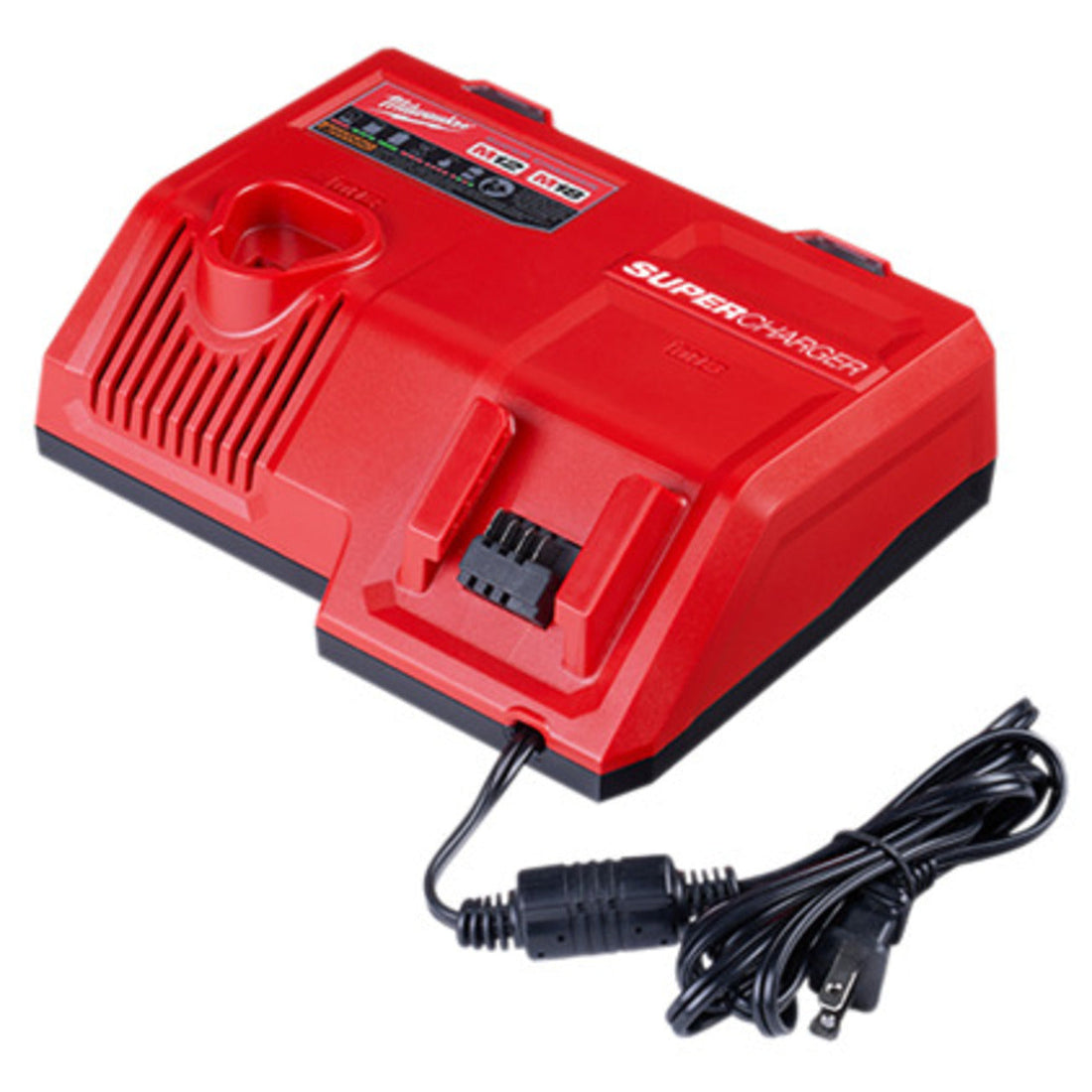
Milwaukee Super Charger vs Rapid Charger: Which One Should You Buy?
The Rapid Charger (48-59-1808) is the right charger for most M18 owners. It handles every HO and standard RedLithium pack Milwaukee sells, costs $119.00, and came in your kit for a reason. The Super Charger (48-59-1809) runs about 2× the price and earns that premium in exactly two situations: you own M18 Forge batteries (which need it to hit their advertised fast-charge speeds), or you're running a crew that can't sit around for an hour between cycles. If the Rapid Charger came with your kit, you're not leaving anything on the table for HO and standard packs.
The Quick Verdict: Who Should Buy Which Charger?
Get the Rapid Charger if…
- You own M18 HO or standard RedLithium packs and don't need faster than ~60 minutes on a 5.0 Ah battery
- You're a DIYer or weekend user — a second battery costs less than the upgrade to a Super Charger and gives you continuous runtime anyway
- You already have a kit-included charger and it's working fine
Get the Super Charger if…
- You own M18 Forge batteries — these are spec'd for the Super Charger and won't hit their headline charge times on the Rapid
- You're a contractor or crew where tools run all day and faster turnaround directly affects productivity
- You're standardizing a multi-battery charging station and every minute of charge time adds up
Skip both (for device charging) if…
- Your actual problem is charging phones, radios, or heated gear on site — neither Milwaukee charger does that. You want a USB-C fast charger for M18 batteries or a M18 power inverter for that job.
Spec-by-Spec Comparison
Charge Rate and Amperage
The Super Charger pushes a higher amperage output than the Rapid Charger, which is why large packs charge noticeably faster. The Rapid Charger is no slouch — it's what Milwaukee ships in most kit configurations for a reason — but the Super Charger's output rate is meaningfully higher on 8.0 Ah+ packs and essential for Forge's fast-charge spec.
- Rapid Charger amperage: Milwaukee does not publish a single official amperage figure for this model; refer to the spec sheet in your box or Milwaukee's product page for the confirmed output rating.
- Super Charger amperage: 6 A AC (M18™ & M12™ Super Charger model 48-59-1811)
Battery Compatibility: Which Packs Work on Each Charger?
Both chargers work with M18 RedLithium packs — standard, HO, and Forge. The difference isn't *whether* they charge, it's *how fast*.
| Battery Line | Rapid Charger (48-59-1808) | Super Charger (48-59-1809) |
|---|---|---|
| M18 Standard RedLithium | ✓ Full speed | ✓ Full speed |
| M18 High Output (HO) | ✓ Full speed | ✓ Full speed |
| M18 Forge | ✓ Charges safely | ✓ Required for advertised fast-charge |
| M12 packs | ✗ Does not fit | See note below |
M12 owners: the Rapid Charger (48-59-1808) is M18 and M12 dual-platform compatible, charging both battery systems sequentially up to 40% faster than standard chargers. On the Super Charger side, Milwaukee offers multiple models with varying M12 compatibility: the M18™ & M12™ Super Charger (48-59-1811) and M18™ & M12™ Four Bay Super Charger (48-59-1818) are compatible with M12 batteries, while the M18™ Dual Bay Simultaneous Super Charger (48-59-1815) is M18-only. If you're unsure which Milwaukee platform you're actually on, read up on M12 vs M18 differences to sort that out fast.
Cooling: Active Fan vs. Passive
This is a real, physical difference. Both the Super Charger and the Rapid Charger feature active cooling — specifically Milwaukee's COOL-CYCLE™ Active Cooling System, which provides high-speed cooling for less downtime.
On a hot jobsite, charging multiple packs back-to-back, that active thermal management matters — it reduces pack temperature during charge, which Milwaukee ties directly to battery longevity and safe fast-charging on Forge packs.
Size, Weight, and Cord Length
The Super Charger is physically larger — a higher-amperage charger needs more hardware. It's a shop or van charger, not something you toss in a bag to carry to a quick job. The Rapid Charger is more portable. For exact dimensions and cord length, refer to the spec sheets on Milwaukee's product pages for each model.
Price
- Rapid Charger (48-59-1808): $119.00
- Super Charger (48-59-1809): pricing is significantly higher — expect to pay roughly double the Rapid Charger's price at most retailers
That price gap is the crux of the "is it worth it?" question. More on that below.
Side-by-Side Spec Table
| Rapid Charger 48-59-1808 | Super Charger 48-59-1809 | |
|---|---|---|
| Amperage output | See Milwaukee spec sheet | 6 A AC (model 48-59-1811) |
| Active cooling | Yes (COOL-CYCLE™) | Yes (COOL-CYCLE™) |
| M18 Standard / HO compatible | Yes | Yes |
| M18 Forge fast-charge | No — charges slowly | Yes — required |
| M12 compatible | Yes — dual-platform | Varies by model (see compatibility note above) |
| Street price | $119.00 | Significantly higher — check current retailer listings |
Real-World Charge Times by Battery
This is where the Super Charger earns its money — or doesn't, depending on your pack lineup.
| Battery | Rapid Charger (48-59-1808) | Super Charger (48-59-1809) |
|---|---|---|
| M18 HO 3.0 Ah | Check Milwaukee's published specs | Faster — check Milwaukee's published specs |
| M18 HO 6.0 Ah | Check Milwaukee's published specs | Faster — check Milwaukee's published specs |
| M18 HO 8.0 Ah | Check Milwaukee's published specs | Noticeably faster — check Milwaukee's published specs |
| M18 HO 12.0 Ah | Check Milwaukee's published specs | Noticeably faster — check Milwaukee's published specs |
| M18 Forge 6.0 Ah | Slower than Super Charger — not optimized for Forge fast-charge | 15 minutes (Milwaukee's advertised fast-charge time) |
> Charge times are from Milwaukee's published specs. Real-world times vary with battery temperature and state of discharge — a hot pack fresh off a drill will always take longer than the published number.
Why Forge Batteries Change the Math
The M18 Forge line was designed around the Super Charger. Milwaukee spec'd those packs to charge fastest with the Super Charger's higher amperage and active cooling working together. The Rapid Charger will charge a Forge pack safely — it won't damage it — but you won't get the fast charge times Milwaukee advertises on the Forge battery page.
If you're invested in the Forge platform, the Super Charger isn't optional — it's part of the system you bought into. Running Forge packs on a Rapid Charger is a bit like buying a performance truck tire and driving on a dirt road at 35 mph. It works. You're just not getting what you paid for.
For more on how Forge packs compare to HO and standard RedLithium in the first place, compare M18 Forge vs. High Output vs. RedLithium before you decide which battery line to build around.
When the Rapid Charger Is the Smarter Buy

Most DIYers and homeowners are in this camp, and there's no shame in it.
Here's the math: the Super Charger costs meaningfully more than the Rapid Charger — enough that a second M18 HO 5.0 Ah battery often runs in the same price range as that gap. With two batteries, you're running one on the tool while the other charges — which means *continuous* runtime with a Rapid Charger, versus faster charging with a single battery on a Super Charger.
For weekend projects, renovations, and occasional jobsite work, two batteries and a Rapid Charger beats one battery and a Super Charger every time. The Rapid Charger that came with your M18 kit is genuinely the right tool for that use case. Milwaukee ships it as the default for a reason.
The Super Charger makes sense when faster charging directly translates to more jobs done — which means professional crews, not guys knocking out a Saturday punch list.
See also: what M18 FUEL really means — if you're sorting out which M18 tools and batteries actually make sense for your workflow, that post covers the FUEL line in the same no-hype way.
What About a USB Charger for the Jobsite?
One thing both of these chargers have in common: they don't charge your phone, radio, or heated jacket. They are battery-to-tool chargers, full stop.
If your real problem on site is keeping devices powered, that's a different tool entirely. Two options worth knowing:
Milwaukee M18 USB-C power supply — plugs into your M18 battery and delivers USB-C fast charging up to 65W. Charges phones, tablets, and most USB-C devices directly from the packs you already own.
power inverter for M18 batteries — 150W inverter with a 120V outlet plus two USB ports. When you need to run small AC tools, a laptop, or anything that needs a proper outlet, this turns any M18 battery into a jobsite power source.
Neither of these replaces your battery charger — they work alongside it. You're using your charged M18 packs to power everything else on the truck or bench.
FAQ
Q: What's the difference between the Milwaukee Super Charger and Rapid Charger?
The Super Charger (48-59-1809) outputs more amperage and includes Milwaukee's COOL-CYCLE™ Active Cooling System — it's required to hit M18 Forge batteries' advertised fast-charge speeds and meaningfully faster on large HO packs (8.0 Ah+). The Rapid Charger (48-59-1808) is Milwaukee's standard kit charger, also features COOL-CYCLE™ active cooling, handles every HO and standard RedLithium pack without issue, and is the right call for most users.
Q: Is the Milwaukee Super Charger worth it?
Only in two situations: you own Forge batteries, or you're running tools all day in a professional context where charge-time turnaround costs you money. For DIYers and weekend users with HO packs, a second battery and the Rapid Charger is almost always the better investment.
Q: Does the Super Charger work with all M18 batteries?
Yes — it charges every M18 RedLithium pack (standard, HO, and Forge). Forge packs are the only ones that require the Super Charger to hit their published fast-charge times; HO and standard packs charge fine on either charger.
Q: Will the Rapid Charger charge a Forge battery?
Yes, safely — but not at Forge's headline speeds. Those advertised fast-charge times are spec'd for the Super Charger. You won't damage a Forge pack on a Rapid Charger, but you won't get the full benefit either.
Q: Can either charger charge M12 batteries?
The Rapid Charger (48-59-1808) is dual-platform compatible and charges both M18 and M12 batteries. On the Super Charger side, compatibility depends on the specific model — the M18™ & M12™ Super Charger (48-59-1811) and Four Bay model (48-59-1818) support M12, while the Dual Bay Simultaneous model (48-59-1815) is M18-only. If you own M12 tools and need a mobile charging or USB solution, the M12 USB charger for heated jackets covers the M12 platform.
Q: Can the Super Charger or Rapid Charger charge my phone or USB devices?
No — they charge Milwaukee batteries only. For phones, radios, and other USB devices on site, the USB-C fast charger for M18 batteries is the accessory you need, or the M18 power inverter if you need a full 120V outlet.
Q: What model numbers should I look for?
Milwaukee Rapid Charger = 48-59-1808. Milwaukee Super Charger = 48-59-1809. Those numbers are on the box and in Milwaukee's catalog — don't buy a used charger without confirming the model number.
The charger decision is straightforward once you know your batteries. Rapid Charger for HO and standard RedLithium — it's the right call for most of us. Super Charger if you're in the Forge ecosystem or running all-day professional work. And whichever one you land on, the right accessories — USB-C adapters, inverters, quality bits — are what make the M18 platform actually pay off on a real job.
Browse the full Milwaukee collection and pick up what's actually missing from your kit.