
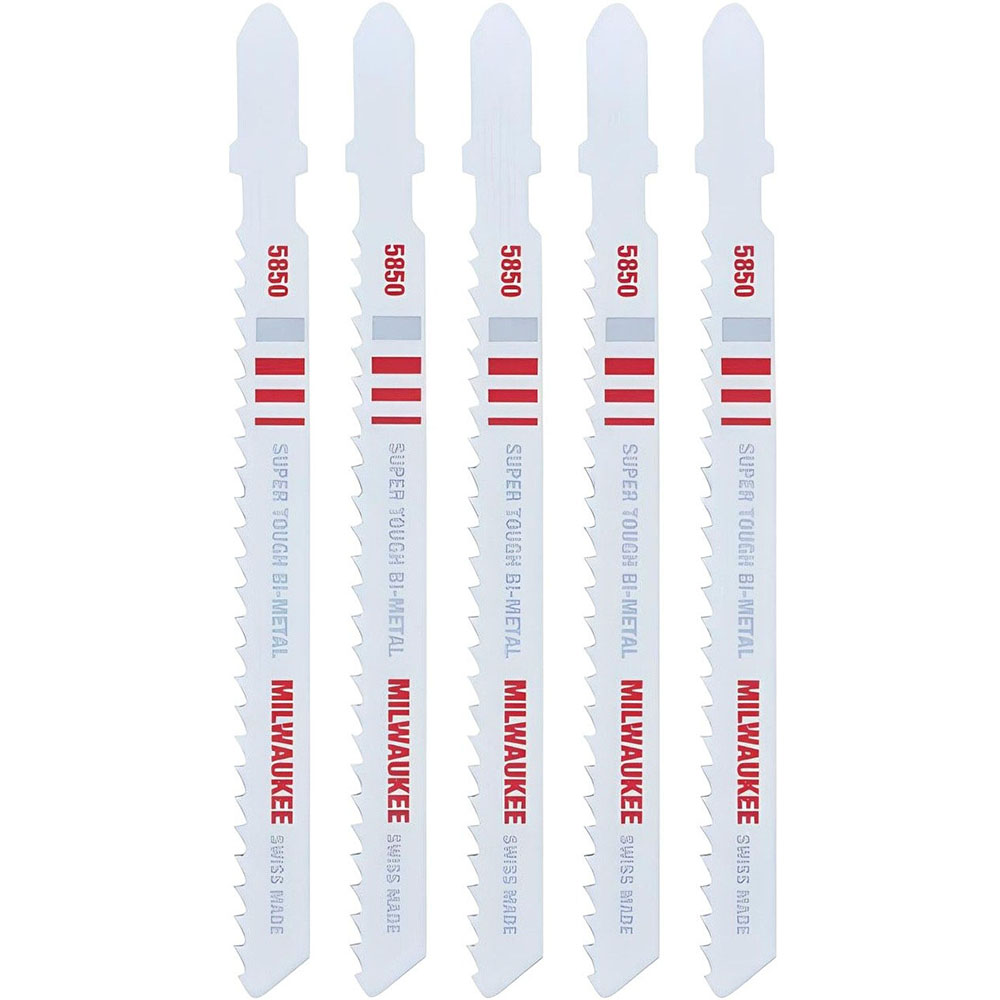
Jigsaw T-Shank Blade Compatibility: What Fits Your Milwaukee or DeWalt
Jigsaw T-shank blade compatibility is straightforward: T-shank is the modern standard and fits virtually every major brand — Milwaukee, DeWalt, Bosch, Makita, and the rest. If your jigsaw was made in the last 15–20 years, it's almost certainly T-shank. The one exception: older U-shank (bayonet) jigsaws that use a set-screw clamp won't accept T-shank blades without an adapter. Once you've confirmed you have T-shank, the brand on the blade packaging doesn't matter. TPI and material are what determine the cut — not the logo.
T-Shank vs. U-Shank — What's the Physical Difference?
T-Shank (Tool-Free Quick-Release)
T-shank gets its name from the T-shaped collar at the blade's base. That collar snaps into a spring-loaded chuck — no tools, no set screws, one squeeze to release. Faster to swap, more secure under vibration, and the tang geometry is a de facto universal standard — confirmed by Bosch, Milwaukee, and other major manufacturers — which is why it became dominant.
Every current Milwaukee M18, M12, and DeWalt 20V MAX cordless jigsaw uses T-shank.
U-Shank (Bayonet / Set-Screw)
U-shank blades have a flat, notched shank clamped by one or two set screws — you need a hex key to swap blades. Still found on some older jigsaws and a handful of budget saws. Easy to identify: if the chuck has a lever or button release, it's T-shank. If there's a screw, it's U-shank.
The two types are not interchangeable. Don't force a T-shank blade into a U-shank chuck.
Do Milwaukee and DeWalt Jigsaws Use T-Shank?

Yes — all current Milwaukee and DeWalt cordless jigsaws use T-shank. Here's the breakdown:
| Platform | Model Family | Shank Type | Notes |
|---|---|---|---|
| Milwaukee M18 | 2645-20, 2737-20 (M18 FUEL) | T-shank | Full-size; longer stroke |
| Milwaukee M12 | 2445-21 (M12 compact) | T-shank | Shorter stroke — watch blade length |
| DeWalt 20V MAX | DCS331, DCS334 | T-shank | Standard and orbital models |
All models listed use T-shank — confirmed across Milwaukee's M18 and M12 lines and DeWalt's 20V MAX family.
One practical upside for two-platform shops: if you run both Milwaukee and DeWalt on the same job, you're buying one type of blade for both saws.
Are T-Shank Blades Interchangeable Across Brands?
Yes — and this is worth saying plainly because most blade guides hedge around it.
The T-shank tang geometry is standardized. A Bosch T-shank blade seats in a Milwaukee chuck. A Diablo blade runs in a DeWalt. Lenox, Freud, Milwaukee, DeWalt — same interface. As Bosch states on their blade packaging, T-shank blades "fit all T-shank jig saws" and "fit tools of most brands." Brand is not a compatibility variable.
What is NOT freely interchangeable is blade length. Longer blades on a compact saw can bind if the blade exceeds the saw's stroke travel. On the M12 compact jigsaw, stick to shorter blades that match its stroke length; the M18 handles full-length blades without issue.
The takeaway: choose blades by TPI and material. The logo on the packet is irrelevant.
What Actually Matters When Buying T-Shank Blades
Two specs do the work: TPI (teeth per inch) and blade construction (bi-metal vs. high-carbon steel).
TPI by Material
| Material | Recommended TPI |
|---|---|
| Soft wood / framing lumber | 6–10 |
| Hardwood / finish cut | 10–12 |
| Sheet metal / thin metal | 18–24 |
| Hardened metal / pipe | 24–32 |
TPI guidance is consistent across published blade selection guides from Milwaukee, Bosch, Lenox, and Diablo.
Lower TPI cuts faster and rougher. Higher TPI cuts slower and cleaner. Match TPI to what you're cutting and how clean the edge needs to be — that's the whole decision.
Bi-Metal vs. High-Carbon Steel
Bi-metal blades (high-speed steel teeth bonded to a flexible carbon-steel body) last longer in mixed-material work — wood with nails, metal, demo cuts where you're not sure what you'll hit. Worth the extra cost for anything beyond clean lumber.
High-carbon steel blades are cheaper and work fine for wood-only cuts. They dull fast on metal contact, so don't use them where fasteners are likely.
Both types come in T-shank as standard. Material construction doesn't change the shank.
FAQ: Quick Answers on Jigsaw Blade Compatibility
Are T-shank jigsaw blades universal? Yes — T-shank blades fit any modern jigsaw with a tool-free blade clamp, regardless of brand. T-shank fits over 90% of current jigsaw makes and models, making it the effective universal standard across the industry.
What is the difference between T-shank and U-shank jigsaw blades? T-shank has a T-shaped collar that snaps into a tool-free quick-release chuck. U-shank (bayonet) has a flat shank clamped with one or two set screws. They are not interchangeable.
Do Milwaukee jigsaws use T-shank blades? Yes — all current Milwaukee M18 and M12 cordless jigsaws use T-shank blades, including the 2645-20 and 2737-20 (M18 FUEL) and the 2545-20 (M12 FUEL).
Do DeWalt jigsaws use T-shank blades? Yes — all current DeWalt 20V MAX jigsaws use T-shank blades — the DCS331B, DCS334B, and DCS335B are all T-shank.
Can I use any brand's T-shank blades in my jigsaw? Yes. Bosch, Milwaukee, DeWalt, Diablo, Lenox, and Freud T-shank blades all seat in the same chuck. Choose by TPI and material, not brand.
What TPI do I need for cutting wood vs. metal? Wood TPI varies by application — fewer teeth for rough framing cuts, more for clean finish edges. Metal requires higher TPI based on material thickness and hardness; check the blade manufacturer's selection guide for your specific application.
What does "T-shank" stand for? The "T" refers to the T-shaped tang on the blade's shank that locks into the jigsaw's quick-release clamp — it may also appear in product literature as "tang shank" or "universal shank."
If your M18 or DeWalt 20V jigsaw needs blades, you're buying T-shank — sort by TPI for your material and you're done. For the rest of your Milwaukee and DeWalt accessory needs, browse the Milwaukee and DeWalt collections.
Working through other blade and bit compatibility questions? See our guides on circular saw blade compatibility, hole saw arbor standards, and hex vs. round shank bits — these three cover the shank and arbor decisions most people run into.