
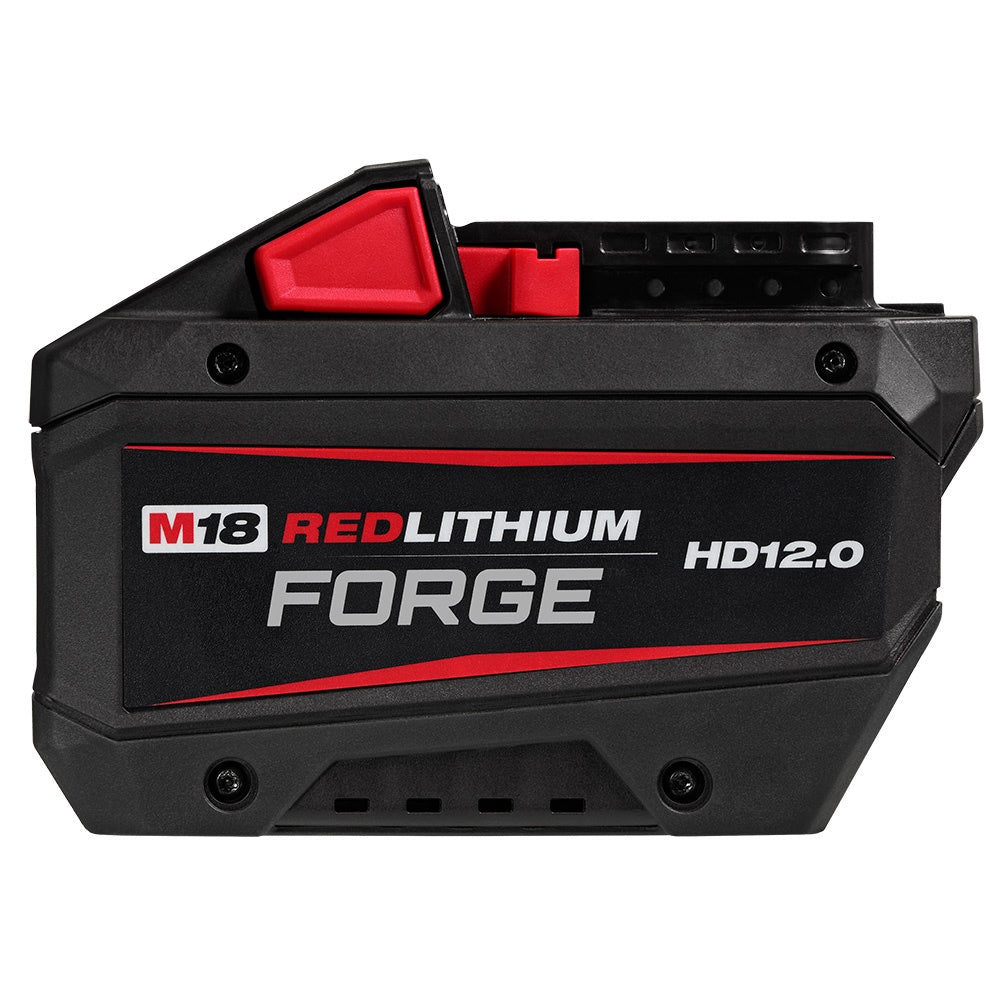
Milwaukee Forge HD12 vs DeWalt FlexVolt 12Ah: Which Big Battery Wins in 2026?
Neither battery wins outright in the Milwaukee Forge HD12 vs DeWalt FlexVolt 12Ah matchup — they win for different owners. If you're already running Milwaukee M18, the Forge HD12 is the right upgrade: tabless cells, full backwards compatibility with every M18 tool you've owned since 2005, and dramatically faster charging when you pair it with the right charger. If you're on DeWalt 20V MAX, the FlexVolt DCB6112 is the right move: same tabless cell technology, 12Ah at 20V, and a built-in upgrade path to 60V FlexVolt tools whenever you're ready. Switching platforms to chase battery specs is almost never worth it. Here's the honest comparison.
Milwaukee Forge HD12 vs DeWalt FlexVolt 12Ah — Spec Comparison at a Glance
| Milwaukee Forge HD12 | DeWalt FlexVolt DCB6112 | |
|---|---|---|
| Voltage | 18V nominal / 20V max | 20V MAX / 60V MAX (auto-switching) |
| Capacity | 12.0 Ah | 12.0 Ah at 20V / 4.0 Ah at 60V |
| Cell tech | Tabless | Tabless |
| Platform fit | All M18 tools (2005–present) | All 20V MAX + FlexVolt 60V tools |
| Cross-platform? | No | No |
| Warranty | 3 years | 3 years |
Charge times are in their own section below — because the number that matters depends entirely on which charger you already own.
What "Tabless" Actually Means (and Why Both Brands Went There)
For years, battery cells were connected to each other using small metal tabs welded onto the end of each cylindrical cell. Those tabs create a pinch point — current has to squeeze through them, which generates heat and limits how fast you can push amps through the pack.
Traditional tab welds vs tabless construction
Tabless cells eliminate those welds. The electrode rolls up the full width of the cell, so current flows across the entire face rather than through a narrow metal tab. More surface area, lower internal resistance, less heat generated per charge cycle.
Both Milwaukee and DeWalt moved their flagship 12Ah packs to tabless construction in 2024–2025. Milwaukee calls theirs "Forge" technology. DeWalt's DCB6112 uses a similar tabless architecture. The marketing language differs; the underlying physics is the same.
Why tabless cells matter for your tools
Three practical effects. First, heat is the primary killer of lithium-ion capacity — less heat per cycle means the pack holds more of its rated capacity longer. Second, lower internal resistance lets the battery sustain higher amp draws without voltage sag, which shows up as more consistent power on demanding tools like grinders and table saws. Third, faster charging: less heat generated during charge means you can push more current in without triggering the battery management system's thermal throttle.
That last point is what the "charge faster" marketing is really about — but only if your charger can actually push the higher current. More on that in the charge-time section.
Runtime and Power — Which Battery Hits Harder on the Tools You Own?
Milwaukee Forge HD12 on M18 FUEL tools
The Forge HD12 is built for M18 FUEL grinders, circular saws, table saws, and other high-draw tools. On a sustained-draw tool like an M18 FUEL rear-handle circular saw, the extra capacity over a 5Ah pack is real and noticeable — you're not swapping packs mid-cut. On your M18 FUEL impact driver or drill, you'll barely notice the difference in runtime compared to a 6Ah; you'll absolutely notice the extra weight.
The Forge HD12 is also the battery that makes a M18 power inverter worth owning. A 150W inverter drawing off a 12Ah pack gives you hours of runtime for charging laptops and running small tools at a campsite or remote jobsite — a 5Ah pack doesn't have the same staying power for that use case.
FlexVolt DCB6112 on 20V MAX vs 60V tools

The DCB6112 is a two-mode battery. In any 20V MAX tool — your existing drills, impacts, saws — it runs at 20V and delivers 12Ah of capacity. That alone makes it useful. But slide it into a FlexVolt-labeled tool (their 60V table saws, FlexVolt circular saws, miter saws), and the pack's internal circuitry automatically switches the series configuration to deliver 60V. At 60V it's equivalent to about 4Ah — so you're trading runtime for voltage on those tools. The same logic applies to the DeWalt 150W inverter — the extra capacity at 20V makes it a legitimate jobsite power source for a full day.
Where the extra Ah does NOT help
Short-burst tools don't care. Your impact driver fires in two-second bursts — it doesn't need 12Ah of reserve. Your M18 or 20V MAX drill driving screws into framing lumber won't feel the difference between a 5Ah and a 12Ah. The 12Ah is a high-draw, long-run tool battery. Buying two 12Ah packs and running them in rotation is usually the wrong call — one 12Ah for the saw and a 5Ah for the drill beats two 12Ah bricks on opposite ends of your belt.
Charge Time — The Real Number on the Charger You Probably Own
This is where the marketing math gets slippery.
Forge HD12 charge times: which charger you use matters
Milwaukee rates the Forge HD12 at approximately 35 minutes (to 80% supercharge) on the M18 Super Charger (48-59-1818). That's the $180 charger most buyers *don't* own — the standard M18 Rapid Charger (48-59-1808) stretches charge time to 130 minutes, which is a significant difference.
If you're still on the Rapid Charger, upgrading to the Forge HD12 without also buying the Super Charger means you're getting the runtime benefits but not the charge-speed benefits. See Super vs Rapid Charger comparison for the full breakdown on which charger is worth the upgrade first.
FlexVolt DCB6112 charge times: fast charger vs standard
DeWalt's DCB6112 charges noticeably faster on the DCB1112 12A fast charger than on older equipment. On the standard DCB115 — the charger most 20V MAX owners have — expect a considerably longer wait. That gap matters on a long job day. See charger compatibility guide if you're not sure which DeWalt charger you're running.
Verdict: budget for the fast charger
Neither battery hits the marketing number on the charger 90% of buyers own. Budget for the fast charger when you buy the 12Ah flagship — otherwise you're running your most expensive pack on a timeline that doesn't match the pace of work.
Weight, Balance, and Tool Feel
A 12Ah flagship pack is noticeably heavier than the 5Ah or 6Ah packs most people use day-to-day. The FlexVolt DCB6112 uses a 15-cell configuration to support 60V operation, which generally makes it heavier than the Forge HD12. Milwaukee specs the Forge HD12 at 3.3 lb; the DCB6112 adds more mass on top of that thanks to its dual-voltage cell arrangement.
That weight matters on vertical work. Running a 12Ah pack in an M18 or 20V MAX drill while driving overhead screws fatigues your wrist faster than a 5Ah does. The 12Ah shines on tools where the battery sits low and the tool rests on the work: table saws, miter saws, grinders on a bench, jobsite radios. It's not the pack you want on a drill you're carrying around a framing job all day.
Warranty, Cell Tech, and Price Per Amp-Hour
Both packs carry a 3-year limited warranty. Milwaukee covers M18 batteries for three years from purchase. DeWalt's terms include the same three-year coverage plus one year of free service and a 90-day money-back guarantee — a slightly more comprehensive package on paper.
On price, both flagship 12Ah packs land in a similar premium range — you're spending real money on either one. The platform lock-in cost is bigger than the price difference between them. If you own six Milwaukee M18 tools, the cost of switching to DeWalt to get the DCB6112 is not the battery price — it's replacing every tool. That math makes the "which battery wins" question almost irrelevant for most buyers.
On a per-amp-hour basis, both are more expensive than their brand's standard 5Ah or 6Ah packs. That premium buys you tabless cells, faster charge capability, and sustained high-draw performance. If you don't regularly run high-draw tools for extended periods, the cost-per-Ah math doesn't pencil out.
Which One Should You Buy?
The decision tree is short.
Already on Milwaukee M18? Buy the Forge HD12. It fits every M18 tool you own — that backwards compatibility stretches to 2005. Pair it with an M18 Super Charger if you don't have one. Add an M18 USB-C charger to pull a workday's worth of USB-C device charging off the pack without burning through your tool batteries. See the full Milwaukee accessory lineup at Milwaukee accessories. For deeper context on where the Forge HD12 sits in Milwaukee's battery lineup, M18 battery lineup comparison covers the field.
Already on DeWalt 20V MAX? Buy the DCB6112. It works in every 20V MAX tool now and hands you the 60V FlexVolt upgrade path later with no additional battery spend. Pair it with a DeWalt USB-C charger for device charging on the job. See the DeWalt accessory lineup at DeWalt accessories. For the full DeWalt battery picture, FlexVolt 12Ah detailed review has the deep-dive, and 20V MAX vs FlexVolt guide explains the 20V/60V switching for anyone still working it out.
Starting fresh with no existing tools? The battery comparison matters less than which tool ecosystem fits your work. Milwaukee M18 FUEL is the dominant platform for trades. DeWalt 20V MAX / FlexVolt is the dominant platform for contractors. Pick the platform, then pick the battery.
Frequently Asked Questions
Are the Milwaukee Forge HD12 and DeWalt FlexVolt 12Ah interchangeable?
No. They use entirely different battery interfaces and voltage systems. The Milwaukee M18 slide connector and the DeWalt 20V MAX slide connector are not the same, and no adapter safely bridges the two platforms. Do not look for an adapter — it doesn't exist in a reliable form.
Is the Forge HD12 worth it over the M18 High Output 12Ah?
If you own the M18 Super Charger, yes — the tabless cells cut charge time meaningfully and sustain higher amp draws with less heat. If you're still on the Rapid Charger, the runtime on your tools is nearly identical to the older M18 HO 12Ah. The extra spend is hard to justify until you also upgrade the charger.
Does the FlexVolt 12Ah work in regular DeWalt 20V tools?
Yes. Slide it into any 20V MAX tool and it runs at 20V, delivering the full 12Ah. It only switches to 60V configuration when seated in a tool labeled FlexVolt. You don't have to do anything — the battery handles the switch automatically.
How long does the Forge HD12 take to charge?
Milwaukee claims approximately 35 minutes (to 80% supercharge) on the M18 Super Charger (48-59-1818). On the standard M18 Rapid Charger, expect significantly longer — 130 minutes.
How long does the FlexVolt 12Ah take to charge?
DeWalt rates the DCB6112 as significantly faster on the DCB1112 12A fast charger than on older equipment. On a standard DCB115, charge time stretches considerably — plan for a multi-hour recharge window mid-day if that's your only charger.
Which is heavier, the Forge HD12 or the FlexVolt 12Ah?
Both are heavy compared to a 5Ah or 6Ah pack. The FlexVolt DCB6112 is generally heavier because the 15-cell configuration needed to support 60V operation adds mass. Milwaukee specs the Forge HD12 at 3.3 lb; the DCB6112 runs heavier. Either way, both will fatigue your wrist faster than a standard pack in overhead or one-handed work.
Can I use a 12Ah battery on a small M18 or 20V drill?
Physically, yes — the pack snaps in and the tool runs normally. Ergonomically, it's a bad match. A 12Ah pack tips the balance of a compact drill backward, and holding that weight overhead or at arm's length for a full day wrecks your wrist. Save the 12Ah for grinders, circular saws, table saws, and jobsite radios where the battery sits low or the tool rests on a surface.
Does one charge faster than the other on their brand's best charger?
Head-to-head on fastest-available chargers, Milwaukee's Super Charger paired with the Forge HD12 is the faster combination per-Ah on paper. DeWalt's DCB1112 12A fast charger with the DCB6112 is close behind. Both are fast when paired with the right charger — and slow when they're not.
Whichever platform you're locked into, the 12Ah flagship is only as fast as the charger sitting next to it and only as useful as the accessories you pair it with. A 12Ah pack running a USB-C fast charger or a 150W inverter is a real jobsite power system. The same pack on a slow charger is a $250 brick that takes half a day to refill.
Browse the fast chargers, USB adapters, and inverters that make a 12Ah pack pull its weight: Milwaukee tools for M18 owners, DeWalt tools for DeWalt owners.