
Circular Saw Blade Tooth Count Guide: Which Count for Every Cut
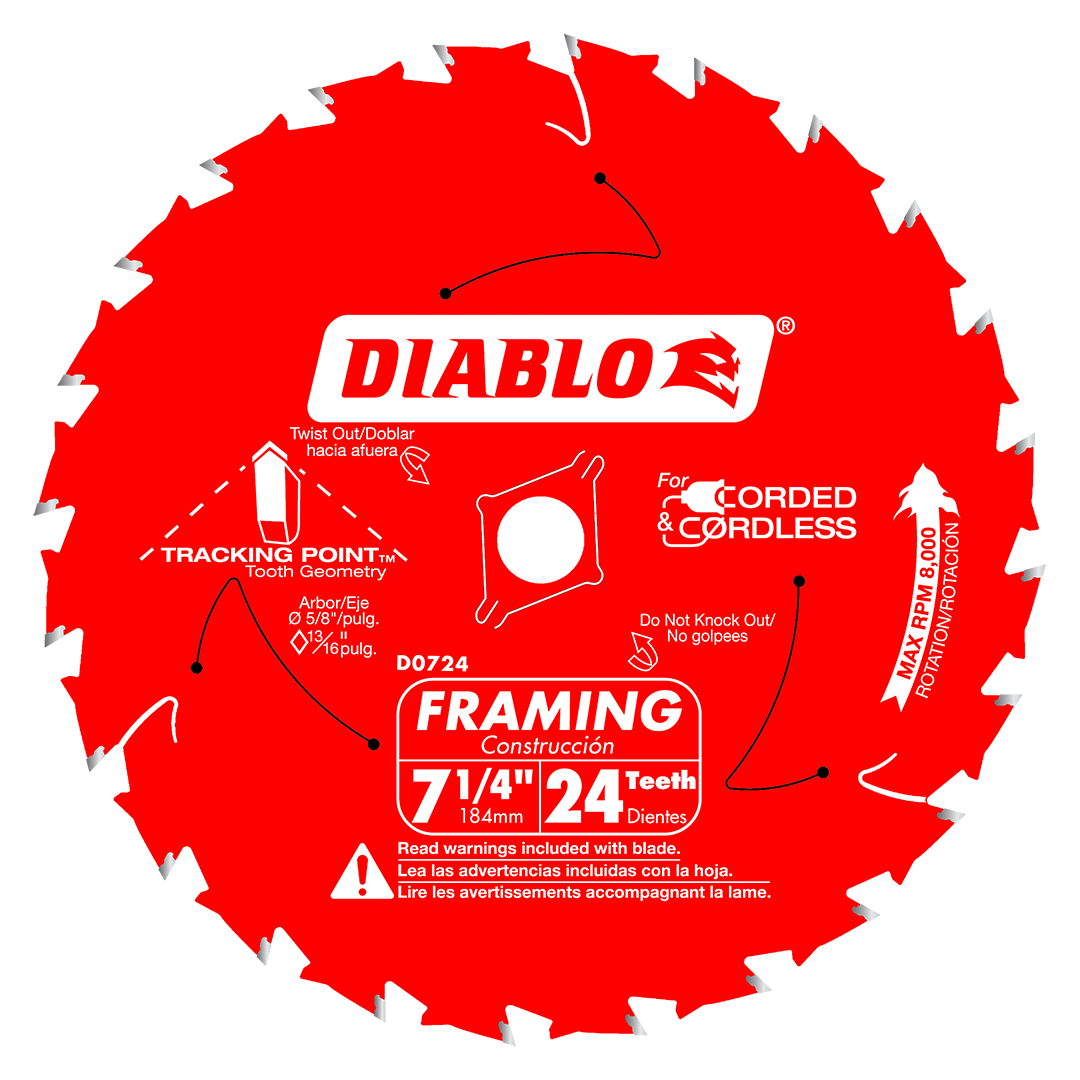
Circular saw blade tooth count controls how fast you cut and how clean the edge comes out. Fewer teeth cut faster and rougher; more teeth cut slower and cleaner. For framing and rough cuts in dimensional lumber: 24T. For plywood, OSB, and sheet goods: 40T. For finish cuts in hardwood or trim: 60T or higher. If you're running an M18 or 20V MAX cordless saw, add one more rule: always choose a thin-kerf blade at whatever tooth count you pick — your motor runs cooler and your battery lasts longer. Full breakdown by material below.
What Does Tooth Count Actually Control?
Chip Load Per Tooth
Every tooth on a circular saw blade removes a small chip of material with each pass through the cut. Tooth count controls how big that chip is relative to your feed rate.
Fewer teeth mean each tooth takes a larger bite. Chips come off fast, the blade clears them before they can recut, and the saw moves through stock quickly. That's ideal for framing — you want speed, and a rough edge doesn't matter.
More teeth take smaller bites. Each pass is finer, the surface comes out cleaner, and heat builds faster because there are more friction events per inch. That's what you want for finish work. Just don't expect to rip through a stack of 2×10s at the same pace.
Hook Angle
Hook angle is the tilt of each tooth face relative to the blade's center. It's a completely separate spec from tooth count, and it controls how aggressively the tooth grabs the material.
A high positive hook angle — 15° on a dedicated framing blade — pulls the blade into the cut. Fast, aggressive, built for ripping lumber. A fine crosscut blade also runs at 15°, designed to feed smoothly without grabbing. MDF and melamine blades use a slight negative hook angle — the Freud LU97M010 is specced at −3° — to prevent chipping on entry.
Don't conflate hook angle with tooth count. A 40T blade with a high hook angle grabs aggressively. A 40T blade with a low hook angle feeds smooth. Both have 40 teeth. The geometry matters as much as the count.
Kerf Width
Kerf is the width of material the blade removes per pass. Full-kerf blades cut around 1/8". Thin-kerf blades cut a narrower path — 0.059″ on a blade like the Diablo D0724A.
That ~1/32" difference is why thin-kerf matters so much on a battery-powered saw. More on that below.
Which Tooth Count for Each Material?
| Material | Recommended Tooth Count | Thin Kerf? | Notes |
|---|---|---|---|
| Framing / dimensional lumber (2× stock) | 24T | Yes, on cordless | Fast chip evacuation; rip cuts eat fine teeth; coarse keeps pace with your feed rate |
| Plywood / OSB / sheet goods | 40T | Yes, on cordless | Balances speed and tearout control on both faces |
| MDF / particle board | 60T | Yes | Dense, dusty material; 0° or slight negative hook reduces face blowout; watch your feed rate |
| Hardwood, finish cuts | 60T–80T | Yes, on cordless | Slower feed required; verify blade max RPM ≥ saw no-load RPM before running |
| Pressure-treated / wet lumber | 24T carbide-tipped | Yes | PT resin gums fine teeth fast; coarse clears before buildup can cook the carbide |
| Composite decking | 60T+ | Yes | Abrasive filler content; use carbide rated specifically for composite or it won't survive a deck |
| Metal / fiber-cement | Dedicated specialty blade | N/A | Not a wood-blade application; tooth count is not comparable; do not use wood blades on these materials |
The thin-kerf column for cordless isn't a suggestion — it's the right default. Here's why.
Why Thin-Kerf Matters More on Cordless Than You Think
Cordless circular saws run at lower no-load RPM than corded saws. The Milwaukee M18 FUEL 2732-20 spins at 5,800 RPM unloaded. The DeWalt DCS570B comes in at 5,500 RPM. A typical corded saw — a Skilsaw SPT67WM-22, for reference — runs around 5,500–5,800 RPM. That gap is real.
Less RPM means each tooth hits the material with less rotational force. Mount a full-kerf blade on a cordless motor and you're asking a less powerful motor to cut a wider path through the same material. It bogs, runs hotter, and the battery drains faster — sometimes noticeably so mid-board in hardwood.
Thin-kerf blades remove roughly 25% less material per pass. That's less resistance on the motor, less heat at the blade, and more cuts per charge. On a corded saw with a 15A motor, this difference is small enough that many pros never think about it. On an M18 or 20V MAX with a 5.0Ah pack, you'll feel it.
The rule for cordless: default to thin-kerf at every tooth count. Only step to full-kerf if your blade selection doesn't exist in a thin-kerf version, or if blade deflection is a concern in thick hardwood where rigidity matters more than efficiency.
When Is 40T the One Blade to Leave on the Saw?
Most cordless circular saws on a job site do mixed work all day: ripping framing, cross-cutting sheet goods, trimming boards to length. You're not swapping blades every five minutes.
A 40T ATB+R thin-kerf blade is the practical answer for that use case. ATB (Alternating Top Bevel) geometry alternates the bevel angle of each tooth, which handles crosscuts cleanly. The "R" — a raker tooth mixed in every few ATB teeth — clears chips on rip cuts. Together they handle a wide range of materials without being exceptional at any one of them.
The honest trade-off: a combo blade is the right default, not the best blade for any specific job. Dedicated finish carpentry? Swap to 60T and slow your feed. Framing all day? Drop to 24T and speed up. The 40T ATB+R is what you run so you can get through a mixed day without stopping every hour to change blades.
What Tooth Count Won't Tell You
Tooth count is the first number most people look at on the package. These four specs get skipped and they matter:
Carbide grade. Blade carbide runs C3 (general purpose) and C4 (premium — harder, holds an edge longer on abrasive materials). The grade is listed on blade packaging or the manufacturer spec page. For composite decking, hardwood, or other abrasive materials, C4 lasts noticeably longer. For general framing, C3 is fine.
Expansion slots. The slots cut into the blade body let it flex slightly as heat builds during a fast cordless cut. More slots means better heat management and less blade warp under sustained load. On a summer deck job where you're running long, it matters.
Maximum blade RPM. Every blade has a max RPM printed on its body and listed in its spec. That number must be equal to or greater than your saw's no-load RPM — always check this before mounting a blade, especially with finish blades running high tooth counts.
Arbor size. Standard cordless circular saws use a 5/8" arbor. Most 7-1/4" blades match this, but don't assume — confirm before buying, especially with import blades. For full arbor and blade size compatibility detail, see detailed compatibility guide.
FAQ
What tooth count circular saw blade for plywood?
40T. It balances speed and tearout control on both faces of the sheet. On a cordless saw, use thin-kerf. If you need a tearout-free face veneer cut — furniture, cabinet parts — step up to 60T and slow your feed rate.
What tooth count for framing lumber?
24T. Rip cuts through dimensional lumber generate large chips. A fine-tooth blade loads up fast and bogs your cordless motor down. 24T evacuates chips cleanly and keeps the saw moving at a pace that matches how fast you can feed it.
Is more teeth always better on a circular saw?
No. More teeth means a finer cut but slower feed, more heat, and more power draw per pass. On a cordless saw that's especially costly because you're burning amp-hours. Match tooth count to the material — more teeth is only better when finish quality requires it.
What tooth count for cutting pressure-treated wood?
24T, carbide-tipped. PT lumber is loaded with chemical preservatives and often still carrying moisture. That resin gums fine teeth fast and burns them. Coarse teeth clear the sticky material before it has time to build up and cook the carbide tips.
Can I use a 60T blade for framing?
Technically yes. Practically, no. It's slow, builds heat fast, and cuts into your battery runtime on a cordless saw. A 60T blade on framing is also harder on the blade itself — you're pushing a fine-tooth cutter through rough, knotty dimensional lumber it wasn't designed for. Keep the 24T for framing; swap to 60T for finish work.
What's the difference between a 24T and 60T circular saw blade?
A 24T removes material fast with a rough edge — right for framing, demo, and rough cuts where the edge gets covered or doesn't matter. A 60T takes finer bites, leaves a smooth edge, and works best for finish cuts in hardwood or sheet goods where tearout shows. Wrong choice either way: too many teeth on rough stock burns the blade and bogs your motor; too few teeth on finish work splinters the edge.
Does tooth count matter more on a cordless circular saw?
Yes. Cordless saws run at lower RPM and have a fixed amp-hour budget per charge. A high-tooth-count, full-kerf blade on an M18 or 20V MAX draws more power per pass and generates more heat than the same blade running on a corded saw with a wall outlet behind it. Picking the right tooth count — and defaulting to thin-kerf — makes a measurable difference in how many cuts you get per charge.
The right blade at the right tooth count is the accessory that makes your cordless saw cut clean instead of burning through stock and battery. For M18 platform owners, browse M18 accessories. DeWalt 20V MAX users, head to 20V MAX tools.
Saw blades aren't in our catalog yet — that's a gap we're working to fill. What is there: chargers, inverters, and bit sets that run off the same battery you just cut with.
Cutting with a reciprocating saw? Sawzall blade selection guide covers Sawzall blade selection by material and TPI. For oscillating tool blades, see oscillating tool blade compatibility. For jigsaw blades, jigsaw blade compatibility guide covers T-shank compatibility in full.