
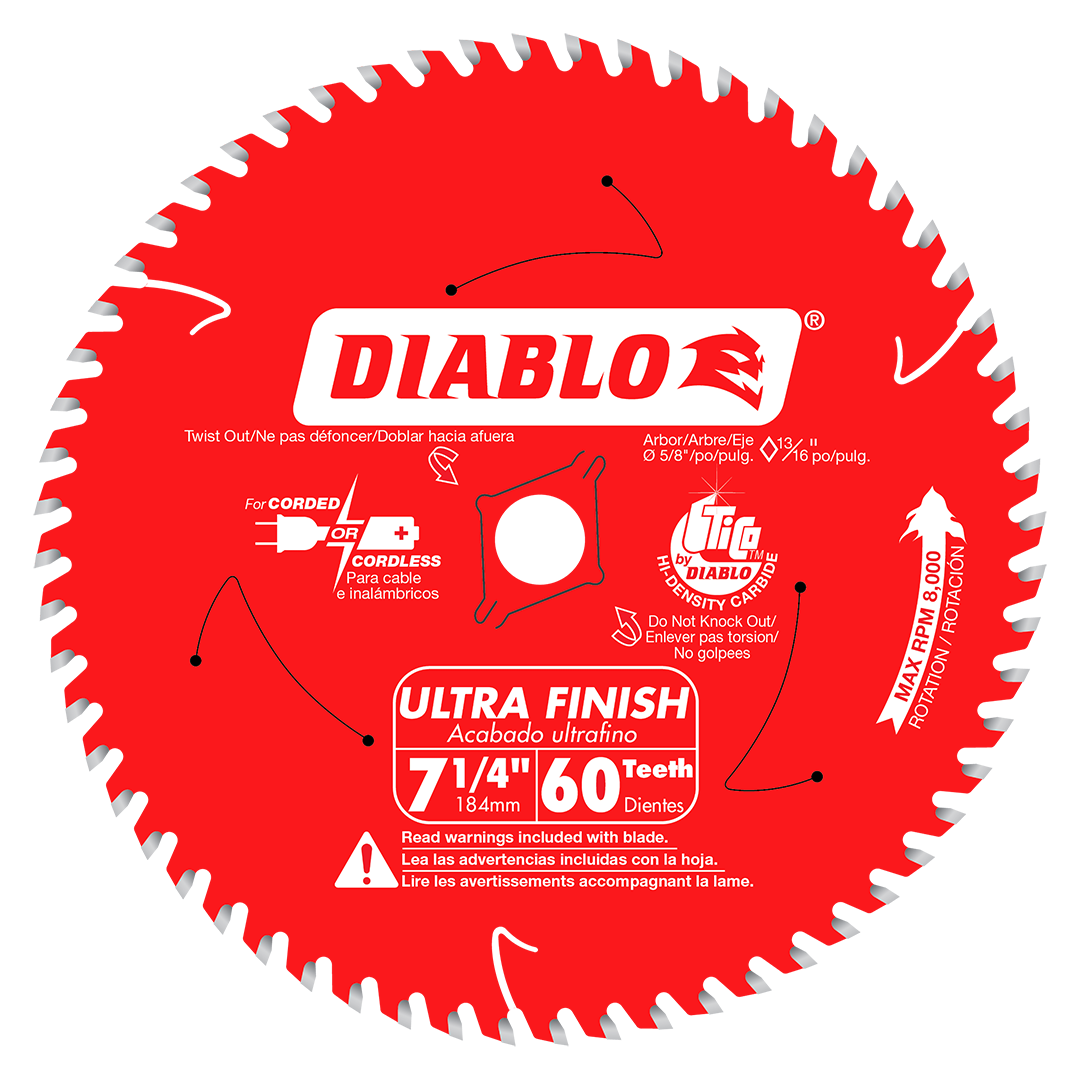
Diablo vs Milwaukee vs DeWalt Circular Saw Blades: Which Should You Buy?
Diablo, Milwaukee, and DeWalt circular saw blades all use the standard 5/8" arbor — a Diablo blade drops onto a Milwaukee M18 saw, a Milwaukee blade fits a DeWalt 20V MAX, and vice versa. You are not locked to the OEM blade. The only fit question that actually matters first: match the diameter to your saw (6‑1/2" for most cordless; 7‑1/4" for corded and high-output cordless). Get the diameter right, then choose by tooth count and kerf. For most cuts, Diablo gives the best cut quality per dollar. Milwaukee and DeWalt OEM blades earn their premium on demolition, nail-embedded work, and OEM-platform tuning. Badge loyalty should be last on your list.
Quick Verdict — Which Blade Wins for What
| Brand | Best For | Price Tier | The Short Version |
|---|---|---|---|
| Diablo (Freud) | General cuts, finish work, wide selection | Mid | Best cut-quality-per-dollar; TiCo carbide and Perma-Shield coating; widest specialty lineup |
| Milwaukee | Demolition, nail-embedded, M18 OEM pairing | Mid–Premium | Strong demo/nail-slicer lines; OEM-tuned for M18 motors |
| DeWalt | Framing, general use, same-day retail availability | Mid | Solid framing-blade value; wide stock everywhere; OEM-tuned for 20V MAX |
Do Diablo, Milwaukee, and DeWalt Blades Fit Your Saw?
Yes — one caveat.
Match the Diameter First
Most cordless circular saws — Milwaukee M18 and DeWalt 20V MAX included — take a 6‑1/2" blade. Larger corded saws and high-output cordless models (Milwaukee M18 FUEL with the larger shoe, DeWalt FLEXVOLT with deep-cut capacity) take 7‑1/4". Check the spec plate on your saw; that number overrides everything else. A 7‑1/4" blade won't seat correctly on a 6‑1/2" saw, and a 6‑1/2" blade on a 7‑1/4" saw wastes cutting depth.
Arbor Size — the 5/8" Standard (and the Diamond Knockout)
Once the diameter matches, arbor size is a non-issue. All three brands use the industry-standard 5/8" arbor. Many blades also include a diamond-shaped knockout insert, which lets them fit older saws with a 5/8" diamond arbor. If you see "5/8" w/ diamond knockout" in the spec, the blade covers both arbor styles.
The Takeaway — Brands Interchange; You're Not Locked In
Diablo, Milwaukee, and DeWalt blades are physically interchangeable across saw brands at the same diameter. A Diablo 40-tooth 7‑1/4" blade runs on a Milwaukee M18 saw. Milwaukee's nail-embedded demo blade drops onto a DeWalt saw. The OEM logo on the blade is not a lock. (our blade sizing guide has the full arbor and diameter breakdown if you want to go deeper.)
Diablo (Freud) Circular Saw Blades — Where They Win
Cut Quality Per Dollar, Wide Selection, and the Coating That Matters
Diablo is made by Freud, a Bosch Power Tools brand — one of the oldest carbide-tooling manufacturers in the business. Freud engineers blades as their core product, not as an OEM accessory line bolted onto a power-tool catalog. That focus shows.
TiCo carbide (Titanium Cobalt) is Diablo's premium carbide blend — denser and harder than standard C3/C4 carbide, so the teeth hold a sharp edge longer before the blade needs to be sharpened or swapped. Perma-Shield is Diablo's non-stick coating; it cuts friction and heat during the cut, and it keeps pitch and resin from loading up on the blade when you're running through pressure-treated pine or sticky hardwoods.
Their framing blade — the D0724A, a 24-tooth 7‑1/4" — tracks straight and resists overheating under sustained cuts in ways that cheap blades don't. On finish work and plywood, their higher-tooth options leave edges clean enough to skip sanding on most visible cuts.
Where Diablo isn't the automatic pick: The nail-embedded and demo line exists but isn't as battle-tested as Milwaukee's. And if your saw manufacturer requires OEM accessories under a warranty claim, Diablo won't check that box.
For most people doing framing, general construction, cabinetry, plywood, and trim — Diablo is the right call. See our full Milwaukee blade review for a look at how the Milwaukee OEM line stacks up on a Milwaukee saw specifically.
Milwaukee Circular Saw Blades — Where They Win
OEM Tuning for M18 Saws, and the Demolition Lines
Milwaukee's blade geometry — hook angle, plate thickness, gullet design — is developed alongside their M18 cordless platforms. On clean cuts, most users won't feel this tuning difference. On sustained, high-demand cuts over a full day of work, blade longevity is where you see it.
Where Milwaukee genuinely separates from the field: demolition and nail-embedded work. Their demo-rated carbide lines — led by the 48-40-0750, a 24-tooth blade built for nail-embedded material — are purpose-built for the abuse of hitting fasteners mid-cut without immediately blowing teeth or veering off track. If you're doing teardown, cutting old framing that may have nails, or running remodel work where stopping to probe for every fastener isn't realistic — Milwaukee's demolition blades earn the price premium.
Their finish and plywood line, the 48-40-0726 (a 7-1/4" Fine Finish blade with 40 teeth), is solid but doesn't consistently beat Diablo at the same tooth count on clean-cut quality per dollar.
Price reality: Milwaukee OEM blades cost more than comparable Diablo blades on general cuts. On demo work, that premium is justified. On everything else, it largely isn't.
DeWalt Circular Saw Blades — Where They Win

Availability, Framing Value, and 20V OEM Tuning
DeWalt blades are available at almost every big-box store, hardware store, and online retailer, often in stock for same-day pickup. That's not a trivial advantage. On a job site where a blade dulls mid-project, availability wins. Their framing blades — the DWA171424, a 24-tooth 7‑1/4" — are a solid mid-tier value and tuned for the torque curves of 20V MAX and FLEXVOLT motors.
For rough framing, OSB sheeting, and general construction cuts — work where you're putting hard miles on a blade and edge-quality is secondary to speed — DeWalt's framing blades make the price-per-blade math work. When a blade is going to get beat up, spending less per blade is the right call.
DeWalt finish and plywood blades (the DWA11080, a 10", 80-tooth Fine Finish blade) are competitive but, like Milwaukee, don't reliably edge out Diablo on finish-cut quality per dollar.
Where DeWalt pulls ahead: Retail availability and consistent in-store stock. For a 20V MAX platform user who needs a blade today, there will be a DeWalt blade at the nearest hardware store. The matching-accessory argument also matters to some contractors on warranty-sensitive jobs.
Which Blade for Your Cut?
Tooth count is the real decision driver. Here's the practical breakdown:
| Application | Tooth Count | Notes |
|---|---|---|
| Framing / fast rip cuts | ~24T | Aggressive, fast cut; rough edge is fine for structural work |
| General purpose | ~40T | Good balance of speed and edge quality; most DIY work |
| Finish / plywood / trim | 60T+ | Slower cut, clean edge; worth the step-up for visible work |
| Metal (sheet metal, conduit) | Specialty metal blade | Don't use a wood blade on metal |
| Fiber cement | PCD or fiber-cement-specific | Standard carbide dulls fast on cement board |
| Demolition / nail-embedded | ~24T reinforced carbide | Milwaukee's demo lines are built for this; Diablo has options too |
For the full breakdown by material and a closer look at tooth geometry, see our tooth-count breakdown.
Running a Cordless Circular Saw? Why Kerf Beats Brand
If you're running Milwaukee M18 or DeWalt 20V MAX, kerf deserves your attention before brand.
Kerf is the width of the slot the blade cuts through the material. A thin-kerf blade (typically ~0.059"–0.094") removes less material per pass than a full-kerf blade (typically 0.109"–0.126" — about 1/8"). Less material removed means less load on the motor, which means more cuts per battery charge. On a cordless saw already working against runtime limits, this compounds significantly across a full day of work.
All three brands offer thin-kerf options across their standard lineups. If you're doing cordless framing or general cuts, look specifically for the thin-kerf version. The brand on the label is a secondary decision once you've confirmed thin-kerf and the right diameter.
Our kerf comparison guide has the full runtime math if you want to see the actual numbers.
FAQ
Do Diablo blades fit Milwaukee and DeWalt saws?
Yes. All three brands use the standard 5/8" arbor. The only thing to confirm: the blade diameter matches your saw — 6‑1/2" for most cordless, 7‑1/4" for corded and high-output cordless. Get the diameter right and the blade fits, regardless of brand.
Are Diablo blades better than Milwaukee or DeWalt?
For most cuts, yes — Diablo gives the best cut quality per dollar and the widest selection across tooth counts and applications. Milwaukee and DeWalt OEM blades pull ahead on demolition and nail-embedded work, and they're dialed in for their own cordless platforms. For general construction and finish work, Diablo is hard to beat at the price.
Who makes Diablo saw blades?
Freud, a Bosch Power Tools brand. Freud has been in the carbide tooling business for decades and designs blades as their primary product — not as a sideline to a tool catalog.
Does circular saw blade brand actually matter?
Less than you'd think. Tooth count and kerf affect cut quality and cordless runtime far more than the logo stamped on the plate. Pick the right tooth count for your material, go thin-kerf for cordless work, and then use brand as a tiebreaker based on the specific application.
What's the best blade for a cordless circular saw?
A thin-kerf blade in the correct diameter for your saw. Thin kerf removes less material per pass, which reduces motor load and extends how many cuts you get per charge. That applies whether you're on Milwaukee M18 or DeWalt 20V MAX.
What tooth count do I need — framing vs finish?
~24T for framing and fast rip cuts. ~40T for general-purpose work. 60T+ for clean finish cuts and plywood where visible edge quality matters.
Tool Army stocks the accessories that keep your Milwaukee and DeWalt platforms working — chargers, USB adapters, power inverters, bit sets. For the blades themselves, any hardware store or big-box will have all three brands on the shelf. For everything that plugs into your M18 or 20V MAX stack:
Browse the full Milwaukee accessory lineup → shop Milwaukee
Browse the full DeWalt accessory lineup → explore DeWalt