
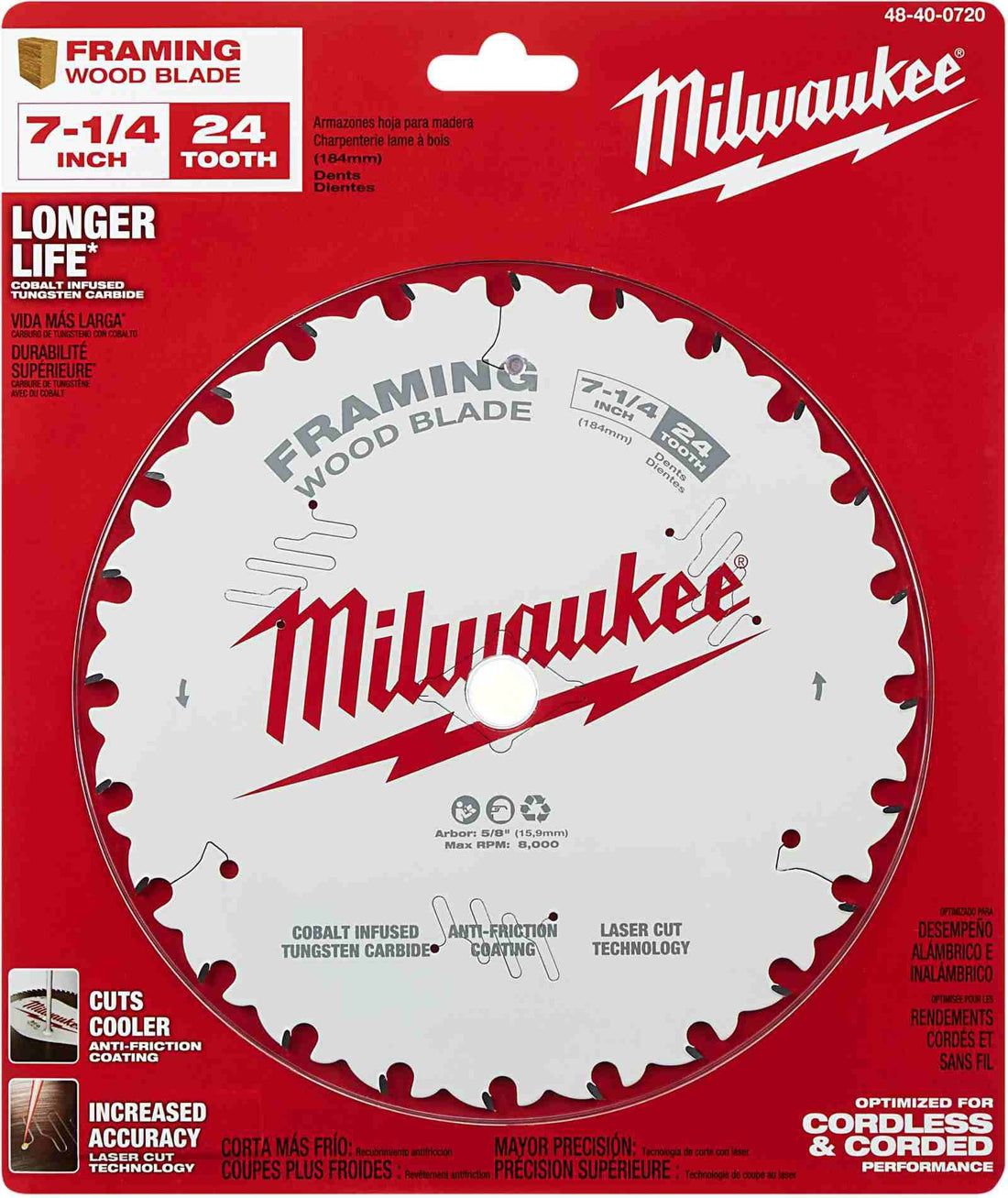
Thin Kerf vs Full Kerf Circular Saw Blades: Which One Belongs on a Cordless Saw?
For a cordless circular saw, run a thin-kerf blade — roughly 0.059"–0.071" kerf on a standard 7-1/4" blade. It removes less material per pass, so the motor draws fewer amps, the battery runs noticeably longer per charge, and the saw is less likely to bog in thick stock. Full-kerf blades (approximately 0.094"–0.126") belong on corded table saws and heavy worm-drives where extra plate stiffness matters more than energy efficiency. On a battery saw, that stiffness advantage mostly disappears and you just lose runtime. Two real exceptions: sustained heavy ripping on a FLEXVOLT or M18 HD-class saw with a large battery, and cheap demo blades where you expect to hit nails.
What "Kerf" Actually Means — and Why Cordless Changes the Math
Kerf Is the Total Cut Width, Not Just the Plate
People mix this up constantly. Kerf is the total width of material the blade removes per pass — the plate *plus* the carbide tooth overhang on each side. A blade with a 0.049" plate can still cut a 0.071" kerf because the carbide tips protrude past the steel on both sides, preventing the plate from binding in the cut.
This distinction matters because manufacturers use "thin kerf" to describe the whole system — thinner plate, smaller carbide overhang, narrower total cut. When you're shopping, look for the kerf number in inches or millimeters printed on the blade packaging. Plate thickness alone doesn't tell the whole story.
Thin-Kerf and Full-Kerf Spec Ranges
On a 7-1/4" blade:
- Thin kerf: approximately 0.059"–0.071" kerf width; plate thickness roughly 0.049"–0.055"
- Full kerf: approximately 0.094"–0.126" kerf width; plate thickness noticeably heavier
Those aren't vague categories — they're printed specs. Diablo's D0724X and Freud's LU84R011 both land in the thin-kerf window. Freud's LU84M011 and Forrest's WW07407125 are full-kerf examples. The gap between 0.071" and 0.094" looks small on paper. On a battery saw, you feel it in runtime.
Why Less Material Removed Means More Cuts Per Charge
The physics is straightforward. Every cubic inch of wood the blade removes costs motor effort. A thin-kerf blade cuts a narrower slot per inch of travel — measurably less resistance at the teeth. Less resistance means fewer amps drawn, which means the battery delivers more cuts before it hits the low-voltage shutoff.
Blade manufacturers and independent testers consistently report more cuts per charge with thin-kerf blades on the same battery saw. How much more depends on wood species, moisture content, tooth count, and battery Ah — a specific percentage would require controlled testing we haven't run. But the direction is reliable and well-established: thin kerf stretches runtime; full kerf doesn't.
Thin Kerf vs Full Kerf Circular Saw Blades: Side-by-Side Comparison
| Spec | Thin Kerf | Full Kerf |
|---|---|---|
| Kerf width (7-1/4" blade) | ~0.059"–0.071" | ~0.094"–0.126" |
| Plate thickness | ~0.049"–0.055" | Heavier (varies by maker) |
| Primary use | Cordless saws, portable sidewinders | Corded table saws, worm-drives |
| Plate stiffness | Moderate — anti-vibe slots compensate | High — less deflection under sustained load |
| Material waste per cut | Less sawdust | More sawdust |
| Amp draw on cordless | Lower | Higher |
| Battery runtime | Better | Worse |
| Price at comparable quality | Similar | Similar |
One note on stiffness: modern thin-kerf blades use laser-cut anti-vibration slots and expansion cuts to control deflection and heat dissipation. A quality thin-kerf blade from Diablo, Milwaukee, or DeWalt won't wander on a clean, supported cut. See the FAQ below for more on this.
Cordless-Specific Verdict by Saw Class
Compact 6-1/2" Cordless — Thin Kerf, No Debate
Running a Milwaukee 2730-20 M18 with its 6-1/2" blade, a DeWalt DCS391, or a DCS565? The answer is thin kerf, period. Compact cordless saws have smaller motors with less torque headroom than their 7-1/4" siblings. Put a full-kerf blade on a 6-1/2" cordless and it will bog the motor on anything thicker than light plywood — and on many saws it'll trip the electronic overload. You're not getting better cuts; you're thrashing the motor and draining the battery faster for zero benefit.
Every major blade maker offers a 6-1/2" thin-kerf option. That's the only blade class worth putting on a compact cordless.
7-1/4" M18 FUEL / DeWalt FLEXVOLT — Thin Kerf First, Full Kerf Rarely
The Milwaukee 2830-20 M18 FUEL rear-handle (5,800 RPM no-load) and the DeWalt DCS578 FLEXVOLT 60V, with a 2-9/16 in. max cut depth at 90°, are high-output cordless saws. They can spin a full-kerf blade without immediately stalling.
"Can" and "should" are different things. For framing, plywood, cross-cuts, and most rip cuts in dry lumber — thin kerf. More cuts per charge, no quality penalty. The narrow window where full kerf earns its place on these saws: heavy, sustained ripping through wet or dense hardwood with a 9Ah or 12Ah pack, where blade deflection under prolonged sideload is a genuine concern. That's a real but uncommon situation. If that describes your everyday work, you probably already own a corded worm-drive for it.
Track Saw Plunge Blades — Different Category
Track saw blades aren't interchangeable with standard circular saw blades. Most run thin-kerf profiles as the standard, engineered to match the saw's splinter guard and riving knife geometry. Follow the diameter and kerf spec your track saw manufacturer specifies — don't substitute a general-purpose circular saw blade here.
When Full Kerf Still Wins

Corded Table Saws and Worm-Drives — Their Home Turf
Full-kerf blades exist for good reason. On a 10" or 12" contractor or cabinet saw, sustained feed rates create significant lateral loading on the blade. The thicker plate resists deflection and heat buildup over a long workday in a way thin-kerf steel can't match. Same logic applies to a high-amperage corded worm-drive — the motor has the torque, and the blade needs the rigidity to match it. This is the use case full-kerf blades are designed for.
Heavy Repetitive Ripping in Dense or Wet Stock with a Big Battery
Ripping a stack of wet 2×10 Douglas fir with a FLEXVOLT or M18 HD-class saw and a 12Ah pack? A quality full-kerf blade can handle that sustained sideload and may deflect less over long rip cuts than a thin-kerf blade under the same conditions. This is a legitimate edge case — just not the everyday job for most cordless users.
Demo Cuts Where You Expect Nails
This one's practical. Tearing out subfloor, cutting through walls, removing old framing — if you don't know what's in there, a cheap full-kerf demo blade takes nail hits better than a premium thin-kerf blade. The thicker plate absorbs the impact. Buy the cheap demo blade, use it hard, replace it. Don't run a quality framing blade into unknown demo material.
What to Look for on the Blade Packaging
The Kerf Number — It's Printed Right There
Every quality blade lists the kerf width on the packaging and usually on the blade body too. For cordless 7-1/4" saws, target anything in the 0.059"–0.071" range. If a blade's packaging only lists plate thickness but not kerf, that's a lower-tier product — quality makers show both. The number isn't hidden; if you can't find it, keep looking.
Tooth Count — The Other Half of the Blade Decision
Kerf tells you how much material gets removed. Tooth count tells you whether the cut is fast and rough or slow and clean. Twenty-four teeth for framing lumber. Forty to sixty teeth for plywood and sheet goods. These two specs work together — a thin-kerf blade with the wrong tooth count for your cut is still the wrong blade.
Our comprehensive guide to tooth count covers this in full. No need to rehash it here — get both specs right.
Arbor Size and Blade Diameter
A 7-1/4" blade with a 5/8" arbor fits every standard 7-1/4" cordless circular saw from Milwaukee and DeWalt. Compact 6-1/2" saws use a 6-1/2" blade, typically with a 5/8" arbor — but some saws use a 20mm arbor. Check the saw's spec before buying a 6-1/2" blade.
Full compatibility detail — arbor adapters, max cutting depth by blade diameter, which 6-1/2" blades fit which compact cordless saws — is detailed in our blade compatibility guide. Once you confirm the blade fits, then pick the kerf.
Carbide Tip Quality and Blade Coatings
This matters more for blade life than the thin/full distinction. Diablo's TiCo carbide, Milwaukee's Nitrus Carbide, and DeWalt's Elite Series carbide tips hold an edge significantly longer than generic imported tips. A premium thin-kerf blade from any of those three will outlast a budget full-kerf blade in real use. Buy the better carbide, not just the thicker plate.
Also look for anti-vibration slots in the blade body — the laser-cut patterns that control heat expansion and dampen harmonic vibration during the cut. All quality thin-kerf blades have them now. If a bargain thin-kerf blade has a plain, slotless body, skip it.
Recommended Thin-Kerf Blades by Platform
No circular saw blades in the Tool Army catalog at the moment — we've flagged this to the catalog team, since saw blades are a consistent content driver across the Milwaukee and DeWalt posts. In the meantime, here's what's worth running.
Milwaukee M18 Saws (7-1/4" and 6-1/2")
Milwaukee's own blades are engineered for the M18 platform and a clean starting point:
- 48-40-0724 — 24T, 7-1/4", framing, thin-kerf
- 48-40-0725 — 40T, 7-1/4", general/finish, thin-kerf
For aftermarket, Diablo D0724X (24T, 7-1/4") is the most consistently recommended thin-kerf framing blade for cordless saws across platforms. It lands squarely in the thin-kerf window with TiCo carbide tips and a good anti-vibration slot pattern.
Browse our full Milwaukee collection.
DeWalt 20V MAX / FLEXVOLT Saws (7-1/4" and 6-1/2")
DeWalt's Elite Series blades are matched to the 20V MAX and FLEXVOLT platforms:
- DWA171424 — 24T, 7-1/4", framing; 0.065 in. kerf
- DWA171460 — 60T, 7-1/4", fine finish, thin-kerf
Diablo D0724X works equally well on DeWalt saws — the 5/8" arbor is the same standard across both platforms, and blade quality doesn't care about saw color.
Shop our complete DeWalt lineup.
FAQ
Is thin kerf better than full kerf on a cordless saw? Yes, in almost every case. Thin kerf removes less material per pass, so the motor draws fewer amps and the battery delivers more cuts per charge. Full kerf is engineered for the high-torque motors in corded table saws and worm-drives — that extra plate stiffness is built for sustained load, not battery efficiency.
What is a thin-kerf blade used for? General cordless circular saw work — framing, cross-cuts, plywood, sheet goods, most rip cuts in dry lumber. It's the standard blade class for any battery-powered saw and for portable corded sidewinders under 15 amps. If you own a cordless saw, thin kerf is your default.
Do thin-kerf blades wobble more? They can deflect slightly under sideload if the blade is dull, forced sideways, or cutting unsupported material. Quality thin-kerf blades use anti-vibration slots and laser-cut expansion cuts to control this. Keep the blade sharp, let the saw do the work, and support the workpiece properly — deflection stops being a real-world issue with a quality blade.
Can you use a full-kerf blade on a cordless saw? Physically yes, practically no for most users. On a compact 6-1/2" cordless, a full-kerf blade will bog the motor and can trip the electronic overload on cuts through anything substantial. On a 7-1/4" FUEL or FLEXVOLT saw you can occasionally run full kerf for heavy ripping, but you'll get noticeably fewer cuts per charge for the privilege.
Are thin-kerf blades less durable? Not meaningfully. Carbide tip quality drives blade life far more than plate thickness. A premium thin-kerf blade from Diablo, Milwaukee, or DeWalt will outlast a cheap full-kerf blade from a discount rack every time. Buy the better carbide.
Do Milwaukee and DeWalt cordless saws need special blades? No. Any 7-1/4" blade with a 5/8" arbor fits the standard 7-1/4" cordless saws from both brands. Compact 6-1/2" saws take a 6-1/2" blade — usually 5/8" arbor, occasionally 20mm. Check your saw's spec page before buying a 6-1/2" blade. Compatibility is what matters, not the blade's brand logo.
What kerf width should I look for on a cordless circular saw blade? On a 7-1/4" cordless saw, target 0.059"–0.071". On a 6-1/2" cordless, thin kerf is the only sensible choice — typically printed as approximately 0.059" on the blade. If the kerf number isn't on the packaging, keep looking.
If you own a battery-powered circular saw, buy thin-kerf blades. The runtime difference is real, the cut quality is equal or better with a quality blade, and full kerf gives you nothing useful on a battery platform except in a narrow edge case most cordless users never hit. Spend what you'd waste on a thick-plated blade on a spare battery instead — that'll actually move the needle on your day.
For more on blade selection for Milwaukee saws specifically, our guide to Milwaukee saw blades breaks down the full lineup by cut type and application. And if the compatibility question extends to your reciprocating saw, our reciprocating saw blade compatibility guide covers that side of the shop.
Milwaukee accessories: explore the Milwaukee collection. DeWalt accessories: explore the DeWalt collection.