
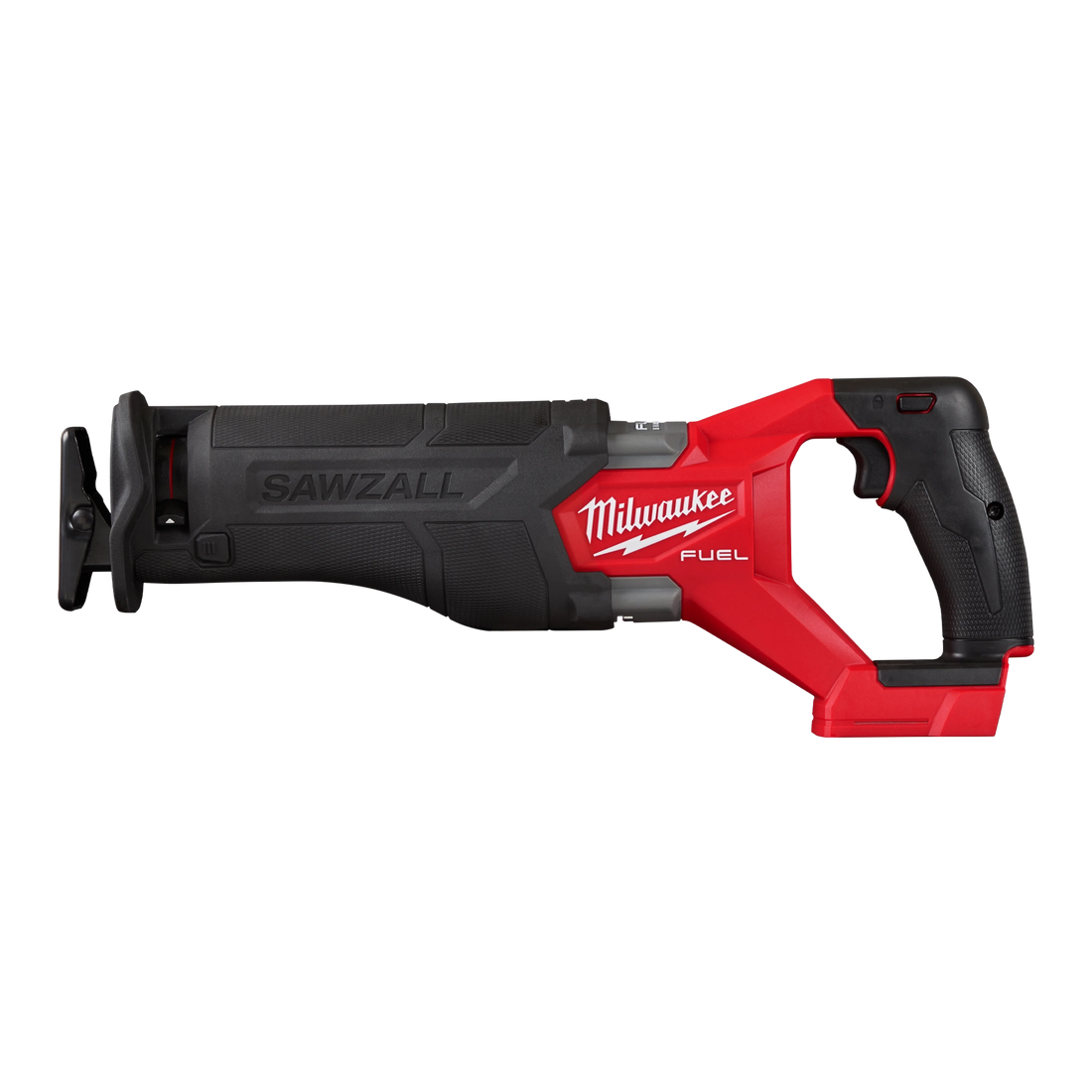
Reciprocating Saw Blade Compatibility: Do Blades From Any Brand Fit Any Saw?
Almost all reciprocating saw blades sold today use the T-shank — also called the "universal shank" — a standard that Milwaukee, DeWalt, Bosch, Makita, Diablo, Lenox, and every other major blade brand has shared since the late 1990s. If your saw takes a T-shank, any T-shank blade fits. That covers every current Milwaukee M18 Sawzall and every current DeWalt 20V MAX recip saw. The brand on the blade package doesn't affect fit. What you're actually choosing by is TPI, blade length, and material.
What Is a T-Shank and Why Does It Make Blades Universal?
The shank is the locking end — not the cutting end
A recip blade has two distinct parts: the shank (the rear tab that locks into the chuck) and the blade body (the cutting teeth). Compatibility is entirely about the shank. The T-shank gets its name from its T-shaped locking slot — every saw that accepts one uses the same physical interface. This is why you can drop a Diablo demo blade into a Milwaukee saw or a Milwaukee SAWZALL blade into a DeWalt without any adapter.
T-shank vs. U-shank: what you'll still find on old tools
Before T-shank took over, some tools — mainly older Black & Decker and early Ryobi models — used a U-shank. The two are not interchangeable. The U-shank was eventually phased out by every major brand as the universal shank became the industry standard.
If your saw was made after roughly 2000, it's almost certainly T-shank. If you have an older beater with a U-shank chuck, cross-brand compatibility doesn't apply — and finding blades gets harder since current blade production is almost entirely T-shank. Check the blade clamp when the saw is empty: a T-shank clamp uses a lever or button release and a slot the T-tab drops into. When in doubt, check your owner's manual.
Related: T-shank jigsaw blades cover the same standard for jigsaws.
Milwaukee Sawzall Blade Compatibility
Which Milwaukee M18 Sawzall models use T-shank?
Milwaukee's M18 Sawzall lineup — the 2720-20, 2821-20 FUEL, and 2720-21, among current production models — all use Milwaukee's 1/2 in. Universal Tang for blade retention. Milwaukee has run this shank standard across its cordless Sawzall lineup for decades.
Can you run DeWalt, Bosch, or Diablo blades in a Milwaukee Sawzall?
Yes — any T-shank blade goes in. "SAWZALL blade" is Milwaukee's brand name for its T-shank recip blade line. It's not a proprietary shank. A Diablo bi-metal demo blade, a Lenox titanium blade, a DeWalt metal-cutting blade — they all lock in the same way. See our Milwaukee blade selection guide for a deeper breakdown of Milwaukee's own blade lineup and when it's worth staying in-brand.
DeWalt Reciprocating Saw Blade Compatibility

Which DeWalt 20V MAX recip saw models use T-shank?
DeWalt's 20V MAX recip saws — the DCS380B, DCS367B, and DCS388B, among current models — all use the standard universal reciprocating saw shank. Same story as Milwaukee.
Can you run Milwaukee or Diablo blades in a DeWalt saw?
Yes. Fit is not brand-locked on any current DeWalt recip saw. A Milwaukee SAWZALL blade drops right into a DCS380B. A Bosch blade does too. Buy whatever blade gives you the right TPI and material for the cut — not whatever matches your saw's logo.
Picking the Right Blade — By Material, Not by Brand
Fit is settled. The real decision is what you're cutting:
| Material | TPI Range | Blade Type | Length |
|---|---|---|---|
| Wood (fast, rough) | 3–6 | HCS or BIM | 6"–12" |
| Wood + nails (demo) | 6–10 | BIM | 6"–9" |
| Thin metal / conduit | 18–24 | BIM | 6" |
| Thick steel / pipe | 14–18 | BIM | 6"–9" |
| Hardened / cast iron | 5–8 | Carbide-tipped | 6" |
| Fiberglass / composite | 10–14 | BIM | 6" |
TPI ranges and blade types vary by product and manufacturer; the figures above reflect typical specifications across major blade brands. Standard recip saw blade lengths are 4 inches, 6 inches, 9 inches, and 12 inches.
What "BIM" means and why it's the demo default
BIM = bi-metal. Hardened teeth welded to a flexible alloy-steel back. That combination handles flex without snapping and cuts a wider range of materials than HCS. For demo work — mixed material, hidden nails, unknown substrate — BIM is the standard pick. HCS is cheaper and fine for clean wood cuts, but it dulls fast on anything harder and snaps under flex.
When to go carbide-tipped (and when it's overkill)
Carbide teeth outlast BIM dramatically on hardened materials: cast iron pipe, fiber cement siding, rebar. They're slower and more expensive per blade, but they're the only practical choice for those materials. For framing lumber and general demo debris, carbide is overkill.
Blade length — match material thickness, not saw size
Longer blades flex more and reach deeper in demo situations. For precision work or thin stock, a shorter blade (6") is easier to control. The blade just needs to clear the material — running a 12" blade through a 2×4 adds unnecessary flex and wasted stroke.
Circular saw blade sizing covers similar logic if you're sorting out circular saw blades too.
FAQ — Reciprocating Saw Blade Compatibility Questions
Are all reciprocating saw blades universal? Nearly all modern recip blades use the T-shank, so yes — any T-shank blade fits any T-shank saw, regardless of brand. The one exception is the U-shank, found on older tools (pre-late 1990s) that are now rare.
Do Milwaukee Sawzall blades fit DeWalt reciprocating saws? Yes. Milwaukee SAWZALL blades use the standard T-shank — the same shank all current DeWalt 20V MAX recip saws accept. They're interchangeable in either direction.
What shank type do reciprocating saws use? The T-shank (universal shank) has been the industry standard since the late 1990s. All major current brands — Milwaukee, DeWalt, Bosch, Makita, Ryobi — use it.
Can I use any blade in my Milwaukee Sawzall? Any T-shank blade fits current Milwaukee M18 Sawzall models. Blade brand doesn't affect fit. Choose by TPI and material for the job.
What is TPI on a reciprocating saw blade? TPI = teeth per inch. Fewer teeth (3–10 TPI) = faster, rougher cuts in wood. More teeth (14–24 TPI) = slower, cleaner cuts in metal. For demo work with nails, 6–10 BIM is the standard choice.
What's the difference between HCS, BIM, and carbide recip blades? HCS (high carbon steel) is cheap and wood-only. BIM (bi-metal) has hardened teeth on a flexible back — the all-purpose default. Carbide-tipped handles what HCS and BIM can't: cast iron, fiber cement, rebar.
Do DeWalt and Bosch recip blades fit Milwaukee saws? Yes — all use T-shank. Blade fit is not brand-locked on any current major-brand recip saw.
Blade brand is a non-issue for fit — any T-shank blade goes in any current recip saw. The choice is TPI, material, and length. If you're sorting out accessories for your Milwaukee M18 or DeWalt 20V platform — chargers, inverters, driver bits — browse the Milwaukee and DeWalt collections. And if you're working through other cutting accessory compatibility questions, hole saw arbor compatibility and oscillating multi-tool blade compatibility cover the same ground for different tool types.