
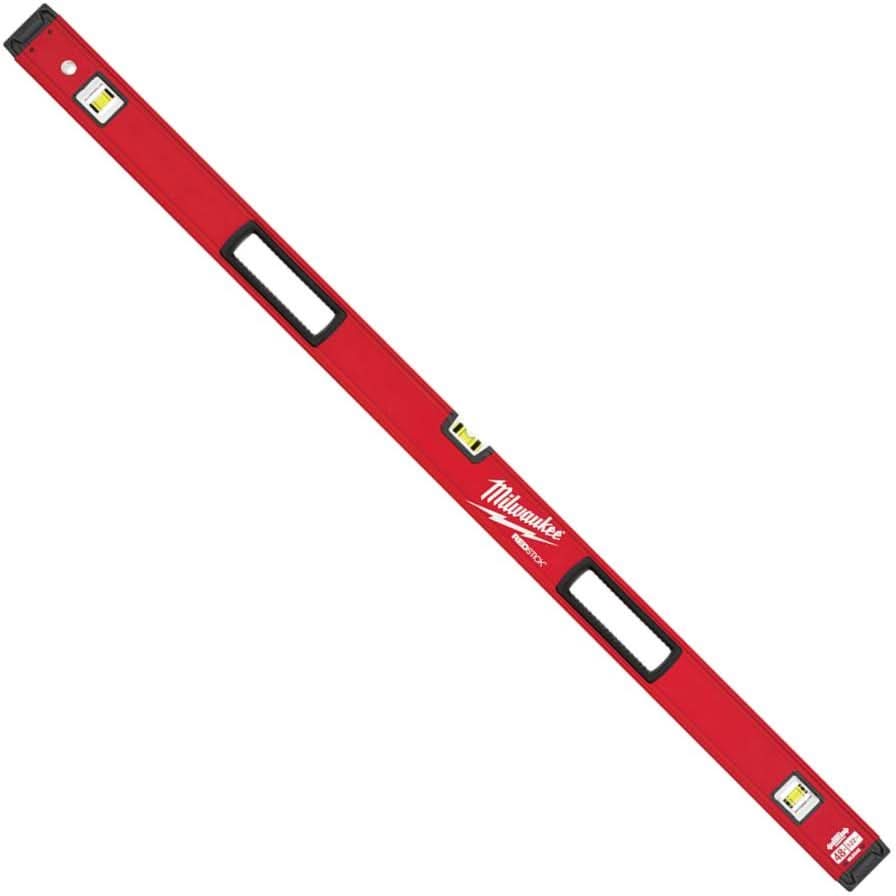
Milwaukee REDSTICK vs Stabila Levels: Which One Actually Belongs on Your Jobsite?
Choosing between a Milwaukee REDSTICK and a Stabila level? Both brands publish the same accuracy spec: 0.5 mm/m normal, 1.0 mm/m tilted. So "which one is more accurate?" is not the question worth asking. The real decision axes are vial readability, drop tolerance, magnetic pull, and which one makes sense for *your* trade.
The short version: For most trades that measure and mark for a living, Stabila Type 196 / R-Beam still edges out Milwaukee REDSTICK on vial readability and long-term calibration hold. But Milwaukee's REDSTICK Backbone matches Stabila's accuracy spec on paper, survives 6-ft drops the Stabila isn't rated for, and runs noticeably less at most retailers. Frame walls or remodel? REDSTICK Backbone. Set cabinets, hang doors, or lay tile? Stabila.
| Milwaukee REDSTICK Backbone | Stabila Type 196 | |
|---|---|---|
| Accuracy | 0.5 mm/m normal / 1.0 mm/m tilted | 0.5 mm/m normal / 1.0 mm/m tilted |
| Vial system | SharpSite (magnified, high-contrast) | Electron beam-welded acrylic |
| Drop rating | 6 ft (marketed claim) | Not published; reinforced frame + end caps |
| Magnetic option | Yes — rare-earth magnets | Yes — "-M" model variants |
| Price, 48 in. | Lower — see price section | Higher — see price section |
The 30-Second Verdict
| Trade | Reach for | Why |
|---|---|---|
| Framer / rough carpenter | REDSTICK Backbone | Drop tolerance, price, abuse-site durability |
| Electrician / conduit runner | Either; lean Stabila | Magnetic versions both solid; Stabila edges for precision layout over a career |
| Cabinet installer / finish carpenter | Stabila Type 196 | Calibration hold, vial reputation — no margin for error |
| Tile setter | Stabila | Full short-to-long range, consistent vial construction |
| Serious DIY | REDSTICK Compact or Slim | Capable level, better price for occasional use |
Framer / Rough Carpenter → REDSTICK Backbone
Framers beat levels up. Dropped from scaffolding, kicked across decks, rattled around truck beds. The REDSTICK Backbone's marketed 6-ft drop rating is the right answer here. Stabila doesn't publish a drop rating, and nobody should be sending a $200 German level to a framing site without some anxiety.
The price gap matters on a framing crew too. When you're buying four levels for a team, the savings compound.
Electrician / Conduit Runner → Toss-Up, Lean Stabila
Electricians live in the torpedo size and need a 48 in. for panel work and conduit runs. The magnetic version is basically mandatory — you need both hands free against steel studs and panel boxes. Both brands' magnetic levels are solid here.
Edge to Stabila mainly because electricians and instrumentation techs tend to do precision layout over a long career, and Stabila's calibration-hold reputation matters across years of daily use. If you're a REDSTICK person, the Backbone won't embarrass you. But if you're buying fresh: yellow.
Cabinet Installer / Finish Carpenter → Stabila Type 196

No question. The Type 196's vial readability and calibration hold are why finish carpenters have reached for yellow levels for 30 years. One drawer that doesn't close flush is one too many. Get the Stabila.
Tile Setter → Stabila
Tile setters need a short level (torpedo or 24 in.) and a long level (48 in. minimum). Stabila covers both with the same vial construction and the same accuracy standard. The Type 106T torpedo and Type 81S are standards in the trade. REDSTICK makes torpedoes too, but calibration reputation matters more here than drop resistance.
Serious DIY → REDSTICK Compact or Slim
The Compact and Slim are priced for the occasional user and are completely capable levels. REDSTICK Compact and Slim aren't trying to compete with Stabila Type 196 — they're a different product tier aimed at the homeowner who levels a deck once and hangs shelves twice a year. Save the Stabila premium for materials or better fasteners.
Accuracy: The Spec That Doesn't Tell the Whole Story
Both Milwaukee and Stabila publish the same accuracy tolerance for their premium levels: 0.5 mm/m horizontal and vertical (normal), 1.0 mm/m tilted at 45°.
That parity matters: on paper, neither level is more accurate than the other.
What "0.5 mm/m" Actually Means at 4 Ft and 8 Ft
Here's the math translated to real-world distances:
| Level length | Max error at 0.5 mm/m spec |
|---|---|
| 24 in. (0.61 m) | ≈ 0.3 mm |
| 48 in. (1.22 m) | ≈ 0.6 mm |
| 72 in. (1.83 m) | ≈ 0.9 mm |
| 96 in. (2.44 m) | ≈ 1.2 mm |
At 4 ft, the allowable error is smaller than a thick pencil line — imperceptible in any trade application. Both levels are spec-equivalent the day you buy them. The question is what happens over 12 months of daily use.
Certified vs Actual: Calibration Drift Over 12 Months
Stabila's electron beam-welded acrylic vials are sealed against temperature and humidity changes. The construction is the core of Stabila's 130-year calibration reputation — the bubble fluid doesn't evaporate, and the vial housing doesn't flex with ambient conditions.
Milwaukee's SharpSite vials are engineered for visibility first — magnification and high contrast. They hold calibration well for most trades. The open question is drift after repeated impacts. For framing crews that don't recalibrate monthly, that's largely theoretical. For finish carpenters where a 0.2 mm error in a cabinet run shows up in every drawer gap, Stabila's track record is worth the premium.
Vial Systems Compared
Milwaukee's SharpSite Vial
SharpSite is designed for one thing: fast reads in bad conditions. Magnification and a high-contrast bubble let you read the level from a wider angle and in dim light — useful on a framing site at dawn or in a mechanical room with a single work light.
If you're reading a level from 6 ft away while holding something else, SharpSite has a real advantage over a standard vial.
Stabila's Electron Beam-Welded Acrylic Vial
Stabila's vials are manufactured with a welding process that completely seals the acrylic housing. The result: no evaporation, no thermal cycling issues, no expansion and contraction with temperature swings that can introduce drift in competing designs.
The tradeoff is that Stabila vials — especially on older Type 196 and R-Beam models — read smaller and dimmer than Milwaukee's magnified design. First time you use a Stabila, the bubble takes a second to trust. After a week, you stop noticing. Stabila has updated contrast on some newer models, but the SharpSite is still faster to read at a glance.
Drop Resistance: The Real Jobsite Differentiator
Milwaukee's 6-Ft Drop Rating (REDSTICK Backbone)
Milwaukee markets the REDSTICK Backbone with a published drop rating. The "Backbone" name refers to the structural spine built into the level's frame — a reinforced aluminum chassis designed to absorb impacts without shifting calibration. End caps are integrated into the structure rather than bolted on.
On any site where a level comes off scaffolding or out of a bucket and meets concrete, this matters.
Stabila's Reinforced Frame + Protective End Caps
Stabila doesn't publish a drop rating. That doesn't mean the Type 196 and R-Beam are fragile — both are well-built aluminum profiles — but they're not designed for repeated 6-ft falls. Stabila sells protective end caps and carrying cases because the design philosophy treats these as calibration-critical precision instruments you're supposed to protect. That makes complete sense for finish work. It's a mismatch for a framing site.
Magnetic Pull (For Steel Stud, Conduit, HVAC)
Both brands offer magnetic versions using rare-earth magnets. Stabila's magnetic variant is the Type 196-2M, featuring neodymium rare-earth magnets mounted flush with the level face.
The magnetic versions are essentially mandatory for:
- Metal stud framing and drywall layout
- Conduit runs and electrical panel installation
- HVAC duct and equipment leveling
Both brands hold hands-free against vertical steel studs without issue. The functional difference between the two is minimal — pick the magnetic version of whichever brand you're already buying. If you're in metal stud or HVAC work full-time and haven't handled both, spend five minutes with each at the store before committing.
Sizes and Full Lineups
Milwaukee — REDSTICK Lineup
Milwaukee organizes REDSTICK into four tiers, plus torpedoes:
| Tier | Profile | Notes |
|---|---|---|
| REDSTICK Compact | Standard | Entry-level; common sizes 24 in., 48 in. |
| REDSTICK Slim | Thin | Fits tight spaces; lower price point |
| REDSTICK Backbone | Reinforced spine | Drop-rated; available 24–96 in. |
| REDSTICK Box | Box beam | Heavy-duty; 48–96 in. |
Milwaukee also offers REDSTICK torpedo models and a broad range of lengths; check milwaukeetool.com for current size availability.
Stabila — Full Lineup
Stabila's catalog is broader and more segmented:
| Model | Profile | Notes |
|---|---|---|
| Type 81S | Box beam | Compact sizes; popular in tile and finish work |
| Type 96-2 | Box beam | Two plumb vials; standard for window/door install |
| R-Beam | I-beam | Lighter than Type 196; rated at ±1/32 in. at 72 in. (±0.5 mm/m) |
| Type 196 | Rectangular box | Heaviest, most rigid; the flagship level |
| Type 106T | Torpedo | Standard for tile, plumbing, tight spaces |
| 196-2 Digital | Box beam | Electronic display; pro niche use |
Stabila's current catalog spans 31 models across four categories — standard, torpedo/pocket, electronic, and sets — in sizes from 3″ to 96″.
The Type 196 comes in sizes from 24 in. through 96 in.; R-Beam similarly. If you need a full-crew set of one size all the way up, Stabila's range covers it.
Price, Warranty, and Where They're Made
Street Prices Side by Side (48 in. Magnetic)
REDSTICK Backbone consistently runs noticeably less than a comparable Stabila Type 196 magnetic in the 48 in. size. The gap varies by retailer and season — check current prices before buying. For a framing crew buying six levels at once, the difference per unit adds up to real money.
Limited Lifetime — The Fine Print on Both
Milwaukee covers REDSTICK levels under a Limited Lifetime Warranty, free from defects in material and workmanship for the lifetime of the tool. It does not cover calibration drift from use, or damage from drops — even if the level is marketed as drop-rated. Keep your receipt.
Stabila carries its own warranty coverage, with terms that vary by product type.
One thing both brands share: sealed acrylic vials cannot be recalibrated in the field. If your level drifts, you send it to a factory service center. Neither brand covers that for free indefinitely. The flip test (below) is how you check whether it's still true before you commit to a service call.
Milwaukee (Global Assembly) vs Stabila (Made in Germany)
Stabila levels are manufactured in Annweiler am Trifels, Germany. The company has been there since 1889 and states it prominently on product pages and company communications. That origin is part of what you're paying for.
Milwaukee REDSTICK levels are assembled globally. For most buyers the origin matters less than the specs. For tradespeople who care where their tools come from, Stabila's German pedigree is a genuine differentiator.
The Honest Recommendation by Trade
One more time, flat:
| Trade | Pick | Reason |
|---|---|---|
| Framer / rough carpenter | REDSTICK Backbone | Drop rating, crew pricing, absorbs the abuse |
| Electrician | Either; lean Stabila | Magnetic models both solid; Stabila calibration matters long-term |
| Cabinet install / finish carpentry | Stabila Type 196 | No margin for drift; reputation earned over decades |
| Tile setter | Stabila | Consistent vial construction from torpedo to 72 in. |
| Serious DIY | REDSTICK Compact or Slim | Right capability for the actual use frequency |
If you're buying one level and can only pick one brand: what do you actually do for work? That's your answer.
FAQ
Are Milwaukee REDSTICK levels as accurate as Stabila?
Yes. Both brands publish 0.5 mm/m normal / 1.0 mm/m tilted accuracy for their premium levels. The spec is identical. The difference is vial visibility and long-term calibration hold — not the accuracy rating on day one.
Where are Milwaukee REDSTICK levels made?
Milwaukee REDSTICK levels are made in China. Milwaukee assembles its products globally, with parts sourced internationally.
Where are Stabila levels made?
Annweiler am Trifels, Germany. Stabila has manufactured there since 1889 and states it on every product page and in company communications.
Do Milwaukee REDSTICK levels have a lifetime warranty?
Milwaukee covers REDSTICK levels under a Limited Lifetime Warranty, free from defects in material and workmanship for the lifetime of the tool. Coverage is for manufacturing defects — not calibration drift or drop damage.
Does Stabila have a lifetime warranty?
Stabila's spirit levels carry a lifetime accuracy guarantee — if a level develops fog, leaks, or loses accuracy due to a manufacturer defect, Stabila will replace it. Electronic levels are covered for two years and accessories for 30 days. Factory recalibration is not offered as a documented service; if your level drifts and is under warranty, contact Stabila for a replacement.
Which level do most framers use?
Historically Stabila. Over the last several years, REDSTICK Backbone has taken meaningful share on framing sites specifically because of its drop tolerance and lower price point. Both brands have genuine, vocal followings.
Are Stabila levels worth the price?
For finish work, cabinet install, and tile: yes, clearly. For framing and general remodel: it's a value call, not a quality gap. Milwaukee REDSTICK Backbone is not a lesser level — it's a different design philosophy built for a different kind of abuse.
How do you check if your level is actually accurate?
The flip test. Rest the level on a surface and note the bubble position. Flip it end-for-end on the same surface. If the bubble reads identically, the level is true. If it doesn't, the error is half the observed difference. Neither brand's sealed vials can be recalibrated in the field — if the flip test shows drift, contact the manufacturer for factory service.
What's the difference between Stabila Type 196 and R-Beam?
Type 196 is a rectangular box-beam profile — the heaviest and most rigid Stabila level. R-Beam is an I-beam profile: lighter, easier to carry on a ladder all day. Both meet Stabila's accuracy spec of ±1/32 in. at 72 in. (±0.5 mm/m). Type 196 for shop and precision finish work; R-Beam if you're climbing with it daily.
Is Milwaukee REDSTICK Backbone actually drop-rated?
Milwaukee markets the Backbone with a published drop rating. In practice, the Backbone is significantly more impact-tolerant than a standard box-beam level of comparable size. Whether a specific drop scenario matches their test conditions can't be guaranteed — but the structural design is meaningfully different from unrated competitors.
If you've got $150 to build out a level kit, the smart play for most working pros is a Stabila 48 in. magnetic — Type 196 if you do precision finish work, R-Beam if you carry it on a ladder — and a Milwaukee REDSTICK Backbone torpedo for rough work and tight spots. You get Stabila's calibration hold where it matters and Milwaukee's drop tolerance everywhere else.
If you're buying for a framing crew or outfitting from scratch: REDSTICK Backbone 48 in. magnetic across the board. You're not sacrificing accuracy. You're trading some vial readability and German pedigree for a level that survives the floor.
The same "heritage brand vs modern challenger at a real price gap" framework applies to other hand tools. Our titanium hammer comparison piece covers that exact decision for hammers, and speed square guide is worth reading if you're also shopping for layout tools. If a utility knife is on the same shopping list, utility knife comparison runs the same comparison for Milwaukee's red against the long-standing incumbent.
*Editorial, no money page.*