
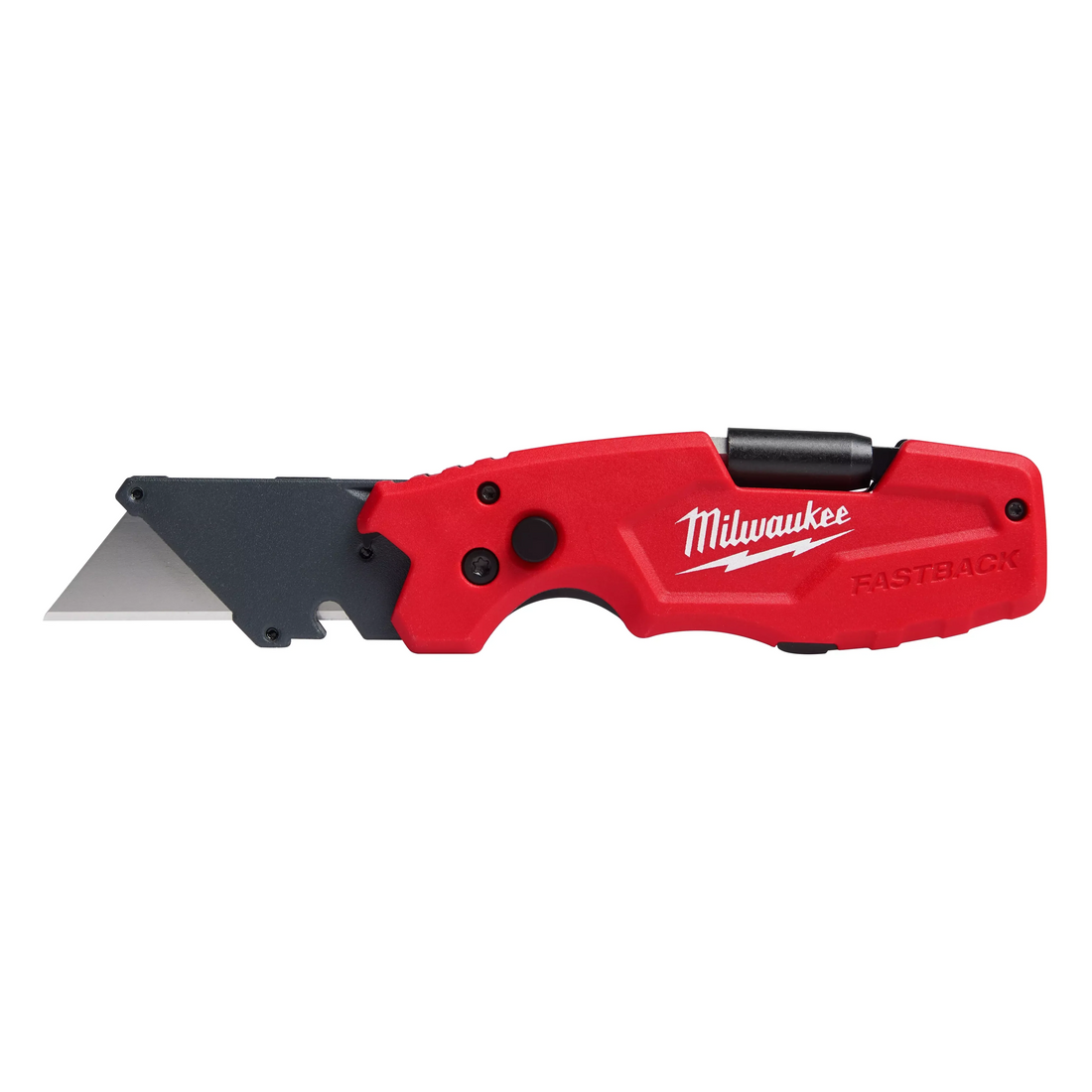
Milwaukee FASTBACK vs. Stanley FATMAX Utility Knife: Which One Belongs on Your Belt?
Short answer: The Milwaukee FASTBACK opens faster one-handed and is the better daily driver for pros who deploy their knife constantly — roofers, insulators, warehouse crews. The Stanley FATMAX has the beefier grip, more on-board blade storage, and a lifetime warranty behind it, making it the smarter pick when the knife spends more time in a tool bag than in your hand. Both utility knives take standard trap-style blades. The real question is how you *use* one, not just which brand is on the handle.
At a Glance: FASTBACK vs. FATMAX Head-to-Head
| Feature | Milwaukee FASTBACK (48-22-1901) | Stanley FATMAX (FMHT10242) |
|---|---|---|
| Open mechanism | Press-and-flip, one-handed | Push-button side-lock, one-handed |
| Blade type | Standard trap-style (2-notch) | Standard trap-style (2-notch) |
| Blade change | Push-button (Gen II); thumb tab (original) | Push-button release |
| On-board blade storage | 5 blades included | 5 induction-hardened blades |
| Belt clip | Wire-form spring clip | Rigid formed belt clip |
| Weight | Lighter, slimmer profile | Heavier, more substantial feel |
| Warranty | Limited Lifetime Warranty covering defects in material and workmanship for the lifetime of the tool | Limited lifetime |
Both knives land in the same budget tier — comparably priced at most major home centers. Check current pricing at Home Depot or Lowe's before you buy; neither will break the bank.
How the Two Knives Actually Open (and Why It Matters)
The opening mechanism is the whole ballgame. Everything else — grip, clip, storage — matters less than whether you can deploy the blade cleanly with one gloved hand when you're three stories up on a roof or halfway through a roll of insulation.
Milwaukee FASTBACK — Press-and-Flip Explained
The FASTBACK's mechanism is dead simple: press the button on the spine of the handle with your thumb, and the blade swings open and locks. No fumbling, no looking down at the knife, no repositioning your grip. The button is oversized and sits proud of the handle — you can find it by feel alone, even with thick gloves.
The blade snaps to a locked-open position with a solid click. Closing is a two-step: press the lock-release near the pivot and fold the blade back in. Milwaukee specs the whole operation as a true one-hand deploy, and that claim holds up.
Roofers and insulators who pull a knife 40–50 times a day built the FASTBACK's reputation. That's what it's engineered for.
Stanley FATMAX — Push-Button / Side-Lock Explained
The FATMAX FMHT10242 uses a push-button release integrated into the side of the handle. It's smooth and deliberate — designed so the knife won't accidentally deploy when it's riding in a tool pouch or work bag. Opening it requires a more intentional thumb motion than the FASTBACK.
That's not a knock. If your knife lives in a pouch between uses and you're not deploying it constantly, the FATMAX's controlled release is exactly what you want. Accidental deployment is a real concern on a folding utility knife, and Stanley's side-lock addresses it.
The Gloved-Hand Test — Which One Wins With Insulated Gloves On?
Based on pro-reviewer consensus and the geometry of each mechanism: the FASTBACK wins with gloves on. Milwaukee's spine button is large enough to actuate with a gloved thumb without repositioning your grip. Stanley's side-lock push-button is smaller and demands more precision — not impossible with gloves, but noticeably slower under test conditions.
If your work involves insulation, cold-weather framing, or any trade where insulated or rubber-grip gloves are on all day: the FASTBACK is the right call.
Blade Change: Push-Button (Milwaukee) vs. Push-Release (Stanley)
Both knives take standard trap-style utility blades — the 2-notch format used across nearly the entire utility knife market. Stanley 11-921 blades, Milwaukee FASTBACK replacement blades, and generic blades from any hardware store fit either knife. No proprietary nonsense to deal with.
Changing blades on the FASTBACK: Newer Gen II models (the 48-22-15xx push-button series) use a push-button blade release — press it and the blade slides free. Original FASTBACK models use a thumb tab near the pivot. Either way it's tool-free and takes about five seconds once you've done it once.
Changing blades on the FATMAX: Stanley's push-button release on the FMHT10242 works similarly — no tools, fast swap. Pro reviewers note the Stanley release operates smoothly even with wet or greasy hands.
On-board spare blade storage: This is the real differentiator between these two knives. The FASTBACK 48-22-1901 stores 5 spare blades in the handle. The FATMAX FMHT10242 stores 5 induction-hardened blades. If you go through blades fast — drywall scoring, roofing shingles, box work — on-board storage matters. You want spares on the knife, not buried in your tool bag. (For blade selection by material, see our drywall blade guide.)
Build, Grip, and Belt Clip (Which One Takes a Beating)
Grip: The FASTBACK handle is narrower and more streamlined — closer to a traditional folding knife silhouette. It's comfortable for most hand sizes and fast to draw. The FATMAX has a wider, more aggressive grip with rubberized over-mold panels that give more surface area for a firm hold when you're scoring heavy material or working with damp hands. For long cutting sessions, the FATMAX grip is easier to hold without cramping.
Belt clip: Milwaukee's wire-form spring clip is light, low-profile, and clips to almost any belt, pocket, or tool pouch. It's one of the better clips in this price range. The wire form does have one failure mode: catch it on something repeatedly and it can deform over time. It's replaceable, but it's a wear point worth knowing about.
Stanley's clip on the FMHT10242 is a rigid formed design that tends to handle repeated abuse better than a wire form.
Overall feel: The FATMAX is heavier and more substantial — it feels like a purpose-built cutting tool you'd pull out to do real work. The FASTBACK feels lighter and quicker. Neither feels like a cheap knife; both are clearly designed to last on a jobsite.
Which Model to Actually Buy Inside Each Line
Most comparisons stop at "Milwaukee vs. Stanley." That's not enough. You're choosing a specific SKU, and the lineup options inside each brand matter.
Milwaukee FASTBACK Lineup — Which Model Is Right for You?
- 48-22-1901 (Original FASTBACK): The standard. Full-length handle, press-and-flip open, on-board blade storage. This is the one most pros mean when they say "the Milwaukee folding knife." Best for: all-day jobsite carry where deployment speed is priority.
- 48-22-1902 (Compact): Shorter overall length, same press-and-flip mechanism. Noticeably more pocketable than the 1901 — the handle is trimmer from end to end. Best for: pocket carry, lighter trades work, smaller hands. Not the choice if you're doing heavy cutting that requires a full grip.
- 48-22-1903 (Flip): The blade pivots out from the side rather than swinging on the same axis as the handle. Some users find the side-flip faster; others prefer the standard press-and-flip. Try both if you can before committing — it's a preference call.
- Gen II Push-Button (48-22-15xx series): Adds push-button blade release to the change process, making swaps cleaner and faster. If you're buying new today, this is the version to get.
Stanley FATMAX Lineup — Which Model Is Right for You?
- FMHT10242 (Standard FATMAX Folding): The flagship folding FATMAX and the primary comparison in this article. Push-button open, aggressive rubberized grip, on-board blade storage. The right choice if you're buying one FATMAX.
- FMHT10288 (Premium Folding): The key differentiators from the FMHT10242: the FMHT10242 uses an auto-retracting safety blade that retracts on lost contact, while the FMHT10288 uses manual retraction — but adds ExoChange, Stanley's magnetic blade-swap system — and runs 0.75" longer overall. Generally understood to step up in handle material quality and grip feel. If you're doing extended cutting work and want the best FATMAX has to offer, this is worth a look.
- Retractable FATMAX variants: Stanley makes retractable fixed-blade knives under the FATMAX label as well, but those are a different tool for a different job — not what you're comparing here.
Warranty and Where They're Made
Milwaukee FASTBACK: Covered by Milwaukee's Limited Lifetime Warranty — lifetime repair or replace for defects in material and workmanship. Country of manufacture: check the product packaging or Milwaukee's spec sheet for current origin information.
Stanley FATMAX: Covered by Stanley's Limited Lifetime Warranty against defects in material and workmanship. This is one of the more consistently honored warranties in hand tools — field reports from pros back that up, and Stanley's process for warranty claims is straightforward. Country of manufacture: Thailand.
If warranty service is a significant factor — particularly if you're buying for a crew — Stanley's track record here is well-established.
The Verdict — Pick FASTBACK If…, Pick FATMAX If…
Pick the Milwaukee FASTBACK (48-22-1901 or Gen II) if:
- You deploy your knife constantly — 20 to 50-plus times a day
- You work in gloves most of the day and need a big, findable release button
- Open speed is the primary requirement (roofing, insulation, box work, warehouse)
- You want a lighter, slimmer carry that doesn't add bulk
Pick the Stanley FATMAX (FMHT10242) if:
- The knife deploys less frequently and lives in a tool bag or pouch between uses
- Grip comfort over long cutting sessions matters more than open speed
- You want more on-board spare blade storage
- You work with wet or greasy hands and need the rubberized grip to hold
- You want Stanley's lifetime warranty with its established service track record
Neither is the wrong choice. The FASTBACK is optimized for deployment frequency; the FATMAX is optimized for ergonomics and durability per use. Figure out which problem you're actually solving, and the answer is clear.
Frequently Asked Questions
Which is better, the Milwaukee FASTBACK or Stanley FATMAX? For fastest one-handed deployment and heavy daily use — trades where you're opening a knife constantly — the FASTBACK wins. For grip comfort over long sessions, more on-board blade storage, and Stanley's lifetime warranty, the FATMAX wins. They're built for different use patterns.
Does the Milwaukee FASTBACK take standard utility blades? Yes. Every FASTBACK model accepts standard trap-style 2-notch utility blades — the same format used across the utility knife industry. Any standard replacement blade from a hardware store will fit.
How do you change the blade on a Milwaukee FASTBACK? On newer Gen II models (48-22-15xx series): press the blade-release button and slide the old blade out, slide the new one in. On original FASTBACK models, press the thumb tab near the pivot to release the blade lock. No tools required either way.
How many spare blades does each knife hold on-board? The FASTBACK 48-22-1901 stores 5 spare blades in the handle. The FATMAX FMHT10242 stores 5 spare blades. If on-board storage is a deciding factor, pull both spec pages and confirm before you buy.
Is the Stanley FATMAX utility knife covered by a lifetime warranty? Yes — Stanley's Limited Lifetime Warranty covers FATMAX hand tools against defects in material and workmanship. Stanley has a well-established reputation for honoring it.
Where are Milwaukee FASTBACK knives made? Milwaukee manufactures its tools across multiple facilities; check the product packaging or Milwaukee's official spec sheet for the current country-of-origin information on the FASTBACK 48-22-1901.
What's the difference between the FASTBACK Compact and the standard FASTBACK? The Compact (48-22-1902) has a shorter overall length than the standard (48-22-1901) — same press-and-flip mechanism and blade type, just a tighter package. The standard gives you a fuller grip for heavy cutting work; the Compact fits better in a pants pocket. Larger hands doing all-day cutting: go standard. Pocket carry is the priority: go Compact.
Which utility knife is better for drywall? Neither is purpose-built for drywall — the knife handle matters less than the blade for drywall work. See our drywall scoring and finishing guide for the right blade picks and knife configurations for drywall scoring and finishing.
Both knives earn a spot in a serious hand-tool kit. If you're putting together your hand-tool lineup and want the same level of comparison for other gear, check out the titanium hammer comparison breakdown — same honest take on which tool fits which worker. For pliers, the premium slip-joint pliers guide comparison covers that premium-vs-premium trade-off. And if a screwdriver upgrade is next on the list, the insulated driver selection guide article walks through the same question in the insulated driver category.