
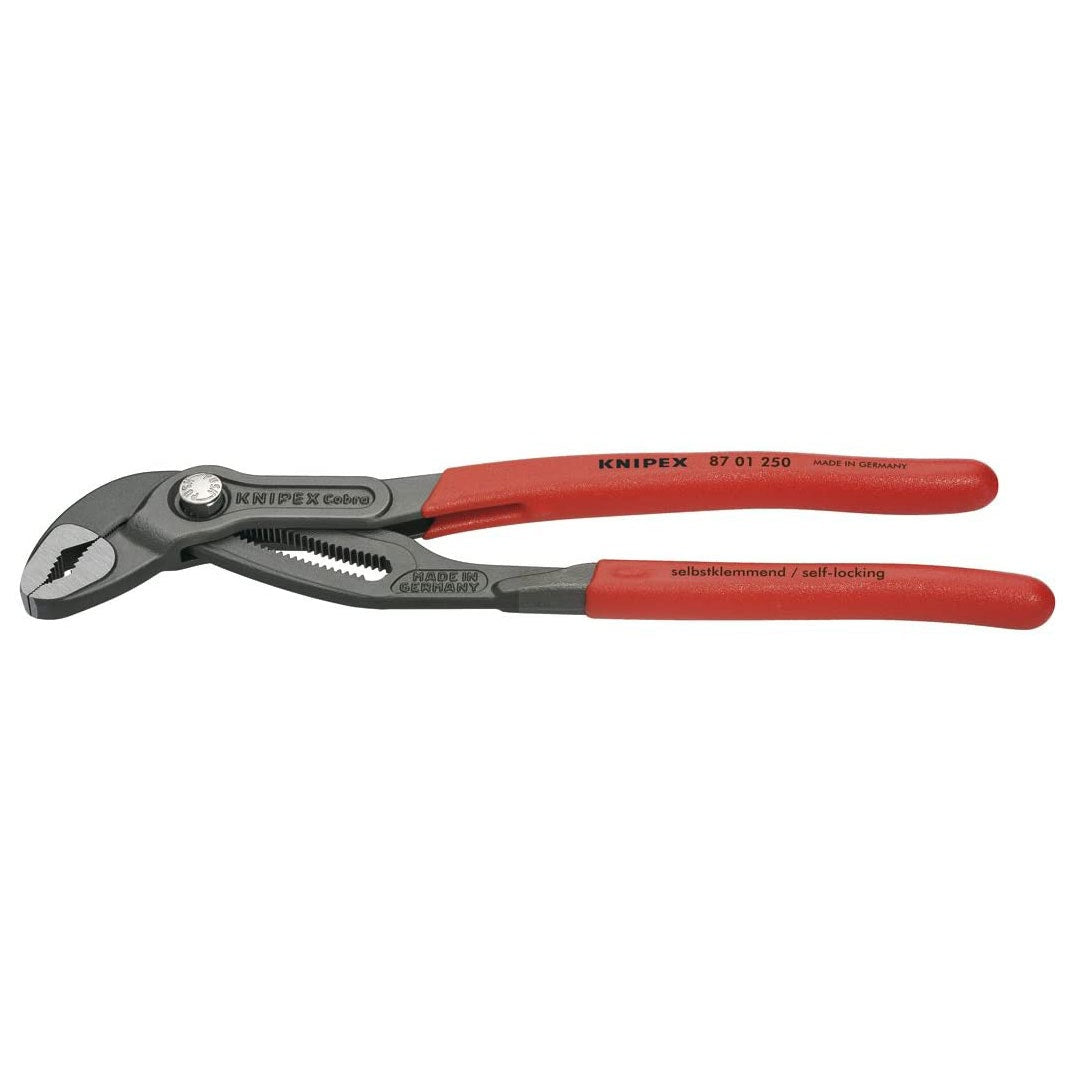
Channellock vs Knipex Cobra: Which Tongue-and-Groove Plier Should You Actually Buy?
Channellock vs Knipex Cobra — the short answer: if your hands hold these tools all day — plumbing, hex fittings, rounded fasteners — the Knipex Cobra 87 01 250 (10") is worth the extra money. Push-button adjustment, parallel jaws that grip hex flats without slipping, and a slimmer head that fits tight spots. If you mostly chase a drain nut a couple times a year, need the widest jaw on a budget, or work somewhere tools walk off, the Channellock 440 (12") is still the right call — wider serrated jaw, made in Meadville, PA, and roughly one-third the price. Both are good tools. They're good at different things.
At-a-Glance: Channellock vs Knipex Cobra
Three matched pairs. Pay more attention to the jaw capacity column than the length — the Cobra opens considerably wider than the same-length Channellock, which matters the moment you're reaching for a 1.75" drain nut.
| Model | Length | Max Jaw Capacity | Adjustment | Made in | Street Price |
|---|---|---|---|---|---|
| Knipex 87 01 180 | 7" (180 mm) | ~1.5" / 36 mm* | Push-button | Germany | $37–$40 |
| Channellock 426 | 6.5" | ~1.0" / 25 mm* | Tongue-and-groove | Meadville, PA, USA | $15.39 |
| Knipex 87 01 250 | 10" (250 mm) | ~2.0" / 50 mm* | Push-button | Germany | $39–$43 |
| Channellock 430 | 10" | ~1.5" / 38 mm* | Tongue-and-groove | Meadville, PA, USA | $19.32 |
| Knipex 87 01 300 | 12" (300 mm) | ~2.75" / 70 mm* | Push-button | Germany | $61.43 |
| Channellock 440 | 12" | ~2.0" / 50 mm* | Tongue-and-groove | Meadville, PA, USA | $24.97 |
Bold = top pick for each brand. *Jaw capacities are approximate — verify exact figures on each manufacturer's product page before purchasing.*
Both brands cover their pliers with a lifetime warranty against defects in materials and workmanship. Knipex builds the Cobra from chrome vanadium electric steel, oil-hardened. Channellock uses high-carbon steel.
At matched size, the Cobra typically runs 2.5–4× the price of the Channellock. Everything below is about whether that gap is worth it for your situation.
How the Adjustment Mechanism Actually Feels in Use
Knipex Cobra: One-Handed, Every Time
Push the button at the joint, slide the lower jaw to position, release. Locked. The Cobra offers 25 discrete positions — more than you'll use, spaced closely enough that you can dial to the right bite on almost any fitting without hunting.
The practical advantage compounds on back-to-back adjustments. Under a sink — P-trap slip nut first, then the drain flange, then the supply valve angle stop — the Cobra adjusts one-handed while your other hand holds the fitting. You don't set the tool down between steps. On a job with a dozen fittings, that adds up to real time.
Channellock Slip-Joint: Proven, But Two-Handed

The tongue-and-groove design Channellock invented hasn't changed much: line up the channel you want, push the lower jaw into a groove, go. It works. The catch: two hands to adjust, every time.
There's a second failure mode worth knowing before you commit. On repeated re-grips — especially with the larger 440 — the web of your hand between thumb and forefinger can get pinched as the handle gap closes. Not on every grip. Not to everyone. But it's more common with the Channellock than the Cobra on long sessions, and it's worse with the bigger sizes. The 440 has 7 tongue-and-groove positions. Fewer positions means a cruder fit — sometimes one notch too tight or one notch too loose.
Jaw Geometry: Parallel Hex-Grip vs. Wide Serrated
Why the Cobra Grips Hex and Round Fittings Better
The Cobra's jaws stay roughly parallel as they close. On a hex nut, that's flat-on-flat contact — two full jaw faces against two faces of the nut. On round pipe, both sides bite evenly. The induction-hardened teeth hold grip on corroded or slippery surfaces that a coarser jaw would skip on.
This is the core reason plumbers and mechanics tend to switch to the Cobra once they've used one. Working a worn compression fitting behind a water heater — hex nut, awkward angle, no room to fumble — the Cobra grips and stays gripped. The Channellock's angled jaws contact a hex nut at two points rather than two faces. On a fresh, sharp hex nut: fine. On a slightly worn fastener at a bad angle: that's how corners get rounded.
One real Cobra limitation to know upfront: its narrower parallel jaw can slide off wide, low-profile slip-nut wings — the kind on older drain strainers and some wide-flange PVC fittings. Not enough jaw width to cover the broad flat surface. That's the Channellock's territory.
Why the Channellock Sometimes Grips Wide Flat Fittings Better
The Channellock's angled serrated jaw is wider relative to its length class. On a large drain basket nut or a wide chrome P-trap slip nut, that jaw width gives more contact area than the Cobra's narrower profile. The deeper serrations also cut through heavy corrosion better on fittings you encounter once every few years and need to move *right now*.
For big, grungy, wide-faced fittings — the Channellock is the right tool. For daily close-quarters work on hex, compression, and standard plumbing fittings — the Cobra wins.
Are Knipex Cobras Worth the Price Over Channellocks?
For daily-use tradespeople, yes. Push-button adjustment, parallel hex-grip jaws, and a slimmer head pay for themselves in time and knuckles over a full day of plumbing or mechanical work. You'll pay roughly 2.5–4× more at matched size — for pros who use the tool daily, that spread is worth it. For occasional homeowner use, no: the Channellock 440 does 90% of the same work for roughly a third of the price.
If you're a plumber, mechanic, or electrician running tongue-and-groove pliers all day, the Cobra pays for itself quickly in fewer re-grips, fewer stripped fasteners, and less hand fatigue by end of shift. If you're clearing a drain clog twice a year, that math doesn't hold — save the money.
Which Size to Buy (and Which Pair to Own)
If You Only Buy One
Cobra: The 87 01 250 (10") handles everything — supply valves, P-traps, hex nuts, compression fittings, conduit lock-nuts. Fits in a tool pouch and a back pocket. Start here.
Channellock: The 440 (12") over the 430. It opens to roughly the same jaw capacity as the Cobra 250, handles large drain nuts with room to spare, and costs no more than the 430 at most retailers. For a homeowner's first tongue-and-groove plier, this is the right pick.
Two-Tool Kits
Knipex pair: 87 01 250 (10") + 87 01 180 (7"). The 10" does the main work. The 7" gets into tight vanity cabinets, behind toilets, and onto small compression angle stops where a 10" is too long. Add the 87 01 300 (12") only if you regularly work large-diameter drain assemblies or gate valve packing nuts.
Channellock pair: 440 (12") + 426 (6.5"). The 440 is the workhorse. The 426 covers tight quarters — bathroom supply valves, small supply lines, conduit lock-nuts inside a crowded electrical panel. If large building drain work is routine, the 460 (16") eventually earns its spot — it opens to 3.75 inches (95.25 mm).
Durability, Warranty, and Country of Origin
Knipex
Knipex manufactures the Cobra line in Wuppertal, Germany, producing around 59,000 pliers per day. Chrome vanadium electric steel, forged and multi-stage oil-hardened, with induction-hardened teeth rated around 61 HRC designed to hold grip across the tool's life. Knipex backs the Cobra with a non-transferable Lifetime Limited Warranty against defects in materials and workmanship.
Channellock
Channellock manufactures its tongue-and-groove pliers — the 420, 426, 430, 440, and 460 — in Meadville, Pennsylvania, where the company has operated since 1886 with more than 350 workers across two facilities. High-carbon steel throughout. Channellock covers its hand tools with a Limited Lifetime Warranty to the original owner against defects in material and workmanship, excluding normal wear and misuse.
Both brands honor legitimate defect claims. Neither covers wear (chipped teeth from heavy use) or abuse (bent jaws, heat damage from a torch). That's standard — but worth knowing before you file a warranty claim on a pair you used as a hammer.
When the Cheaper Channellock Is the Smarter Buy
- Tools walk off your jobsite. A stolen Cobra stings. A stolen Channellock stings less. On high-theft sites, don't buy expensive hand tools.
- You use tongue-and-groove pliers a few times a year. Two-handed adjustment doesn't matter when you adjust twice per project.
- Big, wide fittings are your main job. Large drain basket nuts, wide PVC couplings, older chrome slip-nuts with low-profile flanges — the Channellock's wide jaw covers more surface than the Cobra at matched size.
- You're buying for a homeowner. A Channellock 430 or 440 is exactly the right first tongue-and-groove plier for someone who doesn't own any.
- You need several pairs. Equipping a crew, stocking a truck, or setting up a shop? Three Channellock 440s cost less than one Cobra 250. The math isn't close.
FAQ
Are Knipex Cobras worth the money over Channellocks?
For daily-use tradespeople — plumbers, mechanics, electricians — yes. The push-button adjustment, parallel hex-grip jaws, and slimmer head pay for themselves in time and knuckles over a full day of work. For occasional homeowner use, no. A Channellock 440 does 90% of the same work for roughly one-third the price, and the two-handed adjustment won't matter when you use the tool twice a year.
What's the difference between the Knipex Cobra and the Knipex Pliers Wrench?
The Cobra (87 series) has serrated parallel jaws — it's a true tongue-and-groove plier for gripping pipe, hex nuts, and round stock. The Pliers Wrench (86 series) has smooth parallel jaws that work like an adjustable wrench: no serrations, no marks on chrome or polished fittings. They're complementary, not interchangeable. Use the Cobra where you need bite; use the Pliers Wrench where finish matters.
Which size Knipex Cobra should I buy first?
The 87 01 250 (10"). It covers most plumbing, mechanical, and general work — supply valves, P-traps, hex nuts, compression fittings — and fits in a standard tool pouch. Add the 87 01 180 (7") for tight-space work, and the 87 01 300 (12") only if you regularly deal with large-diameter drain assemblies.
Are Channellock pliers made in the USA?
Yes. Channellock has manufactured its tongue-and-groove pliers — including the 420, 426, 430, 440, and 460 — in Meadville, Pennsylvania since 1886, using domestically sourced steel.
Where are Knipex Cobras made?
Germany. Knipex is headquartered and manufactures in Wuppertal's Cronenberg district, with a workforce of about 1,800 employees.
What's the jaw capacity difference at the 10" size?
The Cobra 87 01 250 opens considerably wider than the same-length Channellock 430 — that gap is meaningful when you're reaching for a larger drain nut or compression fitting. For matched jaw capacity to the Cobra 250, step up to the Channellock 440 (12") — not the 430.
Do either of these scratch chrome or polished fittings?
Yes, both will. Hardened serrated teeth mark chrome. For chrome or polished fittings, use a Knipex Pliers Wrench (86 series) — smooth jaws, no bite marks — or wrap the fitting in a rag before grabbing it with either of these.
What does the lifetime warranty actually cover?
Both brands warrant against defects in materials and workmanship — manufacturing faults, not normal wear or abuse. A jaw that cracks without impact or a pivot that seizes prematurely: covered. Chipped teeth from daily use, bent jaws from prying: not covered. Knipex backs the Cobra with a Lifetime Limited Warranty to the original purchaser only; Channellock covers its hand tools with a Limited Lifetime Warranty to the original owner for as long as they possess the tool.
For most pros and serious DIYers, the answer eventually becomes "both" — they fill genuinely different roles and the pair isn't expensive once you spread it over years of use. If you're picking one today: daily trade work points to the Cobra 87 01 250; occasional home plumbing points to the Channellock 440.
The natural next comparison from here is the Knipex Cobra vs. the Knipex Pliers Wrench.
*editorial, no money page.*