
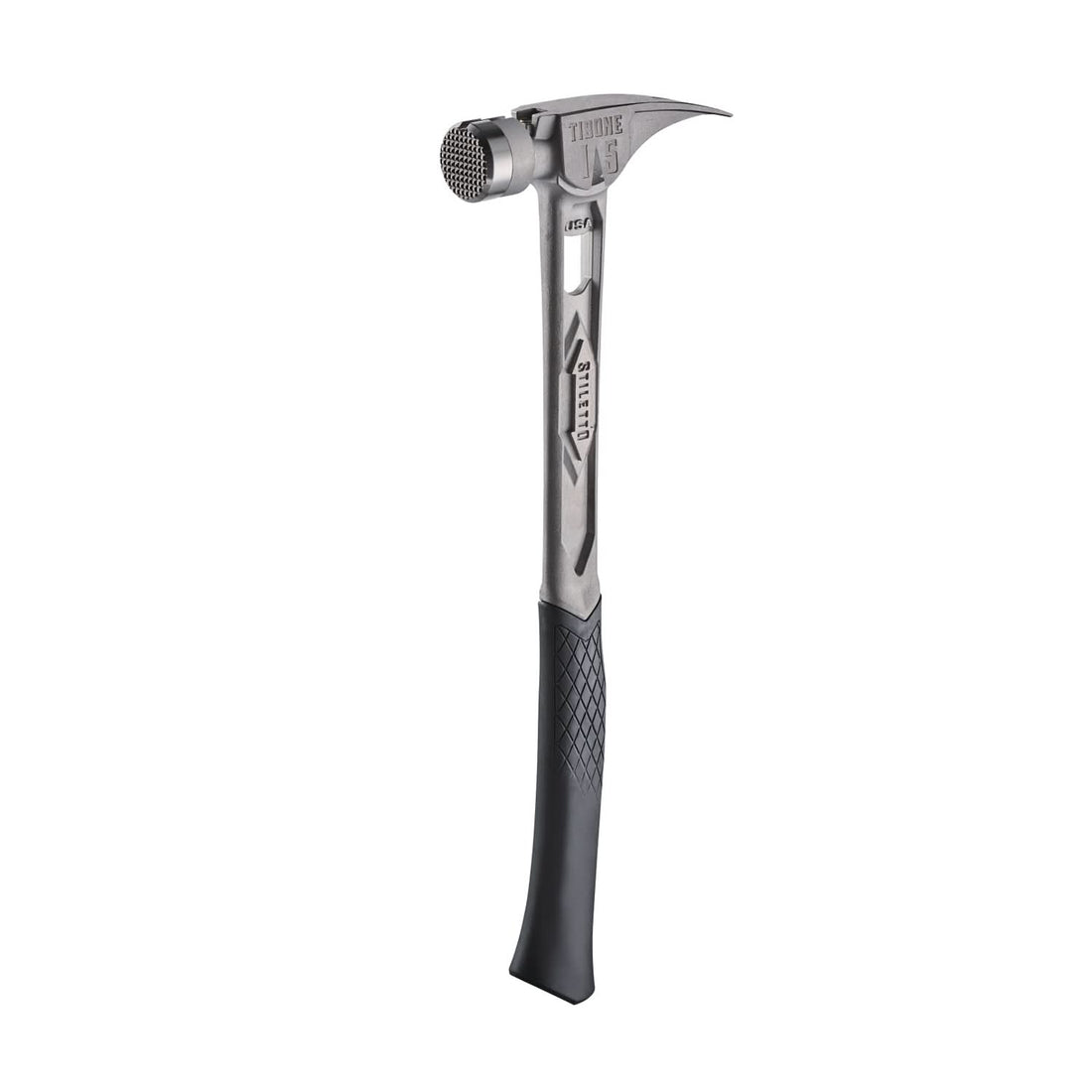
Estwing vs Stiletto Titanium Hammer: Which One Actually Earns Its Price
Estwing wins on price and durability. Stiletto wins when your elbow is the limiting factor. Titanium is roughly 43% less dense than steel (Ti: ~4.51 g/cm³ vs. steel: ~7.85 g/cm³) — which means a 15 oz titanium head drives nails with the authority of a 22 oz steel head, but sends far less recoil shock back into your tendons. If you frame for a living, a Stiletto TB-15 at roughly $175–220 pays for itself in the elbow damage you won't accumulate. If you swing a hammer on weekends, an Estwing E3-22S at roughly $35–50 does the same job and will outlast you.
The 30-Second Verdict (by User Type)
Weekend DIYer / Homeowner → Estwing E3-22S

You're not swinging enough hours for the titanium premium to matter. The E3-22S is one-piece forged steel — indestructible, with a genuine leather grip, and at $35–50 you could buy five of them for the price of one Stiletto. Buy the Estwing, save the difference.
Trim / Finish Carpenter → Stiletto TI14MC

You swing a hammer a lot, but with control — not production-framing volume. The TI14MC's 14 oz head with smooth face gives you precision and spares your tendons over long trim days, currently available in the $114.99–$117.37 range.
All-Day Framer / Form Carpenter / Roofer → Stiletto TB-15
This is the trade the Stiletto was designed for. Fifteen ounces of titanium that drives with the authority of a significantly heavier steel head, a milled replaceable face, and curved-neck geometry built for production work. The ~$175–220 price hurts once. Tennis elbow injections hurt for years.
Demo / Rough Work / Prying → Estwing
Titanium claws chip when you lever hardened nails or rough lumber. For anything involving sustained prying, keep an Estwing (or a dedicated demo bar) in your hand. Don't use a Stiletto for this.
Why Titanium Hammers Exist — The Recoil Physics, Not the Marketing
Density and Mass
The core difference is material density. Titanium runs ~4.51 g/cm³; structural steel runs ~7.87 g/cm³. For the same head volume, a steel head is nearly twice as heavy as a titanium one. That's not a marginal difference — it shows up in your hand on every single strike.
Same Driving Energy, Less Mass
Kinetic energy is ½mv². Drop the mass by 43% and swing speed goes up. Because velocity is squared in that equation, a faster swing with a lighter head can match the driving energy of a heavier, slower swing with steel. The Stiletto TB-15's 15 oz head drives nails effectively at the speeds a trained framer naturally swings — and the recoil that comes back on impact is proportional to that lower mass, not to the 22 oz steel equivalent.
What Stiletto's "10× Less Recoil Shock" Claim Actually Means
Stiletto markets their titanium hammers as delivering 10× less recoil shock than steel. That's a manufacturer figure, not an independent lab measurement. Treat it as directional. What's real: lower-mass head, less mass decelerating at impact, less energy bouncing back up the handle. Whether the multiplier is 10× or 6× doesn't change the practical result across 300 strikes a day.
Estwing vs. Stiletto: Full Spec Comparison
| Estwing E3-22S | Stiletto TB-15 | Stiletto TI14MC | |
|---|---|---|---|
| Head material | One-piece forged steel | Titanium | Titanium |
| Head weight | 22 oz | 15 oz | 14 oz |
| Overall length | ~16 in† | ~18 in† | See specs† |
| Face type | Smooth | Milled, replaceable | Smooth |
| Handle options | Leather grip (E3-22S) / Shock Reduction Grip (E3-22SM)† | Hickory or fiberglass | Hickory or fiberglass |
| Claw style | Curved | Straight | Curved |
| Warranty | Lifetime | See manufacturer† | See manufacturer† |
| Approx. price | ~$35–50 | ~$175–220 | ~$150–190 |
| Best for | DIY, demo, general use | Production framing, form work | Trim, finish, light framing |
*† Verify current lengths, SKU designations, and warranty terms at estwing.com and stiletto.com before ordering. Prices are approximate at time of publish.*
Where Estwing Genuinely Wins
Price
The math is simple: four Estwing E3-22S hammers for the price of one Stiletto TB-15. If you don't swing a hammer enough hours per day to accumulate real recoil wear on your tendons, the premium never pays itself back.
Indestructibility
One-piece forged steel from head through handle — there is no joint to fail, no head to loosen, no part to replace. The leather grip wears in and gets better over time. The Shock Reduction Grip version (E3-22SM) adds a nylon/vinyl overmold for more surface cushion. Neither configuration has a failure mode that requires you to order anything.
That last point is worth sitting with: the Stiletto TB-15's replaceable face is a genuine feature, but it means there's eventually a part to replace. The Estwing simply doesn't have that conversation.
Better for Demo and Nail-Pulling
Steel claws survive prying work that chips titanium. Any situation involving sustained leverage — pulling hardened spiral nails, demolishing old framing, working a claw under boards — belongs to the Estwing. Stiletto's own guidance cautions against using their heads for prying tasks.
Where Stiletto Genuinely Wins
Joint Fatigue Over a Full Workday
This is the one reason to buy a Stiletto. If you're driving 300–500 nails a day, five days a week, the cumulative recoil difference between a 22 oz steel head and a 15 oz titanium head accumulates into real biological wear. Lateral epicondylitis (tennis elbow) shows up often enough in framers that experienced crew members can often date their injury to the years before they switched. The Stiletto doesn't make your elbow bulletproof. It removes a significant mechanical stressor, consistently, every day.
Replaceable Milled Face on the TB-Series
The TB-15's milled face gives better positive contact on nail heads — less glancing blow, more direct transfer. And when it eventually smooths out, you replace just the face — replacement faces are available through Stiletto's accessories lineup. Estwing offers nothing comparable in their steel framing line.
Curved-Neck Geometry
The TB-15's curved neck puts the strike angle closer to ideal for production framers driving nails overhead or into plates. It's the kind of thing you notice over a full day without being able to articulate exactly why — the hammer sits better in the swing.
The Two Mistakes People Make
Buying a Stiletto for Weekend Work
You're paying for elbow protection you don't need. A DIYer driving 30 nails on a Saturday afternoon accumulates negligible recoil load. The $150–180 gap between an Estwing and a Stiletto is a real amount of money that doesn't translate into any real benefit at that usage level. Buy the Estwing. Spend the rest.
Buying an Estwing When You Frame 5 Days a Week
This is the worse mistake. You saved $180 on a hammer. Then you spent two years developing lateral epicondylitis, paid for cortisone injections, maybe missed work. The Stiletto premium is cheap compared to the medical bill it prevents. If you're a production framer and you've never had elbow trouble — good. Buy the Stiletto anyway. Prevention costs less than treatment.
Handle Materials — A Real Trade-Off Nobody Discusses
Estwing: Leather Grip vs. Shock Reduction Grip
The E3-22S features a smooth face; the E3-22SM features a milled face. Both models come with Estwing's nylon-vinyl Shock Reduction Grip, molded on, which the company rates at roughly 50% vibration reduction. It's comfortable and durable without any break-in period.
Neither changes the fundamental: one-piece steel construction transmits vibration more directly than any tool with a separate handle-to-head joint. The grip dampens surface sensation — it doesn't change what's happening mechanically.
Stiletto: Hickory vs. Fiberglass
Both are available on most TB and TI models. Hickory absorbs some vibration through the wood grain and has a traditional feel that experienced carpenters often prefer. Fiberglass holds up better in wet conditions and doesn't need any maintenance. The gap in vibration transmission between them is real but modest compared to the head-material difference.
Vibration Transmission: Rough Ranking
From least to most, for framing use:
1. Stiletto titanium + hickory handle 2. Stiletto titanium + fiberglass 3. Estwing with Shock Reduction Grip (E3-22SM) 4. Estwing with leather grip (E3-22S)
Two Things You May Have Searched
"Stiletto titanium" — who makes it now? Stiletto is owned by TTI — Techtronic Industries, the same parent company that owns Milwaukee Tool. It's no longer an independent brand. The quality has held up, but it's worth knowing you're buying from the Milwaukee side of the house, not a small titanium specialty shop.
"Estwing titanium hammer" — does one exist? Not a pure-titanium head. Estwing makes an aluminum-titanium hybrid framing hammer called the Al-Pro line — a 14 oz head with a steel face bonded to an aluminum body. It's a middle-ground option at roughly half the price of a Stiletto and worth a look if you want weight reduction without the full titanium premium.
Frequently Asked Questions
Are Stiletto hammers worth the money? Only if you swing one for a living. The premium pays for reduced recoil shock — which matters over 8-hour days across years of production work, not over a weekend deck build. Framers, form carpenters, and roofers get their money back in avoided elbow strain. Homeowners don't.
Is a titanium hammer better than a steel hammer? Not for driving nails — steel and titanium transfer equivalent driving energy when swing speed adjusts for head mass. Titanium is better for *your body*. The ~43% lower density means less recoil energy travels back up the handle to your wrist and elbow on every strike.
Why are Stiletto hammers so expensive? Titanium costs roughly 5–10× more than steel per pound as raw material, it's harder to forge, and Stiletto's US-machined heads with replaceable faces add real tooling cost. The premium reflects material and labor — not just branding.
Does Estwing make a titanium hammer? Not a pure-titanium head. Estwing makes an aluminum-titanium hybrid framing hammer — the AL-PRO™ Hammer — with a steel face bonded to an aluminum body: a different product from a pure-titanium head, at a lower price than a Stiletto and a reasonable middle-ground option.
What hammer do professional framers use? On production framing crews, you'll most often see Stiletto TB-II and TB-15 titanium models, and Estwing E3-22S or E3-30S steel hammers as the durable, affordable alternative. The split tracks closely to whether the framer has ever dealt with tennis elbow.
How much lighter is a Stiletto than an Estwing? A Stiletto TB-15 has a 15 oz head vs. the Estwing E3-22S's 22 oz head — roughly 32% lighter. It drives with comparable authority because swing speed increases as head mass drops.
Can you use a Stiletto for demo work? You can. You shouldn't. Titanium claws chip when prying hardened nails or levering framing lumber. Keep an Estwing or a dedicated demo bar for that work and save the Stiletto for driving.
Which One to Order
The breakdown is simple:
- Weekend DIYer or occasional user: Estwing E3-22S. Nothing to second-guess.
- Trim / finish carpenter: Stiletto TI14MC. The 14 oz smooth face earns the premium over long detail days.
- Production framer / form carpenter / roofer: Stiletto TB-15. Replaceable milled face, curved neck, built for production volume.
- Demo, prying, or rough use: Estwing, every time.
If you're rounding out a hand-tool kit beyond the hammer, the same price-vs-daily-use logic applies to pliers — Channellock vs. Knipex Cobra runs the identical calculation for tongue-and-groove pliers, and Klein vs. Knipex linesman pliers covers it for linesman work. Electrician pliers guide adds the electrician-specific angle, and utility knife recommendations rounds out what most trades carry on a framing or finish job.