
Best Utility Knife for Drywall: 5 Picks for Every Cut
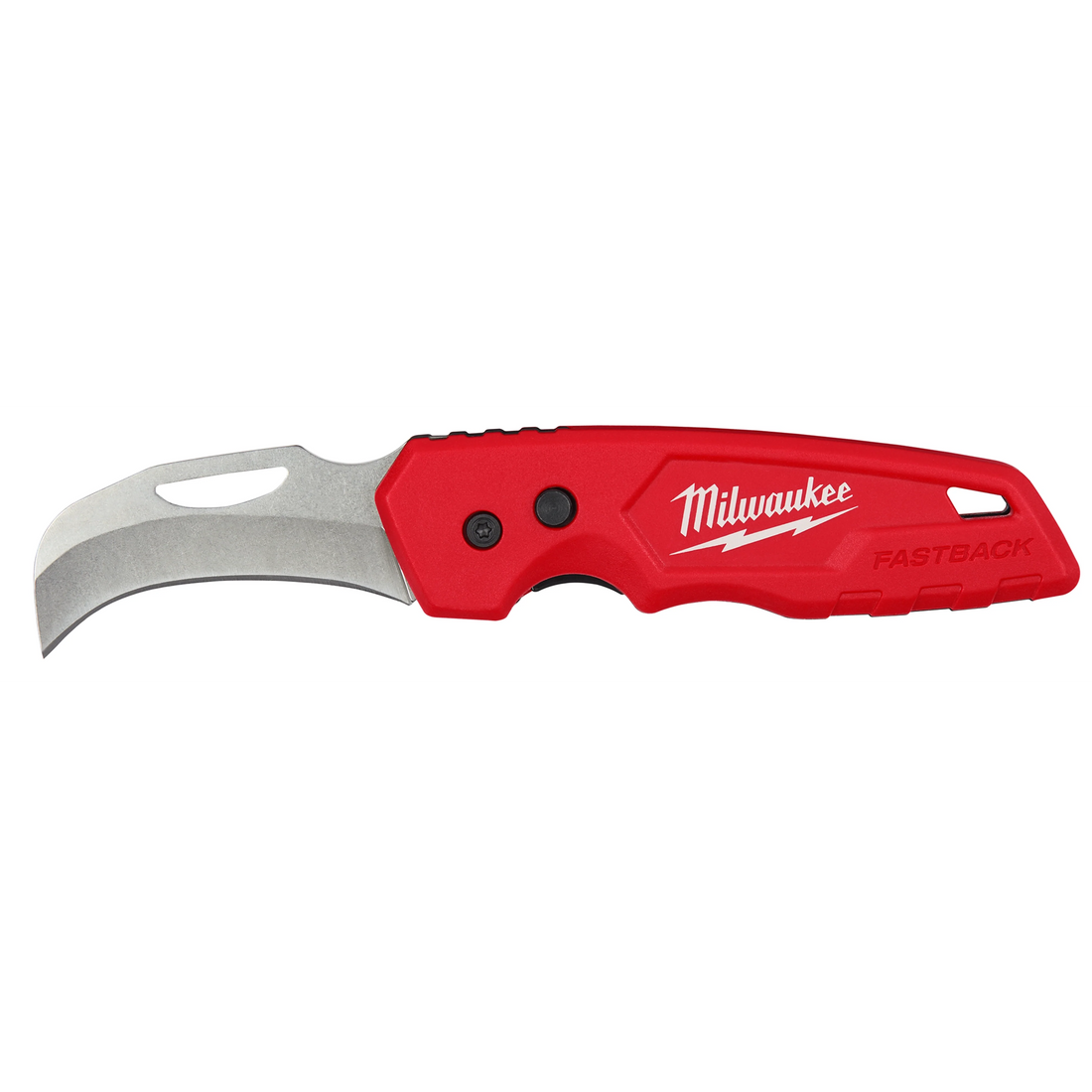
The Milwaukee FASTBACK 48-22-1525 is the best all-around utility knife for drywall. It deploys one-handed in a flip, holds firm under scoring pressure, and has no auto-retract spring to gum up with gypsum dust. If you hang drywall regularly — even part-time framing and patching — it's the one to get. For light or occasional work, a quality retractable like the Stanley FatMax does the job. The right pick hinges on one thing: how much drywall you cut and whether you're scoring-and-snapping full sheets or cutting through for boxes and rough openings.
Two Cuts, Two Different Demands
Drywall isn't one material with one cutting job. It's two distinct operations, and a knife that's great at one can be miserable for the other.
Score and Snap
This is the majority of cuts when hanging full sheets. You run the knife roughly 1/4" deep along a straightedge — just enough to break the paper face. The gypsum snaps cleanly on the score line. Done right, it's shallow, controlled, repeated strokes. A hook blade excels here: the curved tip tracks a T-square channel without skating off and naturally limits penetration depth. You want a knife with a firm, non-flexy grip — any lateral wobble translates directly to a ragged score.
Cut-Through for Outlets, Patches, and Curves
Outlet boxes, switch boxes, vent rough-ins, custom patches — these demand full-depth cut-throughs. You're driving the blade the full thickness of the board: 1/2" (12.7 mm) for walls, 5/8" (15.9 mm) for ceilings. Multiple passes through the gypsum core. That core is essentially fine calcium sulfate powder, and it abrades a blade edge roughly 3–4× faster than cutting through softwood. This is why blade-change speed is a real spec, not filler.
Fixed Blade vs. Retractable for Drywall — An Honest Call
Both work. The question is which one holds up through a full day of hanging.
Retractable: The blade slides into the body when you release thumb pressure or hit a lock button. Fine for casual use. The problem is gypsum dust: fine powder works its way into the slide mechanism over time. A sticky retract is annoying; a blade that snaps back unexpectedly under load is a cut finger. On a job where you're scoring 40 sheets, this becomes a legitimate concern.
Folding fixed-blade: The blade folds into the handle like a pocket knife and locks open rigidly — no spring, no mechanism for dust to foul. Safety comes from the positive lock rather than an auto-retract spring. Production hangers prefer these because there's one fewer failure point, and one-handed deployment means no fumbling with a slider while holding the knife against a panel.
| Knife type | Best for |
|---|---|
| Folding fixed-blade | Production hanging, repeated scoring, dusty conditions |
| Retractable | Occasional patching, multi-task site knife, light-duty use |
What to Look for — Specs That Actually Matter for Drywall
Blade extension depth. You need enough blade exposed to score through 5/8" Type X in a single clean pass. Most standard utility knives clear this depth easily, but verify before buying anything marketed as "compact."
Quick-change / tool-free blade replacement. Gypsum dulls blades fast. If swapping a blade takes a screwdriver and three minutes, you'll push a dull blade longer than you should. The difference between a 30-second swap and a three-minute one is real when you're on a deadline.
Handle grip in dusty conditions. After scoring a few sheets, your hands, your gloves, and everything nearby are coated in fine white powder. A smooth-body knife gets slippery fast. Wide handles with aggressive texturing or rubberized overmold keep the knife in your hand when the dust is thick. This isn't a comfort preference — it's a safety issue.
Standard utility blade format. For knives that accept replaceable blades, stick with the standard utility format (the 3-notch trapezoid stocked at any hardware store or drywall supply house). Proprietary blade formats are a supply-chain problem on a job site. The replaceable-blade knives in this list all use the standard format.
The 5 Best Utility Knives for Drywall
Best Overall — Milwaukee FASTBACK 48-22-1525
The FASTBACK flips open one-handed with a thumb stud — same motion every time, no different than opening a pocket knife. It carries a fixed stainless steel hawkbill blade — not a replaceable utility blade format — so the curved geometry that tracks a T-square without skating is always ready, with nothing to swap and no mechanism for gypsum dust to foul. The blade lock is positive with no play, which matters when you're bearing down on a scoring stroke.
The handle is wider and more textured than most of the competition — right for gloved hands coated in drywall dust. This is the knife production hangers reach for because it's fast, reliable, and has no spring mechanism asking to fail on you.
Best Retractable — Stanley FatMax
If your utility knife sees drywall a few times a year — patch work, small repairs, one ceiling in one room — a retractable is practical. The Stanley FatMax FMHT10288 is the standard-bearer: solid build, widely available, standard blades. The bi-material handle holds up in dusty conditions better than smooth-grip alternatives.
The caution stands: if you're hanging all day, watch the slide mechanism for sticking from gypsum buildup. For occasional use, that's not a realistic concern.
Best Budget Pick (Under $20) — Irwin ProTouch
The Irwin ProTouch fixed-blade utility knife typically lands well under $20 and does nothing wrong. The soft-grip over-mold handles dusty conditions, blade changes are straightforward, and it takes standard blades. It's not as fast to deploy as a folding FASTBACK, but for stocking a tool bag for repair and patch work on a budget, it earns the spot. Not every job requires a $40 knife.
Best for Heavy Production Work — Milwaukee FASTBACK 48-22-1502

The Milwaukee FASTBACK 48-22-1502 is the standard-size FASTBACK with on-board blade storage — spare blades ride in the handle itself, so you're not digging through a tool bag when gypsum dulls an edge mid-sheet. (The compact model is the 48-22-1500, a distinct SKU.) It shares the same flip-open one-handed deployment and positive blade lock as the rest of the FASTBACK line. The blade storage is the practical differentiator for heavy production work: when you're hanging dozens of sheets and changing blades frequently, having spares on the knife keeps the pace up.
Dedicated Drywall Scoring Knife — Hyde 45500 (Category Note, Not a Utility Knife)
The Hyde 45500 is purpose-built for one operation: long, straight scores on drywall paper, run against a T-square. It's faster and more consistent for that single task than any utility knife. It will not do outlet cut-outs or cut-throughs — the blade geometry is fixed for shallow scoring only.
If 90% of your work is scoring and snapping full sheets, add this alongside a utility knife. If you need both scoring and cut-throughs, a utility knife handles both. This is a complement at volume, not a replacement.
Hook Blade vs. Standard Blade for Drywall
The knife body is a blade carrier. What you run in it is the cut.
Hook blades for scoring. The hooked tip grips into the paper face and tracks a T-square without skating sideways. Milwaukee SHOCKWAVE hook blades, Irwin hook blades, and other standard-format hook blades fit any knife body in this list that accepts replaceable utility blades — a broad lineup that covers every scoring need.
Standard blades for cut-throughs. A fresh sharp standard blade is right for outlet rough-ins and patches. The hook geometry doesn't add anything once you're cutting full-depth through the gypsum core.
Change frequency. The trade rule of thumb is a fresh blade every 3–4 sheets of drywall for clean scoring. Pushing a dull blade means more pressure, more blade flex, and a rougher score line. Blades cost almost nothing. Don't stretch them.
Frequently Asked Questions
What type of utility knife is best for cutting drywall? A folding fixed-blade utility knife is best for production work. It deploys fast one-handed, stays rigid under scoring pressure, and has no auto-retract spring to clog with gypsum dust. A retractable works for occasional patching or a multi-task site knife.
Can I use a regular utility knife to cut drywall? Yes — any sharp standard utility knife cuts drywall. The differences that matter in practice are blade-change speed (gypsum dulls blades faster than most materials), grip performance in dusty conditions, and mechanism durability over repeated use.
What blade is best for cutting drywall? A hook blade for scoring the paper face — the curved tip tracks a straightedge and resists skating. A fresh standard utility blade for full cut-throughs like outlet boxes. Both are standard format and available at any hardware store or drywall supply house.
How often should I change blades when cutting drywall? More often than for wood. Replace the blade when it starts tearing the paper face rather than slicing cleanly, or when you feel drag on the stroke — the gypsum core abrades edges quickly. Dull blades mean more pressure, more flex, and ragged cuts. Blades are cheap — don't stretch them.
Is a fixed blade or retractable blade safer for drywall? A retractable feels safer for casual use. But a quality folding knife with a positive lock is equally safe in practice — and more predictable in dusty conditions where a gummed-up spring can cause a retractable blade to stick open or snap back unexpectedly under load.
Is a dedicated drywall scoring knife better than a utility knife? For long straight scores only, yes — a dedicated scoring knife like the Hyde 45500 is faster and tracks a T-square more consistently. But it can't handle cut-throughs. A utility knife does both, which makes it the right tool for general drywall work. Add the scoring knife if straight-score volume justifies it.
For other hand-tool comparisons, see Channellock vs. Knipex Cobra, the Knipex Pliers Wrench, and Klein and Knipex Linesman Pliers. The Milwaukee FASTBACK 48-22-1525 is stocked at The Home Depot, Menards, Lowe's, and direct from Milwaukee Tool — no markup, no tricks.