
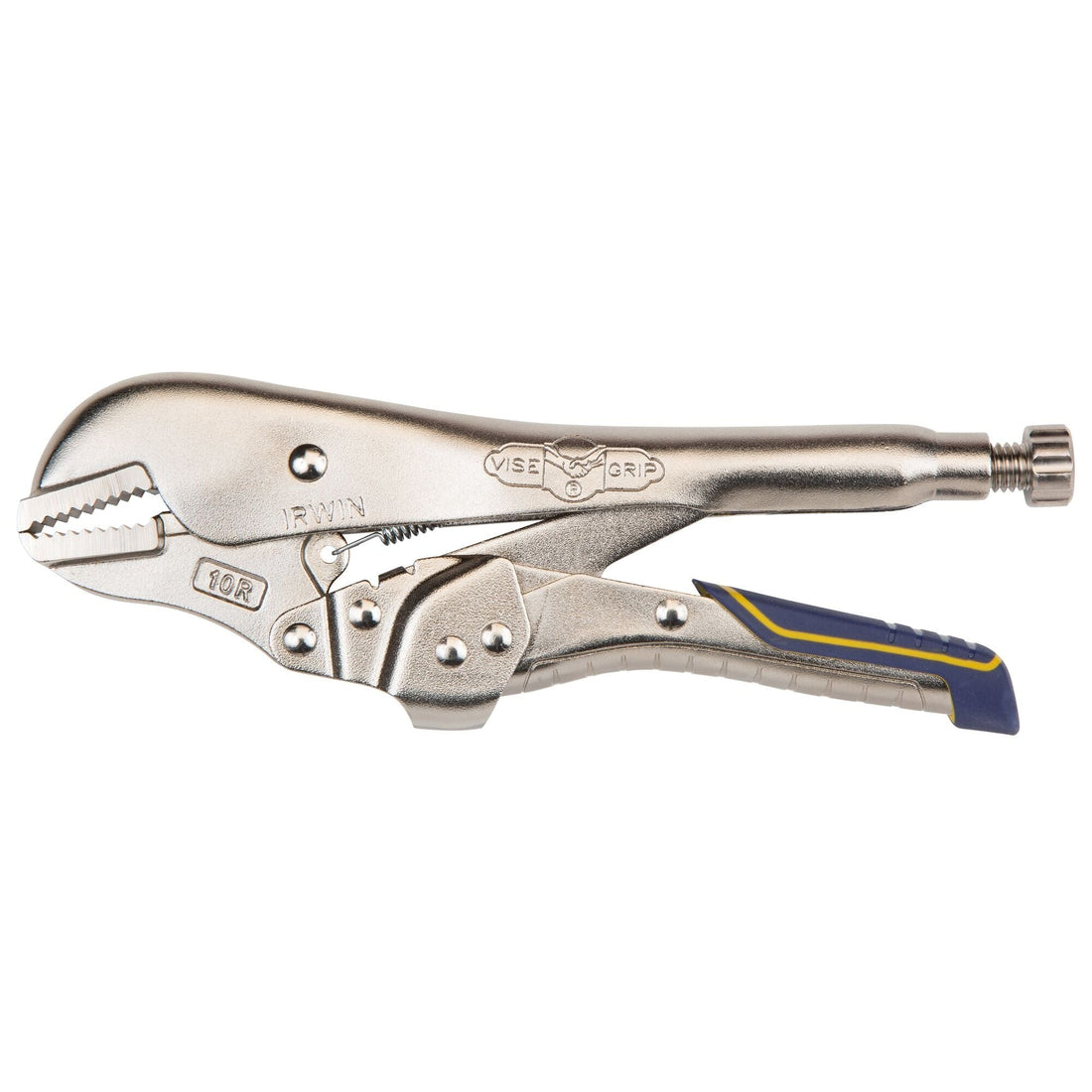
Best Locking Pliers: Which Jaw Type, Size, and Brand Actually Matter
For most people, start with a 10" curved-jaw locking pliers. Irwin Vise-Grip model 2078210 has been the go-to for decades — drop-forged alloy steel, 1-9/16" max jaw opening, wire cutter built in, adjustment screw that still dials in smoothly after years of use. Milwaukee's hand-tool locking pliers (48-22-3510) match it in build quality at a similar price. If you work electrical or need to reach into tight spaces, a 6" long-nose is the right second buy. Skip the 7" — a 6" and a 10" divide the work more cleanly without overlap. Here's the breakdown behind those defaults.
Quick Picks at a Glance
| Model | Jaw type | Length | Max jaw opening | Wire cutter | Best for | Price tier |
|---|---|---|---|---|---|---|
| Irwin 2078210 (10WR) | Curved | 10 in | 1-9/16 in | Yes | General use, bolt extraction, pipe | Mid |
| Milwaukee 48-22-3510 | Curved | 10 in | — | — | General use, heavy-duty | Mid |
| Irwin 213LN | Long-nose | 6 in | — | — | Electrical, tight corners | Mid |
| Craftsman CMHT81637 | Curved | — | — | — | Occasional DIY use | Budget |
| TEKTON 37122 | Curved | 10 in | — | — | Budget general use | Budget |
Exact jaw openings and wire cutter inclusion for the Milwaukee, Irwin 213LN, Craftsman, and TEKTON models vary by configuration — check current manufacturer listings for up-to-date specs.
The Irwin 10WR's built-in wire cutter slot handles light tasks — pulling wire staples out of framing, nipping small-gauge wire — but it's not a substitute for real diagonal cutters on heavier wire or cable. Think of it as a convenience feature, not a dedicated cutter.
Street prices shift. The Irwin 10WR and Milwaukee 48-22-3510 typically land in the same mid-tier range at big-box retailers; Craftsman and TEKTON come in noticeably cheaper.
Jaw Types — What Each One Actually Grips
Curved Jaw — Why It's the Default
The curved jaw grips round stock: pipe, bolt heads, rounded nuts a wrench can no longer bite. The curved geometry centers itself on a cylinder and locks in. That's why it's the first buy for almost everyone — plumbers, mechanics, general contractors, weekend DIYers.
When you need to extract a rounded-off nut, hold a fitting while you tighten a compression ring, or clamp a rod steady while a helper threads from the other end, curved jaw is the right call. Most people never need anything else.
Long-Nose — Electrical Panels, Cabinet Hardware, Tight-Corner Grips
The long-nose style narrows down to reach where a curved jaw can't — breaker panels, tight cabinet hinges, closely spaced fittings. Electricians often carry a 6" long-nose as their main locking pliers, reaching for a 10" curved only when jaw capacity is the issue.
It also locks onto small-diameter objects the curved jaw overshoots — small bolts, cabinet hinge pins, wire bundle clips. The Irwin 213LN is the standard here. If you're not working electrical or in tight quarters regularly, it's a second buy. If you are, it might belong in your first slot.
For pliers optimized specifically for electrical work and panel access, see Klein vs. Knipex for electricians.
Straight Jaw — Flat Stock and Hex Fittings
The straight jaw aligns flush against flat and hex surfaces — square stock, flat strap, hex fittings. Less common than curved, and a curved jaw handles most of the same work anyway. Fabricators and welders who regularly hold flat steel stock in position reach for straight jaw specifically. For general trades, it's a third buy at best.
C-Clamp / Welding Style — A Different Tool Altogether
The C-clamp style locks across flat surfaces like a one-handed clamp — designed for holding sheet metal at a weld joint. It functions more like a clamp than pliers. If you're welding regularly, you probably already know you want these. Otherwise, skip it. This style warrants its own deep-dive post when search volume supports it.
Size Selection — Which Length to Own First, Second, and Skip
10" is the first buy. The reach-to-jaw-capacity ratio works for most jobs. You get enough lever arm to close onto most fasteners and fittings you'll encounter, and it fits a standard tool belt pouch.
6" is the second buy — specifically if you work electrical or in tight quarters. A 6" long-nose paired with a 10" curved covers the full range without much redundancy. The 6" won't have the jaw capacity for large-diameter work, but that's what the 10" is for.
12" earns a slot for heavy pipe and large-bolt extraction. A plumber pulling corroded 1.5" supply-line fittings or a mechanic removing a large stub axle nut — that's when the 12" earns space in the bag. It's not an everyday tool for most people. Borrow or rent one before committing to a purchase.
7": skip it. The 7" isn't bad — it's just redundant if you own a 6" and a 10". The 6" handles small-access work; the 10" handles everything else. The 7" sits in the middle without doing either job better than what you already own.
Irwin Vise-Grip vs. Milwaukee vs. Budget Options — The Honest Comparison
Irwin Vise-Grip — The Name, the History, the Current Reality
Vise-Grip was invented in DeWitt, Nebraska in 1924 and manufactured there for most of its history. Production moved out of DeWitt after Apex Tool Group acquired the brand around 2008, and the brand is now manufactured overseas.
Is the current-production Irwin worse than the old American-made version? Forum threads will have you believing quality fell off a cliff. The reality is more measured: the 2078210 is still drop-forged alloy steel, the adjustment screw is still knurled and smooth-turning, and jaw fit tolerance is still tight. The biggest shift was in steel sourcing and secondary finishing — things you won't notice until a cheap jaw cracks under heavy extraction torque. The current Irwin doesn't do that reliably. Compared to other mid-tier options available today, it holds its own.
Milwaukee 48-22-3510 — A Genuine Challenger

Milwaukee built their hand-tool line to compete, not just co-brand. The 48-22-3510 is a 10" curved jaw — same footprint as the Irwin 10WR — built to comparable specifications in drop-forged alloy steel with jaw capacity suited to the same range of general-trade work.
Where it matches Irwin: jaw fit is tight, compound adjustment screw action is smooth, and the steel feels comparable in the hand. Where it diverges: Milwaukee's locking pliers line is narrower — fewer jaw styles and size options than Irwin's full catalog. If you need a 213LN-style long-nose or a C-clamp welding model, you're back to Irwin. For the core 10" curved jaw, either works.
Craftsman and TEKTON — When Budget Is the Right Call
Craftsman's CMHT81637 is aimed at homeowners who need locking pliers a few times a year — holding a strap while wrestling a hose clamp, clamping work for a quick solder joint. They're not drop-forged alloy steel across the board, and under heavy rotational torque the difference shows. For occasional use, they're fine.
TEKTON's 37122 earns more respect than typical budget competition — TEKTON uses drop-forged steel on their hand tools and publishes specs clearly. If you want something better than Craftsman without spending mid-tier money on a tool you'll reach for once a month, TEKTON is worth a look.
What "Premium" Actually Buys
The gap between budget and mid-tier shows up in three specific places:
1. Steel grade. Drop-forged alloy steel (Irwin, Milwaukee) versus unspecified carbon steel (some budget). The difference matters under heavy extraction torque and over years of use. 2. Compound adjustment screw action. The knurled screw on the lower handle is a compound mechanism — it lets you fine-tune jaw width in small increments before locking. A well-machined screw dials in precisely; a cheap one feels gritty and gives you "close enough." After five years of adjusting under pressure, that grit wears on you. 3. Jaw fit tolerance. Tight jaw fit means the locking toggle engages cleanly and holds. Sloppy fit means you're fighting the tool instead of the fastener.
You won't feel any of these differences opening the package. You feel them five years in.
When NOT to Use Locking Pliers
This is the section most buying guides skip. We're not skipping it.
Fasteners you plan to reuse. Serrated locking-plier jaws chew hex corners. A bolt you've locked onto will show bite marks and may no longer seat squarely in a socket or box-end wrench. Use an open-end or socket for fasteners you want intact afterward.
Soft metals — aluminum fittings, brass valves. Locking pliers crush soft metal before they grip it. You'll deform the fitting before you build enough friction to turn it. A strap wrench grips soft-metal pipe and fittings without biting.
Calibrated or torqued fasteners. Locking pliers give you no controlled force — you squeeze until it feels tight. Cylinder head bolts, drain plugs with a spec torque, or anything requiring a torque wrench value: don't use locking pliers. There's no way to control how much you're applying.
Coated, chrome, or decorative work. Chrome-plated fixtures, polished pipe, decorative hardware — the jaws scratch and gouge. Soft-jaw pliers or padded channel-locks are the right call.
Reach for locking pliers when none of those conditions apply and you're good. But those four situations come up constantly — they're how people damage fasteners and fittings they didn't have to.
For a full look at channel-lock (water pump) pliers and how they compare to locking pliers in everyday use, see our detailed comparison of channel-lock and locking pliers.
Frequently Asked Questions
What is the best brand of locking pliers?
Irwin Vise-Grip is the standard benchmark — widely available, proven at every level of trade work, and the 10WR is in nearly every professional tool bag. Milwaukee's hand-tool locking pliers match it in build quality at a similar price. For occasional use, Craftsman holds up fine. One important clarification: Knipex does *not* make a traditional locking pliers. Their Cobra pliers are water pump pliers — a different tool that requires continuous hand pressure. If you see Knipex listed in a locking-pliers roundup, the writer mixed up the categories. See whether a Knipex pliers wrench is worth it for where a Knipex pliers wrench fits in — it's a legitimate tool, just not this one.
What size locking pliers should I buy first?
10" curved jaw. It handles the widest range of jobs — bolt extraction, clamping pipe, holding work while you weld or solder. Add a 6" long-nose as a second buy if you work in electrical or tight quarters. Skip the 7".
Are Irwin Vise-Grips still made in the USA?
No. Production moved from DeWitt, Nebraska after Apex Tool Group acquired the brand around 2008, and current manufacturing is overseas. Whether that move degraded quality is a legitimate debate — see the brand comparison section above for the full take.
What's the difference between curved-jaw and straight-jaw locking pliers?
Curved jaw grips round stock — pipe, bolt heads, rounded objects — better. The curved geometry centers itself on a cylinder. Straight jaw locks more cleanly onto flat stock, hex fittings, and square shapes. Most people only ever need curved jaw.
Can locking pliers damage nuts and bolts?
Yes, and it's the most common misuse. The serrated jaws bite into soft metals and round off hex corners on fasteners. Use locking pliers on fasteners you're removing and replacing, not ones you need in good shape afterward.
How do I adjust the clamping pressure on locking pliers?
Turn the knurled adjustment screw on the lower handle. Clockwise tightens the jaw opening; counterclockwise widens it. Set it so the jaws lock with firm but single-handed handle pressure — too tight and you can't close them without two hands. The goal is one solid squeeze to engage the toggle, not a death grip.
What's the difference between locking pliers and channel-lock (water pump) pliers?
Locking pliers toggle-lock in place and hold a grip without you squeezing. Channel-lock pliers require continuous hand pressure to maintain grip. For clamping — holding a fitting in place while you tighten with another tool or hand — locking pliers are the right call. For turning and adjusting fittings, channel-locks or a proper wrench are better. Full breakdown at channel-lock vs. Knipex comparison.
These picks are based on published specs and manufacturer materials. No sponsored picks, no affiliate arrangements — if the budget option is right for your job, that's what we said to buy.
For non-locking options in tight spaces where you need precision grip without the toggle mechanism, our needle-nose pliers guide covers the field.