
Best Framing Hammer: Honest Picks for Every Type of Framer
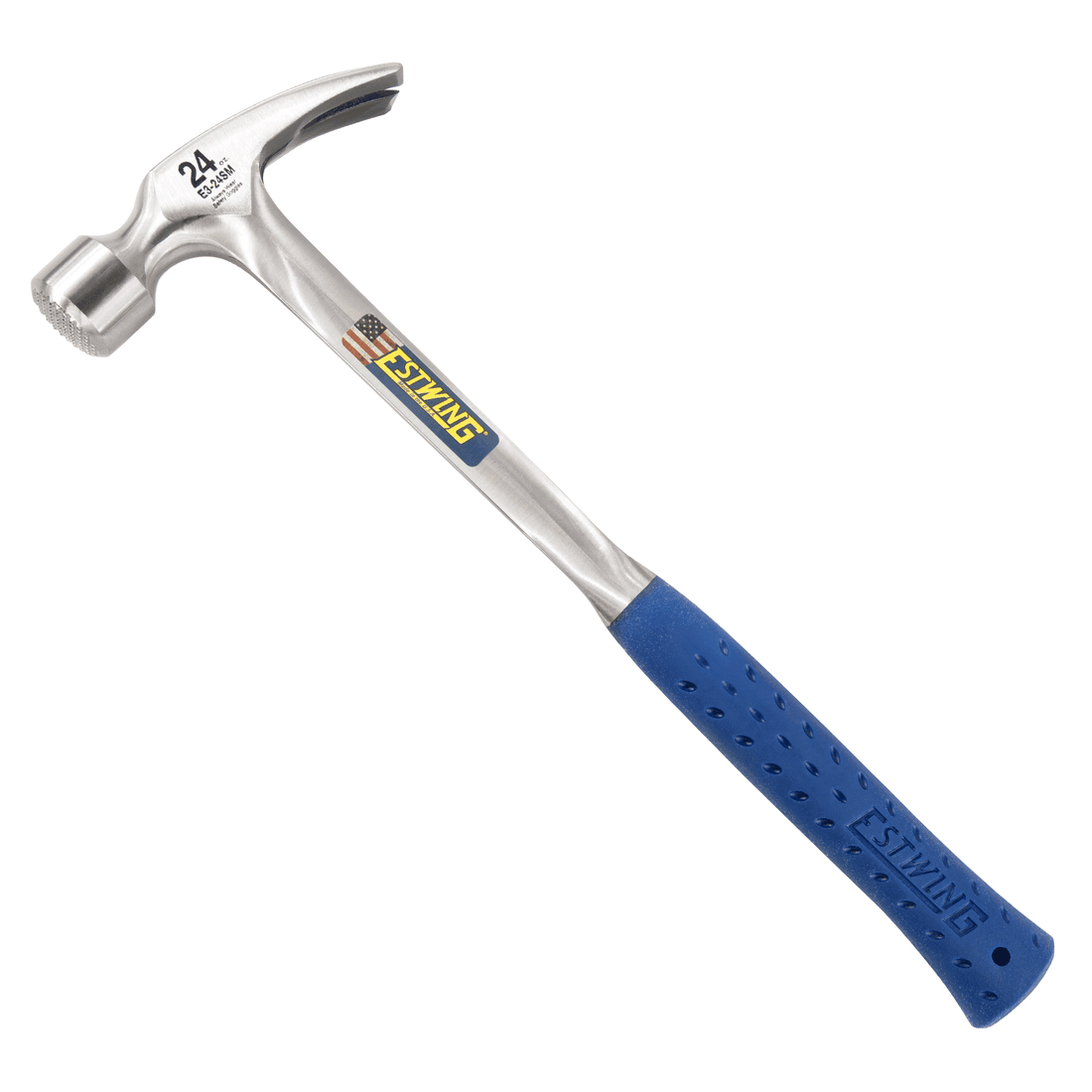
For most framers, the Estwing E3-22S is the best framing hammer for the money: 22 oz, one-piece forged steel, straight rip claw, around $45–55, and it will outlast the job site. If you're swinging all day on production framing and your elbow is starting to file complaints, the Stiletto TBF15SC (15 oz titanium, ~$200–230) earns back its price in body preservation. Everything else lands between those two poles. Below: how to pick the right weight for your work, when a milled face is the wrong call, and five picks sorted by what you're actually building.
What Makes a Framing Hammer Different from a Regular Hammer
A framing hammer isn't just a heavier version of the claw hammer sitting in your garage. The differences are purpose-built — get them wrong and you'll either fatigue out by noon or buy a tool that fights the work rather than doing it.
Weight — Why Framing Hammers Run 20–32 oz
The 16 oz "contractor" hammer is fine for hanging pictures or light trim. It doesn't have the driving mass for structural nails — 16d sinkers, ring-shank decking, joist hanger spikes. Framing hammers run 20–32 oz of steel head (or 14–16 oz if the head is titanium). That mass converts into driving energy without requiring extra swing effort. Go lighter than 20 oz on framing and you're adding swings; go heavier than 28 oz all day and you're adding fatigue. Both are a problem.
Straight (Rip) Claw vs. Curved Claw
The curved claw on a general-purpose hammer is optimized for one thing: pulling individual finish nails, where the curve gives mechanical advantage. Production framers pull nails from concrete forms, pry apart stacked lumber, and lever stakes out of the ground. For all of that, a straight rip claw works like a short pry bar. It pulls nails fine; it pries and levers far better than a curved claw. If the hammer you're looking at has a curved claw, it's a general-purpose hammer, not a framing hammer.
Milled Face vs. Smooth Face — The One Spec Most Buyers Get Wrong
A milled face (also called checkered or waffle face) has a crosshatch texture machined into the striking surface. Under a fast, hard swing, it grips nail heads and reduces the chance of a glancing blow — important when you're driving 10 nails a minute. The trade-off: that texture will permanently mark any finished surface it touches. One mis-hit near trim, flooring, or cabinets leaves a waffle stamp that won't sand out cleanly.
Most framing hammers default to milled. The Estwing E3-22S is one of the exceptions — the "S" suffix designates the smooth face variant. Check the suffix before ordering.
Pick Your Weight First
Don't start with brand. Start with weight — the wrong weight for your work type will make even a premium hammer miserable.
| Use case | Weight range | Why |
|---|---|---|
| Production framing, all-day repetitive swing | 20–22 oz steel | Enough driving mass without accumulating fatigue over an 8-hour day |
| Heavy timber, post-and-beam, concrete form work | 25–28 oz steel | Heavier mass for large structural fasteners and serious prying tasks |
| All-day swing with reduced fatigue | 14–16 oz titanium | Drives like ~22 oz steel; shock absorption cuts vibration at impact |
The titanium row exists because of physics. Titanium absorbs shock at the moment of impact — that energy goes into the nail rather than up your arm. A 15 oz titanium head delivers comparable driving output to a 22 oz steel head, with a fraction of the vibration fatigue. You're not swinging a weaker hammer; you're swinging one that doesn't fight back.
The Five Picks
| Hammer | Weight | Handle | Face | Claw | Approx. Price |
|---|---|---|---|---|---|
| Estwing E3-22S | 22 oz | One-piece steel + vinyl grip | Smooth | Straight rip | ~$45–55 |
| Stiletto TBF15SC | 15 oz | Wood or fiberglass (varies by production run) | Milled | Straight rip | ~$200–230 |
| Vaughan 999L | 20 oz | White hickory | Milled | Straight rip | check current pricing |
| DeWalt DWHT51054 | 22 oz | Fiberglass | Smooth | Straight rip | ~$30–45 |
| Fiskars IsoCore (22 oz) | 22 oz | IsoCore composite | Milled | Straight rip | ~$35–55 |
*All specs verify against manufacturer pages at Stage 5 before publication — see placeholder index.*
Best Overall — Estwing E3-22S (~$45–55)
Right for: Most framers, most job types. Weekend DIYers tackling a deck or room addition. Anyone who wants a lifetime hammer without a premium price tag.
Skip if: You frame production all day and elbow fatigue is already a problem. One-piece steel transmits vibration honestly — it's not a weak design, it just doesn't absorb shock.
The E3-22S is built from one-piece forged steel construction, head to handle, with a Nylon Vinyl grip and a smooth face. Estwing has been building these essentially the same way since the 1920s. There are no joints to fail, no handle to swell in rain, no weak point. The E3-25S and E3-28S give you the same construction at 25 oz and 28 oz for heavy timber or form work. Buy the E3-22S once; your apprentice will probably inherit it.
Best for All-Day Production Framing — Stiletto TBF15SC (~$200–230)

Right for: Production framers swinging 6–8 hours daily. Anyone with existing wrist or elbow issues. Crew leads who bill by the frame and need consistent performance at 3 pm as well as 8 am.
Skip if: You frame occasionally or on weekends. At $200+, the ROI is measured in accumulated body-hours — on a single deck build, you won't feel enough difference to justify the price.
The TBF15SC is built around a titanium head, kept light enough to significantly reduce swing fatigue without sacrificing driving output. The handle material has varied across production runs — the TBF15SC has shipped with both hickory and fiberglass — so confirm the current spec when ordering. At impact, titanium's lower density and higher elasticity mean less rebound energy traveling back into your grip. That's material science, not marketing copy. If your elbow has started giving you grief by week three of a large framing job, the TBF15SC is the right conversation to have with your tool budget.
For a direct head-to-head on specs, price-per-year math, and who genuinely benefits, see our Estwing vs. Stiletto comparison.
Best Wood Handle — Vaughan 999L
Right for: Framers who prefer the feel and flex of wood. Anyone who wants a user-serviceable handle — wood can be replaced; steel and fiberglass handles can't.
Skip if: You work in wet conditions regularly. Wood swells and dries with moisture changes, and the head fit can loosen over time without attention. Also skip if you're prone to hard prying abuse on the handle — hickory will eventually crack where fiberglass won't.
Vaughan has been making production framing hammers since 1885. The 999L is a white hickory-handle, milled face, straight-claw framing hammer at 20 oz. Wood absorbs some vibration through natural flex and has a grip feel that many long-time framers prefer over the stiffer response of steel or fiberglass. It's a traditional choice, not a compromise. And if you do crack the handle eventually, you replace the handle — not the whole hammer.
Best Fiberglass / Budget — DeWalt DWHT51054 (~$30–45)
Right for: Budget-conscious framers, occasional DIYers building a deck or shed, anyone who needs a solid second site hammer without a big outlay.
Skip if: You need a hammer built for decades of production prying and daily abuse. Fiberglass handles can crack under hard leveraging tasks; this isn't the right tool to use as a dedicated pry bar.
The DWHT51054 comes in at 22 oz, fiberglass handle, smooth face, straight rip claw. At $30–45, it's the most accessible pick here, and it's not a bad hammer — it drives nails cleanly, and fiberglass handles absorb more vibration than one-piece steel. Platform-loyal DeWalt users who want everything in one brand will find it serviceable. Just treat it like a framing hammer, not a pry bar.
Best Anti-Vibration Mid-Range — Fiskars IsoCore 22 oz (~$35–55)
Right for: Framers who want better vibration reduction than a steel-handle hammer, without the titanium price. Anyone new to production framing who hasn't yet figured out how much vibration fatigue bothers them.
Skip if: You want a hammer with deep production framing credibility. Fiskars is better known for garden tools; the IsoCore framing hammer is solid, but you won't see it dominating commercial job sites.
The Fiskars 750240-1002 relies on the IsoCore™ Shock Control System — an integrated handle design that dampens vibration at impact. It won't match titanium for shock absorption — that's physics, not a product failure — but it meaningfully reduces the sting compared to a steel-handle hammer, at mid-range prices. If you're not sure yet whether titanium is worth $200 to you, the Fiskars is a useful data point.
Framing Hammer Handle Materials Compared
| Handle | Vibration absorption | Durability | Grip feel | Price tier |
|---|---|---|---|---|
| Steel (one-piece) | Low — transmits impact directly | Highest — no joints, no failure point | Firm; depends on grip wrap | $ – $$ |
| Hickory wood | Moderate — natural flex absorbs some shock | Good; can loosen or crack; user-serviceable | Natural, warm, traditional flex | $ – $$ |
| Fiberglass | Moderate — better than steel, less than titanium | Good; can crack under hard prying | Smooth with overmold grip | $ – $$ |
| Titanium | High — material absorbs shock at impact | Highest overall; head outlasts most handles | Varies by handle pairing | $$$$ |
Milled Face or Smooth — Choose Once, Choose Right
The rule is simple: milled face for rough framing only.
Milled face grips nail heads under a fast swing, reduces glancing blows, and makes high-pace driving safer and more consistent. For rough structural work — wall framing, floor systems, roof framing — it's the right default. The texture doesn't matter because the lumber will be covered before the job is done.
The moment you're working near trim, flooring, cabinets, or any finished surface, a milled face is a liability. One bad swing and the waffle pattern is permanently stamped into your baseboard or hardwood. It won't sand out cleanly.
Most framing hammers in this guide default to milled — the Stiletto TBF15SC, Vaughan 999L, and Fiskars IsoCore are all milled. The Estwing E3-22S and the DeWalt DWHT51054 are the exceptions: both carry smooth faces. The Estwing's standard "S" variant carries a smooth face, with the milled version designated separately as the E3-22MRW. Confirm the face type when ordering any model.
FAQ
What weight framing hammer should I use?
20–22 oz for production framing all day — enough mass to drive structural nails without accumulating fatigue. 25–28 oz for heavy timber, post-and-beam, or concrete form work where fasteners are larger and prying is frequent. 14–16 oz titanium if wrist or elbow fatigue is your primary problem — it delivers the driving energy of ~22 oz steel while absorbing the shock that would otherwise travel up your arm.
What's the difference between a framing hammer and a regular hammer?
Framing hammers are heavier (20–32 oz vs. the 16 oz standard), have a straight rip claw rather than a curved claw, and almost always come with a milled face. They're built for power and pace on structural nails — not finish work. A regular hammer can drive a framing nail. A framing hammer can drive a finish nail too, but it's the wrong tool for the work.
Is a milled face better for framing?
For rough framing, yes. It grips nail heads and reduces slippage when you're swinging hard. Keep it away from any finished surface — trim, flooring, cabinets — or it will leave marks that can't be sanded out cleanly.
Is a titanium framing hammer worth it?
If you frame production all day, yes. Titanium absorbs shock at impact; that energy goes into the nail instead of your wrist and elbow. A 15 oz titanium hammer drives like ~22 oz steel in output with significantly less vibration. At ~$200, the calculus is long-term body preservation, not single-job performance. For occasional framing, the math doesn't work.
What is the difference between a rip claw and a curved claw?
A rip (straight) claw is designed for prying apart lumber, pulling stakes, and pulling nails from concrete forms — lever tasks. A curved claw has more mechanical advantage for pulling individual finish nails but is hard to use as a pry bar. Production framers use straight.
What framing hammer do professional framers use?
Estwing (steel, value-focused pros), Stiletto (titanium, fatigue-focused pros on larger crews), and Vaughan (wood-handle traditionalists) are the most common on production sites. Milwaukee and DeWalt models appear more often among platform-loyal DIYers and tradespeople than among dedicated commercial framers.
How is a framing hammer different from a roofing hammer?
A roofing hammer — properly called a roofing hatchet — has a pick or blade on one end for splitting and scoring shingles, and runs lighter overall. A framing hammer is heavier with a straight rip claw. Wrong tool for roofing; right tool for structural lumber.
If you've narrowed it to Estwing vs. Stiletto, this detailed breakdown goes head-to-head on specs, handle options, and the price-per-year body-preservation math. While you're building out your framing kit, speed square selection and best tape measures are worth a look next.