
Best Speed Square: Swanson, Empire, and Which Size You Actually Need
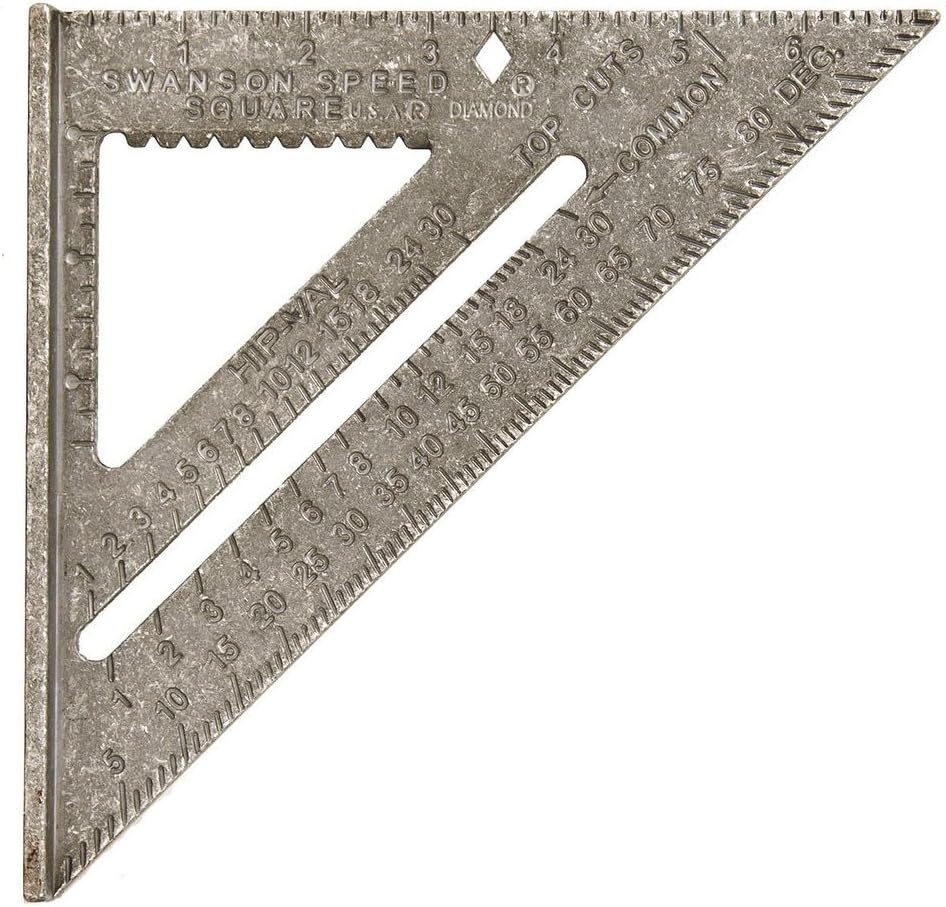
The Swanson T010 is the best speed square for most trades. Framers, roofers, and serious DIYers have trusted it for decades — aluminum body, readable rafter tables, accurate pivot right out of the box. It's priced low enough to be an easy pickup at any home center, and nothing in that range comes close. If you do roofing layout on wide rafters where a 7-inch blade runs short, buy the Swanson S0101 12-inch instead. For everyone else: T010, done.
7-Inch vs. 12-Inch Speed Square — Pick the Right Size First
Most roundups skip straight to ranking brands. That's backwards. The one decision that actually matters before brand is *length* — buy the wrong size and you've got the right tool for the wrong job.
When the 7-Inch Is the Right Call
Seven inches handles 90% of real work. Framing walls, marking rafters, scribing bevel cuts, laying out a deck — the 7-inch blade gives you enough reference edge for standard dimensional lumber and sits in your tool belt without fighting you all day.
Framers almost never pick up a 12-inch square. The lighter weight and shorter profile are advantages when you're marking hundreds of cuts on 2× stock. Trim carpenters and DIYers doing basic layout? Get the 7-inch and don't overthink it.
When the 12-Inch Earns Its Keep
Roofers doing hip-and-valley layout on wide rafters — engineered lumber, 12-inch or 16-inch OC spacing across wider spans — start to run out of reference edge with a 7-inch square. That's where the 12-inch pays off: one pass instead of two, fewer repositioning errors. Same story for sheathing layout across large sheet goods.
That's a real but narrow use case. If it's not you, it's not your tool.
| Task | Recommended Size | Why |
|---|---|---|
| Framing walls and floors | 7-inch | Fast, belt-friendly, handles all 2× stock |
| Standard rafter layout | 7-inch | More than enough for common pitches |
| Hip/valley rafter layout, wide spans | 12-inch | Longer edge cuts repositioning in half |
| Large-format sheathing layout | 12-inch | One mark per sheet instead of two |
| Trim carpentry / finish work | 7-inch | Lighter, less intrusive on finish lumber |
| General DIY — decks, fences, sheds | 7-inch | Handles everything a homeowner will cut |
What Separates a Good Speed Square from Shelf Filler
Aluminum vs. Composite/Nylon
Aluminum is the standard for a reason. The Swanson T010 and Empire 2994 both use it — the material holds its shape under jobsite abuse, and the stamped rafter tables stay readable after years of use. Weight is low, price is low, accuracy holds.
Composite or nylon bodies (Milwaukee 48-22-7125, some Stanley models) are genuinely tough. Drop one off a roof and it bounces where aluminum would ding. But there's a real trade-off: rafter tables on composite squares are molded or printed rather than stamp-etched into the metal, and legibility takes a hit. Squinting at a pitch table in low light or with dirty hands, the stamped aluminum wins every time.
For most trades: buy aluminum. If you lose squares off scaffolding with some regularity and never use the rafter tables anyway, composite is worth a look — just go in knowing the legibility trade-off.
Degree Markings
Standard 7-inch speed squares cover the full 0–90° range at the pivot corner. The pivot corner works as a protractor — set any common bevel or rafter angle, hold the lip on the board edge, and scribe along the blade. Works as a saw guide too.
The key quality check is pivot accuracy. Cheap import squares often have loose tolerances at the pivot — the degree markings don't match the actual angle of the blade. Run the scribe-and-flip test (below) on any new square before trusting it on a cut.
Rafter Tables
The tables stamped into the body show rise-per-run ratios across a broad range of common pitches, along with corresponding rafter lengths per foot of run.
Roofers use these constantly. Framers cutting hip and valley stock use them. Trim carpenters, deck builders, and most DIYers almost never need them — you can step off any common pitch by hand faster than looking up the table.
Don't buy a square because of rafter tables unless you'll actually use them. Do pay attention to legibility if you will.
Lip (Fence) Depth
The lip hooks over the board edge so the square registers square to the face without drifting. Lip depth is comparable between the Swanson T010 and Empire 2994 — both handle standard framing stock without issue, though specs vary slightly by model. Deeper lips grip thicker stock — doubled headers, 4× lumber — more reliably. Shallower lips are less intrusive on finish material close to an edge.
For rough carpentry and framing, standard lip depth is fine on any of the picks below. For finish work on thinner stock, it's worth noting but rarely a deal-breaker.
Best Speed Squares — The Picks
Best Overall — Swanson T010 (7-Inch Aluminum)
The T010 is the category default, and it's earned it. Aluminum body, stamped rafter tables across a practical pitch range, accurate pivot, and affordably priced. It's been the jobsite standard long enough that every other square gets measured against it. Start here unless one of the picks below fits your situation better.
Best Aluminum Alternative — Empire 2994 (7-Inch)

The Empire 2994 is the strongest argument against defaulting to Swanson every time. Also aluminum, also accurate, priced in the same affordable range. Some tradespeople prefer the Empire's degree-marking layout or lip profile — it's not a downgrade, it's a real alternative.
Concrete case for the Empire: if it's in stock and the T010 isn't, grab it without hesitation. If you're already a trusted Empire level user, that accuracy track record carries over.
Best for Heavy Jobsite Abuse — Milwaukee 48-22-7125 (7-Inch Composite)
According to Milwaukee, the overmold body absorbs impact better than cast aluminum, and the bi-material construction keeps the blade true under stress. In practice, this square is built to survive drops that would ding aluminum. It costs more than the Swanson or Empire — expect to pay a premium for the durability upgrade.
The downside is rafter-table legibility — molded markings are harder to read quickly than the T010's etched aluminum. If pitch tables are part of your daily workflow, the Milwaukee is the wrong pick. If you're a framer who buries squares in mud regularly and never uses the rafter tables, the durability premium is worth it.
Best 12-Inch — Swanson S0101
Same logic as the T010: Swanson's 12-inch is the field standard. Aluminum body, extended rafter tables for wider spans, priced at $14.98. Get this if the size section told you to; skip it if it didn't.
Budget Fallback
A current Stanley or Irwin 7-inch is a workable alternative when the Swanson and Empire are both out of stock. Just run the scribe-and-flip test before trusting any cut — accuracy on budget alternatives varies more than it does on the named brands.
Quick Comparison
| Model | Size | Material | Rafter Tables | Best For |
|---|---|---|---|---|
| Swanson T010 | 7-inch | Aluminum | Yes, stamped | Most trades — buy this first |
| Empire 2994 | 7-inch | Aluminum | Yes, stamped | Solid Swanson alternative |
| Milwaukee 48-22-7125 | 7-inch | Composite | Yes, molded | Max durability, skip if you use pitch tables daily |
| Swanson S0101 | 12-inch | Aluminum | Yes, extended range | Wide-span roofing and sheathing layout |
| Stanley or Irwin 7-inch | 7-inch | Varies by model | Varies | Last-resort budget fallback |
All five picks land under $30. Current prices are in each section above — these are verified in Stage 5 before publication.
How to Check Your Speed Square's Accuracy (Takes 60 Seconds)
You need a pencil and a straight board — any clean 2×4 works. This catches pivot errors and warped blades that no brand guarantee covers.
Step 1 — Scribe the first line. Hold the square's lip tight against one long edge of the board. Draw a line across the face of the board along the blade, and mark where that line starts.
Step 2 — Flip and scribe. Without moving the board, flip the square end-for-end. Register the same lip against the same edge. Align the blade tip with your original start mark and draw a second line.
If both lines fall exactly on top of each other, the square is accurate. Any visible gap between the two lines at the far end means the pivot is off — the wider the gap, the worse the error.
Good aluminum squares from Swanson and Empire typically hold this test through normal use. Any square that's been dropped on concrete or driven over can fail it. Run this check on a new square before the first cut, and again any time the tool takes a hard hit.
FAQ — Speed Square Questions Answered
What is the best brand of speed square? Swanson is the industry standard — the T010 is on more jobsites than any other square. Empire is the strongest alternative at roughly the same price, not a step down in accuracy. Milwaukee's composite model is durable but costs more for a difference most trades won't notice day-to-day.
What size speed square do I need? Get the 7-inch for framing, roofing, and general layout — that covers 90% of trades work and all of DIY. Only move to the 12-inch if you're doing roofing layout on wide rafters or large sheathing runs where the longer edge saves meaningful time.
What's the difference between a speed square and a rafter square? Same tool, different name. "Rafter square" calls out the pitch tables on the body; the physical tool is identical. Some manufacturers use one term, some use the other — don't read anything into it.
Are cheap speed squares accurate? Not reliably. Swanson and Empire deliver real accuracy at budget prices. Generic import squares — especially multi-packs — are inconsistent at the pivot, which is the one place accuracy matters most. Always run the scribe-and-flip test before trusting a cut.
How do I check if my speed square is accurate? See the full method above — it takes a straight board and 60 seconds. Hold the lip on a board edge, scribe a line, flip the square end-for-end, align on the same start point, and scribe again. Lines land on top of each other: accurate. Any visible gap: the square is off.
Can a speed square be used as a protractor? Yes. The pivot corner has degree markings covering the full 0–90° range. Set the angle you need, hold the lip on the board edge, and scribe or use the blade as a saw guide. Standard use for common rafters, bevel cuts, and angled crosscuts.
What is the lip on a speed square for? The lip — sometimes called the fence — hooks over the board edge so the square registers flush to the face without drifting. Deeper lips handle thicker stock more securely; shallower lips are less intrusive on thin finish material.
If you're building out your hand tool kit past the speed square, a framing hammer is the next honest purchase — see Estwing vs. Stiletto titanium for a straight take. For layout and cutting that pairs with your square, best drywall utility knife and Milwaukee Fastback vs. Stanley Fatmax are both worth five minutes. And best nut driver set covers the other easy grab that earns its spot in the bag.