
Best Nut Driver Sets in 2026: Matched to Your Trade
For electricians and HVAC techs, a Klein Tools 7-piece cushion-grip SAE nut driver set (model 631) covers 90% of daily fasteners. If you hit bolt studs regularly — panel work, terminal lugs, motor terminals — you need hollow shank, full stop. A solid-shank set physically can't do that job. Below: which set wins for each trade, which sizes you'll actually use, and the two specs (shank type and magnetic retention) that determine real-world usefulness far more than brand name or star rating.
Nut Driver vs. Socket — Which One, and When?
Where Nut Drivers Beat Sockets
A nut driver is a one-handed tool. You spin it with your fingertips — no ratchet, no socket swap, no second hand stabilizing an extension inside a panel. For small hex fasteners (1/4", 5/16", 3/8") and repetitive, light-torque work in tight quarters, a nut driver runs laps around a ratchet. In an electrical panel while your other hand manages a wire, that speed matters.
Where Sockets Beat Nut Drivers
A corroded fastener on a 20-year-old piece of equipment? Overtorqued panel cover hardware? That's a ratchet-and-socket job. Nut drivers are short and built for light torque — they're not designed to break a stubborn fastener loose. Extensions, universals, flex heads: all of that belongs to the socket world.
When You Need Both: Nut Drivers and Sockets
Most electricians and HVAC techs carry both. The nut driver handles the 30-second terminal screw. The socket handles the panel cover bolt that's been in place since 2003. If you've been relying on a socket adapter to reach tight spaces, it's worth reading why socket adapters fail in tight quarters — adapters fail at exactly the moments when a nut driver would have done the job cleanly.
The Two Specs That Actually Decide This Purchase
Hollow Shank vs. Solid Shank: What's the Difference?
This is the most important spec for anyone doing panel work or terminal-block wiring. Most people don't know it exists until they need it.
A hollow-shank nut driver has an open bore through the center of the shank. It slides over a threaded bolt stud and seats on the nut sitting beyond those threads. A solid-shank driver hits the protruding threads and stops — the nut is out of reach.
Concrete example: bus-bar connections in a service panel. The lug bolt threads extend past the nut. A solid shank bottoms out on the threads before touching the nut. The hollow shank clears the threads and seats flat. You either have hollow shank or you're fishing for a socket.
Hollow shank is required for:
- Service panel bus-bar and lug connections
- Motor terminal blocks
- Appliance and breaker terminal studs where threads protrude past the clamping nut
Solid shank is fine for:
- Sheet-metal screws
- Cabinet hardware
- Conduit fittings
- Most HVAC equipment panel fasteners
If panel wiring is a regular part of your day, hollow shank isn't optional equipment — it's what the job requires. If you're mostly on sheet-metal screws and equipment panels, solid shank holds up better and isn't a compromise.
How Important Is Magnetic Tip Retention?
A strong tip magnet holds a hex nut one-handed. You load the nut, reach into the panel, drive it home. Drop it with a weak magnet and you're hunting for it inside a J-box or on a concrete floor.
The field test before buying: hold a hex nut on the tip and shake the driver hard. A magnet worth owning holds the nut. A weak one drops it immediately. Many budget sets start passable and lose retention within a few months of daily use. Klein, Wiha, and Wera sets maintain it.
No numeric spec exists for this — it's a qualitative check, not a datasheet entry. But it's the second-most-important daily-use feature after shank type.
Best Nut Driver Sets by Trade
Best Nut Driver Set for Electricians
Klein Tools 7-piece cushion-grip SAE set (model 631) is the default answer for electrical work — not because it leads Amazon reviews, but because your supply house stocks it individually. Lose a 5/16" driver, you buy one replacement. You don't scrap the whole set.
Klein's cushion-grip handle holds up under daily trade use and the shank construction is tough enough for panel work without so much stiffness that you strip small terminal screws on lighter-gauge hardware.
For most electricians, the 7-piece SAE is the set. The 9-piece adds sizes you'll reach for twice a year.
When to go hollow-shank instead: any time you're regularly landing on bus-bar studs or panel lug bolts. Klein offers hollow-shank nut drivers in several SAE configurations. If your day splits between terminal screws and bus bars, consider owning both: a solid-shank 7-piece for the terminal work and hollow-shank drivers in your three most-used sizes for the stud work.
The broader Klein-vs.-German-brand decision that comes up in your electrical kit is covered in the Klein vs German brands debate — same trade-off framework, same conclusion that trade and use case determine the winner.
Best Nut Driver Set for HVAC and Refrigeration Techs
HVAC runs metric. Terminal screws at 5.5mm, equipment panels at 7mm and 8mm, heavier mechanical hardware at 10mm. If you're on an SAE set borrowed from your electrical bag, you're fighting the wrong tool all day.
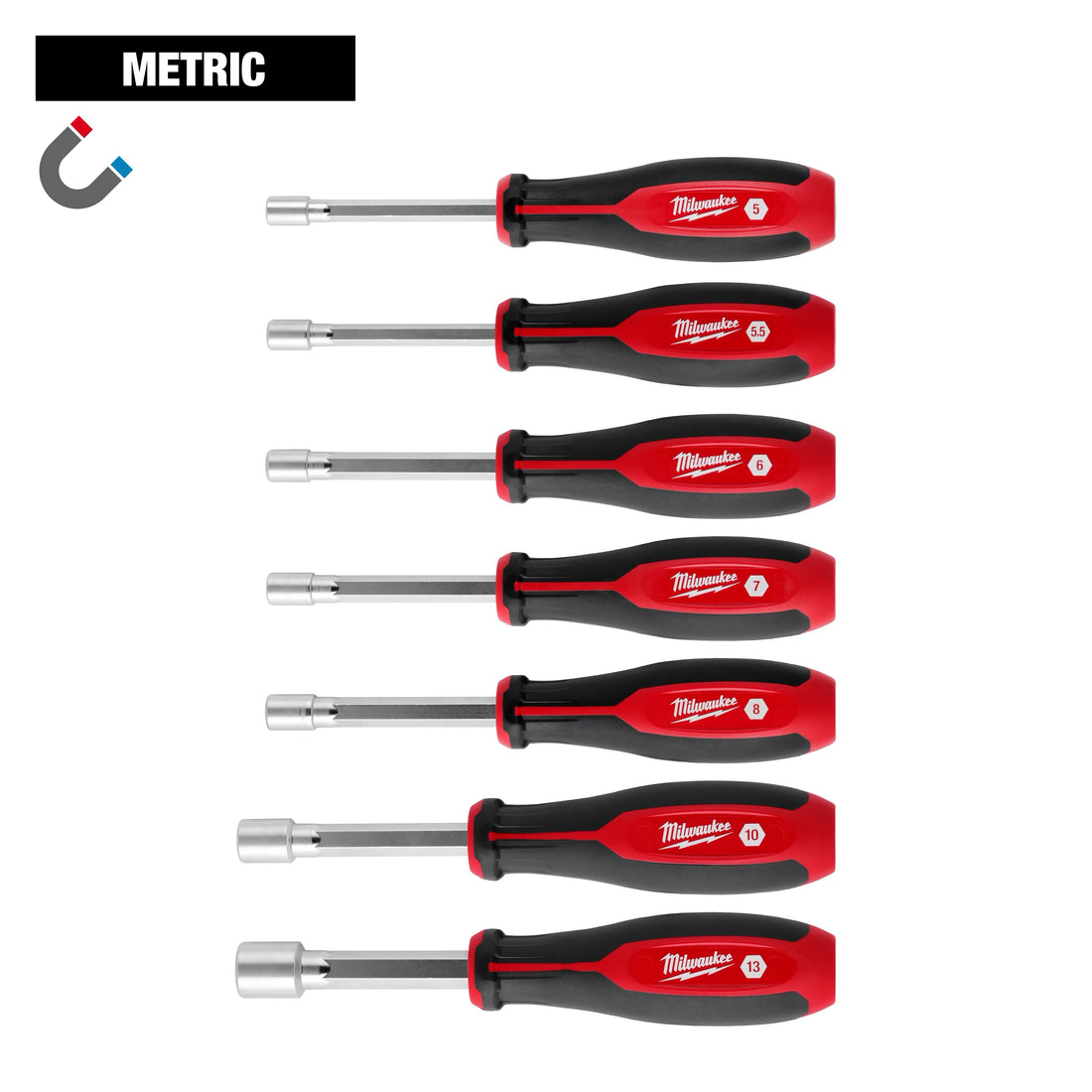
Wiha SoftFinish® Metric Nut Driver 7 Pc. Set (SKU 34194, available in 5.0, 5.5, 6.0, 7.0, 8.0, 10.0, and 13.0 mm) is the precision-side recommendation. Tip geometry is tighter than most US-made alternatives, magnetic retention holds, and the set covers the core HVAC sizes — 5.5mm, 7mm, 8mm, and 10mm are all included.
Wera makes a comparable metric set (SKU 05029510001) with a rotating cap that spins quickly under fingertip pressure — worth looking at for high-volume terminal work.
Don't try to solve HVAC fastener work with a combo SAE/metric set. The use-frequency split is too different. Buy metric for equipment work and keep an SAE set for the control panel hardware that hasn't standardized yet.
Best Nut Driver Set for General DIY and Cabinetry
Cabinet hardware twice a year doesn't need Klein pricing. A 7-piece SAE set from Channellock, Craftsman, or Stanley — such as the Capri Tools Kontour 25000-NDS7H3PS at $39.99 — covers everything you'll actually drive.
What you give up versus Klein: handle comfort over extended use, shank longevity at the handle junction, and magnetic retention over time. For occasional DIY, none of that gap is worth the price difference. For daily trade use, it is. Buy honestly for how you actually work.
Best Nut Driver Set for Production and Assembly Work
If you're driving the same fastener into fixtures or assemblies all day, hollow shank is the priority — you'll hit stud situations constantly and solid shank will slow the line.
Milwaukee makes hollow-shank nut drivers designed for sustained repetitive use — the 7 PC SAE HollowCore™ set (SKU 48-22-2447) covers ¼", 5/16", 11/32", 3/8", 7/16", ½", and 9/16". Klein also offers hollow-shank sets in SAE (65411, 65456, and 65456MAG) and metric (65456M and 65456MAGM) configurations. Either works; match to the shank sizes your assembly hardware actually calls for.
What Sizes Come in a Nut Driver Set? (And Which Ones You'll Actually Use)
| Trade | High-frequency sizes | Filler you rarely touch |
|---|---|---|
| Electrical | 1/4", 5/16", 3/8", 7/16" | 3/16", 9/32", 11/32" |
| HVAC / Refrigeration | 5.5mm, 7mm, 8mm, 10mm | 4mm, 5mm (electronics, not heavy trade) |
| General DIY | 1/4" through 1/2" | 3/16", 11/32" |
| Production / Assembly | Match to hardware spec | N/A |
A standard 7-piece SAE set includes 3/16″, 1/4″, 5/16″, 11/32″, 3/8″, 7/16″, and 1/2″. A 9-piece typically adds 9/16" and 5/8" — both the Klein 33524 and Wiha 32288 run the full range from 3/16″ through 5/8″.
For electrical work: 1/4" and 5/16" cover the majority of panel terminal screws. The 3/8" and 7/16" handle panel hardware and some breaker terminals. You'll use the 1/2" occasionally and the 3/16" almost never.
The practical takeaway: a clean 7-piece SAE set outperforms a 9-piece with filler sizes, because the extra drivers clutter your pouch and slow your reach for the four sizes you actually want. Buy for what you drive, not the longest size list on the packaging.
When Insulated Nut Drivers Are Required — Not Optional
This is a code requirement, not a preference, and the distinction matters.
Insulated means voltage-rated to 1,000V and certified under recognized international standards for insulated hand tools. That rating is tested, certified, and stamped on the handle — the double-triangle symbol marks it as compliant. Without that stamp, it's not insulated.
A rubber cushion-grip is not insulation. Comfort handles are ergonomic features, not electrical barriers. Do not treat them as equivalent.
Under NFPA 70E, insulated tools are required for energized work on circuits above 50V. For live-circuit work, this isn't guidance — it's the requirement.
Klein, Wiha, and Ideal Industries all make certified insulated 7-piece nut driver sets, each carrying a certified 1,000V rating. The price premium is real — insulated 7-piece sets cost considerably more than standard trade sets, reflecting the additional materials, testing, and certification involved.
Don't upsell a DIYer — or yourself — into insulated drivers for work on dead circuits. Lockout/tagout means cushion-grip is fine. Insulated is for live work, and that's the only scenario where it's required.
Frequently Asked Questions
What sizes come in a standard nut driver set?
Most 7-piece SAE sets include 3/16", 1/4", 5/16", 11/32", 3/8", 7/16", and 1/2". A 9-piece typically adds 9/16". For electrical work, 1/4" and 5/16" cover the majority of fasteners you'll hit in a day. The 3/16" and 11/32" are filler for most trades.
What is the difference between a hollow shank and a solid shank nut driver?
A hollow shank has an open bore through the center so the driver slides over a protruding bolt stud and seats on the nut beyond those threads. A solid shank hits the threads and stops short. For panel wiring, terminal blocks, and bus-bar connections, hollow shank is essential — solid shank physically cannot reach the nut.
Are magnetic nut drivers worth it?
Yes. A strong magnet holds the nut one-handed and keeps it from dropping inside an electrical box or wall cavity. The field test: hold a hex nut on the tip and shake hard. A good magnet holds it; a weak one drops it. Premium sets from Klein, Wiha, and Wera maintain magnetic strength over time. Many budget sets don't.
What is the difference between a nut driver and a socket?
A nut driver turns small hex fasteners quickly with one hand — no ratchet required, faster for light repetitive work. A socket accepts a ratchet and delivers far more torque. Nut drivers lose to sockets when you need force or need extensions to reach. For corroded, stubborn, or overtorqued fasteners, reach for the socket.
Do I need a metric nut driver set?
Only if your work involves metric fasteners — HVAC, appliances, European-spec equipment, import vehicles. Pure electrical work in the US is almost entirely SAE. If you regularly do both, a dedicated SAE set plus a dedicated metric set beats one cluttered combo; the use-frequency split between trades doesn't overlap in practice.
Is Klein or Wiha better for nut drivers?
Klein is the electrical-trade standard in the US — widely stocked at supply houses, individually replaceable, built to handle daily panel work. Wiha is the choice for electronics, instrumentation, and precision low-voltage work where tip geometry and ergonomics matter more than shank brute strength. The same US-trade-standard vs. German-precision trade-off comes up with pliers; that same trade-off in linesman pliers covers the same framework. Pick by what your trade already runs.
What does a nut driver set cost?
Pricing scales with tier: budget sets from brands like Craftsman or Stanley are the most affordable entry point, mid-range trade sets from Klein or Channellock step up considerably from there, premium German-made sets from Wiha or Wera sit at the high end of non-insulated options, and insulated sets carry the largest premium of any category, reflecting their testing and certification requirements.
The Short Version
Three questions settle this purchase:
1. Do you wire panels or reach terminal-block studs regularly? Hollow shank is non-negotiable. Add it to your kit or make it the starting point. 2. What does your trade actually drive? SAE for electrical. Metric for HVAC. A real split means two purpose-built sets, not one combo. 3. Do you ever work on live circuits? Insulated (IEC 60900-rated, double-triangle stamped) — or don't touch it.
For related hand-tool kit decisions, a detailed electrician brand comparison covers the Klein-vs.-German-brand question with the same trade-based framework. And if socket adapters keep failing in tight quarters, why adapters fail under demand explains exactly why a nut driver solves that problem cleanly.
*Once a hand-tools pillar post is built, this comparison is the natural first cluster link. — The Tool Army Crew*