
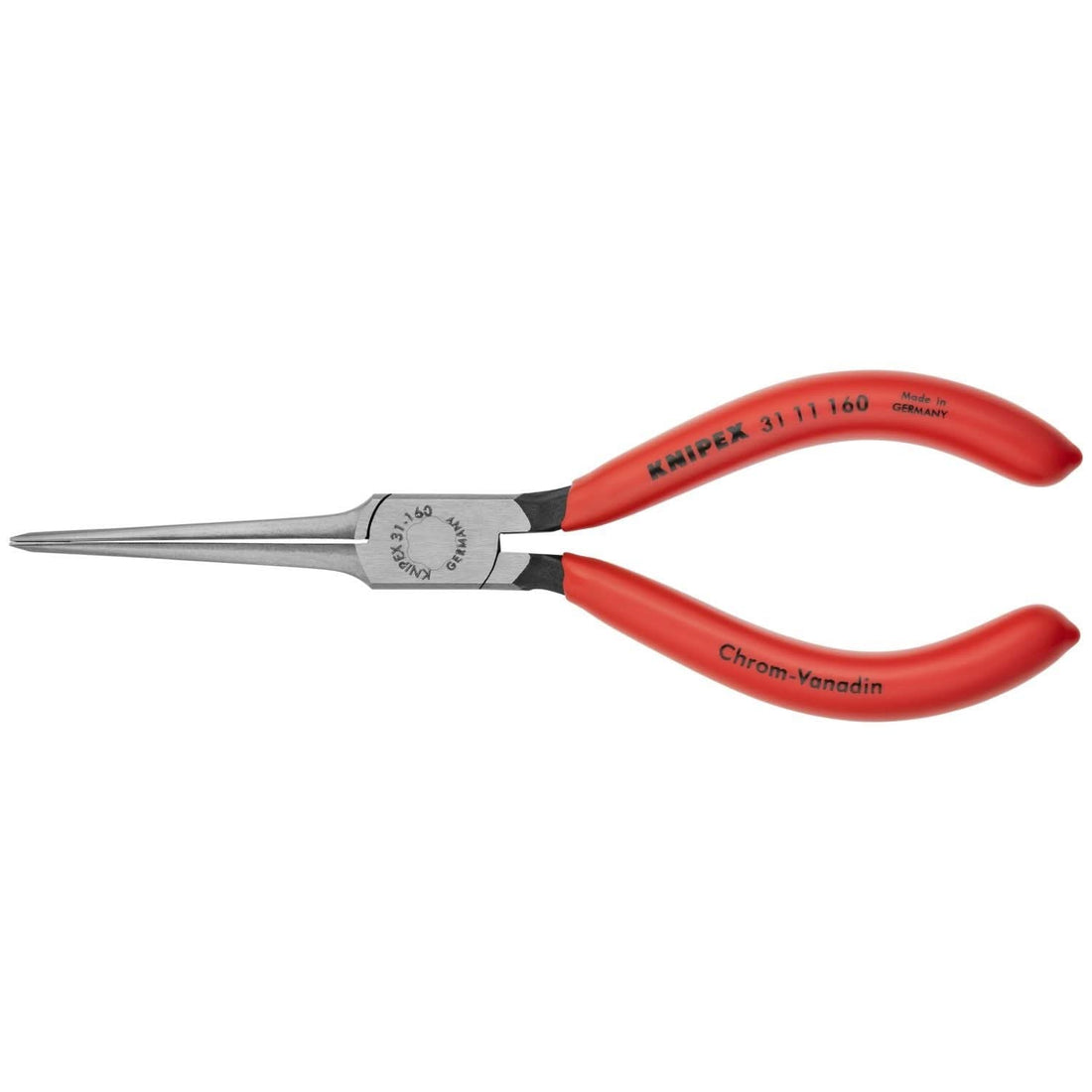
Best Needle Nose Pliers: Pick the Right Jaw Profile First, Then the Brand
The best needle nose pliers for most trade and DIY use: Knipex 26 11 200 (7.87", standard jaw). For built-in wire cutting tuned to THHN: Klein J203-8N (8"). Best budget for occasional light work: Irwin 2078300 (~6"). Before you shop, sort out your jaw profile — standard, long-reach, bent, or round nose — because grabbing the wrong shape costs you more time than a cheap pair does. A bent-nose pair that doesn't fit your workflow stays in the drawer. Everything after this answers the profile question first, then names a winner per use case. For the brand matchup in more depth, see the Klein vs Knipex pliers comparison.
What Type of Needle Nose Pliers Do You Actually Need?
Most buyers skip this step and end up with a pair that technically works but constantly gets in the way. Jaw profile matters more than brand for the first purchase.
Standard Needle Nose (6–8")
This is the default — tapered jaws, straight axis, good for anything from stuffing wires into an outlet box to fishing a zip-tie end through a bundle. The 7–8" range hits the sweet spot: long enough to reach into a standard electrical box, short enough to keep control of what you're grabbing. Most people reading this need a pair in this range. If you're not sure, this is your answer.
Long-Reach (9–10"+)
Longer jaws, usually slimmer, built for deep junction boxes, engine bays, or anywhere you can't get your hand in alongside the tool. The trade-off is real: the extended jaw flexes more under lateral load. Don't use long-reach pliers for anything that requires torque or prying — you'll spring the jaw alignment. Milwaukee's 48-22-6100 fits this category at 9 inches overall. Buy this as a second pair, not a first.
Bent / Angled Nose
The jaw angles 45–90° off the handle axis. Sounds odd until you've tried to work around a conduit stub or a panel bus bar without one — the bent nose lets you grip at an angle your wrist physically can't reach straight-on. The Knipex 28 21 200 (7.87") is the standard here. This profile is underused and genuinely worth owning if you do any panel work or tight engine-bay wiring.
Round Nose
Stop here if you're considering round nose for electrical or general shop work — this is a different tool entirely. Round nose jaws are conical, designed for forming wire loops: jewelry, guitar-amp wiring, loop terminals. They cannot grip anything usefully. They're sold in the same aisle as needle nose pliers and the names trip people up constantly. If you need needle nose, do not buy round nose.
The Best Picks by Use Case
| Model | Jaw type | Length | Wire cutter? | Spring-loaded? | Handle | Price tier |
|---|---|---|---|---|---|---|
| Knipex 26 11 200 | Standard | 7.87" | Yes | No | Plastic grip | Premium |
| Klein J203-8N | Standard | 8" | Yes | No | Vinyl dipped | Mid |
| Channellock 317 | Standard | ~6.5" | Yes | No | Comfort grip | Mid |
| Irwin 2078300 | Standard | ~6" | Yes | Yes | Bi-material | Budget |
| Knipex 28 21 200 | Bent 45° | 7.87" | No | No | Plastic grip | Premium |
| Knipex 26 26 200 | Standard (VDE) | ~8" | Yes | No | VDE-insulated | Premium |
*Price ranges approximate; check current listings at major retailers for up-to-date pricing. Tiers: premium ~$30–55, mid ~$15–28, budget ~$10–14.*
Knipex 26 11 200 — Best overall
The induction-hardened tips are the whole argument. Jaw length: 73 mm (2-7/8"). The cutter handles the common wire gauges used in residential and light commercial electrical work. This is the pair you buy once and stop thinking about. One honest trade-off: no spring-loaded jaw, so high-rep work — pulling dozens of staples, terminating a long wire run — tires your grip faster than a spring-loaded pair does. For daily trade use, that's a non-issue. For four-hour repetitive tasks, it matters.
Klein J203-8N — Best for North American electrical trades
The integrated cutter is tuned for THHN — the wire most North American electricians actually cut with pliers. It handles both solid and stranded copper wire across the gauges most commonly used in North American electrical work. Vinyl-dipped handle, not VDE-rated (see below if live-voltage work applies to you). The J203-8N is the jobsite standard not because it technically beats Knipex — it doesn't, on longevity — but because it's been available at every Home Depot for decades at a fair price. For how Klein and Knipex stack up across their full electrical lineup, see the detailed electrical pliers breakdown.
Channellock 317 — Solid mid-tier, made in the USA
The Channellock 317 measures 8.0 inches overall. Drop-forged from high carbon U.S. steel. If you already trust Channellock's slip-joint pliers and want to stay in the same brand ecosystem, this is a safe add. The fit and finish isn't Knipex-level, but it holds up to daily non-electrician shop use without complaint. For more on how Channellock compares to Knipex across plier categories, see the full comparison.
Irwin 2078300 — Best for occasional and light work
The spring-loaded jaw is the point here. Overall length: 8 inches. If you're doing electronics assembly, light fixture work, or household repairs a few times a year, the spring action cuts hand fatigue significantly during repetitive grabbing. The cutter handles light wire but will dull faster than Knipex or Klein on anything heavier than 16 AWG. Don't use this for daily trade work — the tips deform under sustained hard use.
Knipex 28 21 200 — Best bent-nose pair
The 45° jaw offset is the entire reason to buy this. Same induction-hardened tips and box joint as the 26 11 200, bent jaw profile. No cutter on this model, which is appropriate — the bent geometry is for reaching and gripping around obstructions, not cutting. Buy it as a second pair alongside a standard needle nose, not instead of one.
Knipex 26 26 200 — Required for live-voltage work
This is the only pair on this list with VDE-rated insulation: 1,000V AC / 1,500V DC per IEC 60900. Overall length: 200 mm (7.87"). Every VDE tool is individually tested and stamped — look for the VDE shield on the handle, not just "insulated" in the marketing copy. Standard dipped handles (every other pair here) offer no protection on live circuits. If your work is always de-energized, skip the premium and buy the standard 26 11 200 instead.
What Separates a Good Pair From One That Fails in a Year
Induction-hardened vs. through-hardened tips
Induction hardening heats only the jaw tips, creating a hard outer surface over a tougher, slightly softer core. Through-hardened steel is uniform — harder overall but more brittle under repeated impact. For pliers, induction-hardened tips hold their edge at the cutter notch after thousands of cuts. Through-hardened tips chip. Knipex specifies induction hardening explicitly. Most budget pairs don't, which tells you something.
Pivot quality: rivet vs. box joint
A riveted pivot is a single fastener. Adequate when new; wobbles as it wears. A box joint wraps the pivot in a milled channel — the channel maintains jaw alignment even as the fastener loosens over time. On a pair you use daily, jaw misalignment is the first failure mode. Knipex uses a box joint across their lineup; it's a meaningful durability difference over three to five years of daily use.
Handle coating
- Dipped rubber: adequate grip dry, less reliable wet or in gloves. Standard on most mid-tier pairs.
- Bi-material / over-molded: better grip in wet conditions or with gloves. Common on Irwin and some Klein models.
- VDE-rated insulated: individually tested to 1,000V AC / 1,500V DC per IEC 60900. Required for live-voltage work — not a substitute for de-energizing circuits, but real protection when that's not possible. Dipped handles are not rated and should not be treated as rated.
Spring-loaded jaw
Reduces hand fatigue during repetitive-grab work. Genuinely useful for pulling cable staples, working through a bag of zip ties, or any task where you're opening the jaw hundreds of times an hour. In precision work — forming a loop terminal, gripping a small connector — the spring pushes back slightly and reduces feel. Experienced tradespeople often prefer non-spring for that reason. It's a real trade-off, not a feature list item.
Frequently Asked Questions
What is the difference between needle nose and long nose pliers? Functionally the same tool, different names. "Needle nose" is the consumer-catalog term; "long nose" is common in trade catalogs and among tradespeople. Both describe pliers with tapered, elongated jaws. No spec or compatibility difference — just terminology.
What size needle nose pliers is most useful? 7–8" overall length covers the widest range of jobs — long enough to reach into standard electrical boxes, short enough to maintain control. Go 6" if you work in very confined spaces (electronics, jewelry); go 9–10" only if you routinely reach into deep enclosures. Most people need 7–8".
Are Knipex needle nose pliers worth the money? Yes, if you use them regularly on anything heavier than 18 AWG. The induction-hardened tips hold their edge after years of cutting; cheaper pairs deform at the cutter notch within months of daily use. For occasional light work, the premium is hard to justify — the Irwin does the job for a fraction of the price.
Can needle nose pliers cut wire? Only if the pair has a cutter notch built into the jaw — not all do. Models with cutters (Klein J203-8N, Knipex 26 11 200 and 26 26 200) list a rated AWG cutting capacity. Never use the jaw tips to cut — that deforms them permanently, and the tips will never grip cleanly again.
Do I need insulated needle nose pliers? If you're working on or near live circuits, yes — but only VDE-rated insulated pairs (1,000V AC / 1,500V DC per IEC 60900) provide real protection. Standard dipped-rubber handles are not rated for live-voltage work. If your work is always de-energized, standard handles are fine.
What brand of needle nose pliers do electricians use? Klein is the most common brand on North American job sites — the J203-8N is a near-universal jobsite tool. Knipex dominates in Europe and among pros who prioritize long-term durability. Both are legitimate; the gap between them is smaller than the brand loyalty suggests. For a full comparison across their electrical plier lineups, see the Klein vs Knipex pliers guide.
The short version: jaw profile first, brand second. A standard 7–8" pair covers 90% of jobs. Add a bent-nose pair if you do panel work. If you work near live voltage, the Knipex 26 26 200 isn't optional — it's the minimum safe choice. For brand: Knipex 26 11 200 for longevity, Klein J203-8N for the North American trade standard, Irwin 2078300 if you need needle nose occasionally and won't justify the premium.
For what to pair with these: the wire stripper guide covers the tool you'll reach for right after your needle nose, and the diagonal cutters guide rounds out a solid basic electrical hand-tool kit.