
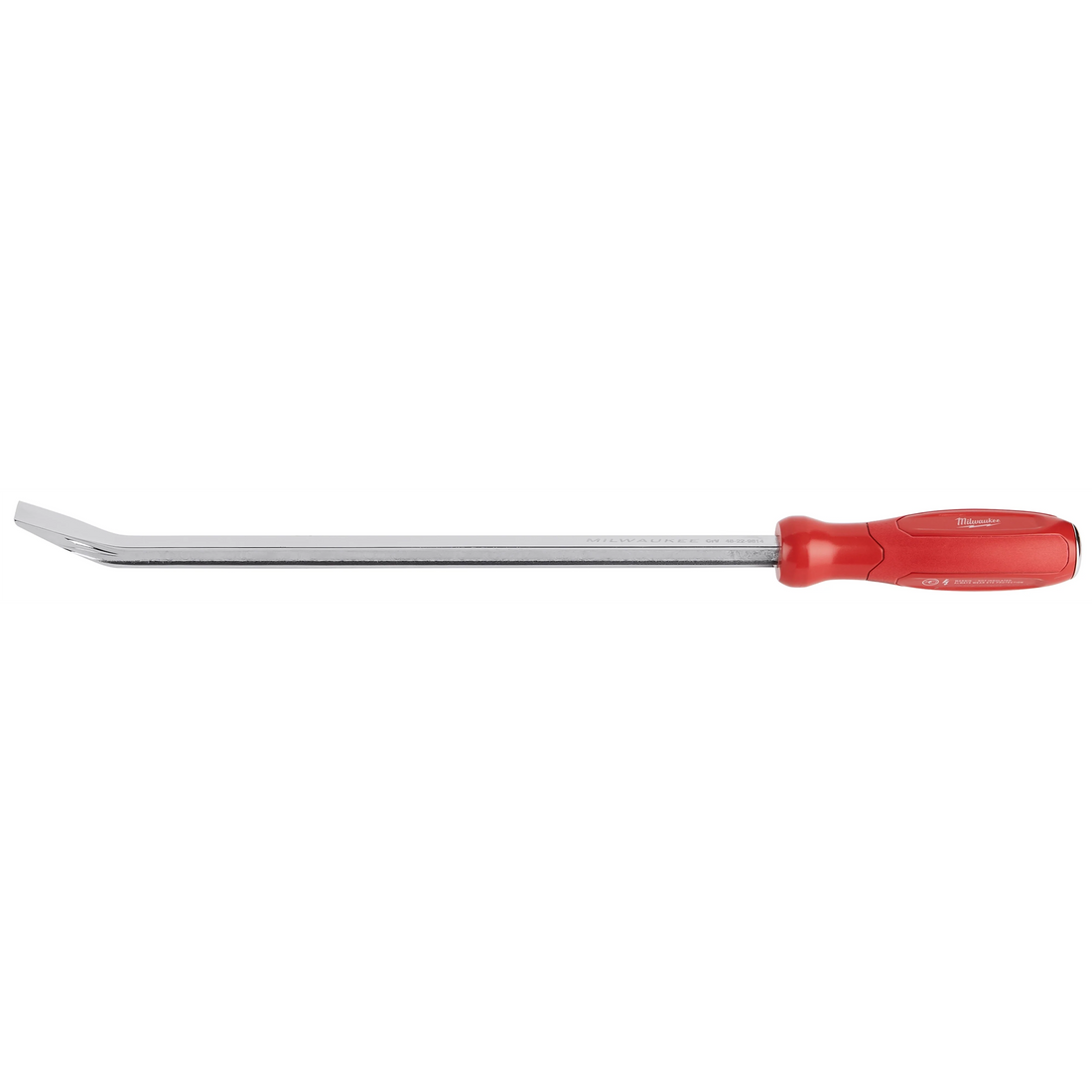
Best Pry Bar for the Job: Flat Bar, Cat's Paw, or Wrecking Bar?
The best pry bar depends entirely on the job — not the brand. Trim and finish work: a flat bar, 6"–18". Pulling buried or countersunk nails: a cat's paw. Heavy demolition and framing teardown: a wrecking bar, 24" or longer. Within each type, Estwing's drop-forged USA steel is the benchmark pros reach for; Stanley FatMax is the solid wide-availability pick when you need it same-day at any big-box. Buy the wrong type — a flat bar when you need a cat's paw — and no brand rescues you. The geometry doesn't work.
Which Type of Pry Bar Do You Actually Need?
This is the question other buying guides skip. They rank ten bars by price without explaining that a flat bar and a wrecking bar aren't different grades of the same tool — they're different tools for different jobs. Buy the wrong one and no quality level helps.
Flat Bar (Nail Bar)
A flat bar is thin, relatively straight, and designed to slip behind trim and framing without gouging what you want to keep. The right tool for:
- Door and window casing removal
- Baseboard and door stop pull
- Popping subfloor boards that haven't been down forever
- Any situation where you care about not splitting adjacent material
The flat profile lets you drive it behind trim with controlled force and get under the fastener close to the surface. Length matters: 6" for extremely tight spots, 12"–18" for general trim and finish work.
A flat bar will not reliably pull a nail that's been driven flush or below the surface. That's geometry, not quality. For buried nails, you need a cat's paw.
If you're doing finish carpentry alongside pry work, see our guide to wood chisels — the audience for careful trim work and good chisels overlaps almost completely.
Cat's Paw (Nail Puller)
A cat's paw is not a prying tool. That distinction matters. The hardened, sharply curved claw is sized to seat around the shank of a nail that's been driven flush or countersunk. You drive the claw into the wood with a hammer, seat it under the nail head, then lever out. Where you need it:
- Framing nails driven flush — 16d sinkers, commons, and spiral-shank
- Ring-shank deck fasteners that backed partially out
- Reclaimed lumber with nails cut or driven down
- Any nail you can't get a flat bar or hammer claw under
Using a cat's paw as a general pry bar dulls the claw fast. Once the tip rolls, it won't seat cleanly — you're driving it into wood and pulling nothing. The sharpness of that claw is the entire tool.
Wrecking Bar (Crowbar)
Long, heavy, built for force. A wrecking bar is 24"–48" and designed for work where the material being removed is going in a dumpster anyway — framing tearout, sheathing removal, concrete form work, structural demo. The long lever arm is the point: one person generating enough force to pop a plate off a slab or separate doubled framing.
Rule of thumb: if you need to swing something to start the prying, or if you're not keeping what comes off, a wrecking bar is right. If the material needs to survive intact, a flat bar with controlled leverage is almost always better.
The crew that carries a wrecking bar is the same one that needs a solid framing hammer — see the best framing hammers for picks in that category.
Gooseneck Bar (Ripping Bar)
Sits between a flat bar and a wrecking bar in weight and geometry. The curved neck keeps the working end seated as the bar flexes under load, giving more bite in deep pulls. Common uses:
- Hardwood and engineered flooring tearout
- Subfloor panel removal
- Higher-force pulls where a flat bar would deflect but a full wrecking bar is overkill
The gooseneck is under-discussed in buying guides. If you do regular floor work, it belongs alongside your flat bar — not instead of it.
What Separates a Good Pry Bar from a Cheap One
Drop-Forged vs. Stamped Steel
"Hardened steel" on packaging means almost nothing without knowing whether the bar is forged or stamped. A stamped bar is cut from flat sheet stock, bent to shape, and heat-treated. It handles light duty fine. Under shock loading — the kind generated when you're swinging a framing hammer onto a cat's paw — a stamped bar can deform or snap without warning.
A drop-forged bar is formed from steel that's been heated and compressed under a die. The grain structure follows the bar's shape rather than being cut across it, which is why forged bars handle shock so much better. Estwing and Vaughan are both drop-forged. The Stanley FatMax catalog has both construction types depending on the model — the Wonder Bar 55-515 is forged.
If a product page doesn't specify forged, assume stamped.
Nail Slot Geometry
The slot at the working end needs to match the nail head you're pulling. A narrow slot seats cleanly on finish nails but slides off the larger head of a 16d common. Too wide and it's too sloppy to grip a small finish nail shank.
For context:
- 8d finish nail head: approximately 0.148 in.
- 16d common nail head: approximately 0.344 in. (11/32")
Flat bars for trim work are generally sized for the 8d–10d range. A wrecking bar's slot is proportionally wider for 16d and larger framing fasteners. Check slot dimensions before assuming a framing-scale bar will also catch finish nails.
Offset Angle
The angle of the working end relative to the bar body controls two things: mechanical advantage and knuckle clearance.
A shallow offset means the bar lies nearly parallel to the work surface when you pry. Less mechanical advantage, but your knuckles stay clear of the floor or wall — important in a stud bay, against baseboard, or any close-quarters trim pull. A steeper offset gives more leverage through the prying arc but brings your knuckles closer to the work in tight spaces.
Estwing's flat bars run a moderate offset that handles both situations acceptably. Some purpose-built trim bars put a shallow offset on one end and a steeper one on the other — useful if you swap jobs frequently.
Finish
Polished steel resists corrosion significantly better than painted. On a painted bar used in wet conditions — pressure-treated lumber, green framing, damp concrete — the paint chips at the working end and rust follows. Estwing's polished finish is one less thing to manage if you're framing in rain or pulling demo on a wet slab.
Best Flat Bars
Estwing Flat Bar (FB-6, FB-12, FB-18) — The benchmark. Drop-forged at Estwing's plant in Rockford, Illinois, polished finish, clean nail slots sized appropriately per length. The FB-12 is the most useful general-purpose flat bar most people will buy. The FB-6 fits where longer bars won't — inside a door jamb reveal, between tight cabinet faces. The FB-18 gets you more leverage pulling wide subfloor boards or when you need a longer prying arc on window trim.
Lengths confirmed: FB-6 at 6 in., FB-12 at 12 in., FB-18 at 18 in. Weight scales proportionally across the three models; consult the current product spec page for each size before purchasing.
For how Estwing holds up in the hammer category — same Rockford, same forging — see how Estwing compares to Stiletto.
Stanley FatMax Wonder Bar (15") — Stocked at virtually every Home Depot and Lowe's, which matters when you need a flat bar today. Bi-material grip on some versions. The steel spec needs verification before you rely on it for shock-loaded work — see the forged vs. stamped note above. For general trim work and occasional use, it's a solid and accessible buy.
Dasco Pro Flat Bar (12") — The value forged option. Common at Ace Hardware and True Value where Stanley doesn't always stock. Comparable or better steel spec than the stamped competition at a lower price point. Check current availability at Ace Hardware or True Value for the active SKU.
| Model | Length | Weight | Construction | Best For |
|---|---|---|---|---|
| Estwing FB-6 | 6 in. | 2.07 lbs | Drop-forged USA | Tight trim, finish work |
| Estwing FB-12 | 12 in. | 1.5 kg | Drop-forged USA | General-purpose flat bar |
| Estwing FB-18 | 18 in. | heaviest in the FB line | Drop-forged USA | Subfloor, longer trim pulls |
| Stanley FatMax (15") | 15 in. | — | Forged | Wide availability, daily trim work |
| Dasco Pro (12") | 12 in. | — | Forged | Value pick, hardware-store reach |
Best Cat's Paw Nail Pullers
Estwing PC210G — Drop-forged claw, sharp enough out of the box to seat cleanly on 16d sinkers driven flush. The hardened claw holds its edge through real job-site use — you won't be re-sharpening it weekly.
When the claw does eventually dull: sharpen the inside radius with a small triangle file or a Dremel, restoring the hook profile rather than filing across the tip flat. Claw geometry is everything.
Value alternative: the EX8 ($29.99) — The only thing that matters in a cat's paw is claw sharpness out of the box and hardness under repeated hammer blows. Avoid anything that arrives dull or feels thin-ground at the tip.
Best Wrecking Bars and Crowbars
Estwing Wrecking Bar (EWB-30 / EWB-36) — Drop-forged, polished finish, built for sustained demo. The 30" is the most common job-site length — enough lever arm for framing teardown without being unwieldy overhead. The 36" earns its extra weight on slab work and concrete forming where you're not lifting it above your shoulders. The EWB-30 weighs 4.00 lbs.
Vaughan Wrecking Bar — Made in Bushnell, Illinois. Excellent steel, less retail presence than Estwing but well-regarded by demo contractors and carpenters who know the catalog. Worth hunting for if you want American-made alternatives. Current models are the 330 (30") and the 336 (36"). The 36" model weighs 4.7 lbs.
Length vs. overhead work: A 36" bar on a flat slab is nearly effortless — the lever arm does the work. That same bar overhead, popping roof sheathing from a ladder, becomes a fatigue problem fast. For overhead or ladder demo, the 24"–30" range is more practical. The extra leverage of a 36" isn't useful when you're fighting gravity to hold it up.
Pry Bar FAQ
What is the difference between a pry bar and a crowbar?
A crowbar (wrecking bar) is a long, heavy bar — typically 24"–60" — with a curved end designed for high-force demolition. "Pry bar" is the broader category that includes flat bars, cat's paws, and crowbars. In everyday use, "pry bar" most often refers to the shorter flat bar used for trim and finish work.
What size pry bar do I need?
6"–12" for trim, finish carpentry, and tight spaces. 15"–18" for general-purpose work — decking, subfloor, window trim. 24"–36" for framing demo and heavy tearout. Longer equals more leverage; shorter equals more control and access in confined areas.
Is Estwing a good pry bar brand?
Yes. Estwing pry bars are drop-forged from USA steel in Rockford, Illinois, and they're the brand professional carpenters and demo contractors name most consistently when asked what's actually on their truck.
What is a cat's paw pry bar used for?
A cat's paw is designed specifically to extract buried or countersunk nails. The sharp curved claw gets driven into the wood with a hammer to seat under the nail head, then levered out. It's not a general prying tool — using it that way damages the claw and makes it useless for the one job it does well.
What pry bar do professional contractors use?
Most framing and demo contractors carry a wrecking bar (30"–36") for demolition and a flat bar (12"–18") for finish cleanup. Estwing and Vaughan are the brands most consistently named by pros in the field.
Are Estwing pry bars made in the USA?
Yes. Estwing manufactures in Rockford, Illinois, maintaining USA production since 1923.
What's the difference between a flat bar and a ripping bar?
A flat bar is thin, relatively straight, and designed for prying trim and boards away from surfaces with minimal marring. A ripping bar (gooseneck bar) has a more pronounced curve, is heavier, and is designed for flooring tearout and higher-force prying where surface protection matters less.
If you're outfitting for framing and demo, the wrecking bar pairs naturally with a quality framing hammer — see the best framing hammers. For heavy cutting work in the same category, our bolt cutter guide covers another piece of the heavy hand-tool lineup. And if you're pulling trim on a finish job, a solid chisel set belongs on the same truck — quality chisels.
*Editorial post, no money page.*