
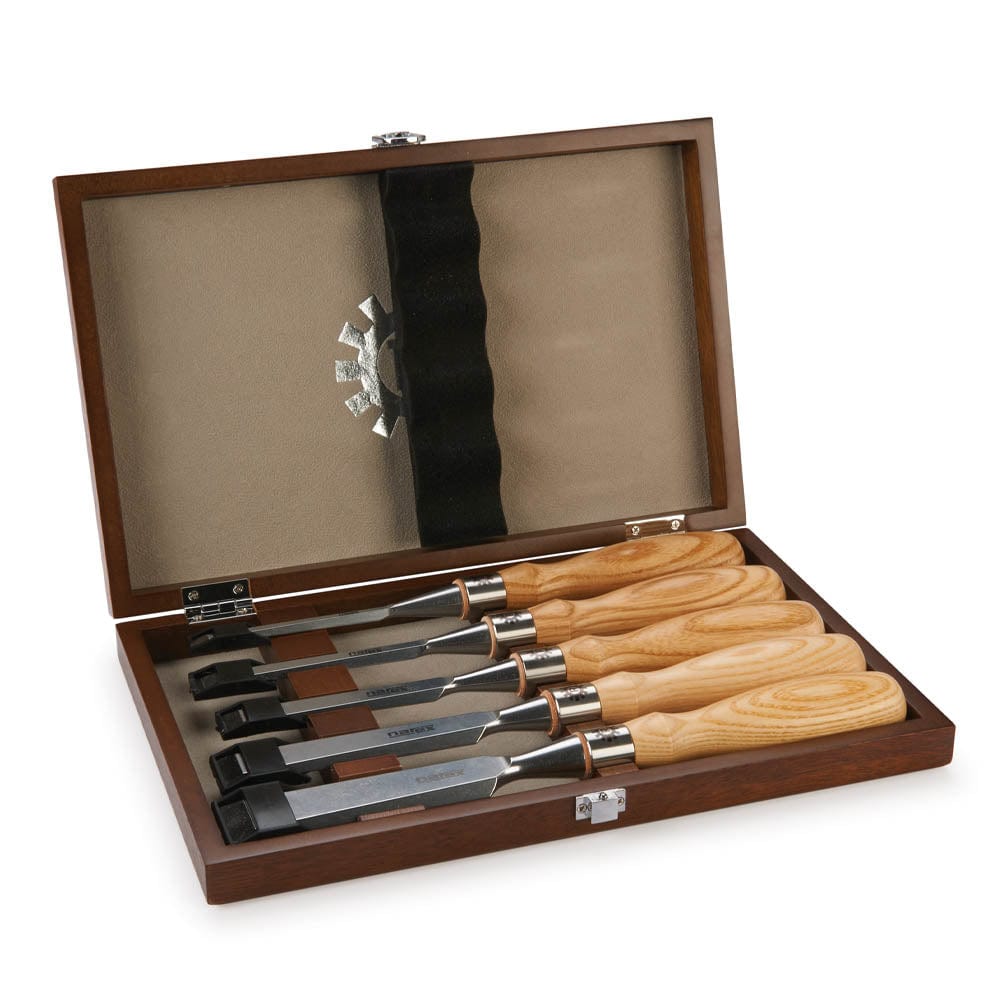
Best Wood Chisel Sets: Picks for Joinery, Bench Work, and Rough Carpentry
The best wood chisel set for most woodworkers is the Narex Premium 5-Piece: O1 steel, honest factory geometry, and under $80. For rough carpentry and heavy mallet work, look at the Irwin Marples M444SB or the current Stanley 5-piece bench chisel set. Cutting dovetails and planning to sharpen regularly? Two Cherries or Lie-Nielsen are worth the price jump. That covers 95% of buyers. The rest of this guide explains why — and which sets arrive ready to cut versus which need a lapping session before they'll do clean work.
Quick Comparison
| Set | Pieces | Steel | Best For | Out-of-Box Edge | Price Tier | Buy At |
|---|---|---|---|---|---|---|
| Narex Premium | 5 | O1 | Fine joinery, bench work | Light honing needed | Mid (~$70–85) | Lee Valley |
| Irwin Marples M444SB | 5 | Cr-Mn | Budget, rough work | Lapping required | Budget (~$30–45) | Home centers, irwin.com |
| Stanley 66-156 | 5 | Cr-V | Rough carpentry | Lapping required | Budget (~$25–40) | Home centers, stanley.com |
| Two Cherries #500 Series | 6 | German carbon | Serious bench work | Ready after strop | Premium (~$120–150) | Lee Valley, Highland Woodworking |
| Lie-Nielsen 5-Piece | 5 | A2 | Long-term investment | Ready after strop | Heirloom ($250+) | lie-nielsen.com |
| WoodRiver V3 | 5 | High carbon steel | Beginner-intermediate | Light honing needed | Mid (~$60–80) | Woodcraft |
*Prices are approximate — check current listings at time of purchase.*
What Separates a Good Chisel Set from Junk
Three things. If a manufacturer won't tell you these upfront, that's your first red flag.
Steel Type — What It Means for Your Sharpening Bench
O1 (oil-hardened): Reaches a very fine edge. Works well on waterstones and oilstones. Loses that edge faster under sustained heavy mallet chopping — designed for fine joinery and paring, not demolition. Narex and Two Cherries use this family of steel.
A2 (air-hardened): Holds an edge longer under production use. Harder to hone to a true mirror finish because of carbide formation in the steel — you'll spend more time at the strop. Lie-Nielsen uses A2. Right choice if you're doing volume work and resharpening once a day rather than mid-session.
Cr-V (chromium vanadium): Tough, handles mallet punishment without chipping as easily, sharpens quickly on coarser stones. This is what you'll find in Stanley and WoodRiver mid-range sets. Right for rough carpentry; not a precision joinery steel.
Cr-Mn (chromium manganese): Similar toughness profile to Cr-V. Used by Irwin Marples. Handles abuse, sharpens accessibly — solid for most DIY and rough work.
Plain carbon or unlabeled: Skip it. These chip, stain, and lose their edge faster than anything listed above. If a set's spec sheet doesn't name the alloy, move on.
Don't lose sleep chasing HRC numbers in marketing copy. A well-ground, properly heat-treated O1 chisel at 59 HRC will outperform a poorly finished 62 HRC chisel on every cut. Geometry and heat treatment matter as much as the steel spec.
Bevel Angle and Back Flatness — the Out-of-Box Reality
Bevel angle sets the edge-durability trade-off. Around 25° is standard for fine joinery and paring — a keen, thin edge that glides through end grain with less force. Closer to 30° suits heavy chopping — more metal behind the edge, longer edge life under mallet abuse. Narex, Irwin Marples, and Lie-Nielsen all specify 30° for their bench chisel lines, placing them toward the robust end of that range and well suited to general bench work and sustained chopping.
Back flatness is where most chisel reviews go quiet. The flat (non-beveled) face of a chisel must be genuinely flat for the tool to make a controlled cut and register properly on a sharpening stone. A hollow or convex back means the edge rocks during honing — you can't establish a clean secondary bevel. Many mid-range sets come out of the factory needing lapping on a flat diamond plate or waterstone before they're fit for joinery. Premium sets minimize this.
When you see "Light honing needed" or "Lapping required" in the table above, back flatness is what's being judged.
Handle Construction and Mallet Compatibility
Tang handles: A spike (the tang) is driven into the wood handle. Lighter and traditional. Can split under sustained mallet use unless the handle base has a ferrule — a metal ring that prevents the wood from splitting outward. Fine for paring and general bench work; not the right design for production mortise chopping.
Socket handles: The handle sits inside a hollow socket. Mallet force transfers through the socket to the blade, and if you crack a handle you replace just the handle. Two Cherries and many traditional makers use socket construction. Preferred for anyone doing sustained heavy chopping.
Handle material: Hornbeam, beech, and boxwood are traditional — durable, pleasant to hold. Plastic overmold (common on Stanley and Irwin) survives mallet abuse and cleans up easily. It's not a problem; it's just not the tactile experience of a wood-handled chisel. Worth knowing before you buy, not a dealbreaker for most work.
The Out-of-the-Box Edge Problem
Here's what most chisel guides skip: "good steel from a reputable maker" does not mean "sharp enough to cut with today."
Two variables determine out-of-box usability:
1. Is the back flat? If not, you'll lap it on a flat plate — coarse diamond stone, or 220-grit wet/dry paper on glass — until it is. That's ten minutes to two hours depending on how far off it is from the factory. 2. Is the bevel correctly ground and polished at the factory, or does it arrive coarse from the grinding wheel? A coarse grind means you're starting your sharpening from scratch — the factory got the chisel to rough shape, not to a working edge.
Sets that typically arrive ready after stropping:
- Lie-Nielsen: Lie-Nielsen states their chisels are ready to use out of the box with minimal honing required — a strop before first use is all that's typically needed.
- Ashley Iles: US retailer Tools for Working Wood (Brooklyn, NY) documents these chisels as arriving sharp and ready to use.
Sets that typically need light honing before fine work:
- Narex Premium: Well-documented in the woodworking community — backs arrive close to flat but benefit from a few minutes on a flat stone before precise joinery. The bevel arrives serviceable. At the price, this is expected and the extra work is minimal.
- WoodRiver V3: These arrive ground but not ready-to-use sharp — a honing session is required before serious work. The starting geometry is solid; you're completing what the factory started.
Sets that require lapping before precision use:
- Irwin Marples M444SB and Stanley production sets: The right tools for rough carpentry and construction joinery, where a hair-splitting edge isn't the priority. For furniture joinery, plan a sharpening session before you start. Community consensus rates the M444SB's out-of-box edge and back flatness noticeably better than Stanley-branded chisels — expect around 30–40 minutes of light honing to get the Irwin to working condition, versus more substantial flattening and sharpening work for the Stanley. Both are a function of price point and production process, not a defect — just know what you're getting into.
The upshot: don't grab a new mid-range set and expect to pare a dovetail tail the same day. And don't dismiss a premium set that costs twice as much — you may recoup the price in setup time alone over the first few projects.
The Picks — Best Wood Chisel Sets by Use Case
Best Overall — Narex Premium 5-Piece Bevel Edge Set
O1 tool steel, hardened to Rc 59, in a five-piece set sized ¼", ½", ¾", 1", and 1¼". Backs require a brief lapping session before fine joinery, but the factory geometry is honest — no egregious hollow backs, no ground-in twist. For most woodworkers buying their first serious set, this is the right starting point.
Available at Lee Valley (leevalley.com) and direct from narex-tools.cz.
Tang handles with ferrule. Fine for bench work and general joinery. These are not production mortise chisels — don't drive them like one.
Best Budget — Irwin Marples M444SB 5-Piece

Cr-Mn steel, blue plastic handles that take a mallet without complaint, widely available at home improvement stores. The M444SB is Irwin's widely available 5-piece set at this price tier — confirm the current model designation at irwin.com before purchasing, as product lines do get updated.
The bevel angle falls within the industry-standard bench chisel range. The set includes 1/4", 3/8", 1/2", 5/8", 3/4", and 1".
These won't be sharp enough for fine joinery out of the box. That's not what they're built for. Put them to work on construction joinery and rough work, or sharpen them properly if you want them to do furniture duty.
Best for Rough Carpentry — Stanley [Current 5-Piece]
Stanley revises its hand tool line with some regularity, but the current 5-piece bench chisel set is the 16-401 — Cr-V steel and plastic handles. Cheap enough to not stress over, tough enough to survive a job site.
If you're reaching for chisels on a framing or rough carpentry job, see our mallet and hammer guide — your mallet or hammer choice matters alongside what you're swinging it at.
Best for Serious Bench Work — Two Cherries #500 Series (6-Piece)

German carbon steel, hardened to 61 HRC. The #500 series has a strong community reputation for arriving with geometry that doesn't require heroic lapping — backs close to flat, bevels consistently ground. The 6-piece set gives you slightly more coverage than the standard 5-piece.
Widely available through specialty woodworking retailers — check current stock and SKU at Lee Valley (leevalley.com) and Highland Woodworking (highlandwoodworking.com).
Tang-handle construction. These are bench chisels — good for joinery, paring, and light-to-moderate chopping. For heavy mortise work, consider dedicated mortise chisels (typically sold individually, not in sets).
Best Premium / Long-Term Investment — Lie-Nielsen 5-Piece
A2 tool steel, made in Warren, Maine. Hardened to HRC 60–62. The geometry out of the Lie-Nielsen shop is the benchmark at this tier — backs are flat, bevels are consistently ground, and the chisels arrive close to ready. Strop before first use; no lapping session required.
A2 steel means each sharpening session takes a bit more work than O1. Plan on a solid stropping routine to maintain the edge between full honing sessions. That trade-off is worth it if you're working regularly — the edge lasts noticeably longer under sustained use.
For current pricing, see lie-nielsen.com — this set sits firmly in the premium tier.
Runner-Up Value Pick — WoodRiver V3 5-Piece (Woodcraft)
Woodcraft's in-house brand targets the beginner-to-intermediate range with decent factory geometry and in-store availability that's genuinely useful if you want to handle a chisel before buying. Steel type: high carbon steel, in a standard 5-piece configuration — check current SKU and availability at woodcraft.com before purchasing.
The WoodRiver V3 designation is confirmed active across Woodcraft's current lineup; verify that the chisel set you're purchasing carries the current V3 specification at woodcraft.com.
Which Sizes Actually Matter?
A standard 5-piece set — 1/4", 3/8", 1/2", 3/4", and 1" — covers 90% of joinery, furniture work, and general carpentry tasks. Start here.
The two you'll reach for constantly: 1/2" and 3/4". These handle mortise walls, tenon shoulders, hinge mortises, and general cleanup. If you're outfitting a shop on a budget, grab those two first.
The one that surprises beginners: 1/4" turns out to be the workhorse for dovetail corners and tight mortise walls. If you're doing any dovetail work, you'll go through more sharpening cycles on the 1/4" than anything else in the set.
When does an 8-piece make sense? When you're regularly cutting wide mortises for cabinet doors or timber joinery that needs a 5/8", 1-1/4", or 1-1/2" chisel. If you find yourself reaching for those sizes consistently, add them individually before buying a whole new set. Don't buy eight chisels until you know which five you're actually using.
Accurate layout before you pick up a chisel is half the job — see our combination square guide.
Frequently Asked Questions
What is the best brand of wood chisels?
Narex for the value tier. Two Cherries for serious bench work. Lie-Nielsen for a long-term investment. "Best brand" depends on how often you sharpen and what you're cutting. A Lie-Nielsen isn't twice as good as a Narex — but if you're cutting dovetails every week, the factory geometry and A2 steel will earn their cost in time saved over a year of regular use.
What chisels should a beginner woodworker get?
A 5-piece bevel-edge bench chisel set in the 1/4"–1" range. Narex Premium or Irwin Marples M444SB are the right starting points. Two or three sharp chisels beat eight dull ones — don't over-buy before you know what work you're doing.
What steel is best for chisels?
O1 for fine joinery — sharpens easily, reaches a keen edge, needs more frequent attention under heavy mallet use. A2 for production or sustained bench work — holds an edge longer, takes more effort to hone sharp. Cr-V or Cr-Mn for rough carpentry — tough, affordable, sharpens fast on budget stones.
How many chisels do I actually need?
Five covers most work. Don't buy eight until you know which five you're reaching for every project. If you're cutting wide mortises regularly, add a 3/4" or 1" individually before upgrading the whole set.
Are expensive chisels worth it?
For regular fine joinery — yes. Premium steel and factory geometry save setup time on every project, and they sharpen better over years of use. For occasional rough carpentry or weekend projects — a mid-range Cr-V set is plenty.
Do chisels come sharp?
Depends entirely on the set. Premium sets like Lie-Nielsen and Ashley Iles arrive close to ready after a strop. Many mid-range and budget sets need lapping and honing before they'll make a clean cut in fine work. It's the question most buying guides answer with a shrug — which is why the out-of-box edge rating is in the comparison table above.
What is the difference between a bench chisel and a mortise chisel?
Bench chisels have a thin, bevel-edged blade for general joinery, paring, and light chopping. Most "wood chisel sets" sold by retailers are bench chisels. Mortise chisels have a thick, stiff blade built to take heavy mallet blows when cutting deep, narrow mortises — they won't flex out of square under impact. Buy mortise chisels individually, matched to the specific mortise widths you're cutting.
What chisel size do I use most?
1/2" and 3/4" handle the widest range of real work. If you're starting with two chisels, buy those.
A sharp $40 chisel outperforms a dull $200 one on every cut. The best chisel is the one you keep sharp. For most woodworkers, the Narex Premium 5-piece hits the right balance — good steel, honest geometry, and a price that doesn't sting. If you're moving into regular hand-tool joinery, Two Cherries or Lie-Nielsen are worth the step up once you know the work is there to justify it.
You'll be driving these chisels with a hammer or mallet — see our titanium vs steel framing hammers if you're still sorting out that side of the kit.