
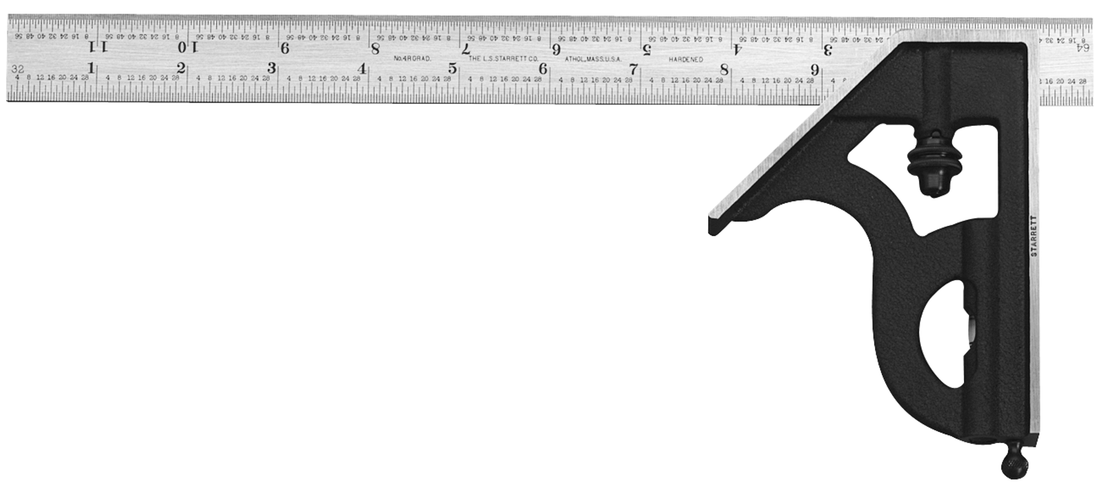
Best Combination Square: Starrett, Empire, Swanson, and One Budget Pick That Punches Up
The best combination square for most tradespeople and serious DIYers is the Starrett 11H-12-4R — the cast iron head and hardened blade hold calibration longer than anything at any price. If you're doing rough construction layout where close-enough genuinely works, the Swanson S0101 costs under $20 and handles the work. For precision woodworking without paying the Starrett premium, the iGaging 35-CBI-12 hits the accuracy sweet spot. Want a built-in spirit level you'll actually trust? The Empire 2997 is the mid-range pick. Here's what separates them — and how to verify any one of them before you trust your project to it.
What Actually Separates a Good Combination Square from a Bad One
Three physical specs determine whether a combination square stays accurate for years or drifts out of square its first season. None of them show up on the price sticker.
Head Material: Cast Iron vs. Die-Cast Zinc vs. Aluminum
The head is the reference surface everything else is measured from. If the head warps, wears, or wasn't machined flat to begin with, blade graduation accuracy is meaningless.
Cast iron (Starrett) is dense, machines flat easily, and holds its geometry. It's heavier, but that's a feature on a precision tool — it registers against a workpiece without skating.
Die-cast zinc or aluminum (Empire, Swanson, most budget tools) is lighter and cheaper to produce. The problem: die-cast parts have more porosity and aren't machined as consistently flat. New, they can be fine. After a few drops or a season on a truck, the reference face is more likely to have shifted.
Extruded aluminum shows up on some low-cost import squares — softer, easier to ding, prone to slight warping. Worst of the three.
This isn't brand snobbery. It's what actually fails first on cheap squares: the head reads false, you trust it, your joinery drifts, and you blame yourself.
Blade Play and Locking Mechanism: The Silent Accuracy Killer
The blade should lock hard with zero side-to-side slop. On quality squares, the locking nut pulls the blade into positive contact with the head — no wiggle.
On budget squares, there's often a small amount of blade play at the lock point. Half a millimeter of slop is invisible until you're scribing a cabinet face or laying out mortises across a board. Then it compounds.
Before you buy in a store: lock the blade at 8" and try to cant it side to side. Any movement is a problem.
Graduation Type: Etched/Milled vs. Screen-Printed
On a Starrett, graduations are physically etched into the blade — they won't wear off. On budget squares, the markings are often screen-printed on the blade face. A year of regular use, especially with mineral spirits or other shop solvents, and you're reading a faded blur.
If a manufacturer spec doesn't say "etched" or "milled," assume printed. It matters more than most buyers realize the first time they need to read a blade that's been in a tool pouch for two years.
Blade Length: 6" vs. 12" vs. 18"
12" is the most versatile — the right first square for nearly everyone. Covers trim carpentry, cabinetry, panel layout, and general metalwork.
6" is the one to add later if you do a lot of bench work, tight joinery, or detail work where a longer blade is in the way. Easier to use in cramped spots, easier to register on narrow stock.
18" exists for large-panel layout. Most tradespeople never need it.
Get the 12" first. You'll know whether you need a 6" after a month of use.
Best Combination Square for Every Use Case
| Square | Head Material | Graduation Type | Best For |
|---|---|---|---|
| Starrett 11H-12-4R | Cast iron | Etched/milled | Precision layout, joinery, metalwork |
| iGaging 35-CBI-12 | Durable metal head | Etched | Tight-tolerance work on a budget |
| Empire 2997 | Die-cast aluminum | Etched | Mid-range with built-in level |
| Swanson S0101 | Heavy-gauge die-cast aluminum | Printed | Rough framing and construction layout |
Best Overall — Starrett 11H-12-4R (12")
The 11H-12-4R has a cast iron head, a hardened and tempered steel blade, and a 4R rule graduation — that's 1/8, 1/16, 1/32, and 1/64" on four different blade edges. The blade locks with a knurled nut that pulls it dead solid. No detectable play at any extension length. Reference faces are ground flat. You verify these things once; you trust them permanently.
The scriber: Pull the carbide-tipped pin from the pocket in the head, drag it along the blade edge, and it scribes a clean line directly into wood or metal — sharper than a pencil, faster than setting up a marking gauge, and it leaves a groove you can feel. Most roundups mention it as a bullet point. It's actually the feature that changes how you lay out joinery once you've used it on dovetail work. Going back to a pencil line feels imprecise.
Who it's for: Anyone doing trim carpentry, cabinetry, joinery, or metalwork where an error at the square compounds downstream. Experienced tradespeople who've bought and replaced cheap squares twice already.
What you give up: Price. The Starrett commands a significant premium — roughly three to five times the cost of a budget square. If you're using a combination square twice a month for rough framing checks, that premium isn't justified.
Where to buy: Starrett.com or Home Depot — confirm current pricing at point of purchase.
Best Budget — Swanson S0101 (12")
The Swanson S0101 has a die-cast head and printed steel blade. Graduation increments are 1/8 in. — enough for rough layout, not enough for joinery.
It costs under $20 and does exactly what an under-$20 square should do: mark 90s and 45s for rough framing, check boards before assembly, live on the worksite without anxiety.
Where it cuts corners: Printed graduations that fade; a lighter head more susceptible to wear; blade play at the lock point that's acceptable for layout checks but not for precision marking.
Who it's for: Framers, rough carpenters, and DIYers who need a square for occasional layout checks and don't want to put $70 down on a tool they'll toss in a bucket. Fine for construction; not right for finish work.
Best Mid-Range — Empire 2997 (12")
The Empire 2997's headline feature is the True Blue vial — a liquid level built into the head that Empire rates to a precise published tolerance. The head is die-cast aluminum, which is a step up from printed-graduation budget tools but behind Starrett's cast iron.
The blade locks solidly for a die-cast square — better than the Swanson at this price range. If you regularly check plumb and level during layout (setting cabinets, marking stud layout on a wall), having that vial on the square rather than reaching for a separate tool is genuinely useful.
Who it's for: General contractors, finish carpenters, and DIYers who want a step up from the Swanson without committing to Starrett pricing. The spirit level is the deciding feature — if you don't need it, put the difference toward the iGaging instead. The Empire 2997 typically lands in the mid-range between budget squares and the Starrett — confirm current pricing at Home Depot before purchasing.
See also: comparing Milwaukee Redstick and Stabila levels if you're also shopping levels.
Best for Tight-Tolerance Work — iGaging 35-CBI-12 (12")
The iGaging is the one that consistently surprises people. Multiple woodworkers and machinists report the head as cast iron — verify the current spec at the listing — and if that spec holds, it explains why field tests (see below) consistently show these passing 90° and 45° checks out of the box.
The blade is dual-sided with SAE fractional and metric markings across both edges. The 6" version (35-CBI-6) is worth noting if you do a lot of bench work.
Production consistency on budget tools varies, so run the field test on yours when it arrives. The hit rate is high enough that this is the recommendation for anyone who needs tight-tolerance accuracy and can't swing the Starrett. Current pricing falls substantially below the Empire and well below Starrett — verify at Amazon before purchase.
Combination Square vs. Speed Square: Which Do You Actually Need?
Quick answer: they do different things. Most tradespeople should own both.
A speed square is a fixed triangle — one piece, no moving parts. Fast to grab, nearly indestructible, good for marking crosscut lines on framing lumber and guiding a circular saw. It does not adjust, does not mark 45° with a sliding blade, and does not function as a depth or height gauge. For speed square picks, see speed square recommendations.
A combination square has a sliding, lockable blade. It marks 90° and 45° from the same head, functions as a depth gauge, checks height, and with a scriber can mark parallel lines at any distance from an edge. The tradeoff: more moving parts, more to go out of calibration.
For rough framing: speed square. For layout, joinery, trim, and metalwork: combination square. Many tradespeople keep a speed square in their apron and a combination square on the bench.
How to Test a Combination Square for Accuracy (Two-Minute Field Check)
This works on any square you own or just bought. No special equipment — just the square, a pencil, and a flat board with a straight reference edge.
1. Lock the blade at a working length — 6" to 8" is plenty. 2. Hold the head firm against the face edge of the board. Mark a sharp, thin pencil line along the blade. 3. Flip the square so the head is still against the same edge but the square now faces the opposite direction. 4. Align the blade tip to the same starting point and mark a second line. 5. Examine where the lines meet or diverge. If they're identical, the square is accurate. A V-shaped gap at the blade tip or at the base tells you the square is off — the wider the V, the larger the error.
Repeat with the 45° face: mark, flip around the same edge registration, mark again.
A Starrett passes every time. A quality iGaging passes most of the time. Budget die-cast squares often show a small gap that widens as the head wears. If a new square fails this test in the store or on arrival, return it — it's a manufacturing defect, not a setup issue.
Frequently Asked Questions
What is a combination square used for? A combination square measures and marks 90° and 45° angles, checks depth and height, scribes parallel lines from an edge, and — on models with a spirit level — checks plumb and level. One adjustable tool covers most layout tasks that otherwise need three or four separate instruments.
What size combination square should I buy? A 12" is the most versatile for general woodworking, trim, and layout work. A 6" is better for tight spots, bench work, and detail joinery. Get the 12" first; add a 6" if you find yourself needing it.
Is Starrett the best combination square? For accuracy and longevity, yes. The cast iron head and hardened blade hold calibration longer than die-cast or aluminum alternatives. Whether it's worth the price depends on how precise your work needs to be — for rough framing, a budget square does the job.
How do I know if my combination square is accurate? Mark a line against the 90° head on a flat board, flip the square against the same edge, and mark again from the same starting point. If the lines don't align, the square is off. The two-minute field test above walks through both the 90° and 45° checks.
Are cheap combination squares accurate enough? For rough layout and construction work, a budget die-cast square is fine. For joinery, cabinetry, or metalworking where a small error compounds across a project, usually not — the head material and blade play at the lock point will drift. The iGaging is the cheapest option that consistently passes the field test.
What does the scriber on a combination square do? It's a carbide-tipped marking pin stored in a pocket in the head. Pull it out, drag it along the blade edge, and it scribes a line directly into wood or metal — more precise than a pencil and faster than setting up a marking gauge.
What's the difference between a combination square and a speed square? A speed square is a fixed triangle — fast, rugged, one-piece. A combination square has a sliding, lockable blade and marks both 90° and 45° with adjustable blade depth. Use a speed square for framing; use a combination square for joinery, trim, and precision layout. See speed square recommendations for more picks.
What's the difference between a combination square and a try square? A try square checks 90° only, with a fixed non-adjustable blade. A combination square does 90°, 45°, and depth/height measurement with an adjustable, removable blade. A good try square can be more accurate at pure 90° checking; a combination square is more versatile.
If you're building out your layout kit, here's what we picked for speed squares and tape measures. If you're adding a level to the kit, we compared Milwaukee Redstick and Stabila levels.