
Bessey vs Irwin Bar Clamps: Which Should You Buy?
For fast one-handed holds and the lowest price, Irwin's Quick-Grip wins. For serious clamping force, steel durability, and flat panel glue-ups, Bessey wins — but only if you buy the right *type*. Most Bessey vs. Irwin bar clamp comparisons go wrong because they compare apples to oranges: Irwin's lineup is essentially one product family — the Quick-Grip trigger clamp — while Bessey makes three distinct types — one-handed, clutch-style, and parallel-jaw — that serve completely different jobs.
Match the type first. Then pick the brand.
The Short Answer: Type-by-Type Verdict
| Clamp type | Best Irwin | Best Bessey | Who wins & why |
|---|---|---|---|
| One-handed trigger | Quick-Grip (standard / XP) | DuoKlamp / EHK | Irwin for temp holds + price; Bessey if you need more force from a trigger |
| Clutch-style / sliding arm | No direct equivalent | CL / GSCC | Bessey — Irwin doesn't compete here |
| Parallel jaw (glue-ups) | Irwin parallel-jaw line | K Body REVO (KRE) | Bessey — flatter pressure, higher force, panel-grade |
| Heavy-duty / fabrication | — | TG series | Bessey only |
Find your type in that table. Everything below explains the why.
First, Match the Clamp Type — You're Probably Comparing the Wrong Two
The most common mistake: someone compares an Irwin Quick-Grip (a one-handed trigger clamp) against a Bessey K Body REVO (a precision parallel-jaw clamp). Those tools are not in the same category. Calling that a fair fight is like comparing a Phillips to a Robertson — both screwdrivers, different jobs.
Here's the lineup at a glance:
- Irwin = Quick-Grip trigger clamp family. One-handed, fast, light, affordable.
- Bessey = a spectrum: one-handed (DuoKlamp, EHK) → clutch-style (CL, GSCC) → parallel-jaw (K Body REVO) → heavy-duty (TG).
One-Handed Trigger Clamps: Irwin Quick-Grip vs. Bessey DuoKlamp / EHK
These are the grab-and-squeeze clamps. One hand stays on the work, the other squeezes the trigger. Both brands make them, and this is the only head-to-head where they're genuinely comparable.
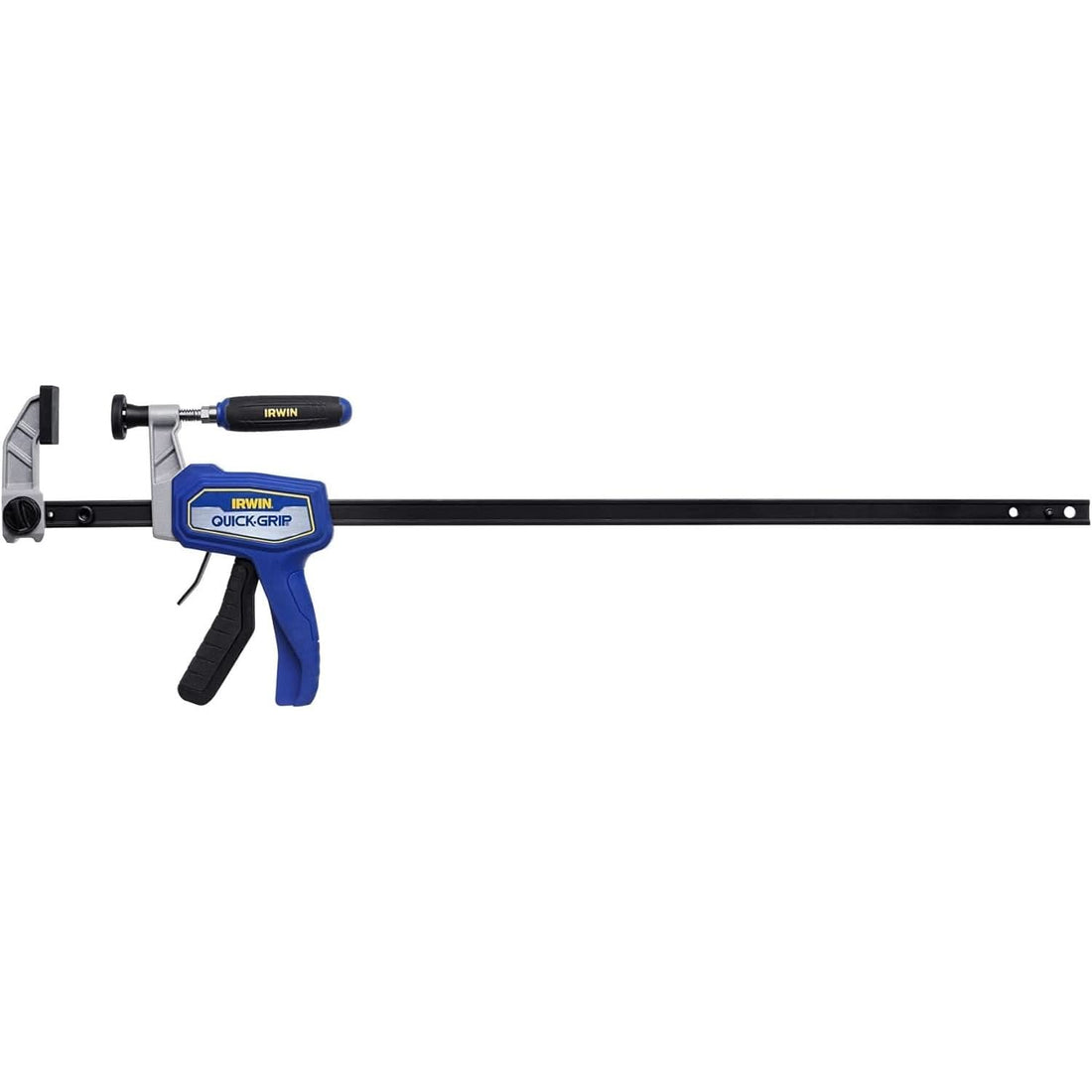
Irwin's Quick-Grip is the category reference. Composite body, ratcheting trigger, built-in quick-release, converts to a spreader by reversing the jaws. Standard models are light-to-medium duty; the XP and Heavy-Duty variants add more force and a heavier bar. Available in lengths from 4.25 in. to 50 in. across the full lineup — the heavy-duty line runs from 6 in. to 50 in., with smaller sizes available in lighter-duty configurations.
Clamping force: standard models run to 300 lbs; the XP/Heavy-Duty line reaches 600 lbs.
Bessey's answer is the DuoKlamp and EHK line. Higher rated clamping force than comparable Quick-Grip models, heavier steel construction, more expensive. The DuoKlamp delivers around 260 lbs; the EHK steps up to a noticeably higher force rating. You'll feel the weight difference immediately — that's the steel rail versus composite.
Verdict here: Quick temporary holds, solo positioning, or clamping while you drive a screw — Irwin. You want more force out of a one-handed clamp and you'll use it every day — Bessey DuoKlamp or EHK.
Clutch-Style / Sliding-Arm Bar Clamps: Bessey CL / GSCC
The clutch-style clamp is Bessey's territory. You slide the jaw down the bar to near your work, then apply force with the handle — the clutch mechanism bites and holds. No ratcheting trigger, very positive engagement, fully two-handed operation.
Irwin doesn't have a direct equivalent here. This category belongs to Bessey.
The CL and GSCC series are steel bar clamps — not fast, but solid and controllable. Good for glue-ups where you want to sneak the jaws in carefully. Their clamping force is substantial, well into the range suited for demanding glue-up and shop work.
Parallel-Jaw Clamps for Glue-Ups: Bessey K Body REVO vs. Irwin Parallel-Jaw
This is where the money is for woodworkers. A parallel-jaw clamp has wide faces that stay 90° to the bar throughout its range. That keeps glued panels flat and square as they cure — instead of bowing under the angled pressure a standard bar clamp applies.
Bessey's K Body REVO (KRE series) is the standard woodworker recommendation. German-made, steel rail, up to 1,700 lbs of clamping force, replaceable jaw pads. Expensive — but when you're gluing up eight boards into a tabletop, a panel that cups during the glue-up costs you far more in rework than the price difference.
Irwin makes parallel-jaw clamps too, at a lower price. Clamping force: 1,150 lbs. The bar and jaw construction isn't as refined as the K Body, but for a DIYer doing occasional cabinet work, Irwin's parallel-jaw option is not a bad call.
Irwin Quick-Grip Bar Clamps: Strengths, Weak Spots, Real Clamping Force
The Quick-Grip is the bestselling one-handed clamp in the category for good reason.
Where it shines:
- One-hand operation — genuinely useful when you're working solo
- Fast. Squeeze, position, done
- Noticeably lighter than steel-bodied competitors
- Converts to a spreader — flip the jaws and push instead of clamp
- Affordable enough to stock up; buy a dozen different lengths without flinching
Where it falls short:
- The composite body and bar flex more than steel under heavy load
- Not the right tool for flat-and-square glue-up work
- Won't match Bessey force ratings at the high end
Irwin warranty: Limited Lifetime Warranty for the original purchaser (one year for electrical/electronic components).
Bessey Bar Clamps: Clutch, DuoKlamp, and K Body REVO Explained
Bessey is a German manufacturer whose reputation for steel construction and clamping force spans decades. The reputation rests on steel construction, high clamping force, and the K Body's parallel-jaw geometry.
DuoKlamp / EHK (one-handed): Bessey's direct response to the Quick-Grip. Steel handle, higher force rating, heavier. You pay for the force and the material, not for extra convenience features.
CL / GSCC (clutch-style): Two-handed sliding-arm clamps. Positive clutch engagement, steel rail, well-suited for glue-up work where you want to control the approach. Force reaches 1,775 lbs on the CL24 model.
K Body REVO (KRE): The flagship woodworking clamp. Parallel jaws stay perpendicular to the bar so panels come out flat. Up to 1,700 lbs of force on a steel rail that doesn't flex under load. Wide jaw pads reduce marring on finished surfaces.
TG series (heavy-duty): Top-end Bessey bar clamps, rated for exceptional clamping force — significantly beyond what clutch-style or parallel-jaw clamps deliver. Built for metal fabrication, fixture work, and applications where the Quick-Grip wouldn't last a week.
Bessey warranty: Lifetime warranty on clamping products; one-year warranty on other tools.
Head-to-Head: Clamping Force, Durability, Weight, and Price
| Spec | Irwin Quick-Grip | Bessey DuoKlamp / EHK | Bessey K Body REVO | Bessey TG |
|---|---|---|---|---|
| Clamp type | One-handed trigger | One-handed trigger | Parallel jaw | Heavy-duty bar |
| Rail / body | Composite + steel bar | Steel | Steel | Steel |
| Clamping force | Light to medium | Medium to high | High | Very high |
| Converts to spreader | Yes | Yes (all DuoKlamp models; EHK except EHKMICRO) | No | No |
| Country of origin | USA — introduced 1988 by American Tool | — | Germany | Germany |
| Relative price (24 in.) | Lower | Mid | Higher | Highest |
Why bar material matters at high force: The Quick-Grip's composite body is fine under moderate load. Under heavy clamping pressure — the kind you'd apply across a multi-board panel glue-up — a composite-bodied bar deflects more than steel. Bessey's steel rail doesn't flex the same way. That's not a knock on Irwin for its intended use; it's a reminder that you can't compare the two brands at maximum load and call it a fair test.
Throat depth: Standard bar clamps from both brands run roughly 2.5 to 3.75 in. of reach. The K Body REVO (KRE series) maintains a uniform 3¾ in. throat depth across all models — useful when clamping assembled cabinet carcasses or thicker laminated stock.
Which Bar Clamp Should You Buy?
DIY / Occasional Use / Quick Temporary Holds → Irwin
Hanging a door by yourself, gluing a picture frame, holding a shelf while you drive a few screws — the Quick-Grip is the right tool and the right price. Pick up a few lengths (6 in., 12 in., and 18 or 24 in. covers most situations) and you'll reach for them constantly. Don't over-spend on Bessey for this work.
Fine Woodworking & Panel Glue-Ups → Bessey K Body REVO

Gluing up a tabletop or cabinet carcass is where the K Body REVO earns its price. The parallel jaws keep the panel from bowing as glue cures. That matters: a cupped tabletop from a bad glue-up is wasted material and frustration. Irwin makes a parallel-jaw option that works for lighter occasional projects, but the K Body is in a different class for serious work.
Metal Fab / High Force / Job-Site Abuse → Bessey (Clutch or TG)
If you're clamping steel, doing welding fixturing, or working in a shop where clamps bounce around in a van every day — Bessey's clutch-style (CL/GSCC) or TG series is the call. The composite-body Quick-Grip is not built for this environment.
One-Handed Positioning While You Work Solo → Either Brand's One-Handed Line
Need a third hand? Both brands deliver. Irwin Quick-Grip is the default because it's affordable enough to buy six and leave them staged around the shop. If you need more force from a one-handed trigger clamp — for something beyond a temporary positioning hold — step up to the Bessey DuoKlamp or EHK. You'll carry more weight and spend more money, but the force rating is there.
Frequently Asked Questions
Are Bessey clamps worth the extra money?
For glue-ups, high-force work, and daily professional use, yes. The K Body REVO's parallel jaws alone justify the premium for woodworkers — flat glue-ups aren't a luxury, they're a functional requirement. Bessey's steel construction on the clutch-style and TG series also outlasts composite-bodied clamps under sustained heavy use. For occasional quick holds and temporary positioning, a Bessey is overkill and the cheaper Irwin is fine.
Are Irwin Quick-Grip clamps any good?
For one-handed speed and temporary or light-duty holds, they're excellent value. They're not the pick for serious glue-up work or high-force applications. Know the use case and they perform exactly as expected.
What's the difference between parallel clamps and regular bar clamps?
A parallel-jaw clamp — like the Bessey K Body REVO — has wide faces that stay perpendicular to the bar throughout the clamp's travel. That means the panel dries flat and square during a glue-up. A standard bar clamp or trigger clamp can rack under load and pull your work out of square. For joinery and multi-board panel assembly, the geometry matters.
How much clamping force do I actually need?
Light holds and jig work need almost nothing — even a few pounds keeps a piece steady while glue tacks. Wood glue-ups want moderate, even pressure spread across multiple clamps; cramming all the force into two clamps just creates a stressed joint and can squeeze glue out. Metal fabrication and structural fixturing is where you want the high numbers — Bessey TG territory. Match the tool to the task.
Can bar clamps be used as spreaders?
Most Irwin Quick-Grip models reverse into spreaders by flipping the jaw orientation — that's a genuine useful feature for installing shelving or expanding frames. Both the DuoKlamp and EHK offer tool-free spreader modes as well — the DuoKlamp switches via a dial toggle, and the EHK via jaw repositioning. The parallel-jaw and clutch-style Bessey clamps do not convert.
Bessey vs Irwin for woodworking and cabinet glue-ups?
Bessey K Body REVO for anything serious — parallel jaws, high force, steel construction. Irwin parallel-jaw if you're on a budget and the work is lighter and occasional. Don't use a trigger clamp (Quick-Grip or otherwise) as your primary glue-up clamp on multi-board panels — you'll rack the work.
Where are Bessey clamps made? Where are Irwin clamps made?
Bessey's K Body REVO and flagship bar clamps carry German manufacturing heritage; production locations vary by product line. Irwin Quick-Grip is a Stanley Black & Decker brand; the country of manufacture varies by model and product line.
Clamp choice isn't really Bessey vs Irwin — it's about matching the type to the job, then picking the brand that wins within that type. Irwin dominates one-handed speed and value. Bessey dominates clamping force, steel durability, and parallel-jaw glue-up precision. In a working shop, you'll probably end up with both: Quick-Grips for quick holds and positioning, K Bodies for panel days.
For more hand-tool comparisons in the same vein — premium brand vs. value, with a clear verdict by use case:
- Knipex Cobra vs. Irwin Groovelock — same "does the premium brand justify the price?" question, for tongue-and-groove pliers (and another Irwin comparison)
- wood chisels — chisels and clamps go together in any glue-up or joinery workflow
- combination squares — keeping your work square before the clamps go on matters as much as the clamps themselves
- Estwing vs. Stiletto titanium hammers — the same premium-vs-value decision pattern, for framing hammers