
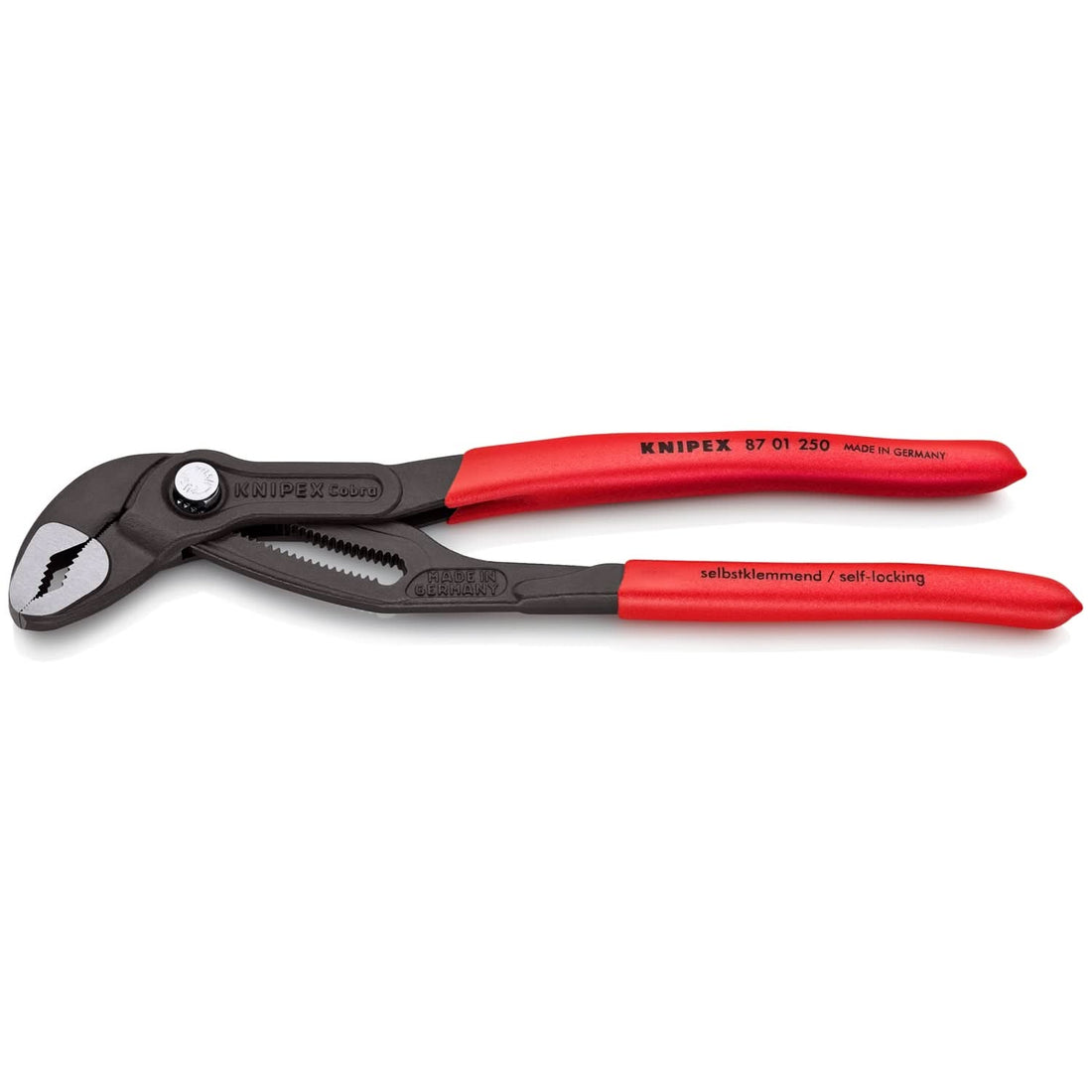
Knipex Cobra vs Irwin GroovLock: Which Tongue-and-Groove Pliers Should You Buy?
The Knipex Cobra vs Irwin GroovLock — the Cobra is the better tool. Its self-locking jaws grip pipe and fittings tighter under load — they won't slip back on rounded fasteners the way a standard groove-joint can. The head is slimmer. It's forged in Germany to last decades. Worth it if pliers are in your hand daily. The Irwin GroovLock costs a fraction, has more positions than a traditional groove-joint, and carries a lifetime warranty. Genuinely capable for home repairs and occasional work. For most people: start with the Cobra 87 01 250 (10"). Budget-limited or need a big cheap jaw? GroovLock.
The short answer — who each one is for
- Buy the Cobra if you're a plumber, HVAC tech, mechanic, or electrician who reaches for tongue-and-groove pliers regularly. The self-locking grip and slim head make a real difference when you're fighting corroded fittings in a tight vanity cabinet or under a dash every day. The price pays off over a career.
- Buy the GroovLock if you do occasional home plumbing, general repairs, or periodic DIY work — a few times a year. It's an honest, capable tool at a much lower entry price, and Irwin backs it for life.
Knipex Cobra vs Irwin GroovLock at a glance
| Knipex Cobra 87 01 250 (10") | Irwin GroovLock 10" | |
|---|---|---|
| Material | Chrome-vanadium, forged, oil-hardened | Steel (see irwintools.com for complete material spec) |
| Adjustment | Self-locking push-button box-joint | Push-button |
| Handle | Plastic over-grip | ProTouch comfort grip |
| Made in | Germany | Taiwan |
| Warranty | Lifetime limited warranty against defects in material and workmanship | Lifetime |
| Sizes available | 100–560 mm (4"–22") | 6", 8", 10", 12", 16" |
| Street price (10") | $40.47 | $24.94 |
Jaw capacity and position count vary by size. For the exact technical data on the models you're looking at, check the Knipex Cobra product page (87 01 series) and the Irwin GroovLock product page directly — both publish full spec tables. For reference, the Cobra 87 01 250 opens to a 50 mm jaw capacity, while the GroovLock 10" reaches 2-1/4" across 16 groove positions.
What are tongue-and-groove pliers — and are these the same type of tool?
Yes. "Water pump pliers" (Knipex's term), "tongue and groove pliers," "groove-joint pliers," and "channel-lock pliers" all refer to the same category: a multi-position adjustable gripping plier with angled jaws, used for pipe, hex fittings, and awkward shapes that a standard open-end wrench can't grip. The Cobra sits in this category. Knipex calls them water pump pliers because the original design targeted packing nuts on old water pumps; the mechanism evolved, the name didn't.
When a plumber says "grab a Channel-Lock" or your HVAC manual says "tongue-and-groove pliers," both the Cobra and GroovLock fit. What separates them is how well they do the job.
The real difference is the adjustment mechanism
Both tools use a push-button to release the jaw position. That's where the similarity ends.
The Cobra uses what Knipex calls a self-locking box-joint. When you squeeze the handles under load, the jaws lock tighter — the geometry is designed so that applied force increases jaw engagement rather than allowing the position to slip back. On a corroded P-trap, a rounded hex nut, or a chrome fitting you cannot afford to round off, that characteristic is the entire ballgame. The GroovLock's button releases and resets cleanly, but it doesn't have the same load-tightening behavior built into the joint geometry.
The Cobra's one-hand adjustment is also faster in practice. Push the button, jaws float open, drop over the fitting, click into position. For a plumber doing dozens of connections in a day, that smoothness compounds.
The GroovLock does offer twice the groove positions of a traditional groove-joint — Irwin markets this as a key selling point. That's a genuine improvement over a basic Channellock-style plier, and for occasional work it's entirely adequate.
Grip, jaw design, and will these things mar your fittings?
Both tools have toothed jaws. Both will leave marks on finished surfaces if you're not careful.
The Cobra's teeth bite hard under load — that's part of the design. Great on stubborn fittings; not ideal for polished chrome on a visible supply line. Same goes for the GroovLock. If you're tightening a chrome faucet nut or any fitting where cosmetics matter, wrap the jaw contact surfaces with a rag or use plumber's tape on the fitting. Or swap to a smooth-jaw adjustable plier — the Knipex Pliers Wrench is the go-to for finished surfaces if you want to stay in the Knipex family.
One genuine Cobra advantage here: the slim, tapered head. The box-joint design keeps the head noticeably more compact than a traditional groove-joint profile. That matters behind a toilet tank, inside a tight cabinet door, or wherever you're working with a hand-and-a-half of clearance. The GroovLock's head is wider — fine for open work, limiting in tight access.
How do build quality and warranty compare?
Knipex Cobra: Forged from chrome-vanadium electric steel, oil-hardened. Made in Germany — Wuppertal, where Knipex has been making pliers since 1882. Chrome-vanadium forged steel is a real spec: harder, tougher, and more wear-resistant than lower-grade alloys. These pliers will outlast most of the other tools in your bag.
Knipex backs the Cobra with a Lifetime Limited Warranty covering defects in materials and workmanship. The warranty applies to the original purchaser and is non-transferable; Knipex will repair or replace the tool at no charge. It does not cover damage from misuse, abuse, alteration, accidents, or normal wear.
Irwin GroovLock: Irwin backs the GroovLock with a lifetime warranty — standard across the Vise-Grip line. If the tool fails under normal use, Irwin replaces it. That's a meaningful commitment for a tool at this price. The GroovLock 10" is manufactured in Taiwan; complete material specifications are available on the Irwin product page.
In practical terms: the Cobra is a buy-once tool if you keep it. The GroovLock's lifetime warranty is the value hedge — if it wears out or goes missing on a jobsite, the replacement cost is low and the warranty covers manufacturing defects.
Price — and is the Cobra actually worth it?
The Cobra 10" runs well above the GroovLock 10" in price. At current retail, the Cobra 87 01 250 runs $39.48 and the GroovLock 10" runs $24.94 — a meaningful gap, and the one that often decides the question for buyers who don't use pliers daily.
For a tradesperson using tongue-and-groove pliers daily, the cost math is simple. Spread the Cobra's price across 20 years of heavy use and it's one of the cheaper things you'll buy. The self-locking grip isn't a comfort feature — it's the difference between a controlled grip on a stubborn fitting and a slip that rounds the edge or strips the chrome on something expensive.
For a homeowner who touches these pliers twice a year for a bathroom fix, the GroovLock is the correct economic choice. The quality isn't equivalent, but the job gets done, and Irwin stands behind the tool for its working life.
Which size should you buy?
For the Cobra: The 87 01 250 (250 mm / 10") handles most residential and light-commercial plumbing, HVAC work, and mechanical tasks — the large majority of fittings you'll encounter. Add the 180 mm (7") if you work in tight access regularly. Step up to the 300 mm (12") if large-diameter supply lines or bigger mechanical fasteners are part of your regular work. The full range runs from 100 mm (4", XS — useful in confined spaces and for fine fittings) up to 560 mm (22", XXL — industrial applications). The complete 87 01 series spans seven sizes: 125 mm (87 01 125), 150 mm (87 01 150), 180 mm (87 01 180), 250 mm (87 01 250), 300 mm (87 01 300), 400 mm (87 01 400), and 560 mm (87 01 560).
For the GroovLock: The 10" is the workhorse. At 12" and 16", the GroovLock's price advantage gets more pronounced — if you occasionally need a large jaw for bigger pipe or fittings and don't want to spend Cobra money for infrequent use, the GroovLock in a bigger size is a reasonable grab.
So which one should you get?
Plumber, HVAC tech, mechanic, or electrician — daily use: Cobra 87 01 250. The self-locking box-joint is a genuine functional advantage that shows up every day on corroded and rounded fasteners. The slim head gets into spots the GroovLock won't. For electricians also weighing Knipex quality against other brands, Klein vs Knipex covers that question directly.
Homeowner, general DIYer, occasional shop work: GroovLock 10". More positions than a basic groove-joint, competitive price, lifetime warranty. Does the job without the premium.
Need a big jaw on a budget: GroovLock 12" or 16". Large-diameter reach without the Cobra price tag.
Want both: Some pros run a Cobra as the daily driver and keep a GroovLock in the work van as the "not worried if it goes missing on a jobsite" spare. Not a bad setup. And if you're trying to decide whether Knipex's adjustable-jaw tools in general justify the price jump, that analysis covers it with the Pliers Wrench as the test case.
FAQ
Are Knipex Cobra pliers worth the money?
For daily professional use, yes. The self-locking grip, compact head, chrome-vanadium forged build, and German manufacturing combine into a tool you buy once and use for decades. For occasional jobs, the GroovLock is genuinely good enough — no need to spend Cobra money if you use pliers a few times a year.
Are Irwin GrooveLock pliers any good?
Yes, for the price. More positions than a basic groove-joint, a ProTouch handle that's comfortable to squeeze, and a lifetime warranty. They don't have the Cobra's self-locking grip behavior, and the head is wider — but if you're not fighting corroded fittings in tight access daily, those differences rarely come up.
What's the difference between water pump pliers and tongue-and-groove pliers?
Nothing — same tool, different names. The adjustable multi-position gripping plier found in every plumber's bag is called "water pump pliers" by Knipex, "tongue and groove pliers" by Irwin and most other brands, and "channel-lock pliers" informally (after the Channellock brand). Cobra and GroovLock are both water pump / tongue-and-groove pliers.
Where are Knipex Cobra pliers made?
Germany — Wuppertal, where Knipex has been manufacturing since 1882.
Where are Irwin GroovLock pliers made?
Taiwan.
What size Knipex Cobra should I buy?
Start with the 87 01 250 (250 mm / 10") — it handles most plumbing, mechanical, and general work. Go up to the 300 mm (12") if you regularly deal with larger-diameter fittings. The 180 mm (7") is a useful second pair for tight-access situations. The full 87 01 series is available in seven sizes: 125 mm, 150 mm, 180 mm, 250 mm, 300 mm, 400 mm, and 560 mm.
Do these pliers scratch or mar fittings?
Both tools have toothed jaws, and both will mark soft metal and chrome finishes under pressure. Wrap the jaw contact area with a rag or tape the fitting if cosmetics matter. For polished surfaces you can't afford to scratch, a smooth-jaw adjustable plier is the right tool — the Knipex Pliers Wrench is the standard recommendation there.
Does the Knipex Cobra really not slip?
The self-locking box-joint design increases jaw engagement as you apply force — the load tightens the grip rather than allowing the position to slip back. That's a function of the mechanism geometry, not a marketing claim. On rounded fasteners and corroded fittings where a standard groove-joint can walk off the edge, the Cobra holds. Whether that matters to you depends entirely on the work you do.
If locking pliers are also on your radar — Irwin Vise-Grip's home territory — this guide breaks down what actually matters in that segment.