
Milwaukee M18 Forge vs DeWalt PowerStack: Which Battery Should You Buy?
Comparing Milwaukee M18 Forge vs DeWalt PowerStack? Stop here first: these two batteries do not fit each other's tools. They're on different platforms — Milwaukee M18 and DeWalt 20V MAX — and no adapter makes them native. So this isn't really a battery race. It's a platform decision.
The tech is genuinely different. Forge uses tabless cylindrical (21700) cells for high-draw power and serious runtime (the HD12.0 tops out at 12 Ah). PowerStack uses stacked lithium pouch cells for a compact, dense pack with a noticeably smaller footprint. If you're Milwaukee: Forge. If you're DeWalt: PowerStack. Here's the why, the specs, and what accessories still fit.
The Short Answer — Which One Wins?
There's no universal winner, and anyone saying otherwise is dodging the real question. These batteries can't share tools. The better question: which platform are you already on?
If you're on Milwaukee M18, the Forge HD12.0 is the highest-capacity, highest-output pack the platform offers. If you're on DeWalt 20V MAX, the PowerStack is your densest, most compact option. Buying into a platform fresh? We'll break that down in the decision section.
First Thing That Matters: They're on Different Platforms
This is the most important line in this post: Milwaukee M18 Forge batteries fit M18 tools only. DeWalt PowerStack batteries fit DeWalt 20V MAX tools only. They are not interchangeable, and no native cross-brand adapter exists.
The M18 and 20V MAX battery interfaces are physically different. You can't mount a Forge pack on a DeWalt tool, and you can't run a PowerStack on a Milwaukee. Full stop.
That matters when you're choosing a new battery. If you already own M18 tools, the Forge is a drop-in upgrade — same interface, nothing changes in your tool kit. Same logic on the DeWalt side. But if someone frames this as a head-to-head competition, they're comparing things that can never actually run against each other in your shop.
If you're curious about cross-brand workarounds, we cover the reality at cross-brand adapters.
What Is the Milwaukee M18 Forge?
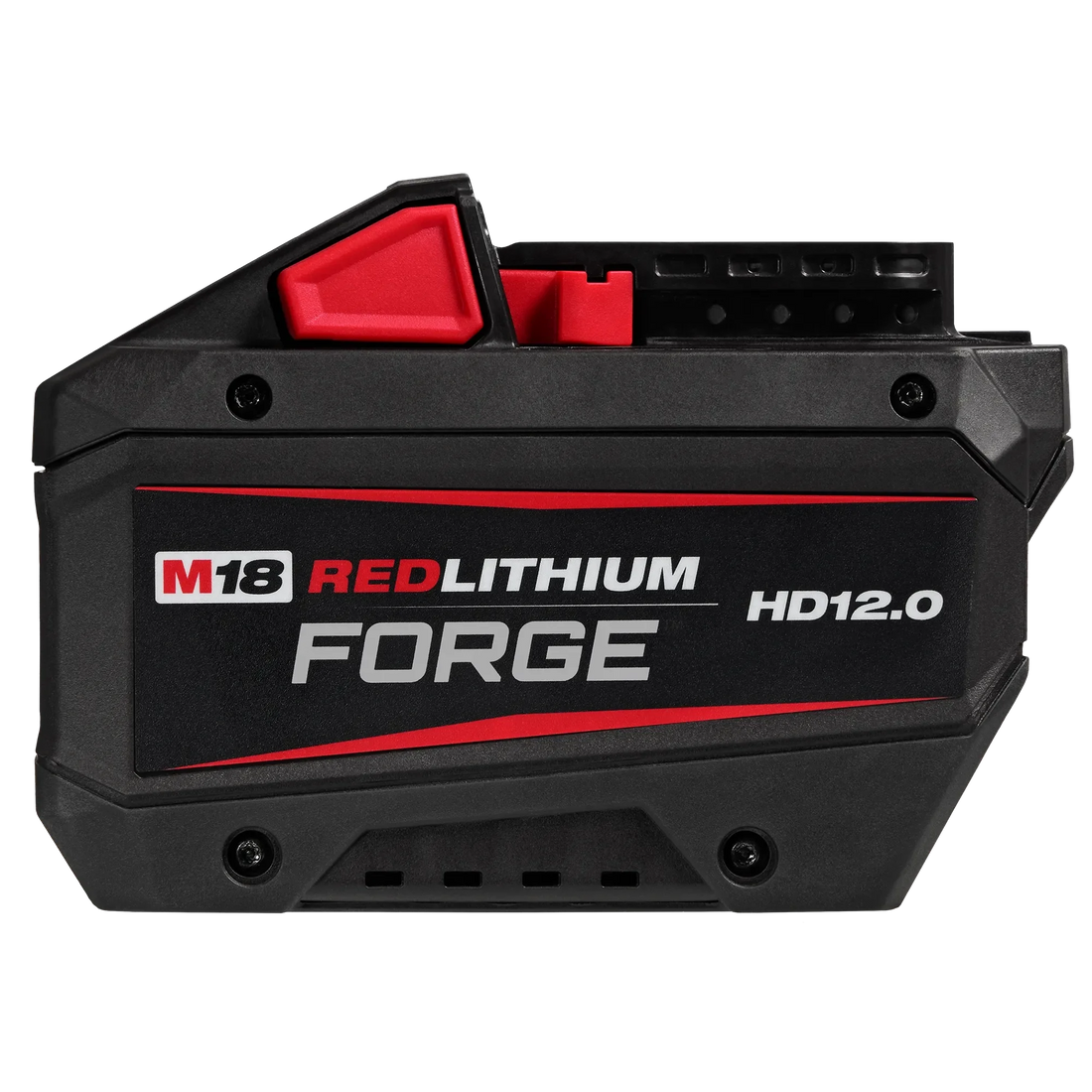
The M18 Forge is Milwaukee's current-generation M18 battery, built around tabless cylindrical (21700) Li-ion cells. In a standard cylindrical cell, current flows through a small metal tab at the tip — a bottleneck that generates heat under load. Tabless construction removes that bottleneck by connecting across the full face of the electrode, cutting internal resistance and letting the pack push more current without overheating.
In practice: Forge is Milwaukee's high-draw, high-runtime battery. It's built for the tools that hammer hardest — rotary hammers, circular saws, high-output impacts — and it's the platform's answer to "I need this to run all day."
Forge lineup:
- HD12.0 (SKU 48-11-1812) — 12.0 Ah, the highest-capacity M18 pack available
- XC6.0 — 6.0 Ah, the mid-size everyday option
The HD12.0 is a physically large pack. It adds noticeable height to the base of your tool — worth knowing if you work in tight spots or care about tool balance. Both Forge packs use the standard M18 interface, so they mount on any M18 tool and charge on any M18 charger.
For how Forge compares to Milwaukee's earlier High Output and REDLITHIUM packs, see Forge vs High Output vs REDLITHIUM.
What Is the DeWalt PowerStack?

The DeWalt PowerStack uses stacked lithium pouch cells — a fundamentally different construction from cylindrical cells. Pouch cells are flat, flexible sheets stacked in layers. Eliminating the dead space between round cell walls means the same energy fits in a smaller, flatter package. The result: PowerStack is DeWalt's compact, punchy pack.
It's not trying to win the runtime crown. It's built for tool balance, reduced pack weight, and a smaller footprint in tools where you're holding the unit overhead, working tight, or doing precision work where a heavy battery throws off your feel.
PowerStack lineup:
- Compact (DCBP034) — 1.7 Ah, built for lightweight tools (compact drills, small impacts)
- XL (DCBP520) — 5.0 Ah, for longer runtimes in mid-size tools
PowerStack is a standard DeWalt 20V MAX battery. It fits any 20V MAX tool and any DeWalt charger — including our USB-C fast charger and power inverter.
DeWalt has published specific claims about PowerStack's power output and size advantage versus a standard 20V MAX pack, citing 50% more power compared to a standard 20V MAX baseline. For the full DeWalt-side battery comparison, see PowerStack vs 20V MAX.
Forge vs PowerStack: Spec Comparison
| Forge HD12.0 | Forge XC6.0 | PowerStack Compact | PowerStack XL | |
|---|---|---|---|---|
| Platform | M18 (18V nom.) | M18 (18V nom.) | 20V MAX (18V nom.) | 20V MAX (18V nom.) |
| Capacity | 12.0 Ah | 6.0 Ah | 1.7 Ah | 5.0 Ah |
| Cell type | Tabless cylindrical (21700) | Tabless cylindrical (21700) | Stacked pouch | Stacked pouch |
| Form factor | Large/tall | Mid-size | Compact/flat | Mid-size |
| Cross-platform fit | M18 only | M18 only | 20V MAX only | 20V MAX only |
Charge times depend on which charger you pair — covered below. Prices move; check current listings before buying.
Which Charges Faster?
Both platforms have fast-charger options that substantially cut wait time. On the Milwaukee side, the M18 Super Charger pushes the most current into a Forge pack — the HD12.0 reaches 80% charge in 35 minutes on the Super Charger. On the DeWalt side, the PowerStack XL also charges quickly on a compatible DeWalt fast charger.
If charge speed is a priority, pair your Forge with the M18 Super Charger. Pair your PowerStack with a DeWalt fast charger. Neither battery is slow on the right charger.
Which Is Smaller / Lighter?
PowerStack, and it's not close at the compact end. The 1.7 Ah Compact is noticeably lighter and flatter than any comparable Milwaukee pack — that's the whole point of pouch-cell architecture. If you're drilling overhead all day or swapping packs fast in a tight tool bag, that difference is real.
The Forge HD12.0 is a big pack. Great for runtime; not what you reach for when balance matters. The XC6.0 is the better everyday choice on the Milwaukee side if you want less bulk.
Which Delivers More Power Under Load?
Milwaukee's Forge marketing centers on reduced internal resistance from tabless cell construction — sustained current output under heavy draw with less heat buildup, with Milwaukee claiming 50% more power over the prior generation.
DeWalt's PowerStack claim is oriented around compactness and power density rather than raw high-draw output — DeWalt rates it at 50% more power versus a standard 20V MAX pack.
Bottom line: if you're running a high-draw M18 tool hard — SDS rotary hammer, circular saw, heated gear — Forge is built for that duty cycle. PowerStack is tuned for compact performance and control, not sustained max-load hammering.
Do Your Chargers, Inverters, and Accessories Still Fit the New Packs?
This is the section spec-review sites skip. Here's the straight answer.
Milwaukee side (Forge batteries):
The Forge HD12.0 and XC6.0 use the standard M18 battery interface. Your existing M18 chargers and accessories mount on them. That includes our M18 USB charger and our M18 power inverter — both compatible with M18 batteries.
One caveat on the HD12.0: it's a physically taller pack than standard M18 packs. Most M18 chargers and inverter cradles have clearance for it, but if you're running a tighter-fitting aftermarket housing, confirm the HD12.0 seats fully before you depend on it in the field.
DeWalt side (PowerStack batteries):
PowerStack is a standard 20V MAX pack. Any DeWalt 20V charger works. Our USB-C charger and power inverter both support all DeWalt 20V MAX batteries, PowerStack included.
Cross-platform:
Running drivers from both brands on the same job? Our magnetic bit holder fits Milwaukee and DeWalt impact drivers. The bit interface is the same ¼" hex on both platforms — the bit holder doesn't care what color your drill is.
Is DeWalt PowerStack Discontinued or Being Renamed?
This question comes up because DeWalt has reorganized its battery lineup naming more than once, and PowerStack has been part of that conversation.
Current status as of this writing: DeWalt retired the PowerStack product name in April 2026, and those batteries are now sold under the 20V MAX XR label.
For the full story on what's happened to the PowerStack name and whether it affects your pack or charger compatibility, see PowerStack discontinuation & XR rename.
Which Should You Buy?
Pick by your situation:
Already on Milwaukee M18? Get the Forge. The interface is the same, your existing chargers work, and the HD12.0 is the biggest runtime upgrade the M18 platform offers. Start with the XC6.0 for a lighter everyday pack; grab the HD12.0 for heavy-draw tools or long-run jobs.
Already on DeWalt 20V MAX? Get the PowerStack. The Compact is worth it if you hate the feel of a heavy pack on a light drill or compact impact. The XL gives you runtime in a smaller envelope than old high-Ah packs.
Buying into a platform fresh? This is really a tool ecosystem decision — which brand's tools fit your work? Both platforms are deep and mature. Don't choose based on a single battery SKU.
Max runtime above everything else? The Forge HD12.0 is the highest-capacity M18 pack on the market at 12 Ah. Nothing else on the M18 platform touches that. Milwaukee M18 + Forge HD12.0 is the answer if uptime is your priority.
Compact and balanced? PowerStack Compact is genuinely smaller and lighter than comparable cordless packs. It won't out-runtime the Forge HD12.0 — it's not trying to. It's trying to disappear in your hand.
Note: this is spec and compatibility guidance, not a lab result. We didn't bench-test either battery. The specs above come from Milwaukee and DeWalt's published data.
For a closer look at how the Forge HD12.0 stacks up against DeWalt's highest-capacity pack, see Forge HD12.0 vs FlexVolt 12Ah.
FAQ
Is the Milwaukee Forge better than the DeWalt PowerStack?
Neither wins outright — they're on different platforms and can never run the same tools. Forge is built for maximum power and runtime on M18. PowerStack is built for a compact, dense pack on DeWalt 20V MAX. Buy the one that matches the tools you already own.
Are Forge and PowerStack the same technology?
No. Forge uses tabless cylindrical (21700) Li-ion cells. PowerStack uses stacked lithium pouch cells. Different physical construction, different engineering trade-offs. Forge targets high current output and runtime; PowerStack targets compact size and density.
Can I use a Milwaukee Forge battery on a DeWalt tool (or vice versa)?
No. The battery interfaces are physically different and incompatible. There is no native cross-brand fit.
Does the M18 Forge fit all M18 tools and chargers?
Yes — it uses the standard M18 interface. The HD12.0 is a physically taller pack than standard M18 batteries; verify clearance on tight-fitting aftermarket charger or inverter housings before use.
Does PowerStack work with all DeWalt 20V MAX tools and chargers?
Yes. PowerStack is a standard 20V MAX battery and is compatible with the full 20V MAX ecosystem.
Which charges faster, Forge or PowerStack?
Depends on your charger. Forge on the M18 Super Charger vs. PowerStack on a DeWalt fast charger are both significantly faster than a standard charger — check each manufacturer's current spec sheet for exact times. Both platforms have fast-charger options worth owning if charge speed matters.
Is DeWalt PowerStack discontinued or renamed?
The PowerStack name was retired in April 2026; those batteries are now sold as DeWalt 20V MAX XR. Full story: PowerStack discontinuation & XR rename.
Will my USB charger or power inverter work with these batteries?
Yes — on the correct platform. An M18 USB charger or inverter works with Forge. A DeWalt 20V charger or inverter works with PowerStack. Neither next-gen battery makes your existing platform accessories obsolete.
Whichever platform you land on, keep it powered. Browse our Milwaukee M18 collection for M18 chargers and inverters, or DeWalt collection for DeWalt 20V accessories. And if you're running drivers from both brands, the magnetic bit holder handles either one.